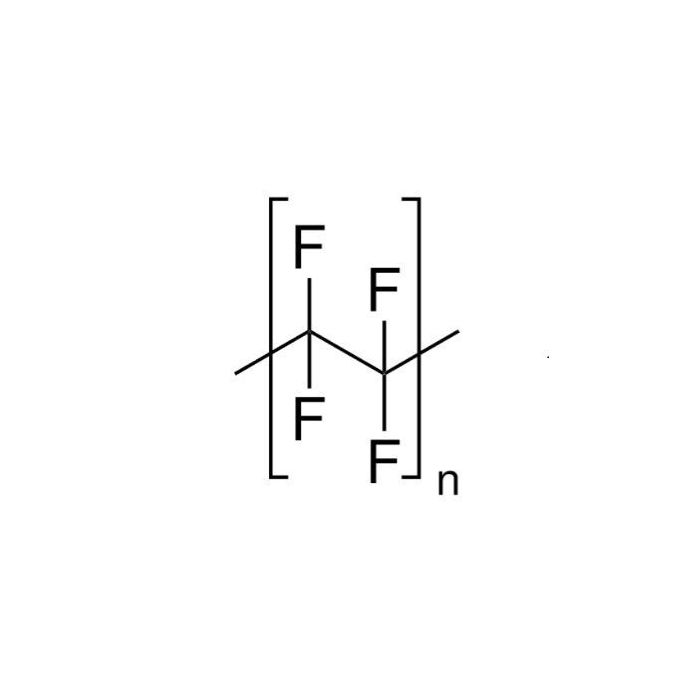
Poly(tetrafluoroethylene)(PTFE) - powder,≤12 μm particle size , CAS No.9002-84-0

CAS: 9002-84-0 Cat. No.: P434335 Formule: (C2F4)n Numéro CE: 618-337-2 PubChem CID: 8301
DISPONIBLE À COMMANDE
GRADE & PURITY powder,≤12 μm particle size
Synonyms
PTFE sheet, 6.35mm (0.25in) thick | Tetrafluorethylene | InChI=1/C2F4/c3-1(4)2(5) | Tetrafluorethene | CCRIS 7738 | Tetrafluoraethylen | Tetrafluoroethylene, inhibited [UN1081] [Flammable gas] | 1,1,2,2-tetrakis(fluoranyl)ethene | PTFE rod, 6.35mm (0.25i
Storage
Room temperature
★
Size
Allemagne (EU)
USA*
Price
Qty
5g
P434335-5g
—
En stock ≥10

61,52€

92,76€
Enregistrer 31,24 € (33.68%)
100g
P434335-100g
—
1 En stock

248,95€

373,91€
Enregistrer 124,95 € (33.42%)
Enter a quantity for the sizes you want to add.
🧪
Why this grade

powder,≤12 μm particle size for sensitive chromatographic and analytical workflows requiring minimal baseline interference.

🌡

Storage & shipping

Room temperature Ships Check lot-specific COA for exact specifications.

📋

Quality documents

SDS, COA, datasheet, and spec sheet available for download. Lot-specific COA accessible via lot number lookup.

📚

Literature proof

Cited in 469 peer-reviewed publications across chromatography, organic synthesis, and cross-coupling reactions.

Vue d’ensemble

Application

Inert lubricant.Physical properties': 'Low coefficient of friction, low critical surface energy and excellent antistick properties.

Specifications

Synonymes
PTFE sheet, 6.35mm (0.25in) thick | Tetrafluorethylene | InChI=1/C2F4/c3-1(4)2(5) | Tetrafluorethene | CCRIS 7738 | Tetrafluoraethylen | Tetrafluoroethylene, inhibited [UN1081] [Flammable gas] | 1,1,2,2-tetrakis(fluoranyl)ethene | PTFE rod, 6.35mm (0.25i
Spécifications et pureté
powder,≤12 μm particle size
Conditions de stockage de stockage
Room temperature
Noms et identifiants
Pubchem Sid488180748
Pubchem Sid Urlhttps://pubchem.ncbi.nlm.nih.gov/substance/488180748
Sourires canoniquesF\C(F)=C(\F)F
IUPAC Name1,1,2,2-tetrafluoroethene
InChIKeyBFKJFAAPBSQJPD-UHFFFAOYSA-N
INCHI1S/C2F4/c3-1(4)2(5)6
Isomères SMILES C(=C(F)F)(F)F
PubChem CID 8301

Documentation

📋 Safety Data Sheet (SDS)

Comprehensive hazard, handling, storage, and regulatory compliance document.

Download SDS →

✅ Certificate of Analysis (COA)

Lot-specific quality data. Enter your lot number to retrieve the exact COA.

Look up COA →

📊 Datasheet

Quick-reference summary of product specifications and applications.

View datasheet →

🔬 Specification Sheet

Full quality attributes and acceptance criteria for this grade.

View spec sheet →

Advanced Data

Taxonomic Classification

Taxonomy Tree

KingdomOrganic compounds
SuperclassOrganohalogen compounds
ClasseVinyl halides
SubclassVinyl fluorides
Intermediate Tree Nodes Not available
Direct ParentVinyl fluorides
Alternative Parents Fluoroalkenes  Organofluorides  Hydrocarbon derivatives  
Molecular FrameworkAliphatic acyclic compounds
Substituents Fluoroalkene - Haloalkene - Vinyl fluoride - Hydrocarbon derivative - Organofluoride - Aliphatic acyclic compound
DescriptionThis compound belongs to the class of organic compounds known as vinyl fluorides. These are vinyl halides in which a fluorine atom is bonded to an sp2-hybridised carbon atom.
External Descriptors fluorocarbon
Structure 3D
Modèle de structure chimique interactif


Mécanismes d'action
Certificats (CoA, COO, BSE/TSE et tableau d'analyse)
C of A & Other Certificates(BSE/TSE, COO):
Analytical Chart:

Find and download the COA for your product by matching the lot number on the packaging.

6 results found

Lot NumberCertificate TypeDateArticle
C2331790Certificate of AnalysisJan 20, 2026 P434335
C2331905Certificate of AnalysisJan 20, 2026 P434335
C2527730Certificate of AnalysisMar 29, 2025 P434335
C2520255Certificate of AnalysisMar 27, 2025 P434335
C2331900Certificate of AnalysisMar 20, 2023 P434335
C2331901Certificate of AnalysisMar 20, 2023 P434335
Propriétés chimiques et physiques
Poids moléculaire100.010 g/mol
XLogP31.300
Hydrogen Bond Donor Count0
Hydrogen Bond Acceptor Count4
Rotatable Bond Count0
Exact Mass99.9936 Da
Monoisotopic Mass99.9936 Da
Topological Polar Surface Area0.000 Ų
Heavy Atom Count6
Formal Charge0
Complexity55.600
Isotope Atom Count0
Defined Atom Stereocenter Count0
Undefined Atom Stereocenter Count0
Defined Bond Stereocenter Count0
Undefined Bond Stereocenter Count0
The total count of all stereochemical bonds0
Covalently-Bonded Unit Count1
FAQ et articles
How to Choose a Hydrogen Evolution (HER) Catalyst: Kinetic Barriers in Water Electrolysis, AWE/PEM/AEM Pathways, and a Materials-Family Roadmap (with a Product Map)
Panorama Guide to Lithium-Ion Battery Electrode Materials: Working Principles, Materials Map, and Selection Navigation (incl. Tables 1–4)
A Panorama Guide to Synthetic Resins: Definitions & Polymerization Mechanisms, Classification Frameworks, Common Resins and Applications, Packaging Codes, and a Selection Roadmap (Tables 1–3)
Optical & Optoelectronic Materials Selection Guide:Positioning materials, key metrics, and validation paths along “Generation → Guiding → Control → Readout” (with product navigation and Tables 1–4)
Biomedical Polymer Insights: Role-Based Task Map, Six Key Material Levers, and a Risk-Driven Evidence Chain (including the Product Navigation Guide and Product Tables 1–3)
uide to Hydrophobic Polymers and Hydrophobic Surfaces: Wetting Models, Evaluation Metrics, and Task-Oriented Material Selection (including Tables 1–3)
How Matting Agents in Coatings Build Low-Gloss Coating Surfaces: Mechanisms, Formulation Trade-Offs, and Product Selection
Why Fluorocarbon Resins Are Weatherable: Structural Stability, Low Surface Energy, and Coating Film Appearance Retention
Guide to Selecting Polyurethane Coating Systems: Application Analysis for Wood, Flooring, Plastics, Automotive, and Industrial Protection
PVDF, FEVE and Functional Fluororesins: System Differences and Application Selection in Fluorocarbon Coatings
Fluorocarbon Resin Coating Formulation Design: Resin Selection, Supporting Systems, and Key Application Control Points
Comprehensive Performance Analysis of Polyurethane Coating Films: Soft/Hard Segment Structure, Microphase Separation, Crosslinking and Curing, and Selection of Representative Chemicals
When Should You Choose Silicone Resin? Selection Comparison with Epoxy, Acrylic, Polyurethane, Fluororesin, and Other Coating Resins
Applications and Selection of Polyester Resins in Industrial Coatings: Powder, Coil, Baking, Packaging, and Metal Coating Scenarios
Applicability Boundaries, Failure Risks, and Alternative System Selection for Chlorinated Rubber Resin in Coatings
Resin Polarity in Coating Formulations: From Molecular Structure to Dissolution, Compatibility, Interfacial Interactions, and Formulation Design
Solid Supports in Packed Gas Chromatography Columns: Definition, Mechanisms of Action, Classification, and Selection
Citations of This Product
Calculateurs de solution
Avis

Avis des clients

Shall we send you a message when we have discounts available?

Remind me later

Thank you! Please check your email inbox to confirm.

Oops! Notifications are disabled.