Organoheterosilane - Organic metalloid salt - Organic oxygen compound - Hydrocarbon derivative - Organic salt - Aliphatic heteropolycyclic compound
Description
This compound belongs to the class of organic compounds known as organoheterosilanes. These are organosilicon compounds where the tetravalent silicon atom is linked to one or more heteroatoms.
External Descriptors
Not available
1. Djoumbou Feunang Y, Eisner R, Knox C, Chepelev L, Hastings J, Owen G, Fahy E, Steinbeck C, Subramanian S, Bolton E, Greiner R, and Wishart DS. ClassyFire: Automated Chemical Classification With A Comprehensive, Computable Taxonomy. Journal of Cheminformatics, 2016, 8:61.
Determine the necessary mass, volume, or concentration for preparing a solution.
Dilution Calculator
Determine the dilution needed to prepare a stock solution.
Reconstitution Calculator
Avis
Avis des clients
Application Protocols
No bioassay protocols (WB, IHC, IF, FC) apply to this materials-science product. For materials processing, consider the following general, literature-based workflows (not product specifications):
Solution casting of polymer/POSS films:
Dissolve polymer (e.g., PMMA) and POSS in a common solvent (CHCl3 or toluene) to a total solids content of 5–15 wt%.
Stir/sonicate at 25–40 °C until homogeneous; filter through 0.45 µm PTFE; cast on level substrate; dry under ambient hood, then vacuum at 40–60 °C.
Spin-coating for thin films:
Filtered solution at 1–5 wt% total solids; 2000–4000 rpm for 30–60 s; soft-bake 60–90 °C; optional vacuum bake.
Melt compounding in thermoplastics:
Pre-blend pellets with POSS powder; feed to twin-screw at standard polymer profile; aim for 1–3 wt% loadings initially; mold test bars and evaluate mechanical/thermal properties.
Adjust solvent, temperature, and loading according to the host matrix and desired properties. For batch-specific instructions or specifications, refer to the CoA/Spec Sheet.
Biological Roles
This product is a methyl-capped polyhedral silsesquioxane for materials science and has no inherent biological function or known physiological role. It is not designed for biochemical assays or as a biomolecule.
General note:
Neutral, hydrophobic organosiloxane cages are typically biologically inert and are used for materials performance, not for interaction with enzymes, receptors, or metabolic pathways.
If biointerfaces are of interest:
Functionalized POSS derivatives (bearing amine, carboxyl, hydroxyl, or poly(ethylene glycol) groups) are used in the literature to tailor biointerfaces, protein resistance, or cell adhesion. The methyl-substituted variant here lacks such functional handles and is not optimized for biological conjugation.
For life science applications, select appropriately functionalized POSS grades and consult their specific data sheets. No biological roles or activities are specified for this item.
Buffer Applications
Not typically applicable. This material is a hydrophobic, methyl-capped POSS cage intended for materials science, not for preparing aqueous buffers.
Practical guidance:
The compound is insoluble in water and does not provide acid/base functionality; it is not used as a buffering agent.
For dispersion studies in aqueous media, researchers typically use surfactants or polymeric dispersants and functionalized POSS derivatives rather than the methyl-capped variant.
Green Alternatives
From a green chemistry standpoint, octamethyl POSS can enable material efficiency by delivering property gains at relatively low loadings compared with traditional mineral fillers. However, solvent choice and end-of-life considerations dominate the footprint.
Environmental perspective (general):
Potential to reduce filler mass: nanoscopic, high-efficiency reinforcement can lower total additive loading, reducing weight and processing energy.
Process solvents drive much of the environmental burden; replacing chlorinated solvents with greener choices is impactful.
Greener processing options (literature/general):
Prefer toluene, ethyl acetate, or cyclopentyl methyl ether (CPME) over CH2Cl2/CHCl3 where solubility and film quality allow.
Explore melt compounding (solvent-free) for thermoplastics; use vented barrels to remove volatiles.
Comparison snapshot (processing focus):
CH2Cl2/CHCl3: excellent solvency, fast drying; high environmental/health concerns.
Toluene: good solvency, lower acute toxicity; still VOC. Consider recovery via condensation.
Ethyl acetate: greener VOC with favorable biodegradability; may require elevated temperature for full dissolution and slower film formation.
CPME/2-MeTHF: bio-derived options with broad solvency windows; test for POSS and polymer co-solubility.
Trade-offs:
Greener solvents may prolong drying times and impact morphology; optimization of solids content, temperature, and drying profile is necessary.
Melt compounding avoids solvent but can risk agglomeration; compatibilizers or functional POSS (not this item) may be needed for strong interfacial adhesion.
Pharmaceutical Uses
No pharmacopeial status or excipient role is specified for this item; refer to CoA/Spec Sheet. This product is sold for research use only and is not intended for human or veterinary use.
General materials-related notes (literature/general):
POSS derivatives have been investigated as fillers in medical-grade silicones and as components in dental or coating materials to enhance mechanical and thermal properties. Those applications rely on medical-grade specifications and often on functionalized cages for covalent integration.
The methyl-capped variant described here is primarily a nonreactive additive; for regulated applications, medical-grade documentation, extractables/leachables profiles, and biocompatibility testing would be required from the specific supplier/batch—none of which are provided here.
For any formulation work, verify composition, purity, and residual volatiles on a batch-specific CoA and conduct application-specific qualification.
Physical Properties
Item-specific specifications are not provided. The following values are typical literature data for octamethyl-substituted T8 POSS; verify against the CoA/Spec Sheet before use in regulated workflows.
Appearance: Not specified for this item; refer to CoA/Spec Sheet. (Literature: white to off-white crystalline solid or powder.)
Molecular weight: ~536.9 g/mol (literature for C8H24O12Si8). Not specified for this item; refer to CoA/Spec Sheet.
Melting behavior: commonly reported as a high-melting solid, often >250–300 °C, with possible sublimation before clear melt depending on sample history (literature). Not specified for this item; refer to CoA/Spec Sheet.
Boiling point: not applicable (decomposes/sublimes; literature). Not specified for this item; refer to CoA/Spec Sheet.
Density: typically ~1.2–1.3 g/cm3 at 25 °C (literature). Not specified for this item; refer to CoA/Spec Sheet.
Solubility (qualitative, literature):
Good solubility in nonpolar/aprotic organics (toluene, CHCl3, CH2Cl2, THF) at ambient temperature.
Poorly soluble/insoluble in alcohols and aliphatic hydrocarbons at room temperature; insoluble in water.
LogP: expected high (hydrophobic); quantitative values vary with method (literature). Not specified for this item; refer to CoA/Spec Sheet.
Thermal properties: high thermal stability under inert atmosphere; oxidative stability lower than under N2/Ar (literature TGA trends). Not specified for this item; refer to CoA/Spec Sheet.
Refractive index: not applicable for a solid; films typically n ≈ 1.42–1.47 (literature, composition-dependent). Not specified for this item; refer to CoA/Spec Sheet.
Quality and Grades
Item-specific grade/purity: Not specified for this item; refer to CoA/Spec Sheet.
Typical materials-science grades (general):
Research grade: suitable for formulation screening, polymer blending, and exploratory coatings work.
High-purity/low-residue grade: controlled alkali/transition-metal content and low volatile siloxanes for electronic or optical applications.
Surface-functional grades: verified end-group identity and functionality (not applicable here if methyl-capped and inert).
What grade means in practice:
For POSS additives, “purity” encompasses organic residue (unreacted silanols, oligomers), volatile cyclosiloxanes, and inorganic ash (SiO2). Lower residues improve film uniformity, dielectric stability, and optical clarity.
Particle size/flow: free-flowing crystalline powder minimizes dosing variability; sieving data may be provided on CoA.
Stabilizers/additives:
None indicated in Product Data. If present, stabilizers (e.g., trace inhibitors or anti-caking agents) would be listed on the CoA. Not specified for this item; refer to CoA/Spec Sheet.
Recommended verification for critical uses:
Check CoA for FTIR/NMR identity (Si–O–Si bands; Si–CH3 signals), TGA residue at 800–1000 °C, DSC thermal events, ICP for metals if electronic applications are intended, and residual silanol by titration/FTIR.
Documentation:
Request batch-specific CoA and, if needed, a specification sheet covering assay, volatiles, ash, and particle size. These parameters are application-dependent and not specified here.
Reaction and Applications
Because the cage is methyl-capped, it is chemically robust and functionally inert, serving primarily as a performance additive or nanobuilding block in materials systems rather than as a reactive monomer.
Acts as a nanoscale, rigid, low-surface-energy filler improving modulus, heat deflection temperature, and dimensional stability of thermoplastics (e.g., PS, PMMA, PEEK) at low loadings (1–10 wt%).
Reduces shrinkage and can suppress creep; effect strength depends on dispersion and interfacial compatibility.
Coatings and thin films:
Enhances scratch/abrasion resistance and lowers surface energy, benefiting anti-smudge or release coatings.
Supports low-k dielectric behavior in hybrid siloxane networks.
Elastomers and adhesives:
In silicones and urethanes, methyl-POSS increases thermal stability and reduces gas permeability (formulation dependent).
Optical materials:
Transparent hybrids can be achieved when refractive index matches the matrix; small cage size minimizes light scattering.
Nonreactive chemistry notes:
The methyl-capped T8 cage lacks silanol or vinyl/epoxy groups; it typically does not covalently bond to matrices. Interfacial compatibilization relies on dispersion, solvent selection, and sometimes co-additives or block copolymers.
If covalent incorporation is required, choose functional POSS analogs (e.g., vinyl-, epoxide-, acrylate-, amine-, or silanol-POSS) for hydrosilylation, radical, or condensation routes.
Processing tips:
Pre-dissolve in a mutual solvent with the host polymer; cast or spin at controlled temperature to avoid phase separation.
For melt compounding, use a twin-screw profile ensuring distributive mixing; avoid excessive residence time to limit thermal history.
Reaction Conditions
The methyl-capped POSS cage is not typically a reactant but a formulation additive. The following are general, literature-based processing conditions for incorporating it into materials; they are not product specifications.
Solution blending and film casting:
Solvent: toluene, CHCl3, CH2Cl2, or THF (dry, inhibitor-free recommended).
Concentrations: 0.5–10 wt% POSS relative to polymer, adjusted to maintain optical clarity.
Temperature: 20–60 °C to aid dissolution; avoid prolonged exposure >100 °C in air.
Processing: magnetic stirring or bath sonication until clear; 0.2–0.45 µm filtration before spin-coating/casting; dry under reduced pressure to remove residual solvent.
Melt compounding (thermoplastics):
Equipment: twin-screw extruder with distributive mixing elements.
Barrel temperatures: typical of host polymer (e.g., 180–280 °C for styrenics/engineering plastics); use nitrogen purge if possible.
Residence time: minimize to reduce thermal history; pelletize and post-dry as appropriate.
Curing systems (thermosets):
Add to resin prior to cure; ensure compatibility with diluents/reactive diluents. Degas under vacuum to avoid voids.
Expected outcomes (literature):
Increased storage modulus and heat distortion temperature at low loading; minimal impact on Tg when dispersion is uniform.
Overloading can cause haze/crystallite formation; mitigate via solvent choice, temperature profile, or compatibilizers. Always confirm with DSC/DMTA and microscopy.
Safety and Handling
Authoritative safety classification for this specific item is not provided in the Product Data; consult the SDS.
GHS information (for this item):
Signal word: Not specified for this item; refer to SDS.
Hazard statements (H-): Not specified for this item; refer to SDS.
Pictograms/GHS class: Not specified for this item; refer to SDS.
General hazards (literature/general):
Low acute toxicity is typical for neutral organosiloxanes; primary concerns relate to dust generation (mechanical irritation) and combustion byproducts (COx, SiOx).
Fine powders may form dust clouds; avoid inhalation and ignition sources.
PPE and handling:
Wear safety glasses, lab coat, and appropriate gloves (e.g., nitrile). Use a dust mask/respirator if airborne particulates may be generated.
Handle in a fume hood when weighing or dissolving; minimize dust.
Storage incompatibilities and precautions:
Keep away from strong oxidizers and strong acids/bases that can cleave siloxane bonds at elevated temperature.
Avoid prolonged exposure to moisture at high temperature; hydrolytic cleavage of Si–O–Si is possible under harsh conditions.
Thermal/processing considerations:
When compounding, maintain adequate ventilation; thermal degradation can produce formaldehyde traces and siloxane fragments (literature reports for polysiloxanes).
First-aid overview (general):
Inhalation: move to fresh air; seek medical attention if symptoms persist.
Skin/eye contact: rinse with water for several minutes; remove contaminated clothing; obtain medical advice if irritation develops.
Ingestion: rinse mouth; do not induce vomiting; seek medical attention.
Always defer to the SDS for authoritative safety data and emergency procedures.
Solvent Selection
This octamethyl-substituted POSS is hydrophobic and organophilic. Solvent choice is typically driven by processing (solution casting, spin-coating, or polymer blending) rather than reaction chemistry (the methyl-capped cage is largely inert).
Polarity/miscibility (literature trends):
Soluble: toluene, xylene, chlorinated solvents (CH2Cl2, CHCl3), and THF at room temperature.
Limited/variable solubility: ethyl acetate, acetone, ethers with high polarity.
For polymer solutions (e.g., PS, PMMA): toluene or CHCl3 often dissolve both matrix and POSS for homogeneous films.
For solution processing with moisture sensitivity elsewhere in the formulation, use anhydrous, inhibitor-free solvents; dry over 3Å/4Å molecular sieves as needed (general practice).
For coatings: CH2Cl2 or toluene supports rapid evaporation; THF offers faster drying but may yield crystallization at high POSS loading—optimize solids content and temperature.
Quick comparison (literature):
Toluene: good solvency, slower evaporation—improves film leveling.
CH2Cl2/CHCl3: strong solvency, fast dry—watch for pinholes.
THF: polar aprotic, miscible with many monomers—monitor POSS recrystallization on cooling.
Practical notes:
Warm (40–60 °C) dissolution can speed processing; avoid prolonged heating >100 °C in air to limit oxidative changes.
Ultrasonication assists dispersion when preparing nanocomposites; filter (0.2–0.45 µm) for optical films.
Storage and Reconstitution
Storage conditions (as provided): Room temperature. Ship under normal conditions.
Recommended storage practice (general):
Keep container tightly closed in a cool, dry place. Store under inert gas or in a desiccator if long-term storage is planned to minimize moisture uptake and contamination.
Avoid exposure to strong oxidizers and sources of ignition. Protect from prolonged heating in air.
Stability notes (literature/general):
Methyl-capped POSS cages are thermally robust and stable at ambient conditions. Hydrolytic cleavage of Si–O–Si requires harsh conditions; normal laboratory humidity at room temperature is typically not problematic.
Reconstitution/dissolution:
For solution preparation, add the powder to an appropriate organic solvent (e.g., toluene, CHCl3, CH2Cl2, THF) with stirring or mild sonication at 20–40 °C until dissolved.
Filter through PTFE (0.2–0.45 µm) prior to thin-film applications to remove particulates.
Freeze–thaw guidance:
Not applicable to this solid; avoid repeated thermal cycling to high temperatures. Maintain at room temperature as specified.
Always refer to the batch-specific CoA/Spec Sheet for any storage qualifiers (e.g., desiccation requirements, shelf life) not specified in the Product Data.
Structure and Identity
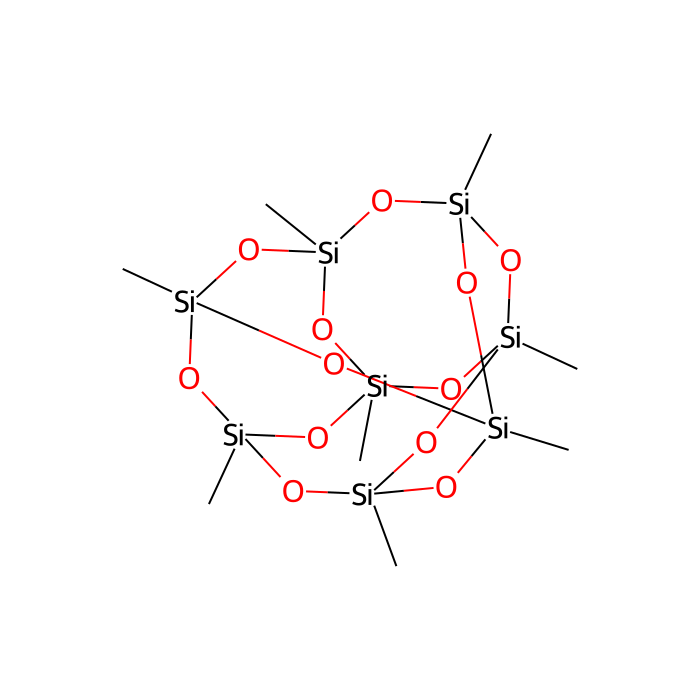
This item corresponds to an octamethyl-substituted polyhedral silsesquioxane (POSS) cage, widely used as a hybrid inorganic–organic nanobuilding block in materials science.
Product identifiers (as provided):
CAS: 17865-85-9
PubChem CID: 519486
InChIKey: 341320 (as provided; consult SDS/registry for canonical string)
Synonyms (literature):
Octamethylsilsesquioxane (T8 cage)
POSS-T8 (Me)
[(CH3)8Si8O12]
Core structural features (literature description):
A rigid, nearly cubic T8 silsesquioxane cage: Si8O12 core (each Si is part of a corner-sharing Si–O–Si network).
Each of the eight silicon vertices bears one methyl substituent (Si–CH3), giving a fully substituted, nonfunctional cage surface.
Functional groups: siloxane (Si–O–Si) framework; peripheral trialkylsilicon character (Si–C) at each vertex; no ionizable groups.
Hybrid inorganic–organic architecture: inorganic silica-like core imparts thermal/oxidative stability; methyl groups confer hydrophobicity and organophilicity.
2D structure in words:
Depict a cubic-like cage of alternating Si and O atoms (Si8O12). Each Si vertex is bonded to one terminal CH3 group. No open silanol groups in the idealized structure.
Molecular formula (literature): C8H24O12Si8. Not specified for this item; refer to CoA/Spec Sheet for confirmation.
Molecular weight (literature): ~536.9 g/mol. Not specified for this item; refer to CoA/Spec Sheet.
SMILES/InChI (canonical, literature): not provided in Product Data. Not specified for this item; refer to CoA/Spec Sheet.
Synthetic Utility
As a methyl-capped T8 silsesquioxane, this compound is primarily a structural nanofiller rather than a synthetic intermediate. Its utility in synthesis is limited by the absence of reactive functional groups.
Functional group profile:
Robust Si–O–Si cage with eight Si–CH3 substituents; no silanol, vinyl, epoxy, or amino groups for further derivatization under mild conditions.
Retrosynthetic perspective:
The T8 core is a terminal structure; methyl capping prevents condensation growth or coupling. If covalent incorporation is desired, select POSS with reactive groups (e.g., octavinyl-, octa(aminopropyl)-, trisilanol-, or epoxide-POSS) for hydrosilylation, nucleophilic ring-opening, or siloxane condensation.
Formulation/synthetic roles (literature/general):
Diluent “nanoblock” in hybrid sol–gel systems to control network density while preserving thermal stability.
Physical blending into monomer syrups (e.g., MMA) prior to polymerization to tune viscosity and reduce polymerization shrinkage; the cage remains largely unreacted and dispersed.
29Si and 13C NMR confirm cage integrity (T8 resonances) and methyl substitution.
FTIR shows strong Si–O–Si stretches (~1100 cm−1) and Si–CH3 bands.
TGA/DSC assess thermal profile and residuals; PXRD can reveal crystalline vs amorphous state, relevant for film clarity.
Target Specificity
Not applicable. This product is a materials additive (methyl-capped POSS) and is not a biological macromolecule or affinity reagent. No antigen/epitope, species reactivity, clone, or isotype applies. No item-specific data are provided.
We use cookies to ensure the website functions properly and, where permitted, to improve your experience. You can manage your preferences at any time in Settings. Learn more in our Cookie Policy.
Shall we send you a message when we have discounts available?
Remind me later
Thank you! Please check your email inbox to confirm.
Products are supplied to verified businesses, institutions, and qualified professionals for research and development use only. Not for use in humans, animals, diagnosis, or therapy.

 F2626335