GRADE & PURITYRecombinant?Recombinant — produced via recombinant expression for defined sequence and consistency. Use for reproducible, animal-free proteins of known origin.ExactAb™?ExactAb™ — Aladdin's antibody line emphasizing precision and validated quality. Use for reliable, specificity-validated antibody applications.Validated?Validated grade — performance confirmed in defined applications before release. Use when you want documented assurance the reagent works as stated.See COA
Recombinant,ExactAb™,Validated,See COA ExactAb™,Recombinant,Validated for sensitive chromatographic and analytical workflows requiring minimal baseline interference.
🌡
Storage & shipping
Store at -20°C,Avoid repeated freezing and thawing Ships Ice chest + Ice pads Check lot-specific COA for exact specifications.
📋
Quality documents
SDS, COA, datasheet, and spec sheet available for download. Lot-specific COA accessible via lot number lookup.
📚
Literature proof
Cited in 0 peer-reviewed publications across chromatography, organic synthesis, and cross-coupling reactions.
Vue d’ensemble
Rabbit anti Human DDB2 Antibody, Recombinant, could be used for WB and so on.
Specifications
Product Name
Recombinant DDB2 Antibody - Anticorps primaire, specific to DDB2, Rabbit IgG
Synonymes
Damage-specific DNA binding protein 2 antibody | Damage-specific DNA-binding protein 2 antibody | DDB p48 subunit antibody | Ddb2 antibody | DDB2_HUMAN antibody | DDBb antibody | DNA damage-binding protein 2 antibody | UV-damaged DNA-binding protein 2 ant
Spécifications et pureté
Recombinant,ExactAb™,Validated,See COA
Mécanismes biochimiques et physiologiques
Required for DNA repair. Binds to DDB1 to form the UV-damaged DNA-binding protein complex (the UV-DDB complex). The UV-DDB complex may recognize UV-induced DNA damage and recruit proteins of the nucleotide excision repair pathway (the NER pathway) to init
Espèce hôte
Lapin
Spécificité
DDB2
Immunogène
A synthetic peptide derived from human DDB2 (AA 350-427).
Contrôle positif
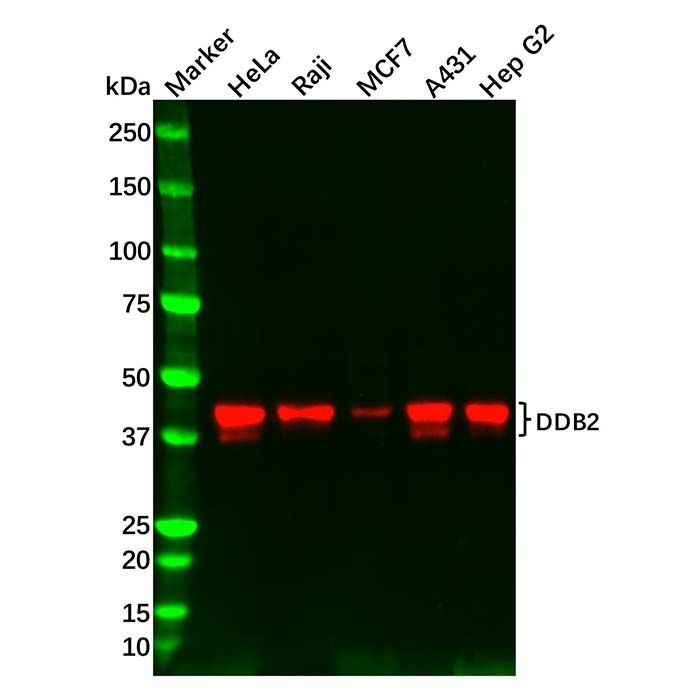
WB: HeLa, Raji, MCF7, A431 and Hep G2 cell lysates.
Conjugation
Unconjugated
Grade
ExactAb™, Recombinant, Validated
Isotype
Rabbit IgG
Type de chaîne lumineuse
kappa
SDS-PAGE
150 kDa
Méthode de purification
Protein A purified
Concentration
See COA
Product Line
Produits biologiques
Stockage et expédition
Forme
Liquid
Conditions de stockage de stockage
Store at -20°C,Avoid repeated freezing and thawing
Expédié en
Ice chest + Ice pads
Stabilité et stockage
Store at 2-8℃ short term (1-2 weeks). Store at -20℃ long term (24 months). Upon receipt, it is recommended to aliquot. Avoid freeze/thaw cycle.
Images
Recombinant DDB2 Antibody (Ab099353) - Western Blot All lanes: Recombinant DDB2 Antibody (Ab099353) at 1/1000 dilution Samples: Lysates at 20 µg per lane Secondary: Goat Anti-Rabbit IgG H&L (HRP) (Ab170144) at 1/20000 dilution
Predicted band size: 48 kDa Observed band size: 39, 42 kDa Exposure time: 6.0 s
Application
Application
Dilution info
WB
1/500-1/1000
Documentation
📋 Safety Data Sheet (SDS)
Comprehensive hazard, handling, storage, and regulatory compliance document.
Determine the necessary mass, volume, or concentration for preparing a solution.
Dilution Calculator
Determine the dilution needed to prepare a stock solution.
Reconstitution Calculator
Avis
Avis des clients
Application Protocols
Tested applications, recommended dilutions, antigen retrieval conditions, and positive controls are Not specified for this item; refer to CoA/Spec Sheet.
General advice (not item-specific; for planning only):
Perform a dilution series to determine optimal working concentration for your matrix.
Include appropriate controls (isotype control, secondary-only control, and positive DNA-damage induction for DDB2 studies).
For authoritative, item-specific protocols, consult the manufacturer’s datasheet for SKU Ab099353.
Biological Roles
DDB2 (damage-specific DNA-binding protein 2) is a key DNA damage sensor in global-genome nucleotide excision repair (GG‑NER).
Molecular function (literature/general): DDB2, in complex with DDB1 (UV‑DDB), recognizes UV‑induced DNA lesions including cyclobutane pyrimidine dimers (CPDs) and 6‑4 photoproducts. DDB2 contributes to chromatin remodeling at damage sites and promotes recruitment of XPC and downstream NER factors.
Complexes and pathways: DDB2 associates with the CUL4‑DDB1 E3 ubiquitin ligase, mediating ubiquitylation of histones and repair factors, facilitating lesion hand‑off to XPC. It intersects with p53 signaling and cell‑cycle checkpoints following genotoxic stress.
Cellular localization: Predominantly nuclear; rapidly accumulates in DNA damage foci upon UV irradiation (literature).
Biological relevance: Loss‑of‑function mutations in DDB2 underlie xeroderma pigmentosum group E (XP‑E), characterized by defective global-genome NER (literature; no clinical claims intended).
Research implications: Antibodies against DDB2 enable quantification of damage recognition dynamics, assessment of repair competency, and mapping of chromatin engagement after UV or chemical DNA damage.
Note: Species reactivity, epitope region, and validation data for this specific antibody are Not specified for this item; refer to CoA/Spec Sheet.
Buffer Applications
Not typically applicable. This product is an antibody reagent used within standard immunoassay buffers rather than a buffering agent itself.
Practical note: Choose assay buffers (e.g., PBS or TBS with appropriate blocking agents and detergents) based on your application (WB, IF, IHC, IP). Composition and compatibility for this item are Not specified; consult the CoA/Spec Sheet.
Green Alternatives
While antibodies are aqueous biologics and not typically framed in solvent-selection green metrics, sustainability considerations can still be applied:
Cold-chain optimization: Plan consolidated shipments to reduce packaging and ice packs. This item ships in an ice chest with ice pads (from Product Data). Consider coordinating orders to minimize shipments.
Format choices: Glycerol‑free, lyophilized formats can reduce cold-chain energy demand if validated for room-temperature shipping (format for this item Not specified). Tradeoff: may require careful reconstitution and can affect stability.
Stabilizers and preservatives: Minimizing hazardous preservatives (e.g., sodium azide) may simplify waste handling. Content for this item is Not specified.
Aliquoting to avoid freeze–thaw: Reduces waste from activity loss, improving efficiency and lowering environmental impact.
Lyophilized at 2–8 °C shipping: lighter, potentially reduced dry ice usage; requires precise reconstitution to restore performance.
Select the format aligning with your lab’s cold storage capacity, waste policies, and reproducibility needs. Always defer to the item’s CoA for permitted storage conditions.
Pharmaceutical Uses
Not applicable. This recombinant antibody is supplied for research use only and is not intended for therapeutic administration, diagnostic procedures, or as a pharmaceutical excipient.
Manufacturing/formulation note: If integrating into assay kits or QC workflows, verify and document isotype, concentration, and preservative content. For GMP or regulated contexts, request supporting quality documentation; item-specific pharmacopeial status is Not specified for this item.
Physical Properties
Item-specific physicochemical parameters are not provided for this antibody preparation.
Appearance/formulation: Not specified for this item; refer to CoA/Spec Sheet.
Concentration: Not specified for this item; refer to CoA/Spec Sheet.
Buffer composition/preservatives: Not specified for this item; refer to CoA/Spec Sheet.
pH: Not specified for this item; refer to CoA/Spec Sheet.
Extinction coefficient (protein, general literature): A280 for IgG typically uses ε ≈ 210,000 M−1·cm−1 (1.4 AU ≈ 1 mg/mL; literature/general). Use item-specific datasheet for exact value.
Stability (general): Recombinant antibodies are typically stable at −20 °C or below; avoid repeated freeze–thaw to preserve binding activity (see Storage & Reconstitution for item-specific guidance).
Note: Small-molecule properties such as boiling point, melting point, density, logP, SMILES, or refractive index are not applicable to antibody biologics.
Recombinant: Produced in a defined expression system, enabling lot-to-lot genetic and sequence consistency relative to hybridoma-derived antibodies (general). This typically improves reproducibility across batches.
ExactAb™: Brand/platform designation indicating a controlled recombinant production workflow. While the platform suggests high specificity and consistency, item-specific sequence, isotype, and QC metrics are Not specified for this item; refer to CoA/Spec Sheet.
Validated: Indicates the antibody has undergone functional testing by the manufacturer. The exact validated applications, species reactivity, and performance metrics are Not specified for this item; refer to CoA/Spec Sheet.
Quality considerations for users:
Request CoA for: isotype/subclass, clonality, concentration, purity profile (e.g., monomer % by SEC), endotoxin level (if relevant), and validated applications with sample data.
Confirm antigen: epitope region or immunogen (full-length vs. fragment vs. peptide) when application requires epitope preservation (e.g., native IP vs. denatured WB).
Reaction and Applications
This antibody is intended for immunoassay and protein detection/enrichment workflows targeting DDB2. No manufacturer application list is provided for this specific SKU; the following are general use-cases for anti‑DDB2 antibodies (literature/general guidance):
Western blot (WB): Detection of DDB2 in cell lysates after denaturing electrophoresis. Pay attention to epitope sensitivity to reduction/boiling. Optimize antigen retrieval and blocking.
Immunofluorescence/Immunocytochemistry (IF/ICC): Visualization of DDB2 nuclear foci following UV irradiation or DNA damage induction; fixation conditions (paraformaldehyde vs. methanol) can affect epitope availability.
Immunohistochemistry (IHC): Assessment of DDB2 expression in tissues; antigen retrieval conditions must be titrated.
Immunoprecipitation (IP/Co‑IP): Enrichment of DDB2 and interacting partners (e.g., DDB1, CUL4-associated complexes) under native conditions.
ChIP/ChIP‑seq: If the epitope is chromatin-associated and compatible, anti-DDB2 can be used to study recruitment to UV lesions (requires rigorous validation).
Practical tips (general):
Titrate antibody to determine minimal working concentration and reduce background.
Use nuclear extraction buffers for DDB2 enrichment when appropriate.
Include DNA damage controls (e.g., UV-C treated cells) to verify specificity of signal dynamics.
Note: Application suitability and dilutions for this SKU are Not specified for this item; refer to CoA/Spec Sheet.
Reaction Conditions
Not applicable to chemical reactions. For experimental conditions involving this antibody in bioassays:
Working temperatures: Typically performed at 4 °C (incubations to reduce background) or room temperature, depending on application (general guidance).
Incubation times, dilutions, and buffers are highly application- and lot-dependent and are Not specified for this item; refer to CoA/Spec Sheet.
For chemical reaction parameters (solvents, catalysts, yields), this section does not apply to antibody reagents.
Safety and Handling
GHS classification: Not specified for this item; refer to SDS.
Signal word / H-statements / pictograms: Not specified for this item; refer to SDS.
Intended use: For research use only (non‑clinical, non‑diagnostic).
Potential hazards (general): Aqueous antibody preparations are typically considered low hazard but may contain low levels of preservatives (e.g., sodium azide) in some formats. This product’s preservative content is not specified—consult SDS/CoA.
PPE: Laboratory coat, gloves, and eye protection are recommended when handling protein reagents and biological materials.
Handling practices:
Work on ice or at 2–8 °C while setting up assays to minimize activity loss.
Avoid microbial contamination; use sterile tools if asepsis is required by your protocol.
Do not vortex harshly; gentle mixing protects antibody integrity.
Incompatibilities (general): Avoid strong oxidizers, extreme pH, and proteases. Materials that promote surface adsorption (unblocked polystyrene, uncoated glass) may reduce effective concentration; add carrier protein if compatible.
First-aid (general guidance; defer to SDS): Rinse with water after skin/eye contact; seek medical attention if irritation persists. If ingested or inhaled as aerosol, move to fresh air and consult medical advice.
Waste: Dispose according to institutional biosafety procedures and local regulations; treat azide-containing wastes appropriately if applicable (not specified for this item).
Solvent Selection
Not typically applicable. This is an aqueous recombinant antibody reagent rather than an organic solvent or small molecule. For best results, use the supplied buffer or manufacturer-recommended reconstitution diluent (see Storage & Reconstitution), and consider:
Compatibility with assay buffer systems (PBS, TBS) and detergents (e.g., Tween-20) only as protocol requires.
Avoidance of organic solvents that denature proteins unless intentionally used for immobilization chemistry.
Storage and Reconstitution
Storage conditions (from Product Data): Store at −20 °C. Avoid repeated freezing and thawing.
Shipping: Ice chest with ice pads (from Product Data).
Best practices (general):
Upon receipt, promptly transfer to −20 °C storage. If frequent use is anticipated, prepare single‑use aliquots on ice to minimize freeze–thaw cycles. Use low‑binding tubes.
Thawing: Thaw on ice. Mix gently by inversion; avoid vigorous vortexing which can denature antibodies.
Short‑term handling: Keep on ice during setup. If buffer contains no antimicrobial preservative (Not specified), minimize time at 2–8 °C.
Long‑term storage options (general): Some antibody formats tolerate −80 °C storage; others are formulated with 30–50% glycerol for −20 °C storage without freezing. The presence of glycerol/preservatives for this item is Not specified—defer to CoA/Spec Sheet before modifying formulation.
Reconstitution: Whether this item is supplied liquid or lyophilized is Not specified. If lyophilized, reconstitute with the recommended volume and buffer on the datasheet, allow to equilibrate 10–15 min on ice, and gently mix to fully dissolve.
Always follow the item’s CoA/Spec Sheet for definitive instructions for SKU Ab099353.
Structure and Identity
This product is a recombinant antibody reagent directed against the human DDB2 protein (Damage-specific DNA-binding protein 2). As a biologic macromolecule, it does not have a single defined small‑molecule structure.
Antigen/Target: DDB2 (DNA damage recognition factor in GG‑NER)
Molecular formula: Not applicable for antibodies; Not specified for this item; refer to CoA/Spec Sheet.
Molecular weight: Not specified for this item; refer to CoA/Spec Sheet. (Typical IgG is ~150 kDa; literature/general)
SMILES / InChI / InChIKey: Not applicable for protein biologics
Structural features (general):
Immunoglobulin domains (variable and constant regions) forming a Y‑shaped heterotetramer (2 heavy + 2 light chains; literature/general)
Antigen-binding sites (paratopes) recognize epitopes within DDB2; exact epitope not specified.
2D/functional description (general): An IgG-class molecule with two Fab arms conferring specificity to DDB2 and an Fc region enabling secondary detection in immunoassays (isotype/subclass not specified for this item).
Synthetic Utility
Not applicable. As a recombinant antibody reagent, this product is not used as a building block or reagent in chemical synthesis. For practical guidance, see Reaction & Applications for immunoassay‑related uses and Storage & Reconstitution for handling.
Target Specificity
Antigen/Target: DDB2 (damage-specific DNA-binding protein 2)
Species reactivity: Not specified for this item; refer to CoA/Spec Sheet.
Clone ID / clonality: Not specified for this item; refer to CoA/Spec Sheet.
Isotype/subclass: Not specified for this item; refer to CoA/Spec Sheet.
Epitope/immunogen: Not specified for this item; refer to CoA/Spec Sheet.
Cross-reactivity/competition: Not specified for this item; refer to CoA/Spec Sheet.
Note: This is a recombinant ExactAb™ antibody (from Product Data). Detailed specificity data and validation images should be consulted in the product CoA/Spec Sheet.
Foire aux questions
What does ExactAb? mean?
ExactAb? indicates the product has been validated for use in rigorous antibody validation workflows. Validation may include positive/negative control samples, signal-to-noise testing, and protocol-specific QC. Lot-specific test data is published on the Certificate of Analysis where available.
What does Recombinant mean?
Recombinant is a defined analytical purity tier suitable for workflows requiring a specific validated property. It specifies a minimum assay percentage, controlled limits on common impurities (water, heavy metals, residue on ignition), and lot-to-lot consistency. Recombinant is one of several purity tiers — choose based on the sensitivity and regulatory requirements of your method.
How should this product be stored?
Store at ?20 °C. Avoid repeated freeze–thaw cycles. Aliquot into single-use volumes before freezing.
How is this product shipped?
This product ships in an insulated container with ice pads. Unpack on arrival and transfer it to the storage condition stated above.
What documentation is provided?
Available product documentation, including Certificates of Analysis (COA), Safety Data Sheets (SDS), and specification sheets, is shown in the product document area. Document availability and access follow the current site policy.
Which species reactivity has this antibody been validated against?
Validated reactivity is listed on the PDP and on each lot's datasheet. We validate against the most commonly tested species for the target (Recombinant DDB2 Antibody); cross-reactivity in untested species may exist but is not guaranteed. Contact technical support for specific species inquiries.
Need help choosing the grade?
Our grade selection guide covers purity, stabilizer status, and application suitability for all variants in our catalog.
Nous utilisons des cookies pour garantir le bon fonctionnement du site et, lorsque cela est autorisé, pour améliorer votre expérience. Vous pouvez gérer vos préférences à tout moment dans les Paramètres. Pour en savoir plus, consultez notre Politique relative aux cookies.
Souhaitez-vous que nous vous envoyions un message lorsque des réductions seront disponibles?
Me rappeler plus tard
Merci ! Veuillez vérifier votre boîte de réception e-mail pour confirmer.
Products are supplied to verified businesses, institutions, and qualified professionals for research and development use only. Not for use in humans, animals, diagnosis, or therapy.

 ZJ26F0434277