QUALITÉ & PURETÉAnimal Free?Animal-free — produced without animal-derived components to reduce contamination risk. Use in biomanufacturing and culture avoiding animal-origin material.Carrier Free?Carrier-free — supplied without added carrier protein/stabilizer. Use when carriers (e.g. BSA) would interfere with conjugation or sensitive assays.Bioactive?Bioactive grade — verified to retain biological activity in functional assays. Use when the molecule must be functionally active, not just pure.ActiBioPure™?ActiBioPure™ — Aladdin's premier line for bioactive and recombinant products. Use when both high purity and preserved biological activity are required.Azide Free?Azide-free — without sodium azide preservative. Use in conjugations, cell work, or assays where azide is toxic or inhibitory.His Tag?His tag grade — recombinant protein bearing a His tag for affinity purification/detection. Use to purify, immobilize, or detect the tagged protein.≥90%(SDS-PAGE)
Accession #
P56817-1
Protein Tag
C-His
Expression system
HEK293
Endotoxin Concentration
<0.1 EU/μg
Bioactivity
Measured by its ability to cleave a fluorogenic peptide substrate, Mca-SEVNLDAEFRK(Dpn)RR-NH2. The specific activity is >5.5 pmol/min/μg.
Animal Free,Carrier Free,Bioactive,ActiBioPure™,Azide Free,His-Tag,≥90%(SDS-PAGE) ActiBioPure™,Animal Free,Azide Free,Bioactive,Carrier Free,His Tag pour les flux de travail chromatographiques et analytiques sensibles nécessitant une interférence de ligne de base minimale.
🌡
Stockage & expédition
Store at -20°C,Avoid repeated freezing and thawing Expédition Ice chest + Ice pads. Consultez le COA spécifique au lot pour les spécifications exactes.
📋
Documents qualité
SDS, COA, fiche technique et fiche de spécifications disponibles au téléchargement. COA spécifique au lot accessible via la recherche par numéro de lot.
📚
Preuve documentaire
Cité dans 0 publications à comité de lecture couvrant la chromatographie, la synthèse organique et les réactions de couplage croisé.
Vue d’ensemble
Purity ≥90% (SDS-PAGE) Endotoxin level <0.1 EU/μg Function Responsible for the proteolytic processing of the amyloid precursor protein (APP). Cleaves at the N-terminus of the A-beta peptide sequence, between residues 671 and 672 of APP, leads to the generation and extracellular release of beta-cleaved soluble APP, and a corresponding cell-associated C-terminal fragment which is later released by gamma-secretase. Post-translational Glycosylated.
Reconstitute in sterile water to a concentration of 0.1-0.5 mg/ml.
Conditions de stockage de stockage
Store at -20°C,Avoid repeated freezing and thawing
Expédié en
Ice chest + Ice pads
Stabilité et stockage
Store at -20~-80℃ for more than 1 year. Upon receipt, it is recommended to aliquot. Avoid freeze/thaw cycle.
Images
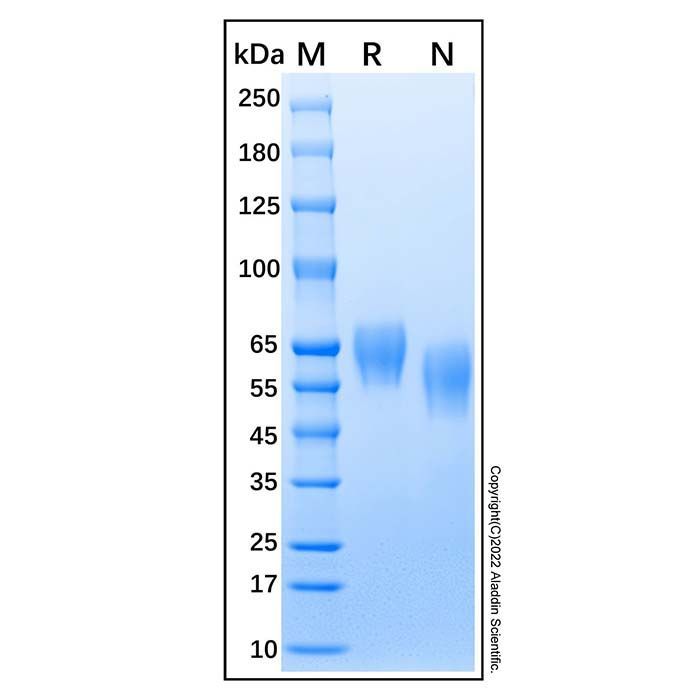
Recombinant Human BACE1 Protein (rp143119) - SDS-PAGE 3 μg/lane of Recombinant Human BACE1 Protein was resolved with SDS-PAGE under reducing (R) and non-reducing (N) conditions and visualized by Coomassie® Blue staining, showing the band at 60.0 - 70.0 kDa under reducing conditions and 55.0 - 60.0 kDa under non-reducing conditions.
Documentation
📋 Fiche de données de sécurité (FDS)
Document complet couvrant les dangers, la manipulation, le stockage et la conformité réglementaire.
Determine the necessary mass, volume, or concentration for preparing a solution.
Dilution Calculator
Determine the dilution needed to prepare a stock solution.
Reconstitution Calculator
Avis
Avis des clients
Application Protocols
Not specified for this item; refer to CoA/Spec Sheet.
General note: For typical BACE1 biochemical assays, see Reaction Conditions for literature-based starting parameters. Item-specific protocols, tested applications, and performance data should be taken from the CoA/Spec Sheet when available.
Biological Roles
General/literature overview (not item-specific)
Function: BACE1 (beta-site APP cleaving enzyme 1) is an aspartyl protease that initiates the amyloidogenic processing of amyloid precursor protein (APP) by cleaving at the β-site, generating the N-terminus of Aβ peptides after subsequent γ‑secretase cleavage.
Localization: Endoplasmic reticulum and Golgi during biosynthesis; active predominantly in acidic compartments such as endosomes, consistent with its acidic pH optimum.
Substrate scope: Beyond APP, reported substrates include neuregulin, L1CAM, CHL1, and others, implicating BACE1 in axon guidance, myelination, and synaptic function (literature context).
Regulation: Activity and trafficking are influenced by luminal pH, glycosylation, lipid composition, and sorting adaptors. Expression levels and maturation (prodomain processing) impact catalytic efficiency.
Enzymology: Contains two catalytic aspartates in a bilobal active site typical of pepsin-like proteases, with a flap region modulating substrate access. Inhibitors often exploit transition-state mimicry (e.g., hydroxyethylamine isosteres).
Relevance for research use
Target validation: Recombinant BACE1 enables direct biochemical assays disentangled from cellular trafficking effects.
Mechanistic studies: Facilitates structure–activity relationship (SAR) exploration of inhibitors and substrate mapping under defined pH/ionic conditions.
Note
This product is for research use only. No medical or clinical claims are made or implied.
Buffer Applications
Item-specific facts (from Product Data)
Buffer composition and formulation for this SKU are not provided. Refer to the CoA/Spec Sheet for exact buffer constituents, pH, and excipients.
General/literature guidance for BACE1 assay buffers (not item-specific)
pH and buffer choice: BACE1 exhibits maximal activity at acidic pH. Common buffers include sodium acetate or MES in the pH 4.0–5.5 range. Titrate pH at the working temperature.
Ionic strength: 100–200 mM NaCl is frequently used to maintain stability and reduce nonspecific interactions; optimize for your substrate.
Additives: 0.001–0.01% nonionic detergents (e.g., Tween‑20) can reduce surface adsorption for low-concentration assays; many ectodomains are active without detergents.
Stabilizers: 10–50% glycerol is often used for frozen stock storage to mitigate freeze–thaw damage. For kinetic assays, keep glycerol low (<5%) to avoid viscosity and activity effects.
Metal ions: As an aspartyl protease, BACE1 does not require metal cofactors; include EDTA only if needed to chelate adventitious metals from other components.
Substrate delivery: If substrates/inhibitors are in DMSO, keep final DMSO low (commonly ≤1–2% v/v) and match DMSO in control wells.
Practical tips
Filter-sterilize assay buffers (0.22 μm) and pre-equilibrate at assay temperature. Use low-bind plastics to reduce enzyme loss, especially for carrier-free formulations.
Green Alternatives
Although this is a protein reagent rather than a traditional solvent or reagent, greener lab choices can still be made around its use.
Greener considerations (general guidance)
Buffer systems: Prefer Good’s buffers (e.g., sodium acetate, MES) prepared with high-purity water instead of phosphate buffers that might require higher ionic strength. Avoid unnecessary preservatives; this item is azide-free—maintain sterility by aliquoting and frozen storage rather than chemical biocides.
Cosolvents: Minimize DMSO content in assays (e.g., ≤1–2% v/v where possible). Consider ethanol or glycerol only as needed and evaluate impacts on enzyme activity.
Stabilizers: Use glycerol judiciously (e.g., 10–50% v/v for frozen storage) to reduce freeze–thaw waste; assess trade-offs with downstream analytics.
Temperature/shipping: Product ships cold; consolidate orders and plan experiments to minimize repeat shipments and reduce cold-chain footprint. Store at −20°C as specified to avoid product spoilage and waste.
Comparison (general)
Chemical preservatives (e.g., sodium azide) vs. cold-chain/aseptic handling: Azide-free formats reduce hazardous waste and are compatible with click chemistry and peroxide-sensitive systems. The trade-off is stricter aseptic technique.
Detergent use: Avoid high concentrations of non-ionic detergents unless required for activity; they complicate waste streams and downstream analytics.
Pharmaceutical Uses
This section addresses formulation/manufacturing context only (no therapeutic claims).
Discovery and screening: Recombinant BACE1 is widely used as a biochemical target enzyme for screening and ranking small-molecule or peptide inhibitors in preclinical research. Biochemical enzyme panels rely on purified, bioactive protein to benchmark potency and selectivity.
Assay development: Enables development/qualification of HTS assays (e.g., FRET peptide cleavage) and orthogonal readouts (HPLC-MS peptide mapping), supporting medicinal chemistry SAR cycles.
Reference standard: Serves as an in-house reference enzyme for lot-to-lot comparability in inhibitor manufacturing QC workflows and for cross-platform method transfer.
Biophysical characterization: The His tag allows immobilization for binding kinetics (SPR/BLI) to characterize interaction parameters (KD, kon, koff) of development candidates under controlled conditions.
Not specified for this item
Compliance status (e.g., pharmacopeial monographs), endotoxin limits, and qualification documents are not provided. For regulated applications, consult the CoA/Spec Sheet and request additional quality documentation as needed.
Note
For research use only. Not for use in diagnostic procedures or as an active pharmaceutical ingredient.
Physical Properties
Item-specific facts (from Product Data)
Appearance: Not specified for this item; refer to CoA/Spec Sheet.
Molecular weight: Not specified for this item; refer to CoA/Spec Sheet.
Molecular formula: Not specified for this item; refer to CoA/Spec Sheet.
General/literature properties for recombinant BACE1 proteins (not item-specific)
Typical construct: soluble ectodomain (catalytic domain) with a polyhistidine tag. Apparent MW can vary widely with sequence boundaries and glycosylation; published values often range ~45–70 kDa for ectodomains under reducing SDS‑PAGE due to glycan content and construct length.
Isoelectric point (pI): depends on construct; reported theoretical pI values for common ectodomains are in the acidic range. Actual pI shifts with glycosylation and tags.
Solubility: readily soluble in aqueous buffers; stability frequently enhanced by 10–50% glycerol and mild detergents for membrane-derived enzymes, though many soluble ectodomains are active without detergents.
Thermal behavior: activity decreases upon prolonged exposure to elevated temperature; many preparations are handled on ice and stored frozen.
Cofactors: as an aspartyl protease, BACE1 does not require metal ions for catalysis; activity depends on acidic pH.
Important
Do not treat any of the above as specifications for this item. Exact buffer composition, concentration, and biophysical parameters for SKU rp143119 are not specified here; refer to the CoA/Spec Sheet for authoritative values.
Quality and Grades
Item-specific grades/attributes (from Product Data) and their implications
Animal Free: Manufactured without animal-derived components to reduce risk of adventitious agents and variability from animal-origin materials. Suitable for workflows with stringent animal-free requirements.
Carrier Free: No added carrier proteins (e.g., BSA). Advantages: undiluted activity, lower background in binding/biophysical assays, and precise mass balance. Handle carefully to avoid adsorption losses.
Bioactive: Supplied in a form validated for biological activity. Expect functional enzymatic activity when used under suitable assay conditions (see Reaction Conditions). Activity units/method are not specified; consult CoA.
ActiBioPure™: Aladdin’s premium purity/bioactivity designation indicating rigorous purification and quality control designed to preserve native function. Specific QC tests for this lot are not listed here; refer to the CoA/Spec Sheet.
Azide Free: Compatible with azide-sensitive downstream uses (e.g., azide-intolerant enzymes, click-ready systems). Requires aseptic handling to avoid microbial growth if stored at ≥2–8°C.
His Tag: Polyhistidine affinity tag facilitates immobilized metal affinity chromatography (IMAC) capture, selective immobilization on Ni2+/Co2+ matrices, and detection with anti-His reagents.
What is not specified for this item
Exact purity (%), endotoxin level, host expression system, sequence boundaries, glycosylation state, buffer composition, activity assay and units, and residual metals are not provided here. Refer to the CoA/Spec Sheet for item-specific quality metrics.
Reaction and Applications
Use-cases for recombinant human BACE1 protein (general/literature guidance; not item-specific specifications)
Enzymology: Quantitative characterization of BACE1 kinetics with fluorogenic or chromogenic peptide substrates derived from APP β‑site sequences. Enables determination of kcat, Km, and inhibition constants (Ki/IC50) for candidate inhibitors.
Inhibitor screening: High-throughput screening (HTS) using FRET substrates (e.g., EDANS/DABCYL-labeled peptides) at acidic pH. Carrier-free format minimizes background in biochemical/biophysical assays.
Substrate profiling: Assess cleavage preferences using peptide libraries or altered APP-derived sequences to map P4–P4′ specificity.
Biophysical studies: His-tag permits immobilization on Ni2+/Co2+ chips or beads for binding assays (BLI/SPR) with inhibitors or antibodies that recognize the ectodomain.
Proteolysis controls: Serve as a positive control enzyme in cell-free studies of APP processing and in comparative assays with related aspartyl proteases.
Practical considerations (general)
Protein handling: Keep on ice; aliquot to avoid freeze–thaw. Use low-bind plastics to minimize adsorption—especially important for carrier-free material.
Assay design: Maintain acidic assay buffer near BACE1 pH optimum; validate substrate concentration above/below Km as appropriate for mechanistic or screening goals. Include detergent only if needed to prevent nonspecific adsorption or to mimic membrane environments; many ectodomains are active without detergents.
Controls: Include blank (no enzyme), heat-inactivated enzyme, and known inhibitor controls. Record inner-filter effects when using fluorescent readouts.
Reaction Conditions
General/literature guidance for in vitro BACE1 assays (not item-specific specifications)
Buffer: Sodium acetate or MES, pH 4.0–5.5. Start at pH ~4.5 and optimize. Maintain ionic strength (e.g., 100–150 mM NaCl) to stabilize the protein and minimize nonspecific binding.
Temperature: 25–37°C are common assay temperatures. Higher temperatures may increase rate but can reduce stability; validate time courses to stay within initial-rate conditions.
Enzyme concentration: Typically low-nanomolar to sub-nanomolar ranges for fluorogenic substrates; adjust to achieve 10–20% substrate conversion in the linear range.
Substrates: FRET peptides modeled on APP β‑site. Monitor fluorescence increase upon cleavage; correct for inner-filter effects and DMSO content.
Cosolvent: Keep DMSO (from inhibitor stocks) minimal, commonly ≤1–2% v/v. Match vehicle in controls.
Controls: Include no-enzyme, heat-inactivated enzyme, and a known inhibitor as positive control for inhibition.
Data quality: Verify linearity with respect to time and enzyme concentration; determine Z′-factor for HTS readiness if applicable.
Notes
The above conditions are general literature starting points and may require optimization for your specific substrate/inhibitor set and this product’s formulation. They are not specifications for SKU rp143119. Consult the CoA for any lot-specific recommendations.
Safety and Handling
Item-specific facts (from Product Data)
Hazard classifications (GHS, pictograms, H‑statements, signal word): Not specified for this item; refer to the SDS.
Azide Free: This preparation is azide-free, minimizing risks associated with sodium azide.
Storage: Store at −20°C. Avoid repeated freezing and thawing. Shipped in ice chest with ice pads.
General safety guidance for recombinant proteins (not item-specific)
PPE: Wear lab coat, disposable gloves, and safety glasses. Avoid inhalation of powders/aerosols and prevent skin/eye contact.
Handling: Keep on ice during use. Work in a clean area to avoid microbial contamination. If aerosol generation is possible (e.g., lyophilizate handling), consider a biosafety cabinet.
Sensitization: Proteins can be potential allergens/sensitizers in susceptible individuals; minimize exposure and use closed tubes.
Incompatibilities: Avoid strong oxidizers and extremes of pH outside recommended assay ranges. Avoid repeated freeze–thaw, which can denature proteins.
First aid (overview; refer to SDS for details):
Skin/eye contact: Rinse with water for several minutes; remove contaminated clothing.
Ingestion/inhalation: Move to fresh air; seek medical advice if symptoms persist.
Spill/cleanup: Absorb aqueous solutions with inert material, wash area with water/detergent. Dispose according to institutional and local regulations for laboratory biological reagents.
Authoritative source
Always consult the product’s SDS for definitive hazard, toxicological, and disposal information specific to the lot and formulation.
Solvent Selection
This product is a recombinant protein intended for aqueous buffers rather than organic solvents.
Applicability: Traditional “solvent selection” guidance for small-molecule chemistry does not apply.
Practical guidance: Focus on buffer selection (pH, ionic strength, stabilizers) described in Buffer Applications and Reaction Conditions. If small amounts of cosolvent are required to dissolve peptide substrates or inhibitors (e.g., DMSO), keep final DMSO ≤1–5% v/v in enzyme assays to preserve activity (general literature guidance; optimize empirically).
Storage and Reconstitution
Item-specific facts (from Product Data)
Storage: Store at −20°C.
Handling: Avoid repeated freezing and thawing.
Shipping: Shipped in an ice chest with ice pads.
General guidance (not item-specific; follow CoA if provided)
Aliquoting: Upon first receipt, thaw (if frozen) on ice, gently mix, and make single-use aliquots in low-bind tubes to prevent multiple freeze–thaw cycles.
Stabilization: For frozen storage, many recombinant proteins are kept in 10–50% glycerol at −20°C to remain partially liquid and reduce freeze–thaw stress; alternatively, store at −80°C without glycerol. Choose based on downstream assay compatibility.
Reconstitution: If supplied lyophilized (not specified here), reconstitute with sterile, cold buffer at an appropriate pH (often acetate or MES, pH ~4.5–5.5 for BACE1 activity) to a convenient stock concentration. Avoid vigorous vortexing; gently pipette or rock to dissolve.
Working stocks: Keep on ice during setup. Use low-bind plastics to minimize adsorption—especially important for carrier-free protein.
Long-term storage: For multi-month storage, consider −80°C. Record freeze dates and avoid repeated thawing.
Not specified for this item
Exact buffer composition, presence/absence of stabilizers (e.g., glycerol, salts), concentration, and protein form (liquid vs lyophilized) are not provided; consult the CoA/Spec Sheet for definitive instructions.
Structure and Identity
Item-specific facts (from Product Data)
Product: Recombinant human BACE1 protein (His-tagged)
Grades/Attributes: Animal Free, Carrier Free, Bioactive, ActiBioPure™, Azide Free, His Tag
SKU: rp143119
Molecular formula: Not specified for this item; refer to CoA/Spec Sheet.
Molecular weight: Not specified for this item; refer to CoA/Spec Sheet.
SMILES/InChI/InChIKey: Not applicable for proteins; not specified for this item.
General/literature description (for context; not item-specific specifications)
BACE1 (beta-site APP cleaving enzyme 1) is a type I transmembrane aspartyl protease of the peptidase family A1. Recombinant research reagents are commonly expressed as soluble ectodomains containing the catalytic domain and engineered affinity tags (e.g., His6) for purification.
Structural features: two conserved catalytic aspartates in the active site (DTGS and DSGT motifs), multiple disulfide bonds in the ectodomain, and typical aspartyl protease fold. Many constructs exclude the transmembrane/cytosolic regions to enhance solubility/activity in vitro.
2D/primary-structure view in words: a single polypeptide chain with N‑terminal signal/leader (often removed in recombinant forms), a globular catalytic ectodomain bearing the active-site dyad, and a C‑terminal tag (His) enabling IMAC purification.
Substrate recognition: prefers the β‑site within amyloid precursor protein (APP) and related sequences; accommodates hydrophobic residues around the scissile bond.
Notes
Exact sequence length, isoform, glycosylation state, and theoretical pI/MW of this lot are not provided here; consult the CoA/Spec Sheet for item-specific identity confirmation (e.g., sequence coverage, SDS‑PAGE banding, MS/peptide map).
Synthetic Utility
This product is a recombinant enzyme rather than a small-molecule building block. It is not typically employed for chemical synthesis in organic solvents.
Limited utility in chemical synthesis (general)
Biocatalysis: While BACE1 is a highly specific aspartyl endoprotease, its native role is peptide bond cleavage at APP-like sites under acidic conditions. It is not generally used for preparative peptide synthesis or broad-spectrum proteolysis.
Analytical peptide processing: In specialized research, BACE1 can be used to generate defined peptide cleavage products from APP-derived sequences as analytical standards for method development.
For synthetic chemistry needs, consider sections Reaction & Applications and Reaction Conditions for biochemical assay setups rather than classical synthetic transformations.
Target Specificity
Not specified for this item; refer to CoA/Spec Sheet.
Note: This section typically lists antigen/target details validated for antibodies or binding proteins. For an enzyme preparation, consult the CoA for any substrate specificity testing or activity assay details performed on the lot.
Foire aux questions
What is the purity of this product, and how is it determined?
This product is supplied at ≥90% purity, determined by SDS-PAGE. Lot-specific values are stated on the Certificate of Analysis.
What does Animal Free mean?
Animal Free indicates that the material has been processed and tested for specialty industrial processing. Specifications focus on the impurities that affect performance in that application — for example, metal content for electronics, particle size for batteries, refractive index for optics, or moisture content for moisture-sensitive processes.
How should this product be stored?
Store at ?20 °C. Avoid repeated freeze–thaw cycles. Aliquot into single-use volumes before freezing.
What does Carrier Free mean?
Carrier Free indicates that the material has been processed and tested for specialty industrial processing. Specifications focus on the impurities that affect performance in that application — for example, metal content for electronics, particle size for batteries, refractive index for optics, or moisture content for moisture-sensitive processes.
How is this product shipped?
This product ships in an insulated container with ice pads. Unpack on arrival and transfer it to the storage condition stated above.
What documentation is provided?
Available product documentation, including Certificates of Analysis (COA), Safety Data Sheets (SDS), and specification sheets, is shown in the product document area. Document availability and access follow the current site policy.
Besoin d'aide pour choisir la qualité ?
Notre guide de sélection des qualités couvre la pureté, le statut du stabilisant et l'adéquation à l'application pour toutes les variantes de notre catalogue.
Nous utilisons des cookies pour garantir le bon fonctionnement du site et, lorsque cela est autorisé, pour améliorer votre expérience. Vous pouvez gérer vos préférences à tout moment dans les Paramètres. Pour en savoir plus, consultez notre Politique relative aux cookies.
Souhaitez-vous que nous vous envoyions un message lorsque des réductions seront disponibles?
Me rappeler plus tard
Merci ! Veuillez vérifier votre boîte de réception e-mail pour confirmer.
Products are supplied to verified businesses, institutions, and qualified professionals for research and development use only. Not for use in humans, animals, diagnosis, or therapy.

 ZJ24F0505372