Determine the necessary mass, volume, or concentration for preparing a solution.
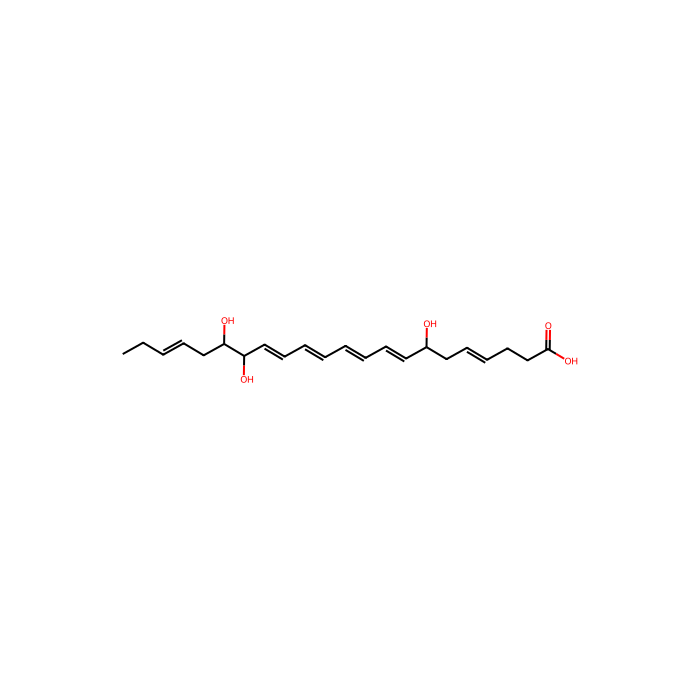
Resolvins are a family of potent lipid mediators derived from both eicosapentaenoic acid (EPA) and docosahexaenoic acid (DHA). In addition to being anti-inflammatory, resolvins promote the resolution of the inflammatory response back to a non-inflamed state. Resolvin D2 is produced physiologically from the sequential oxygenation of DHA by 15- and 5-lipoxygenase and functions to dampen excessive neutrophil trafficking to sites of inflammation. It reduces zymosan-stimulated PMN infiltration by 70% at doses as low as 10 pg per mouse and significantly reduces PAF-stimulated leukocyte adherence and emigration at 1 nM. Also, by stimulating nitric oxide production, resolvin D2 dose dependently decreases leukocyte-endothelial interactions. In a murine model of sepsis, resolvin D2 reduces leukocyte and PMN infiltration, decreases production of pro-inflammatory cytokines, and promotes phagocyte-mediated bacterial clearance.
Taxonomy Tree
| Kingdom | Organic compounds |
|---|---|
| Superclass | Lipids and lipid-like molecules |
| Classe | Fatty Acyls |
| Subclass | Fatty acids and conjugates |
| Intermediate Tree Nodes | Not available |
| Direct Parent | Very long-chain fatty acids |
| Alternative Parents | Hydroxy fatty acids Unsaturated fatty acids Secondary alcohols Polyols Monocarboxylic acids and derivatives Carboxylic acids Organic oxides Hydrocarbon derivatives Carbonyl compounds |
| Molecular Framework | Aliphatic acyclic compounds |
| Substituents | Very long-chain fatty acid - Hydroxy fatty acid - Unsaturated fatty acid - Secondary alcohol - Polyol - Monocarboxylic acid or derivatives - Carboxylic acid - Carboxylic acid derivative - Organic oxygen compound - Organic oxide - Hydrocarbon derivative - Organooxygen compound - Carbonyl group - Alcohol - Aliphatic acyclic compound |
| Description | This compound belongs to the class of organic compounds known as very long-chain fatty acids. These are fatty acids with an aliphatic tail that contains at least 22 carbon atoms. |
| External Descriptors | Docosanoids |
| Solubilité | Soluble in PBS pH 7.2 (~0.05 mg/ml), DMSO (~50 mg/ml), and DMF (~50 mg/ml). |
|---|---|
| Indice de réfraction | n20D1.55 (Predicted) |
| Point d'ébullition (°C) | 78° C |
| Poids moléculaire | 376.5 |
| XLogP3 | 3.100 |
| Hydrogen Bond Donor Count | 4 |
| Hydrogen Bond Acceptor Count | 5 |
| Rotatable Bond Count | 14 |
| Exact Mass | 376.225 Da |
| Monoisotopic Mass | 376.225 Da |
| Topological Polar Surface Area | 98.000 Ų |
| Heavy Atom Count | 27 |
| Formal Charge | 0 |
| Complexity | 555.000 |
| Isotope Atom Count | 0 |
| Defined Atom Stereocenter Count | 3 |
| Undefined Atom Stereocenter Count | 0 |
| Defined Bond Stereocenter Count | 6 |
| Undefined Bond Stereocenter Count | 0 |
| The total count of all stereochemical bonds | 6 |
| Covalently-Bonded Unit Count | 1 |
H225:Highly Flammable liquid and vapor
H333:May be harmful if inhaled
H350:May cause cancer
P201:Obtain special instructions before use.
P210:Keep away from heat, hot surface, sparks, open flames and other ignition sources. - No smoking.
P202:Do not handle until all safety precautions have been read and understood.
P233:Keep container tightly closed.
P240:Ground/bond container and receiving equipment.
P242:Use only non-sparking tools.
P243:Take precautionary measures against static discharge.
P281:Use personal protective equipment as required.
Item-specific validated application protocols were not provided. The following is general, non‑prescriptive guidance for handling and use of lipid mediator standards in research.
These steps are guidance only; optimize for your specific assay and instrumentation.
General literature background (not product‑specific and not a therapeutic claim):
Important note: The above describes general biochemical roles reported in the literature. This product is supplied strictly for research use only and is not intended for diagnostic, therapeutic, or clinical use.
RvD2 is a hydrophobic lipid mediator and is not used as a buffer component. When introducing RvD2 into aqueous buffers for research assays:
For general buffer formulations, refer instead to conventional buffering agents (e.g., phosphate, HEPES, Tris), which are more appropriate for controlling pH.
As a bioactive lipid standard, RvD2’s environmental footprint is dominated by solvent choice and cold‑chain logistics rather than by the molecule itself. Greener practice focuses on solvent selection and process minimization.
Greener considerations (general):
Comparison of common solvents (general):
Trade‑offs:
No pharmaceutical or clinical uses are claimed for this product. It is provided strictly for research use only.
Relevant research/manufacturing contexts (general):
Note: RvD2 is not an approved excipient and is not listed here with any compendial status. Do not use in humans or for diagnostic/therapeutic purposes.
Item-specific physicochemical specifications were not provided for this catalog entry. Refer to the CoA/Spec Sheet for definitive values. The following notes are general/literature guidance for Resolvin-class DHA metabolites and should not be construed as product specifications.
Always confirm experimental solubility and stability empirically under your conditions.
Interpretation and considerations for lipid mediator standards (general guidance):
Recommendation: For bioassays sensitive to isomeric purity, request chromatographic traces and any available stereochemical confirmation supporting the assigned RvD2 configuration for this lot.
This product is primarily used as a bioactive lipid standard and research tool rather than as a synthetic reagent. Accordingly, classical synthetic reaction families (e.g., cross‑couplings, nucleophilic substitutions) are not typical end‑uses. However, RvD2 is frequently applied in the following research contexts:
Practical tips for use as a standard:
Note: For synthesis of RvD2 itself, see the Synthetic Utility section.
Typical laboratory manipulations involving RvD2 focus on solution preparation and analytical workflows rather than chemical reactions. The following guidance is general and literature‑based:
Note: No item‑specific reaction parameters are claimed; consult primary literature for any synthetic preparation of RvD2 or analogs.
Hazard information was not provided for this item. Always consult the product SDS for authoritative safety data.
General laboratory handling for polyunsaturated lipid mediators:
Storage and shipping (item-specific): Store at −80°C. Shipped on dry ice packs + cold packs (as provided).
RvD2, as a long‑chain polyunsaturated fatty acid derivative, behaves as a lipophilic weak acid. Choose solvents that minimize oxidation and enable accurate dosing.
Comparison (general):
Item-specific storage and logistics (from Product Data):
Reconstitution and handling (general best practice for polyunsaturated lipid mediators):
Note: If the product is supplied as a solution or with any stabilizers, consult the CoA/Spec Sheet for exact solvent composition, concentration, and reconstitution instructions specific to this lot.
Resolvin D2 is a specialized pro‑resolving mediator (SPM) biosynthetically derived from docosahexaenoic acid (DHA; n‑3, C22:6). It is a polyunsaturated, multi‑hydroxylated lipid with defined E/Z geometry and stereochemistry along the carbon chain.
Item-specific identifiers (from Product Data):
Structural features (general/literature):
Nomenclature (general):
Note: Exact stereochemical descriptors, formula, and mass for this catalog item are not specified above; consult the product CoA/Spec Sheet for definitive identity parameters.
While RvD2 itself is typically an end‑product reference standard rather than a building block, its structure exemplifies several synthetic challenges and strategies of interest to practitioners:
For researchers synthesizing analogs or isotopologues (e.g., deuterated internal standards), analogous strategies apply, with attention to maintain chromatographic co‑elution and mass shifts suitable for MS quantitation.
This section typically applies to biologics (e.g., antibodies, enzymes) with defined binding targets. RvD2 is a small‑molecule lipid mediator and does not have a product‑specific “target specificity” entry.
General literature context: D‑series resolvins, including RvD2, have been reported to engage GPCR targets in vitro; RvD2 has been associated with DRV2/GPR18 in the literature. These notes are provided for background only and are not item specifications.
For experimental receptor studies, determine target engagement empirically under your assay conditions and consult primary literature for receptor expression systems and readouts.