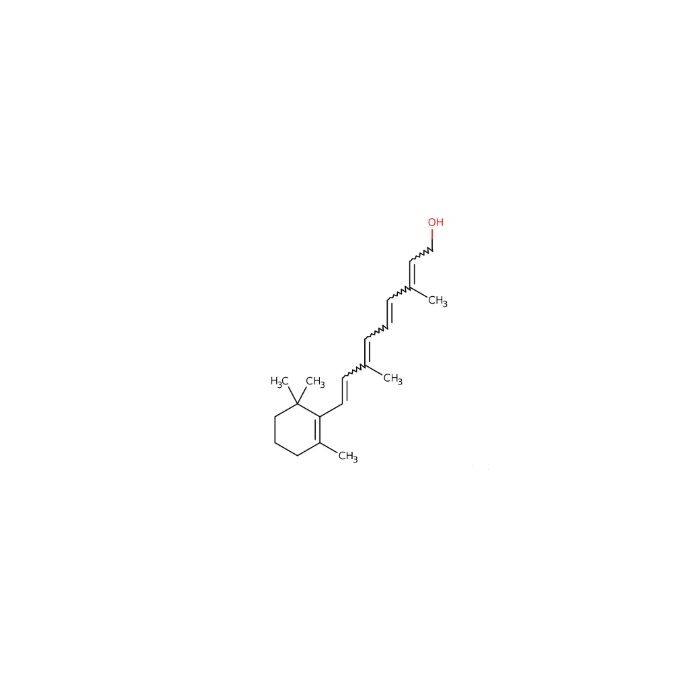
Retinol - BioReagent, ≥97.5%(HPLC), ~3100 U/mg , CAS No.68-26-8

CAS: 68-26-8 Cat. No.: R755730 Formule: C20H30O Poids moléculaire: 286.45 Beilstein Registry Number: 403040 Numéro CE: 200-683-7
DISPONIBLE À COMMANDE
QUALITÉ & PURETÉ BioReagent ? BioReagent grade — tested suitable for life-science and molecular-biology use. Use for cell culture, assays, and biochemical work needing biological compatibility. ≥97.5%(HPLC) ~3100 U/mg
Storage
Protected from light,Store at -20°C,Argon charged
Shipped In
Ice chest + Ice pads
★
Taille
Allemagne (EU)
USA*
Prix
Qté
50mg
R755730-50mg
—
2 En stock
51,98€
250mg
R755730-250mg
—
2 En stock
156,11€
1g
R755730-1g
—
1 En stock
520,56€
Enter a quantity for the sizes you want to add.
🧪
Pourquoi cette qualité

BioReagent, ≥97.5%(HPLC), ~3100 U/mg BioReagent pour les flux de travail chromatographiques et analytiques sensibles nécessitant une interférence de ligne de base minimale.

🌡

Stockage & expédition

Protected from light,Store at -20°C,Argon charged Expédition Ice chest + Ice pads. Consultez le COA spécifique au lot pour les spécifications exactes.

📋

Documents qualité

SDS, COA, fiche technique et fiche de spécifications disponibles au téléchargement. COA spécifique au lot accessible via la recherche par numéro de lot.

📚

Preuve documentaire

Cité dans 25 publications à comité de lecture couvrant la chromatographie, la synthèse organique et les réactions de couplage croisé.

Vue d’ensemble

Retinol or vitamin A alcohol is the main circulating form of vitamin A.

Spécifications

Spécifications et pureté
BioReagent, ≥97.5%(HPLC), ~3100 U/mg
Mécanismes biochimiques et physiologiques
It is not biologically active and works as a precursor of active retinoids. Retinol is converted to retinaldehyde and subsequently to retinoic acid.Retinal, retinol and retinoic acid are the aldehyde, alcohol and acid forms of vitamin A. The retinoids ex
Conditions de stockage de stockage
Protected from light,Store at -20°C,Argon charged
Expédié en
Ice chest + Ice pads
Ce produit nécessite l'expédition en chaîne froide. Les services terrestres et autres services économiques ne sont pas disponibles.
Grade
BioReagent
Pureté
≥97.5%(HPLC)
Noms et identifiants
Pubchem Sid
Sourires canoniques
CC1=C(C(CCC1)(C)C)C=CC(=CC=CC(=CCO)C)C
IUPAC Name
(2E,4E,6E,8E)-3,7-dimethyl-9-(2,6,6-trimethylcyclohexen-1-yl)nona-2,4,6,8-tetraen-1-ol
InChIKey
FPIPGXGPPPQFEQ-OVSJKPMPSA-N
INCHI
1S/C20H30O/c1-16(8-6-9-17(2)13-15-21)11-12-19-18(3)10-7-14-20(19,4)5/h6,8-9,11-13,21H,7,10,14-15H2,1-5H3/b9-6+,12-11+,16-8+,17-13+
Isomères SMILES
CC1=C(C(CCC1)(C)C)/C=C/C(=C/C=C/C(=C/CO)/C)/C
WGK Allemagne
3
RTECS
VH6750000
Poids moléculaire
286.45
Beilstein
403040
Reaxy-Rn
1913942
Reaxys-RN_link_address
https://www.reaxys.com/reaxys/secured/hopinto.do?context=S&query=IDE.XRN=1913942&ln=

Documentation

📋 Fiche de données de sécurité (FDS)

Document complet couvrant les dangers, la manipulation, le stockage et la conformité réglementaire.

<<<<<<< HEAD Télécharger la SDS → ======= Télécharger la SDS → >>>>>>> release248-p3

✅ Certificat d'analyse (COA)

Données qualité spécifiques au lot. Saisissez votre numéro de lot pour récupérer le COA exact.

Rechercher le COA →

📊 Fiche technique

Résumé de référence rapide des spécifications et applications du produit.

Voir la fiche technique →

🔬 Fiche de spécifications

Attributs de qualité complets et critères d'acceptation pour cette qualité.

Voir la fiche de spécifications →

Données avancées

Taxonomic Classification

Taxonomy Tree

KingdomOrganic compounds
SuperclassLipids and lipid-like molecules
ClassePrenol lipids
SubclassRetinoids
Intermediate Tree Nodes Not available
Direct ParentRetinoids
Alternative Parents Diterpenoids  Fatty alcohols  Primary alcohols  Hydrocarbon derivatives  
Molecular FrameworkAliphatic homomonocyclic compounds
Substituents Retinoid skeleton - Diterpenoid - Fatty alcohol - Fatty acyl - Organic oxygen compound - Hydrocarbon derivative - Primary alcohol - Organooxygen compound - Alcohol - Aliphatic homomonocyclic compound
DescriptionThis compound belongs to the class of organic compounds known as retinoids. These are oxygenated derivatives of 3,7-dimethyl-1-(2,6,6-trimethylcyclohex-1-enyl)nona-1,3,5,7-tetraene and derivatives thereof.
External Descriptors Retinoids
Structure 3D
Modèle de structure chimique interactif


Certificats (CoA, COO, BSE/TSE et tableau d'analyse)
C of A & Other Certificates(BSE/TSE, COO):
Analytical Chart:

Find and download the COA for your product by matching the lot number on the packaging.

8 results found

Lot NumberCertificate TypeDateArticle
D2623453D2623453Certificate of AnalysisApr 08, 2026 R755730
D2623456D2623456Certificate of AnalysisApr 08, 2026 R755730
D2623461D2623461Certificate of AnalysisApr 08, 2026 R755730
H2615002H2615002Certificate of AnalysisApr 08, 2026 R755730
F2503514F2503514Certificate of AnalysisMay 17, 2025 R755730
F2503516F2503516Certificate of AnalysisMay 17, 2025 R755730
F2503521F2503521Certificate of AnalysisMay 17, 2025 R755730
J2511019J2511019Certificate of AnalysisMay 17, 2025 R755730
Propriétés chimiques et physiques
SensibilitéHygroscopic
Indice de réfraction1.641
Point d'ébullition (°C)120-125°C
Point de fusion (°C)61-63°C
Poids moléculaire286.500 g/mol
XLogP35.700
Hydrogen Bond Donor Count1
Hydrogen Bond Acceptor Count1
Rotatable Bond Count5
Exact Mass286.23 Da
Monoisotopic Mass286.23 Da
Topological Polar Surface Area20.200 Ų
Heavy Atom Count21
Formal Charge0
Complexity496.000
Isotope Atom Count0
Defined Atom Stereocenter Count0
Undefined Atom Stereocenter Count0
Defined Bond Stereocenter Count4
Undefined Bond Stereocenter Count0
The total count of all stereochemical bonds4
Covalently-Bonded Unit Count1
FAQ et articles
9-cis-Retinoic Acid
Carotenoids: Structural Features, Dietary Sources and Research Applications – With an Aladdin Natural Pigments Product Selection Guide
Analysis of Hydrolyzed Pearl as a Cosmetic Raw Material: Preparation Process, Active Components, and Skincare Formulation Applications
The Dual-Targeted Skin-Brightening Mechanism of 4-MSK: Inhibiting Melanin Production and Reducing Epidermal Pigment Retention
How Do Collagen Peptides Act on the Skin? From Surface Hydration and Percutaneous Delivery to Fibroblasts and Collagen Homeostasis
Phenylethyl Resorcinol (377): Structural Characteristics, Melanogenesis-Regulating Mechanisms, and Related Applications in Formulation Research
How Does Collagen Tripeptide Act on the Skin: Stratum Corneum Delivery, Matrix Protection, and Regulation of Collagen Homeostasis
Mechanisms of Retinol Action in the Skin: From Metabolic Activation and RAR/RXR-Mediated Transcriptional Regulation to Epidermal Renewal and Collagen Homeostasis
Mechanisms by Which PDRN Participates in Skin Repair: A2A Receptor-Related Signaling, Nucleotide Salvage, and Extracellular Matrix Remodeling
Mechanistic Basis of Acetyl Hexapeptide-8 in the Management of Expression Lines: SNARE Complex Interference, Constraints on Percutaneous Delivery, and Combination Strategies
Bakuchiol Is Not “Plant Retinol”: Chemical Structure, Anti-Aging Mechanisms, and Functional Similarities and Differences Compared with Retinol
Citations of This Product
Calculateurs de solution
Avis

Avis des clients

Souhaitez-vous que nous vous envoyions un message lorsque des réductions seront disponibles?

Me rappeler plus tard

Merci ! Veuillez vérifier votre boîte de réception e-mail pour confirmer.

Oups ! Les notifications sont désactivées.