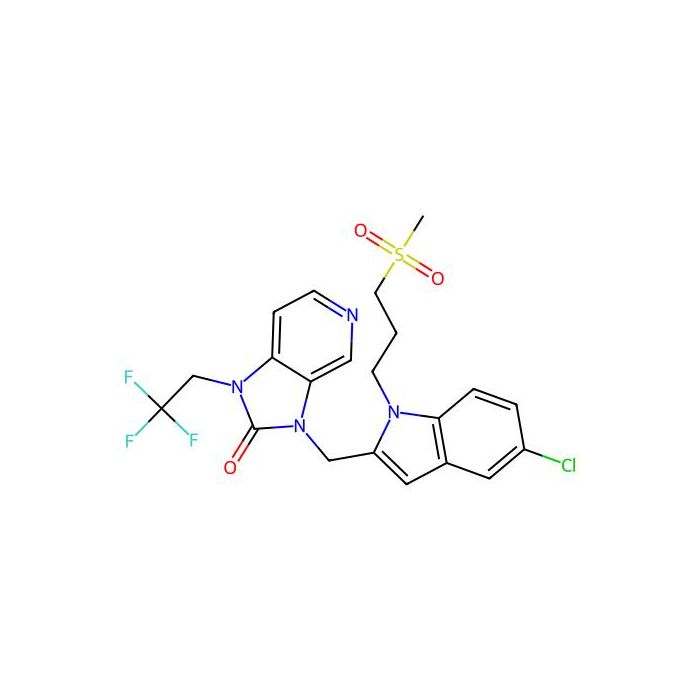
Rilematovir (JNJ-678) is a novel fusion protein inhibitor. Rilematovir has the potential for respiratory syncytial virus (RSV) research.
In Vitro
Rilematovir is a small-molecule respiratory syncytial virus (RSV) fusion inhibitor currently under clinical evaluation in infants hospitalized for RSV infection. Rilematovir binds to RSV F protein in its prefusion conformation. Rilematovir displays very potent antiviral activity and low cytotoxicity. In addition to its activity against the RSV A2 strain, Rilematovir is also highly active against a number of RSV strains from both A and B subtypes. The EC 50 in an RSV infection assay using HeLa cells is 460 pM. MCE has not independently confirmed the accuracy of these methods. They are for reference only.
In Vivo
Oral treatment of neonatal lambs with Rilematovir, or with an equally active close analog, efficiently inhibits established acute lower respiratory tract infection in the animals, even when treatment is delayed until external signs of respiratory syncytial virus illness have become visible . MCE has not independently confirmed the accuracy of these methods. They are for reference only.
IC50& Target:Fusion protein
Spécifications
Spécifications et pureté
10mM in DMSO
Mécanismes biochimiques et physiologiques
Rilematovir (JNJ-678) is a novel fusion protein inhibitor. Rilematovir has the potential for respiratory syncytial virus (RSV) research.
Conditions de stockage de stockage
Store at -80°C
Expédié en
Dry ice packs + Cold packs
Ce produit nécessite l'expédition en chaîne froide. Les services terrestres et autres services économiques ne sont pas disponibles.
Certificats (CoA, COO, BSE/TSE et tableau d'analyse)
C of A & Other Certificates(BSE/TSE, COO):
Analytical Chart:
Calculateurs de solution
Molarity Calculator
Determine the necessary mass, volume, or concentration for preparing a solution.
Dilution Calculator
Determine the dilution needed to prepare a stock solution.
Reconstitution Calculator
Avis
Avis des clients
Application Protocols
No vendor-tested application protocols are provided for this catalog entry.
General usage example (non-item-specific)
Stock preparation: Dissolve in DMSO to 10–50 mM. Vortex/sonicate briefly. If insoluble, incrementally add co-solvent (DMF) or warm gently (≤40 °C).
Biochemical assay: Perform a 10-point, 3-fold dilution series from the stock. Keep final DMSO ≤0.5% v/v unless the assay tolerates more. Include vehicle controls.
Cell assay: Dilute DMSO stocks into complete media to desired concentrations. Typical final DMSO ≤0.1–0.5% v/v. Monitor for precipitation after dilution.
Storage of working plates: Seal and store at −20 to −80 °C for short-term; avoid repeated freeze–thaw. Record plate maps to track concentrations.
Please consult the SDS and the item’s CoA/Spec Sheet for any product-specific recommendations.
Biological Roles
Item-specific biological targets or pathways are not provided in this listing. The guidance below is general for small-molecule research compounds and is not specific to Rilematovir.
General research context
Such compounds are commonly evaluated as test articles in biochemical target assays, cellular phenotypic screens, and mechanistic studies. They may function as enzyme modulators, receptor ligands, or pathway probes, depending on their structure and binding properties.
Typical readouts include activity/inhibition curves, binding affinities (e.g., SPR, ITC), and cellular efficacy markers (reporter assays, imaging, flow cytometry).
Best practices
Establish compound identity and purity before biological testing.
Define vehicle controls (matched DMSO) and incorporate orthogonal assays to confirm on-target mechanisms versus nonspecific effects (aggregation, redox cycling, fluorescence interference).
Determine basic developability parameters (aqueous solubility across pH, chemical stability in buffers and media, and permeability) to interpret assay results correctly.
Important
No medical or clinical claims are made for this product. It is supplied strictly for research use only.
Buffer Applications
Not typically applicable: This product is not a buffering reagent. However, solvent and buffer conditions can influence assay performance with small-molecule test articles.
General guidance (non-item-specific)
Prepare concentrated DMSO stocks and dilute into assay buffers to a final DMSO content that the system tolerates (often ≤0.1–0.5% for sensitive enzymes; up to 1–2% for many cell assays). Validate tolerance empirically.
Consider surfactants (e.g., 0.01–0.05% Tween 20) to reduce nonspecific adsorption to plastics, if compatible with the assay.
Maintain consistent ionic strength and pH to avoid compound precipitation; pre-warm buffers to 25–37 °C before dilution when solubility is marginal.
Filter (0.22 µm) assay buffers to remove particulates that could nucleate precipitation.
Green Alternatives
Because this item is a research screening compound rather than a process solvent or bulk reagent, “green alternatives” are primarily relevant to the choice of dissolution and workup solvents.
Greener dissolution options (general)
Prefer ethanol or isopropanol over DMF/NMP when solubility allows; they are less hazardous and easier to remove.
2-MeTHF or CPME may replace chlorinated solvents for extractions during analytical method development (if extractions are performed).
Comparison (general guidance)
DMSO: Excellent solvency; low volatility; benign for air emissions but can enhance dermal transport—requires careful PPE.
DMF/NMP: Powerful but reproductive hazards; reserve for stubborn solubility cases and minimize use.
Operational tips
Use minimal solvent volumes and prepare concentrated master stocks to reduce waste.
If method development requires non-green solvents (e.g., acetonitrile for LC), employ solvent-saving gradients and microbore columns to cut consumption.
Note
No item-specific environmental hazard data are provided; consult the SDS and institutional green-chemistry guidelines.
Pharmaceutical Uses
No pharmacopeial or excipient role is specified for this item. This product is provided for research use only and is not intended for human or veterinary use.
Common research and development uses (general)
Reference standard: Qualify and calibrate analytical methods (HPLC/UPLC–UV, LC–MS) in discovery and preclinical R&D.
Stability studies: Conduct forced degradation (oxidative, thermal, photolytic, hydrolytic) to develop stability-indicating methods and to understand degradation pathways in solution and solids.
Formulation screening (lab-scale): Explore enabling solubilization approaches (cosolvents, pH adjustments for ionizable analogs, amorphous dispersions) solely for in vitro and exploratory work.
Notes
No clinical, therapeutic, or GMP uses are implied. If cGLP/regulated applications are planned, obtain and qualify appropriate reference materials and documentation (full CoA, extended impurity profile, retest date assignment).
Physical Properties
Item-specific constants
Appearance: Not specified for this item; refer to CoA/Spec Sheet.
Melting point (MP): Not specified for this item; refer to CoA/Spec Sheet.
Boiling point (BP): Not specified for this item; refer to CoA/Spec Sheet.
Density: Not specified for this item; refer to CoA/Spec Sheet.
LogP/logD, pKa, refractive index: Not specified for this item; refer to CoA/Spec Sheet.
Solubility: Not specified for this item; refer to CoA/Spec Sheet.
General, literature-style guidance (not item-specific)
Small-molecule screening compounds are commonly supplied as solids or thin films suitable for preparing concentrated DMSO stocks (typically 10–50 mM). Actual solubility depends on functional groups and salt form.
Practical solubility screening sequence: DMSO → DMF → ethanol or isopropanol → aqueous buffers containing 0.1–1% DMSO or 5–20% co-solvent. Gentle warming (≤40 °C) and brief sonication often help dissolution; avoid prolonged heating.
If the compound forms salts (not specified here), solubility and hygroscopicity can change markedly relative to the free base/acid.
Important
Because no item-specific physico-chemical data are provided in this listing, do not assume values from secondary sources. Verify on the supplied CoA/Spec Sheet or characterize in-house (e.g., KF for water, HPLC UV trace for chromophores) prior to critical use.
Quality and Grades
Item specifics
Grade/Purity: Not specified for this item; refer to CoA/Spec Sheet.
Stabilizers/Inhibitors: Not specified for this item; refer to CoA/Spec Sheet.
Interpreting grades (general context)
Research grade screening compounds are commonly supplied at ≥95% purity by HPLC/UPLC unless otherwise stated. However, do not assume—confirm via the item’s CoA and spec sheet.
For analytical applications (e.g., reference standard), look for full characterization: 1H/13C NMR, LC–MS (or HRMS), HPLC purity trace (with method), and, when applicable, water by Karl Fischer and residual solvent analysis by GC.
What to verify for this product
Identity: Match CAS (1383450-81-4) and, where available, SMILES/InChIKey to your internal records.
Purity and counter-ions: Confirm purity, salt/free-form status, and batch-specific residual solvents.
UV behavior: If using in chromatographic detection, check the CoA for UV spectrum or assess background at your analytical wavelength.
Practical QA/QC tips
Run an incoming QC: orthogonal purity by UPLC (two methods), LC–MS, and, if needed, qNMR for potency assignment.
If you prepare DMSO stocks for screening, record exact concentration by diluting an aliquot to an LC–UV response curve or by gravimetric preparation to minimize dosing variance.
Reaction and Applications
This product is listed as a small-molecule library compound intended primarily for screening, profiling, and reference use rather than as a synthetic reagent.
Research applications (general, non-item-specific)
Biochemical assays: Evaluate as a test article in enzyme or binding assays; establish concentration–response curves (e.g., 10-point 3-fold dilutions from a DMSO master stock).
Cell-based assays: Assess phenotypic effects under controlled DMSO levels; include vehicle controls and positive/negative comparators.
ADME profiling: If sufficient material is available, determine solubility, stability (chemical and microsomal), permeability (PAMPA/Caco-2), and plasma protein binding to inform subsequent studies.
Analytical reference: Use to develop stability-indicating LC or LC–MS methods, forced degradation studies, and to qualify bioanalytical assays.
Not typically applicable
Named-reaction participation or use as a general reagent is not typical for a defined drug-like screening compound unless specifically designed as a building block. If derivatization is intended, first confirm structure and reactive handles from the CoA and evaluate compatibility with standard protections and coupling chemistries.
Reaction Conditions
Not applicable in the usual sense: This product is not supplied or intended as a reagent for named organic reactions. No item-specific reaction conditions are provided.
General notes (only if derivatization is pursued after confirming structure)
Solvents: DMF, DCM, MeCN, dioxane, toluene, or 2-MeTHF are commonly used depending on functional groups.
Temperatures: 0–100 °C typical for coupling/cross-coupling; use inert atmosphere for air/moisture-sensitive steps.
Catalysts/bases: Pd(PPh3)4, Pd2(dba)3/XPhos, CuI, Cs2CO3, K2CO3, DIPEA—selected based on functional handles present.
Workup: Quench carefully; avoid conditions that could degrade the parent scaffold. Purify by reverse-phase prep HPLC when needed to protect labile motifs.
Because no structure or reactivity data are provided for this item, treat all of the above as general literature guidance only.
Safety and Handling
Regulatory/SDS
GHS classification, signal word, pictograms, and H-statements: Not specified for this item; refer to SDS.
Research use only. Not for human or veterinary use.
General laboratory precautions (non-item-specific)
Handle as a potentially harmful small molecule of unknown toxicity. Avoid inhalation, ingestion, and skin/eye contact. Use a chemical fume hood.
Recommended PPE: lab coat, safety glasses, and appropriate chemically resistant gloves (e.g., nitrile). Change gloves frequently when working with DMSO solutions due to enhanced dermal transport.
Low-temperature hazards: Product is stored at −80 °C; containers and dry ice can cause cold burns. Use cryo-gloves; allow vials to equilibrate in a desiccator to minimize condensation.
Incompatibilities and stability (general)
Until structure is confirmed, avoid strong oxidizers/reductants and extremes of pH. Protect from light if conjugated/aromatic motifs are suspected.
Minimize repeated freeze–thaw cycles; aliquot concentrates.
First-aid overview (consult SDS for authoritative guidance)
Skin/eye contact: Rinse with water for ≥15 min; remove contaminated clothing.
Inhalation: Move to fresh air; seek medical advice if symptoms persist.
Ingestion: Rinse mouth; seek medical attention.
Waste
Collect solutions and solids as hazardous chemical waste; segregate halogenated and non-halogenated solvents where applicable.
Solvent Selection
Item-specific solvent data are not provided in this listing. The guidance below is general for small-molecule screening compounds.
General dissolution strategy
Primary solvent: DMSO (high solvency for diverse chemotypes). Prepare 10–50 mM master stocks.
Secondary options: DMF or NMP for recalcitrant compounds; ethanol or isopropanol when aqueous compatibility is needed.
Aqueous use: Dilute DMSO stocks into buffer to ≤0.1–0.5% v/v DMSO for sensitive biochemical assays; up to 1–2% may be tolerated in many cell assays (verify experimentally).
Miscibility profile (general)
DMSO is miscible with water and most organics; DMF/NMP likewise broad-spectrum but with higher boiling points. EtOH/IPA improve volatility and compatibility with biological systems.
Choosing among solvents
Use DMSO for maximum solubilization and stability screening.
Prefer ethanol/IPA for rapid solvent exchange and LC-compatibility when solubility permits.
Avoid neat DMF/NMP in bioassays; instead, use as co-solvents at minimal percentages.
Practical tips
Warm (≤40 °C) and vortex/sonicate briefly to assist dissolution; filter 0.22 µm if particulate persists.
Record actual solvent composition in assay records; solvent can affect target readouts.
For LC/MS analytics, ensure solvent selection matches the ionization mode and avoids adduct formation.
General reconstitution guidance (not item-specific)
Solvent: Prepare a concentrated DMSO stock (e.g., 10–50 mM). If needed, use minimal DMF or ethanol as co-solvent to aid dissolution.
Technique: Allow vials to warm in a desiccator from −80 °C to prevent condensation. Briefly vortex/sonicate; avoid prolonged heating. Filter (0.22 µm PTFE) if particulates persist.
Aliquoting: Dispense single-use aliquots (e.g., 10–100 µL) to avoid freeze–thaw cycling. Store aliquots in tightly sealed, chemically compatible tubes.
Light/moisture: If the structure suggests photosensitivity or hygroscopicity (not specified here), protect from light and moisture.
Stability and retest
Retest date, long-term stability, and thaw–refreeze limits: Not specified for this item; refer to CoA/Spec Sheet. For best practice, minimize time at ambient temperature and document each thaw.
Use note
For research use only. Verify concentration after reconstitution when dosing accuracy is critical (e.g., by diluting an aliquot for LC–UV or qNMR).
Structure and Identity
Product: Rilematovir (SKU: R655660)
CAS: 1383450-81-4; PubChem CID: 118892432
Molecular formula: Not specified for this item; refer to CoA/Spec Sheet.
Molecular weight: Not specified for this item; refer to CoA/Spec Sheet.
SMILES: Not specified for this item; refer to CoA/Spec Sheet.
InChIKey: Not specified for this item; refer to CoA/Spec Sheet.
Structural features
Item-specific structural descriptors (ring systems, heteroatoms, stereochemistry) are not provided in this listing. Consult the Certificate of Analysis (CoA) for definitive identifiers.
2D structure description (general guidance)
Without an item-specific structure, a detailed 2D description cannot be given here. If you have the SMILES/InChI, a quick cheminformatics render will reveal key functional groups (e.g., aromatic/heteroaromatic motifs, amide/urea linkages, halogen substituents) that can inform solubility and handling choices.
Notes
This product is listed under “small molecules & compound libraries,” indicating it is intended as a research chemical reference/stock for screening and discovery workflows rather than as a commodity reagent.
Synthetic Utility
This product is sold as a defined small-molecule research compound, not as a general-purpose synthetic reagent or building block.
If derivatization is contemplated (general, not item-specific)
Confirm the exact structure (SMILES/InChI) and identify modifiable positions (e.g., halides, anilides, sulfonamides, heteroaryl C–H sites) before planning transformations.
Typical transformations on drug-like scaffolds include: amide couplings (HATU/EDC/Oxyma), Suzuki/Negishi cross-couplings (if aryl/alkenyl halides or boronates are present), N-alkylations/acylations, and heteroaryl C–H functionalizations under mild Pd/Cu catalysis.
Protect sensitive moieties (e.g., anilines, phenols) as needed to avoid side reactions.
Caveats
Without item-specific structure, reactivity and compatibility cannot be predicted. For synthetic use, consult the CoA/structure and perform small-scale scouting with orthogonal analytics (LC–MS, TLC, UPLC) to monitor integrity.
Target Specificity
Target, pathway, or binding profile: Not specified for this item; refer to CoA/Spec Sheet or primary literature.
Species reactivity, selectivity metrics, and off-target panel data: Not specified for this item; refer to CoA/Spec Sheet.
Note
If you are using this compound as a probe in target-based assays, establish on-target engagement with orthogonal methods (e.g., CETSA, NanoBRET, SPR) and include appropriate chemical and genetic controls.
Nous utilisons des cookies pour garantir le bon fonctionnement du site et, lorsque cela est autorisé, pour améliorer votre expérience. Vous pouvez gérer vos préférences à tout moment dans les Paramètres. Pour en savoir plus, consultez notre Politique relative aux cookies.
Souhaitez-vous que nous vous envoyions un message lorsque des réductions seront disponibles?
Me rappeler plus tard
Merci ! Veuillez vérifier votre boîte de réception e-mail pour confirmer.
Products are supplied to verified businesses, institutions, and qualified professionals for research and development use only. Not for use in humans, animals, diagnosis, or therapy.