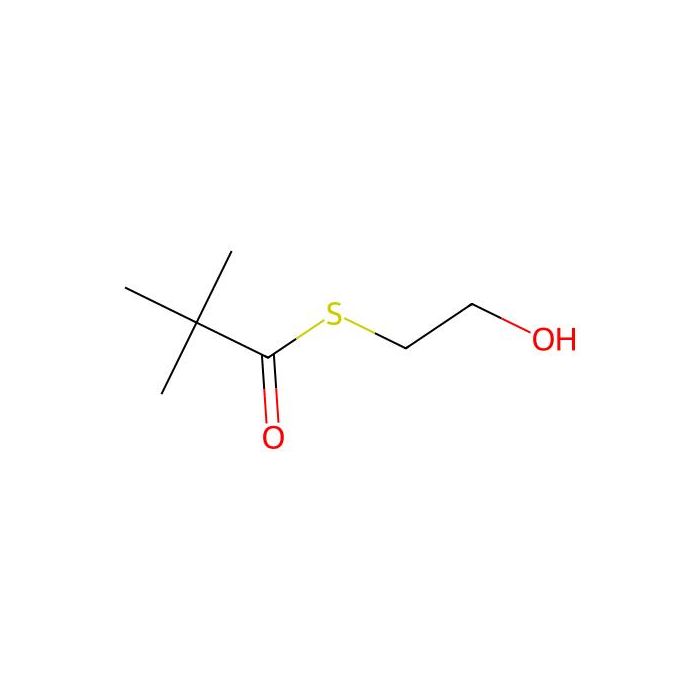
This compound belongs to the class of organic compounds known as thioesters. These are organic compounds containing an ester of thiocarboxylic acid, with the general structure RC(=S)XR' (R=H, alkyl, aryl; R'=alkyl, aryl; X=O,S).
External Descriptors
Not available
1. Djoumbou Feunang Y, Eisner R, Knox C, Chepelev L, Hastings J, Owen G, Fahy E, Steinbeck C, Subramanian S, Bolton E, Greiner R, and Wishart DS. ClassyFire: Automated Chemical Classification With A Comprehensive, Computable Taxonomy. Journal of Cheminformatics, 2016, 8:61.
Certificats (CoA, COO, BSE/TSE et tableau d'analyse)
C of A & Other Certificates(BSE/TSE, COO):
Analytical Chart:
Propriétés chimiques et physiques
Poids moléculaire
162.250 g/mol
XLogP3
1.400
Hydrogen Bond Donor Count
1
Hydrogen Bond Acceptor Count
3
Rotatable Bond Count
4
Exact Mass
162.071 Da
Monoisotopic Mass
162.071 Da
Topological Polar Surface Area
62.600 Ų
Heavy Atom Count
10
Formal Charge
0
Complexity
115.000
Isotope Atom Count
0
Defined Atom Stereocenter Count
0
Undefined Atom Stereocenter Count
0
Defined Bond Stereocenter Count
0
Undefined Bond Stereocenter Count
0
The total count of all stereochemical bonds
0
Covalently-Bonded Unit Count
1
Calculateurs de solution
Molarity Calculator
Determine the necessary mass, volume, or concentration for preparing a solution.
Dilution Calculator
Determine the dilution needed to prepare a stock solution.
Reconstitution Calculator
Avis
Avis des clients
Application Protocols
No assay-validated application protocols are provided for this item. The compound is supplied for general research use as a synthetic reagent.
Practical usage outline (general guidance):
Preparation: Bring to room temperature under argon before opening to avoid moisture condensation. Pre-dry syringes and glassware.
Small-scale pivaloylation (example workflow): Dissolve substrate (1.0 eq) and base (1.5 eq DIPEA) in dry THF (0.1–0.5 M), add this thioester (1.1–1.5 eq) at 0 °C, warm to rt and stir to completion (TLC/LC-MS). Quench with sat. NH4Cl, extract, dry, and purify by silica gel.
Documentation: Record lot number, storage history, and any pre-use drying performed to aid reproducibility.
These steps are generic suggestions derived from thioester acylation practice. Adapt stoichiometry, solvent, and temperature to your substrate and consult the primary literature for closely related transformations.
Biological Roles
This product is intended for research use only. No biological role is claimed for the specific compound. The following context is provided as general background on thioesters (literature), not a statement of use for this item.
Thioesters in biochemistry (general):
Central intermediates in metabolism, including acyl-CoA species (e.g., acetyl-CoA, succinyl-CoA). The thioester bond possesses higher acyl transfer potential than typical oxy-esters, enabling enzyme-catalyzed acylations.
Participate in fatty acid biosynthesis/β-oxidation, citrate synthase initiation, and non-ribosomal peptide/polyketide assembly as thioester-tethered intermediates.
2-Hydroxyethyl motif (general):
Primary alcohols are ubiquitous in biological systems but, in synthetic analogs, primarily serve as functional handles rather than conferring biological activity per se.
Research-relevant implications:
Small-molecule thioesters can serve as mechanistic probes of acyl transfer, enabling kinetic comparisons of S- vs O-acyl donors, leaving-group effects, and the influence of steric demand (e.g., pivaloyl) on enzyme or small-molecule catalysis.
No claims are made regarding biochemical activity, safety in vivo, or suitability for therapeutic applications. Use exclusively in laboratory research with appropriate controls.
Buffer Applications
This compound is not a buffering reagent and is not typically used to prepare pH buffer systems. As a moisture-sensitive thioester bearing a reactive acyl group, it is generally incompatible with aqueous buffer conditions that promote hydrolysis.
Practical note:
If aqueous work is unavoidable (e.g., biphasic extractions or quenching), maintain neutral pH, minimize contact time, and keep temperatures low to limit hydrolysis.
For preparative or synthetic uses, refer instead to the Reaction & Applications, Synthetic Utility, and Reaction Conditions sections.
Green Alternatives
From a green chemistry perspective, thioesters offer a balance between reactivity and selectivity that can reduce the need for harsher acylating agents. However, organosulfur odor and potential thiol byproducts must be managed.
Comparison of acylation options (literature/general):
Option | Pros | Cons
--- | --- | ---
Thioester (this item) | Milder conditions; less corrosive than acid chlorides; good chemoselectivity | Organosulfur odor; hydrolysis releases mercaptoethanol derivatives; sulfide waste handling
Acid chloride | Very reactive; low E-factors possible | HCl generation; corrosive; poor functional group tolerance; moisture sensitive
Anhydride (pivalic) | No halides; tunable | Can be less selective; may require elevated temps or catalysts
Activated ester (pNP, NHS) | No sulfur; useful in peptide work | Often needs stoichiometric leaving group; potential toxicity of phenols
Greener solvent choices (when compatible with substrate):
Replace DCM with 2-MeTHF, CPME, or EtOAc; run under anhydrous conditions to limit hydrolysis.
For polar media, use MeCN or dimethyl carbonate instead of DMF where feasible.
Waste minimization and handling:
Capture organosulfur residues in designated waste; treat off-gassing/odor with charcoal scrubbers.
Favor catalytic acyl transfer promoters (DMAP at low loading) over stoichiometric reagents.
As always, solvent selection and reagent choice should be validated for your specific substrate scope and performance targets.
Pharmaceutical Uses
No excipient or pharmacopeial status is provided for this item, and no clinical or therapeutic use is claimed. The following points describe general roles thioesters can play in pharmaceutical research and manufacturing (not specific to this product):
Intermediate in API synthesis (general):
Thioesters are versatile acyl donors used to introduce sterically demanding groups (e.g., pivaloyl) under mild conditions, aiding protecting-group strategies or late-stage functionalization.
Process considerations:
Compared to acid chlorides, thioesters can reduce corrosive byproducts (no HCl evolution), improving equipment longevity and operator safety in development labs.
Not typically used as an excipient due to reactivity; the free primary alcohol could, in principle, be derivatized to pro-moieties in discovery settings, but such applications are investigational and outside the scope of this listing.
Any pharmaceutical application must undergo comprehensive risk assessment and is beyond the intended research-only use of this product.
Physical Properties
Item-specific physical data have not been supplied for this catalog entry; consult the CoA/Spec Sheet for definitive specifications.
Supplied specifications (from Product Data):
Appearance: Not specified for this item; refer to CoA/Spec Sheet.
Molecular Formula: Not specified for this item; refer to CoA/Spec Sheet.
Molecular Weight: Not specified for this item; refer to CoA/Spec Sheet.
Storage and logistics (from Product Data):
Storage: 2–8 °C, argon charged, desiccated
Shipment: Wet ice
Literature/general expectations for this structure (non-spec):
Physical state: many low-MW thioesters are colorless liquids with characteristic sulfide odor.
Polarity/solubility: amphiphilic (thioester + primary alcohol). Typically miscible with polar aprotic solvents (THF, acetone, MeCN, DMF, DMSO) and alcohols; limited water solubility expected due to pivaloyl bulk.
Hydrogen-bonding: donor/acceptor via –OH; carbonyl is an H-bond acceptor; thioether sulfur is weakly basic.
Handling implications from physicochemical profile (general):
Hydrolytic sensitivity: thioesters can slowly hydrolyze under aqueous basic or strongly acidic conditions; exclude moisture.
Volatility: moderate; minimize prolonged vacuum or elevated temperature unless characterized.
Peroxides: not prone (no ether functionality); routine peroxide testing is not necessary.
Always refer to the SDS and the item’s CoA for precise numerical property data (bp, mp, density, refractive index, UV cutoff).
Quality and Grades
No explicit grade/purity is provided in the Product Data for this item. For exact assay, impurity profile, stabilizers, and release criteria, please consult the CoA/Spec Sheet.
Item-specific status (from Product Data):
Grade/Purity: Not specified for this item; refer to CoA/Spec Sheet.
Appearance: Not specified for this item; refer to CoA/Spec Sheet.
Practical guidance on grades (general):
Research grade thioesters typically prioritize low hydrolysis byproducts (parent acid, thiol/mercapto alcohol) and low residual solvents. Water content and acid number can be critical for moisture-sensitive acylation chemistry.
HPLC grade or “anhydrous” designations (when applicable) indicate tighter control of water and low UV-absorbing impurities—important for photometric monitoring or use in sensitive coupling sequences. If an inhibitor/stabilizer is included, it will be listed on the CoA and may influence downstream reactivity.
What to verify before use (best practices):
Identity: 1H/13C NMR confirming thioester carbonyl (typically δC ~190–200 ppm) and tert-butyl group; HRMS as appropriate.
Purity: chromatography (GC or HPLC) for residual pivalic acid and 2-mercaptoethanol derivatives; check for oxidation products (disulfides) if material has been exposed to air.
Water: Karl Fischer as needed for moisture-sensitive transformations.
If your application has stringent specifications (e.g., peptide chemistry, kinetic studies), request the latest CoA or a custom specification from Aladdin Scientific.
Reaction and Applications
S-(2-Hydroxyethyl) 2,2-dimethylpropanethioate is a pivaloyl thioester bearing a pendant primary alcohol. Thioesters are privileged acyl donors, providing enhanced acyl transfer reactivity relative to oxo-esters with useful chemoselectivity.
Representative application areas (literature/general):
Aminolysis/alcoholysis: Efficient pivaloylation of amines and alcohols under mild base (e.g., DIPEA, pyridine) or with nucleophilic catalysts (DMAP). The 2-hydroxyethyl thio fragment is a competent leaving group.
Selective protection strategies: Installation of the sterically demanding pivaloyl group to modulate basicity or solubility; removable by basic hydrolysis or nucleophile-promoted cleavage.
Intramolecular handle: The terminal –OH can be transformed (e.g., to mesylate/tosylate or carbonate), enabling tethered transformations or bifunctional linker chemistry.
Model for biochemical thioester reactivity: Useful in studying acyl transfer kinetics and sulfur vs oxygen leaving group effects.
Advantages of thioester acyl donors (vs acid chlorides/anhydrides):
Moisture tolerance is improved; fewer side reactions with sensitive substrates.
Better compatibility with base-sensitive motifs; often no HCl generation.
High selectivity for amines over alcohols under tuned conditions.
Practical tips:
Work under inert atmosphere and dry conditions to suppress hydrolysis and oxidation of any liberated thiol.
For alcohol acylation, add catalytic DMAP; for amines, tertiary amine base is usually sufficient.
Monitor by TLC/LC-MS; thioester carbonyl exhibits characteristic IR (~1680–1710 cm−1, literature) distinct from simple esters.
Reaction Conditions
General literature guidance for thioester-mediated acyl transfer is provided below; optimize for your substrate and scale. Item-specific conditions are not specified.
Aminolysis (pivaloylation of amines):
Solvent: Dry THF, MeCN, or DCM.
Base: DIPEA, triethylamine (1.1–2.0 eq). Additives often unnecessary; catalytic DMAP can accelerate sluggish substrates.
Temperature: 0–25 °C, typically 0.5–4 h; monitor by TLC/LC-MS.
Typical outcomes: High selectivity for amines over alcohols; literature yields frequently 70–95% depending on sterics/electronics.
Alcoholysis (formation of pivalate esters):
Solvent: DCM, toluene, or neat alcohol (if using as both solvent and nucleophile).
Catalyst: DMAP (5–10 mol%) or base (pyridine/Et3N).
Temperature: 0–40 °C; exclude water.
Hydrolysis (deprotection or quench):
Conditions: Aqueous base (NaOH, K2CO3) in MeOH/THF/H2O at 0–25 °C; acidic hydrolysis is slower for many thioesters but still feasible.
Precautions and workup:
Maintain inert atmosphere to limit hydrolysis and oxidation of any liberated thiol to disulfide.
Use mildly basic aqueous washes to remove pivalic acid; charcoal can reduce odor if sulfide notes persist.
Purification: Silica gel with nonpolar→moderately polar gradients; add 0.1–1% Et3N to suppress acid-catalyzed decomposition on silica if needed.
These conditions are general references from the thioester literature and should be fine-tuned experimentally.
Safety and Handling
Authoritative hazard classification for this specific item is not provided here; consult the SDS for S-(2-Hydroxyethyl) 2,2-dimethylpropanethioate for definitive GHS information.
GHS details (from Product Data):
Signal Word: Not specified for this item; refer to SDS.
H-Statements: Not specified for this item; refer to SDS.
GHS Classification: Not specified for this item; refer to SDS.
Pictograms: Not specified for this item; refer to SDS.
General hazard considerations for thioesters and low-MW organosulfur alcohols (literature):
May cause skin/eye irritation; organosulfur compounds often have strong odors and can cause headaches or nausea with poor ventilation.
Hydrolysis can release mercaptoethanol derivatives; control pH and moisture to minimize.
PPE and engineering controls:
Use in a chemical fume hood.
Wear safety glasses or face shield, lab coat, and appropriate chemical-resistant gloves (e.g., nitrile). Consider double-gloving for extended handling.
Avoid inhalation of vapors/aerosols; prevent skin contact.
Storage incompatibilities and precautions (general):
Store under inert gas (argon) in a tightly sealed container with desiccant at 2–8 °C (as specified).
Keep away from strong bases/acids (can accelerate hydrolysis), strong oxidizers (may oxidize sulfur), and moisture.
First-aid overview (general guidance; not a substitute for SDS):
Skin/eye: Rinse with water for ≥15 minutes; remove contaminated clothing.
Inhalation: Move to fresh air; seek medical attention if symptoms persist.
Ingestion: Rinse mouth; seek medical attention.
Always defer to the product SDS for authoritative hazard, exposure limits, and spill/accident response.
Solvent Selection
This compound presents a mixed-polarity profile: a thioester carbonyl (acyl transfer functionality) and a terminal primary alcohol. It is generally compatible with a wide range of organic solvents, but moisture control is important.
Polarity/miscibility (literature-based general guidance):
Good solubility in polar aprotic solvents: THF, acetone, acetonitrile, DCM, DMF, DMSO.
Soluble in alcohols (MeOH, EtOH, i-PrOH) though these can participate in transesterification/alcoholysis; use with caution if acyl integrity must be preserved.
Limited solubility anticipated in water due to the bulky pivaloyl group, despite the free –OH.
When to choose specific solvents:
For acylation of amines/alcohols: Dry THF, MeCN, or DCM minimize competing solvolysis; add tertiary amine base (e.g., DIPEA) as needed.
For kinetic studies or monitoring: MeCN or DMSO provide clean baselines for UV/LC.
For purification: Hexanes/EtOAc or DCM/MeOH gradients typically separate from pivalic acid and thiol byproducts.
Comparison notes (general):
Versus acid chlorides: Thioesters allow milder, more chemoselective acylation and are less moisture-reactive than acyl chlorides, permitting broader solvent choices.
Versus anhydrides: Thioesters often reduce over-acylation and oligomerization; they are compatible with more nucleophile-selective conditions.
Ensure solvents are anhydrous when preserving the thioester; even trace water increases hydrolysis and 2-mercaptoethanol release.
Storage and Reconstitution
Follow the item-specific storage conditions provided by Aladdin Scientific.
Storage (from Product Data):
Store at 2–8 °C
Keep under argon (inert atmosphere)
Desiccated (dry environment)
Shipped on wet ice
Handling recommendations (general best practices for thioesters):
Minimize headspace and moisture ingress: backfill with argon/nitrogen after each use; use septum caps for syringe dispensing where practical.
Avoid repeated warming/cooling cycles; if solidifies or becomes viscous at low temperature, allow to equilibrate to room temperature under inert gas before opening.
Protect from strong light and oxidants; store in amber glass if available.
Reconstitution: Not applicable. This item is supplied neat. If dilution stocks are needed, prepare in dry, oxygen-free solvent (e.g., anhydrous THF or MeCN), aliquot under inert gas, and store at 2–8 °C or frozen as appropriate for your workflow.
Stability notes (general):
Thioesters are susceptible to hydrolysis and to oxidation of any liberated thiol. Maintain dryness and exclude air to extend shelf life.
Always refer to the product CoA and SDS for item-specific stability and handling information.
Structure and Identity
S-(2-Hydroxyethyl) 2,2-dimethylpropanethioate is a small-molecule thioester derived from 2,2-dimethylpropanoic (pivalic) acid and 2-mercaptoethanol. It features a pivaloyl carbonyl activated by sulfur (thioester) and a terminal primary alcohol.
Note: Use the product CoA/Spec Sheet for definitive structural identifiers used by Aladdin Scientific.
Synthetic Utility
The combination of a pivaloyl thioester and a terminal –OH makes this molecule a useful bifunctional synthon.
As an acylating agent (literature):
Efficiently transfers the pivaloyl group to amines (aminolysis) and alcohols (transesterification/alcoholysis) under mild base or nucleophilic catalysis. The sulfur leaving group imparts higher reactivity than corresponding oxy-esters while offering better control than acid chlorides.
Chemoselectivity tuning:
Pivaloylation can attenuate nucleophilicity/basicity of alcohols/amines and increase lipophilicity. The bulky tert-alkyl group reduces over-acylation and can protect against undesired side reactions.
Downstream derivatization via the primary alcohol:
Convert –OH to sulfonates (Ms, Ts) for subsequent substitution or to carbonates/carbamates for linker chemistry.
Form intramolecular or intermolecular esters/ethers to build more complex scaffolds.
Orthogonal strategies:
Perform acyl transfer first under neutral to mildly basic conditions, then derivatize the pendant alcohol; or invert the order by masking the –OH before acyl transfer to prevent self-reactivity.
Analytical handles:
Thioester carbonyl appears at lower IR frequency than esters; 13C NMR shows downfield carbonyl, aiding reaction monitoring.
Overall, this reagent bridges reactivity and selectivity, facilitating pivaloyl incorporation while offering a functional handle for diversification.
Target Specificity
Not applicable. This product is a small-molecule thioester reagent and is not an antibody, enzyme, or targeted biological. No antigen/epitope or species reactivity is relevant. For intended uses, see Reaction & Applications and Synthetic Utility.
Foire aux questions
What is the purity of this product?
This product is supplied at ≥98% purity (chemical assay). Lot-specific values are stated on the Certificate of Analysis.
How should this product be stored?
Store at 2–8 °C, desiccated, under argon. It is supplied under an argon blanket; reseal under inert gas after each use.
How is this product shipped?
This product ships chilled on wet ice. Unpack on arrival and transfer it to the storage condition stated above.
What are the CAS number, molecular formula and molecular weight?
The CAS Number is 153121-88-1. InChIKey LIFQCFNVZCHRCI-UHFFFAOYSA-N.
What documentation is provided?
Available product documentation, including Certificates of Analysis (COA), Safety Data Sheets (SDS), and specification sheets, is shown in the product document area. Document availability and access follow the current site policy.
Nous utilisons des cookies pour garantir le bon fonctionnement du site et, lorsque cela est autorisé, pour améliorer votre expérience. Vous pouvez gérer vos préférences à tout moment dans les Paramètres. Pour en savoir plus, consultez notre Politique relative aux cookies.
Souhaitez-vous que nous vous envoyions un message lorsque des réductions seront disponibles?
Me rappeler plus tard
Merci ! Veuillez vérifier votre boîte de réception e-mail pour confirmer.
Products are supplied to verified businesses, institutions, and qualified professionals for research and development use only. Not for use in humans, animals, diagnosis, or therapy.