GRADE & PURITYMoligand™?Moligand™ — Aladdin's line of ligands and bioactive small molecules. Use for receptor, pathway, and binding studies needing defined small-molecule tools.10 mM in DMSO
Moligand™, 10 mM in DMSO Moligand™ for sensitive chromatographic and analytical workflows requiring minimal baseline interference.
🌡
Storage & shipping
Store at -80°C Ships Dry ice packs + Cold packs Check lot-specific COA for exact specifications.
📋
Quality documents
SDS, COA, datasheet, and spec sheet available for download. Lot-specific COA accessible via lot number lookup.
📚
Literature proof
Cited in 0 peer-reviewed publications across chromatography, organic synthesis, and cross-coupling reactions.
Vue d’ensemble
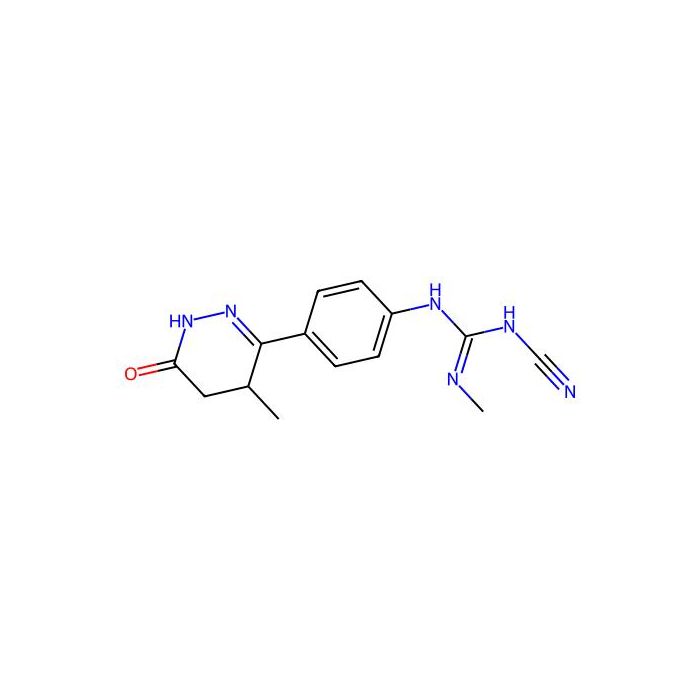
Siguazodan (SKF 94836) is a potent, selective and orally active phosphodiesterase III (PDE-III) inhibitor with an IC 50 of 117 nM. Siguazodan increases cAMP accumulation in intact platelets with an EC 50 of 18.88 μM. Siguazodan also inhibits phenylephrine-induced 5-HT release with an IC 50 value of 4.2 μM.
Specifications
Spécifications et pureté
Moligand™, 10 mM in DMSO
Conditions de stockage de stockage
Store at -80°C
Expédié en
Dry ice packs + Cold packs
Ce produit nécessite l'expédition en chaîne froide. Les services terrestres et autres services économiques ne sont pas disponibles.
Grade
Moligand™
Noms et identifiants
Isomères SMILES
CC1CC(=O)NN=C1C2=CC=C(C=C2)NC(=NC)NC#N
PubChem CID
72124
Poids moléculaire
284.32
Documentation
📋 Safety Data Sheet (SDS)
Comprehensive hazard, handling, storage, and regulatory compliance document.
Certificats (CoA, COO, BSE/TSE et tableau d'analyse)
C of A & Other Certificates(BSE/TSE, COO):
Analytical Chart:
Calculateurs de solution
Molarity Calculator
Determine the necessary mass, volume, or concentration for preparing a solution.
Dilution Calculator
Determine the dilution needed to prepare a stock solution.
Reconstitution Calculator
Avis
Avis des clients
Application Protocols
No product-specific, validated application protocols are provided in the Product Data. The following are general, literature-style workflows for PDE inhibitor deployment; adapt to your system and validate locally.
Stock preparation
Weigh an appropriate amount of Siguazodan quickly to minimize air exposure. Prepare a 10–50 mM stock in anhydrous DMSO. Vortex/sonicate until fully dissolved. Aliquot into low-bind tubes; store at –80°C (see Storage section). Avoid repeated freeze–thaw.
PDE3 enzymatic assay (general)
Buffer: 50 mM HEPES, pH 7.4; Mg2+ as required by the enzyme; add 0.01% Brij-35 to reduce nonspecific binding if compatible.
Substrate: cAMP at a concentration within the linear range of your enzyme preparation.
Dosing: Serially dilute stock in DMSO and add to assay to achieve constant final DMSO (e.g., 0.1–0.5%).
Readout: HPLC quantification of product, radiometric filtration, fluorescence polarization, or coupled luminescent assays. Include time-zero and no-enzyme controls.
Cell-based modulation (general)
Treat cells with compound dilutions spanning anticipated potency. Maintain constant vehicle. After incubation (e.g., 15–60 min), quantify cAMP or PKA substrate phosphorylation.
These are illustrative only; consult your SOPs and validate with appropriate controls.
Biological Roles
Literature context (for research use only)
Siguazodan is described as a selective inhibitor of phosphodiesterase type 3 (PDE3), an enzyme family (PDE3A/3B) responsible for hydrolyzing cyclic adenosine monophosphate (cAMP) and cyclic guanosine monophosphate (cGMP). Inhibition elevates intracellular cAMP levels, modulating protein kinase A (PKA) signaling cascades.
PDE3 isoforms are implicated in regulation of cardiac myocyte contractility, vascular smooth muscle tone, adipocyte lipolysis, and platelet function in experimental models. Siguazodan is often used to dissect PDE3-specific contributions relative to other PDE families (e.g., PDE4 for cAMP, PDE5 for cGMP) in cells or tissues.
In enzymology, it serves as a reference tool to benchmark PDE3 activity, aiding kinetic analyses, isoform selectivity profiling, and structure–activity relationship (SAR) studies when combined with other PDE inhibitors.
In systems biology, transient modulation with Siguazodan can help map feedback between cAMP production (adenylyl cyclase) and degradation (PDEs), assisting in quantifying signal amplification and desensitization dynamics.
Important notes
Actual potency, selectivity, and off-target profiles can vary with assay format, species isoform, substrate concentration, and cell context. Users should determine these parameters empirically under their conditions or consult primary literature.
No clinical or therapeutic claims are made; this compound is provided strictly for laboratory research.
Buffer Applications
This item is a small-molecule research ligand rather than a buffering agent. It does not constitute a conventional buffer component and is not used to set or maintain pH.
Practical guidance
When deploying Siguazodan in biochemical assays (e.g., PDE enzymatic assays), prepare it as a concentrated stock (commonly in DMSO) and dilute into your chosen buffer system (e.g., HEPES, Tris, or MOPS) appropriate for enzyme stability and activity. Maintain constant organic co-solvent across wells and controls.
Verify compound stability and solubility in the selected buffer at the working temperature and time scale. If precipitation is observed, adjust ionic strength, add permissible co-solvent, or reduce final concentration.
For buffer recipes, choose systems aligned with the enzyme or cell model requirements; this compound itself is not a buffering reagent.
Green Alternatives
Because Siguazodan is primarily used as a research tool compound rather than a process solvent or reagent, “green alternatives” focus on greener handling and formulation strategies rather than replacing the active molecule.
Greener handling strategies (general)
Minimize DMSO: Validate the lowest functional DMSO percentage in your assay (often ≤0.1–0.5% v/v) to reduce solvent burden.
Prefer ethanol/water co-solvent systems when chemically and biologically compatible; verify stability and solubility.
Use miniaturized assays (384/1536-well) to reduce overall solvent consumption and waste.
Employ sealed plates and low-dead-volume tips/vials to limit evaporative losses and VOC exposure.
Comparison of common delivery solvents (general)
DMSO: Excellent solvency; higher environmental and health considerations; low volatility but persistence requires careful waste management.
Ethanol: Renewable feedstock, higher volatility; may allow partial substitution for DMSO in some assays.
PEG-400 or aqueous cyclodextrin: Non-volatile alternatives for solubilization; verify assay compatibility and background effects.
Waste reduction
Centralize compound solutions in mother plates and use acoustic or low-volume dispensing to reduce duplicate stocks and expired waste. Segregate halogenated vs non-halogenated organic waste per institutional green-chemistry policies.
Pharmaceutical Uses
Formulation/manufacturing context (non-clinical, research only)
Siguazodan is provided as a research tool compound (Moligand™) and is not intended for human or veterinary use. No pharmacopeial monograph is cited for this item.
In preclinical research workflows, it may be formulated into DMSO-based stocks for in vitro assays or exploratory ex vivo studies. For in vivo method development in laboratory animals (where permitted), co-solvent systems (e.g., PEG/aqueous, cyclodextrin complexes) are sometimes explored to achieve adequate exposure; such work requires local IACUC/ethics approvals and is beyond the scope of this listing.
Excipients typically considered for small-molecule research formulations include aqueous cosolvents (ethanol/propylene glycol), solubilizers (captisol, HP-β-CD), or surfactants (polysorbates) where compatible with endpoints. Stability-indicating methods (HPLC/LC–MS) are recommended to verify integrity.
Compliance note
No therapeutic claims are made. This product is for research use only and not for use in diagnostic procedures or as an active pharmaceutical ingredient.
Physical Properties
Item-specific physico-chemical data
Appearance: Not specified for this item; refer to CoA/Spec Sheet.
Molecular weight: Not specified for this item; refer to CoA/Spec Sheet.
Melting point, boiling point, density, refractive index: Not specified for this item; refer to CoA/Spec Sheet.
Solubility (water/organic), logP, pKa: Not specified for this item; refer to CoA/Spec Sheet.
General guidance for small-molecule inhibitors (literature/practice; not a specification)
Many PDE inhibitors are moderately lipophilic and are commonly handled as DMSO stock solutions (e.g., 10–50 mM) for biochemical or cellular assays. Actual solubility of Siguazodan must be verified experimentally or via the Spec Sheet.
Where aqueous use is required, co-solvent strategies (DMSO ≤1% v/v in the final assay) or use of solubilizing excipients (e.g., low levels of cyclodextrins or surfactants) are typical approaches in research settings.
Filterability can be improved by warming gently to ambient temperature and sonicating the DMSO stock prior to sterile filtration through 0.22 μm PTFE or PVDF, provided the compound is chemically stable under those conditions.
Important
Do not rely on generalized properties in lieu of the CoA/Spec Sheet. Conduct a small-scale solubility and stability assessment under intended assay conditions prior to scale-up.
Quality and Grades
Grade/Purity: Moligand™
What Moligand™ implies
Moligand™ items are curated for small-molecule and compound library applications, emphasizing suitability for screening, target validation, and ligand discovery. This typically prioritizes identity verification and practical usability for assay deployment over application-specific specifications (e.g., low-UV HPLC grade solvents).
Identity and documentation
For this item, specific analytical criteria (e.g., purity threshold, residual solvents, water content, counter-ions) are Not specified for this item; refer to CoA/Spec Sheet. The CoA will provide the definitive release tests (chromatographic purity, structure confirmation by NMR/MS, etc.).
Impurities and stabilizers
No stabilizer or additive is specified for this listing. If your assay is sensitive to trace impurities, request the latest CoA/Spec Sheet and consider in-house QC (LC–MS, qNMR) prior to HTS or SAR studies.
Fit-for-purpose guidance
For biochemical assays, ensure that any residual solvents or salts are compatible with your readout. For cell-based work, confirm endotoxin policy and bioburden if relevant to your application (not routinely provided for small-molecule libraries unless stated).
Reaction and Applications
This product is supplied as a research small molecule (Moligand™) and is not intended primarily as a synthetic building block. Consequently, traditional synthetic “reaction applications” (e.g., cross-couplings, condensations) are not typically applicable.
Research applications (literature context; not product-specific specifications)
Siguazodan is widely cited as a phosphodiesterase type 3 (PDE3) inhibitor used to probe cAMP signaling. In enzymology studies, it is employed to characterize PDE3A/3B activity and to contrast isoform selectivity against PDE1/2/4 families.
In cell biology, it serves as a tool compound for modulating intracellular cAMP levels to study downstream effectors such as PKA and associated phosphorylation events.
In platelet and cardiac research models, it has been used to differentiate PDE3-mediated regulation from other PDEs in functional readouts (aggregation, contractility), strictly in research contexts.
Practical tips
Prepare fresh DMSO stocks and avoid repeated freeze–thaw to maintain potency. Light and moisture sensitivity should be assessed per Spec Sheet.
Verify assay interference by running solvent and compound blanks (inner filter effects for fluorescence, absorbance overlap in spectrophotometric PDE assays). Include counter-screens with non-PDE targets to confirm selectivity in your system.
If your goal is synthetic transformation rather than target modulation, consider purchasing a dedicated building block variant with disclosed functional handles.
Reaction Conditions
Traditional synthetic reaction conditions are not typically applicable to this listing, which is provided as a research probe rather than a reagent or building block.
Assay deployment conditions (general, literature/practice; not a specification)
Enzymatic assays (PDE3): Commonly run at 25–37°C in HEPES or Tris buffers with defined divalent cations and substrate (cAMP) concentrations. Include time-course linearity controls and verify that solvent (e.g., DMSO) is constant across all wells.
Cell-based assays: Dose–response evaluations often span nM–μM ranges depending on endpoint sensitivity; verify cytotoxicity and solvent tolerance. Measure cAMP levels, PKA activity, or downstream phosphorylation as functional readouts.
Stability: Assess compound stability over the assay timeframe (e.g., 1–4 h) via LC–MS to rule out degradation or adsorption losses.
Controls and counter-screens
Include vehicle controls, positive controls (alternative PDE3 inhibitor), and PDE-nonselective or orthogonal inhibitors to benchmark specificity. Run parallel assays against other PDE isoforms if selectivity is a key question.
Note: These are general literature-based practices; consult the item’s CoA/Spec Sheet and your institutional SOPs for definitive conditions.
Safety and Handling
GHS/SDS
Signal word, hazard statements, pictograms, and classification: Not specified for this item; refer to SDS.
General laboratory precautions (good practice; not a substitute for SDS)
Handle in a fume hood and avoid inhalation, ingestion, and skin/eye contact. Wear appropriate PPE: lab coat, nitrile gloves, and safety glasses; upgrade to splash goggles/face protection if splashing/aerosols are possible.
Prevent dust or aerosol formation during weighing and reconstitution. Use calibrated micro-pipettes for DMSO stock preparation to minimize spills.
Incompatibilities: Absent item-specific data, avoid strong oxidizers and strong acids/bases during storage and handling. Use dry, oxygen-limited conditions if the compound is moisture- or air-sensitive (verify via Spec Sheet).
First aid (overview; follow institutional SOPs)
Skin/eye contact: Rinse with water for at least 15 minutes; remove contaminated clothing; seek medical attention as needed.
Inhalation: Move to fresh air; monitor; obtain medical attention if symptoms persist.
Ingestion: Rinse mouth; do not induce vomiting; seek medical attention.
Waste and spills
Collect organic-contaminated waste in appropriate containers per local regulations. Absorb small spills with inert material (vermiculite), then clean with suitable solvent under fume hood. Always defer to the SDS for authoritative guidance.
Research use
For research use only.
Solvent Selection
Item-specific solubility is Not specified for this item; refer to CoA/Spec Sheet. The following guidance reflects general best practice for small-molecule screening compounds and should be verified experimentally.
Primary stock solvent: DMSO is typically preferred due to broad solvency and assay compatibility at ≤0.1–1% v/v in final wells.
Alternative solvents (if compatible): DMF, methanol, ethanol. Confirm chemical stability and assay interference (e.g., autofluorescence, enzyme inhibition by solvent) before use.
Aqueous delivery: Use co-solvents or solubilizers (e.g., 10–20% aqueous DMSO, optional inclusion of captisol/cyclodextrin at low mM) followed by dilution into assay buffers to keep final organic content minimal.
Material compatibility: Prefer glass or high-quality polypropylene for concentrated stocks to mitigate adsorption. PTFE- or PVDF-based membranes are generally compatible for sterilization of organic solutions.
Comparison notes (general)
DMSO: highest solvency; potential to affect membrane integrity or enzyme kinetics at high %.
Ethanol: lower solvency; higher volatility; often acceptable up to 0.5–1% in biochemical assays.
DMF: good solvency but higher toxicity concerns; use sparingly and with enhanced ventilation.
Recommendation
Start with a 10 mM DMSO master stock. Perform a serial dilution solubility check (visual and LC–MS) in your actual assay buffer to establish maximum tolerated concentration without precipitation.
Storage and Reconstitution
Storage conditions (from Product Data): Store at -80°C.
Reconstitution and handling (general guidance; verify with Spec Sheet)
Upon receipt, keep the container closed and cold. Allow to equilibrate to –20°C or 4°C briefly before opening to minimize moisture condensation.
For solution stocks: Use anhydrous, oxygen-free DMSO where possible. Prepare single-use aliquots (e.g., 10–100 μL) to avoid repeated freeze–thaw cycles. Store aliquots at –80°C in sealed, inert-atmosphere vials if feasible.
Thawing: Thaw on ice or at ambient temperature just prior to use. Mix thoroughly and inspect for precipitation or discoloration. Discard if evidence of degradation is observed.
Stability/shelf life: Not specified for this item; refer to CoA/Spec Sheet. Conduct periodic QC (e.g., LC–MS or analytical HPLC) for long-term studies.
Container and compatibility
Use amber or foil-wrapped containers if the compound is light sensitive (check Spec Sheet). Employ low-bind polypropylene or glass vials to reduce adsorption losses.
Research use note
For research use only. Not for human or veterinary use.
Structure and Identity
Product name: Siguazodan (SKU: S1498828)
CAS: 115344-47-3
CID: 72124
InChIKey: Not specified for this item; refer to CoA/Spec Sheet.
SMILES: Not specified for this item; refer to CoA/Spec Sheet.
Molecular formula: Not specified for this item; refer to CoA/Spec Sheet.
Molecular weight: Not specified for this item; refer to CoA/Spec Sheet.
Structural description (general, literature):
Siguazodan is reported in the literature as a small-molecule phosphodiesterase (PDE) inhibitor, commonly associated with selectivity toward PDE3 isoforms. Public domain sources describe it as a heteroatom-containing, aromatic small molecule designed to occupy the PDE catalytic pocket and interfere with cAMP hydrolysis. Exact atom connectivity, stereochemistry, and ring fusion patterns should be confirmed against the CoA/Spec Sheet for this specific item.
Notes
This Moligand™ listing is intended for research screening and ligand discovery workflows. If precise identifiers (SMILES/InChI) are required for registration or modeling, please request the item’s CoA/Spec Sheet for authoritative information.
Synthetic Utility
Siguazodan is supplied as a finished small-molecule research ligand rather than a functionalized intermediate. As such, it is not typically used as a building block in multistep organic synthesis.
Context and options
If your objective is to generate analogs for SAR, consider obtaining the disclosed structure (SMILES/InChI) from the CoA/Spec Sheet, then plan de novo synthesis or late-stage diversification using literature routes. Many PDE inhibitors incorporate heteroaromatic cores amenable to cross-coupling, nucleophilic aromatic substitution, or amide coupling strategies; specific applicability depends on the exact scaffold and substitution pattern.
For bioconjugation or immobilization, it is often preferable to start from a derivatizable analog that bears a handle (e.g., amine, carboxyl, alkyne, azide) distant from the pharmacophore to preserve activity. Such analogs are not specified for this item; inquire about custom sourcing.
Bottom line
Treat this product as a probe compound for target modulation. For synthetic campaigns, request structural details from the Spec Sheet and consult primary literature for scaffold-specific transformations.
Target Specificity
Item-specific target validation data are not provided in the Product Data.
Literature context (for research use only)
Siguazodan is widely referenced as a selective inhibitor of phosphodiesterase type 3 (PDE3), with activity reported against PDE3A and PDE3B isoforms. Selectivity relative to other PDE families (e.g., PDE1/2/4/5) is context-dependent and should be verified under your assay conditions.
Potential off-targets or ancillary activities can vary by concentration, assay design, and species isoforms. Users should perform orthogonal target engagement assays (e.g., thermal shift/DSF, CETSA, or binding displacement where available) to substantiate specificity in their system.
For definitive, product-specific specificity data (e.g., IC50, Ki, selectivity panels), please consult the CoA/Spec Sheet or primary literature.
Foire aux questions
What is Moligand??
Moligand? is one of Aladdin Scientific's premium product lines, formulated for high-purity applications across multiple workflows. Compared to standard grades in the same workflow, Moligand? products typically offer tighter specifications, more rigorous QC, and stronger lot-to-lot consistency.
How should this product be stored?
Store at ?80 °C. Ultra-low temperature storage is required to maintain the specified shelf life.
How is this product shipped?
This product ships frozen with dry ice and cold packs. Unpack on arrival and transfer it to the storage condition stated above; handle dry ice with insulated gloves in a ventilated area.
What are the CAS number, molecular formula and molecular weight?
The CAS Number is 115344-47-3, the molecular formula is C??H??N?O, and the molecular weight is 284.32 g/mol.
What documentation is provided?
Available product documentation, including Certificates of Analysis (COA), Safety Data Sheets (SDS), and specification sheets, is shown in the product document area. Document availability and access follow the current site policy.
Need help choosing the grade?
Our grade selection guide covers purity, stabilizer status, and application suitability for all variants in our catalog.
Nous utilisons des cookies pour garantir le bon fonctionnement du site et, lorsque cela est autorisé, pour améliorer votre expérience. Vous pouvez gérer vos préférences à tout moment dans les Paramètres. Pour en savoir plus, consultez notre Politique relative aux cookies.
Souhaitez-vous que nous vous envoyions un message lorsque des réductions seront disponibles?
Me rappeler plus tard
Merci ! Veuillez vérifier votre boîte de réception e-mail pour confirmer.
Products are supplied to verified businesses, institutions, and qualified professionals for research and development use only. Not for use in humans, animals, diagnosis, or therapy.