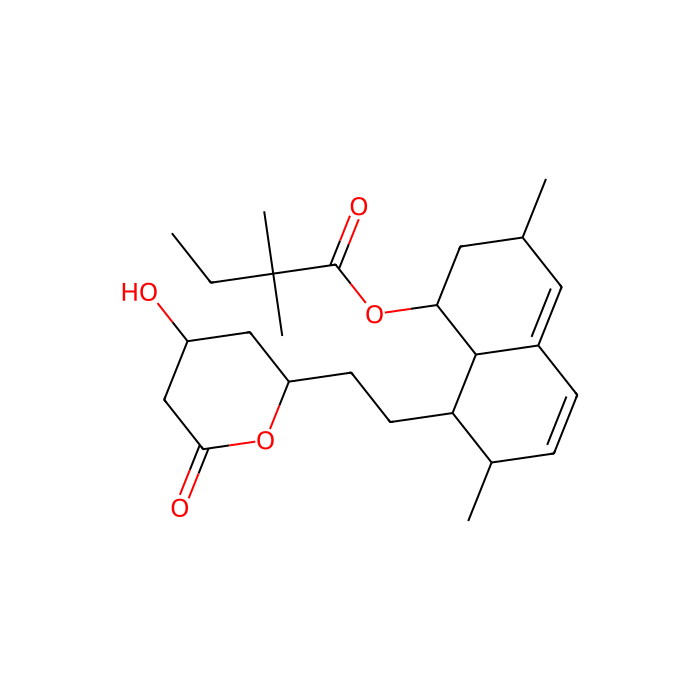
Determine the necessary mass, volume, or concentration for preparing a solution.
| Activity Type | Activity Value -log(M) | Mechanism of Action | Activity Reference | Publications (PubMed IDs) |
|---|

Moligand™, 10mM in DMSO Moligand™ for sensitive chromatographic and analytical workflows requiring minimal baseline interference.
Store at -80°C Ships Dry ice packs + Cold packs Check lot-specific COA for exact specifications.
SDS, COA, datasheet, and spec sheet available for download. Lot-specific COA accessible via lot number lookup.
Cited in 36 peer-reviewed publications across chromatography, organic synthesis, and cross-coupling reactions.
Information
Simvastatin (MK 733) Simvastatin (MK-0733, MK 733) is a competitive inhibitor of HMG-CoA reductase with K i of 0.1-0.2 nM in cell-free assays. Simvastatin induces ferroptosis , mitophagy , autophagy and apoptosis .
In vitro
Prior to use in cell assays, Simvastatin needs to be activated by NaOH in EtOH treatment. Simvastatin inhibits cholesterol synthesis in mouse L-M cell (fibroblast), rat H4II E cell (liver), and human Hep G2 cell (liver) with IC50 of 19.3 nM, 13.3 nM and 15.6 nM, respectively. Simvastatin treatment leads to a dose-dependent increase in serine 473 phosphorylation of Akt within 30 minutes, with maximal phosphorylation occurring at 1.0 µM. Simvastatin (1.0 μM) enhances phosphorylation of the endogenous Akt substrate endothelial nitric oxide synthase (eNOS), inhibits serum-free media undergo apoptosis and accelerates vascular structure formation. Simvastatin displays anti-inflammatory effects in vitro. Simvastatin (10 μM) reduces anti-CD3/anti-CD28 antibody-stimulated proliferation of PB-derived mononuclear cells and synovial fluid cells from rheumatoid arthritis blood, as well as IFN-γ release. Simvastatin (10 μM) suppresses cell-mediated macrophage TNF-γ release induced via cognate interactions by ~30%.
In vivo
Simvastatin orally administration inhibits the conversion of radiolabeled acetate to cholesterol with IC50 of 0.2 mg/kg. Simvastatin (4 mg/day) orally administration for 13 weeks to rabbits fed an atherogenci cholesterol-rich diet, returns the cholesterol-induced increases in total cholesterol, LDL-cholesterol and HDL-cholesterol to normal level. Simvastatin (6 mg/kg) produces an increase in LDL receptor-dependent binding and increases the number of hepatic LDL receptors in rabbits fed a diet containing 0.25% cholesterol. Simvastatin influences inflammation independent of its effect on plasma cholesterol level. In cynomolgus monkeys consumed an atherogenic diet, Simvastatin (20 mg/kg/day) induces a 1.3-fold less macrophage content in lesions, and 2-fold less vascular cell adhesion molecule-1, interleukin-1beta, and tissue factor expression, companied by a 2.1-fold increases in lesional smooth muscle cell and collagen content.
Cell Data
cell lines:
Concentrations:
Incubation Time:
Powder Purity:≥95%
Comprehensive hazard, handling, storage, and regulatory compliance document.
Download SDS →Lot-specific quality data. Enter your lot number to retrieve the exact COA.
Look up COA →Full quality attributes and acceptance criteria for this grade.
View spec sheet →| Activity Type | Activity Value -log(M) | Mechanism of Action | Activity Reference | Publications (PubMed IDs) |
|---|
Find and download the COA for your product by matching the lot number on the packaging.
| Lot Number | Certificate Type | Date | Article |
|---|---|---|---|
 L2230026 | Certificate of Analysis | Sep 09, 2026 | S407772 |
| Solubilité | Solubility (25°C) In vitro |
|---|---|
| Rotation spécifique [α] | 293° (C=1,CH3CN) |
| Point de fusion (°C) | 134°C |
Our grade selection guide covers purity, stabilizer status, and application suitability for all variants in our catalog.
View Moligand™ grade guide →