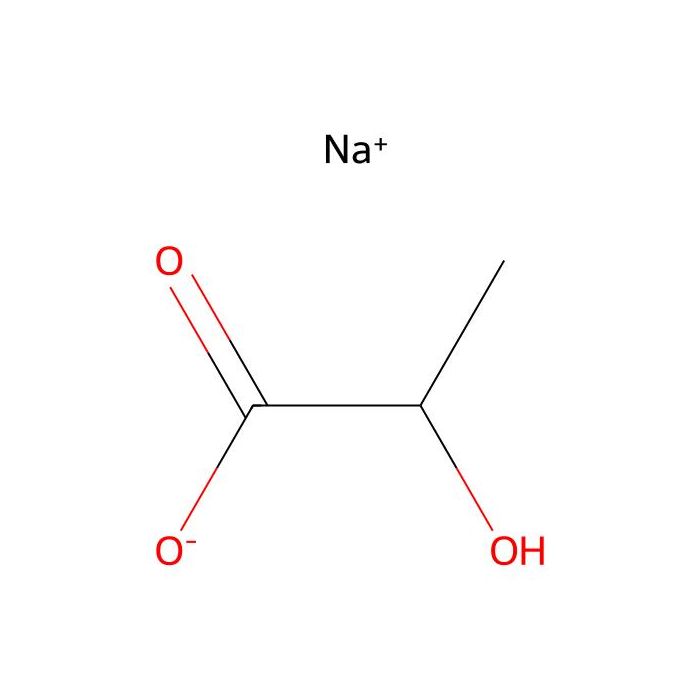
Sodium DL-lactate solution - BioReagent, synthetic, syrup, suitable for mouse embryo cell culture, 60 % (w/w) , CAS No.72-17-3

CAS: 72-17-3 Cat. No.: S755695 Formule: C3H5NaO3 Poids moléculaire: 112.06 Beilstein Registry Number: 4332999 Numéro CE: 200-772-0 PubChem CID: 23666456
DISPONIBLE À COMMANDE
QUALITÉ & PURETÉ BioReagent ? BioReagent grade — tested suitable for life-science and molecular-biology use. Use for cell culture, assays, and biochemical work needing biological compatibility. synthetic, syrup, suitable for mouse embryo cell culture, 60 % (w/w)
Storage
Store at 2-8°C
Shipped In
Wet ice
★
Taille
Allemagne (EU)
USA*
Prix
Qté
100ml
S755695-100ml
Sur commande · 8–12 semaines
84,08€
500ml
S755695-500ml
Sur commande · 8–12 semaines
260,23€
Enter a quantity for the sizes you want to add.

Vue d’ensemble

Lactic acid is an α hydroxyl carboxylic acid produced from pyruvate by the enzyme lactate dehydrogenase (LDH). This mixed isomer lactate has been qualified for use in mouse embryo culture. Lactate regulates pyruvate uptake and metabolism in the preimplantation mouse embryo.

Spécifications

Spécifications et pureté
BioReagent, synthetic, syrup, suitable for mouse embryo cell culture, 60 % (w/w)
Conditions de stockage de stockage
Store at 2-8°C
Expédié en
Wet ice
Ce produit nécessite l'expédition en chaîne froide. Les services terrestres et autres services économiques ne sont pas disponibles.
Grade
BioReagent
Noms et identifiants
SMILES
CC(C(=O)[O-])O.[Na+]
IUPAC Name
sodium;2-hydroxypropanoate
InChIKey
NGSFWBMYFKHRBD-UHFFFAOYSA-M
InChI
1S/C3H6O3.Na/c1-2(4)3(5)6;/h2,4H,1H3,(H,5,6);/q;+1/p-1
Isomères SMILES
CC(C(=O)[O-])O.[Na+]
WGK Allemagne
2
PubChem CID
23666456
Poids moléculaire
112.06
Beilstein
4332999

Données avancées

Taxonomic Classification

Taxonomy Tree

KingdomOrganic compounds
SuperclassOrganic acids and derivatives
ClasseCarboxylic acids and derivatives
SubclassCarboxylic acid derivatives
Intermediate Tree Nodes Not available
Direct ParentCarboxylic acid salts
Alternative Parents Secondary alcohols  Monocarboxylic acids and derivatives  Carboxylic acids  Organic zwitterions  Organic sodium salts  Organic oxides  Hydrocarbon derivatives  Carbonyl compounds  
Molecular FrameworkAliphatic acyclic compounds
Substituents Secondary alcohol - Carboxylic acid salt - Organic alkali metal salt - Monocarboxylic acid or derivatives - Carboxylic acid - Organic oxygen compound - Organic oxide - Hydrocarbon derivative - Organic sodium salt - Organic salt - Organic zwitterion - Organooxygen compound - Carbonyl group - Alcohol - Aliphatic acyclic compound
DescriptionThis compound belongs to the class of organic compounds known as carboxylic acid salts. These are ionic derivatives of carboxylic acid.
External Descriptors organic sodium salt - lactate salt
Structure 3D
Modèle de structure chimique interactif


Certificats (CoA, COO, BSE/TSE et tableau d'analyse)
C of A & Other Certificates(BSE/TSE, COO):
Analytical Chart:

Find and download the COA for your product by matching the lot number on the packaging.

4 results found

Lot NumberCertificate TypeDateArticle
H2614084H2614084Certificate of AnalysisAug 25, 2025 S755695
I2519622I2519622Certificate of AnalysisAug 25, 2025 S755695
I2519623I2519623Certificate of AnalysisAug 25, 2025 S755695
I2519624I2519624Certificate of AnalysisAug 25, 2025 S755695
Propriétés chimiques et physiques
Indice de réfraction1.422-1.425
Poids moléculaire112.060 g/mol
XLogP3
Hydrogen Bond Donor Count1
Hydrogen Bond Acceptor Count3
Rotatable Bond Count1
Exact Mass112.014 Da
Monoisotopic Mass112.014 Da
Topological Polar Surface Area60.400 Ų
Heavy Atom Count7
Formal Charge0
Complexity63.200
Isotope Atom Count0
Defined Atom Stereocenter Count0
Undefined Atom Stereocenter Count1
Defined Bond Stereocenter Count0
Undefined Bond Stereocenter Count0
The total count of all stereochemical bonds0
Covalently-Bonded Unit Count2
FAQ et articles
Research Progress on the Moonlighting Functions of Carbohydrate-Metabolic Enzymes in Replication Programs, DNA Damage Repair, and Inflammatory Activation
From Structure to Rheology: How Carbomer Forms Gel Structures and Enables Thickening, Suspension, and Auxiliary Emulsion Stabilization
Why Do Alcohols Differ in Function: Why Is Glycerol Mainly Moisturizing, Propylene Glycol Mainly Solubilizing, and Isopropyl Alcohol Fast-Drying? — Understanding Personal Care Formulation Functions from Structural Differences
Performance Sources and Formulation Applications of Enzyme-Based Ingredients in Daily Chemical Products: Fermentation Transformation, Enzymatic Reactions, and Application Principles
β-Hydroxybutyrate Detection Methods and Metabolic Significance: Comparative Applications of Enzymatic Assays, Blood Ketone Meters, and LC-MS
Analysis of Hydrolyzed Pearl as a Cosmetic Raw Material: Preparation Process, Active Components, and Skincare Formulation Applications
Moisturizing Mechanism of Polyglutamic Acid: From the γ-Glutamyl Structure to Hydration Networks and Surface Film-Forming Behavior
Mechanisms by Which Fructan-Rich Ophiopogon japonicus Tuberous Root Extract Supports Skin Moisturization and Barrier Function
Stratum Corneum Penetration and Skin Mechanisms of Panthenol: Moisturization, Barrier Repair, and Soothing Effects
Citations of This Product
Calculateurs de solution
Avis

Avis des clients

Foire aux questions

How is this product shipped?
This product ships chilled on wet ice. Unpack on arrival and transfer it to the storage condition stated above.
How should this product be stored?
Store at 2–8 °C. Refrigerated storage is required to maintain the specified shelf life.

Besoin d'aide pour choisir la qualité ?

Notre guide de sélection des qualités couvre la pureté, le statut du stabilisant et l'adéquation à l'application pour toutes les variantes de notre catalogue.

Voir le guide des qualités BioReagent →

Souhaitez-vous que nous vous envoyions un message lorsque des réductions seront disponibles?

Me rappeler plus tard

Merci ! Veuillez vérifier votre boîte de réception e-mail pour confirmer.

Oups ! Les notifications sont désactivées.