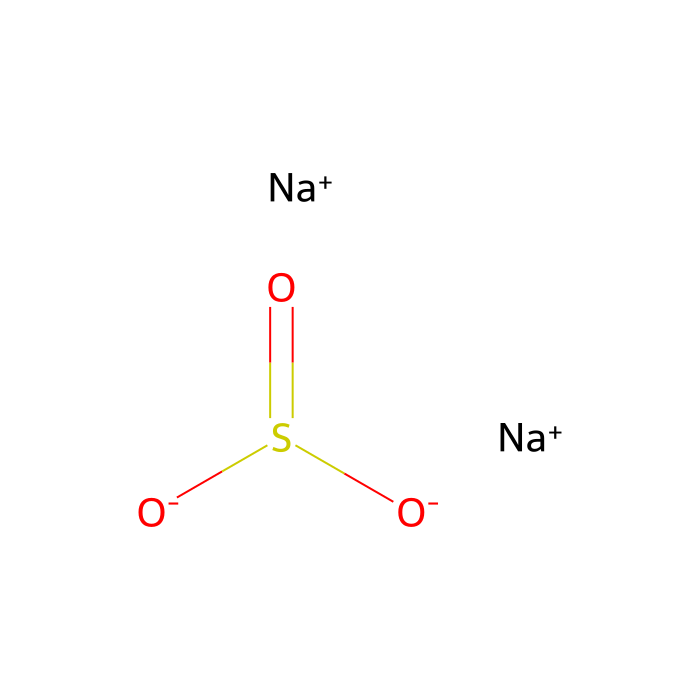
Sodium sulfite - ≥97% , CAS No.7757-83-7

CAS: 7757-83-7 Cat. No.: S572396 Formule: Na2SO3 Poids moléculaire: 126.04 Numéro CE: 231-821-4 PubChem CID: 24437
DISPONIBLE À COMMANDE
GRADE & PURITY ≥97%
Synonyms
SODIUM SULFITE|7757-83-7|Sodium sulphite|Disodium sulfite|Sodium sulfite anhydrous|Sulfurous acid, disodium salt|Natrium sulfurosum|Sulftech|Natriumsulfid|Natriumsulfit|S-WAT|Natrii sulphis|Anhydrous sodium sulfite|Sodium sulfite (Na2SO3)|Exsiccated sodiu
Storage
Room temperature,Argon charged
Shipped In
Normal
★
Size
Allemagne (EU)
USA*
Price
Qty
500g
S572396-500g
1 En stock
1 En stock

12,93€

18,14€
Enregistrer 5,21 € (28.71%)
20×500g
S572396-20×500g
Sur commande · 8–12 semaines

173,46€

327,05€
Enregistrer 153,59 € (46.96%)
Enter a quantity for the sizes you want to add.
🧪
Why this grade

≥97% for sensitive chromatographic and analytical workflows requiring minimal baseline interference.

🌡

Storage & shipping

Room temperature,Argon charged Ships Normal Check lot-specific COA for exact specifications.

📋

Quality documents

SDS, COA, datasheet, and spec sheet available for download. Lot-specific COA accessible via lot number lookup.

📚

Literature proof

Cited in 474 peer-reviewed publications across chromatography, organic synthesis, and cross-coupling reactions.

Vue d’ensemble

Sodium sulfite is a water-soluble inorganic salt commonly used as a reducing agent. It is also employed in sulfonation and sulfomethylation reactions. Furthermore, it serves as a bleaching agent, desulfurizing agent, and dechlorinating agent in the textile industry. In water treatment processes, Na₂SO₃ is used to scavenge oxygen and free chlorine. Sodium sulfite facilitates the purification and separation of aldehydes and ketones by forming adducts with them. Other applications include the production of sodium thiosulfate, detergents, and dyes.
Applications
Sodium sulfite can be used:
As a reducing agent for the hydroxylation of arylboronic acids and arylboronic esters into their corresponding phenols.
In the conversion of α-amino alcohol mesylate hydrochloride salts into sodium α-aminosulfonates.
As an SO₂ precursor for the multicomponent synthesis of DABCO(SO₂)₂, abbreviated as DABSO.

Specifications

Synonymes
SODIUM SULFITE | 7757-83-7 | Sodium sulphite | Disodium sulfite | Sodium sulfite anhydrous | Sulfurous acid, disodium salt | Natrium sulfurosum | Sulftech | Natriumsulfid | Natriumsulfit | S-WAT | Natrii sulphis | Anhydrous sodium sulfite | Sodium sulfite (Na2SO3) | Exsiccated sodiu
Spécifications et pureté
≥97%
Conditions de stockage de stockage
Room temperature,Argon charged
Expédié en
Normal
Pureté
≥97%
Noms et identifiants
Pubchem Sid
Pubchem Sid Url
https://pubchem.ncbi.nlm.nih.gov/substance/528771981
Sourires canoniques
[O-]S(=O)[O-].[Na+].[Na+]
IUPAC Name
disodium;sulfite
InChIKey
GEHJYWRUCIMESM-UHFFFAOYSA-L
INCHI
1S/2Na.H2O3S/c;;1-4(2)3/h;;(H2,1,2,3)/q2*+1;/p-2
Isomères SMILES
[O-]S(=O)[O-].[Na+].[Na+]
WGK Allemagne
1
RTECS
WE2150000
PubChem CID
24437
Poids moléculaire
126.04

Documentation

📋 Safety Data Sheet (SDS)

Comprehensive hazard, handling, storage, and regulatory compliance document.

Download SDS →

✅ Certificate of Analysis (COA)

Lot-specific quality data. Enter your lot number to retrieve the exact COA.

Look up COA →

📊 Datasheet

Quick-reference summary of product specifications and applications.

View datasheet →

🔬 Specification Sheet

Full quality attributes and acceptance criteria for this grade.

View spec sheet →

Advanced Data

Taxonomic Classification

Taxonomy Tree

KingdomInorganic compounds
SuperclassMixed metal/non-metal compounds
ClasseAlkali metal oxoanionic compounds
SubclassAlkali metal sulfites
Intermediate Tree Nodes Not available
Direct ParentAlkali metal sulfites
Alternative Parents Inorganic sodium salts  Inorganic oxides  
Molecular FrameworkNot available
Substituents Alkali metal sulfite - Inorganic sodium salt - Inorganic oxide - Inorganic salt
DescriptionThis compound belongs to the class of inorganic compounds known as alkali metal sulfites. These are inorganic compounds in which the largest oxoanion is sulfite, and in which the heaviest atom not in an oxoanion is an alkali metal.
External Descriptors inorganic sodium salt - sulfite salt
Structure 3D
Modèle de structure chimique interactif


Mécanismes d'action
Certificats (CoA, COO, BSE/TSE et tableau d'analyse)
C of A & Other Certificates(BSE/TSE, COO):
Analytical Chart:

Find and download the COA for your product by matching the lot number on the packaging.

3 results found

Lot NumberCertificate TypeDateArticle
H2504507Certificate of AnalysisAug 21, 2024 S572396
C2327278Certificate of AnalysisMar 29, 2023 S572396
C2327279Certificate of AnalysisMar 29, 2023 S572396
Propriétés chimiques et physiques
SensibilitéSensitive to air and humidity
Point de fusion (°C)500°C
Poids moléculaire126.050 g/mol
XLogP3
Hydrogen Bond Donor Count0
Hydrogen Bond Acceptor Count4
Rotatable Bond Count0
Exact Mass125.936 Da
Monoisotopic Mass125.936 Da
Topological Polar Surface Area82.400 Ų
Heavy Atom Count6
Formal Charge0
Complexity18.800
Isotope Atom Count0
Defined Atom Stereocenter Count0
Undefined Atom Stereocenter Count0
Defined Bond Stereocenter Count0
Undefined Bond Stereocenter Count0
The total count of all stereochemical bonds0
Covalently-Bonded Unit Count3
FAQ et articles
Iron (low valent)
Environmental conditions for storing laboratory chemicals
Tyrosinase: a key regulatory enzyme in melanin synthesis and its biological and applied significance
TEMPO-Catalyzed Oxidation Quick Reference (Alcohol Oxidation Focus): Three Regeneration Routes (NaOCl / Cu–O₂ / PIDA) + Selection & Troubleshooting
Selection of Common Research Salts: A Task Map for Alkali Metal Salts & Alkaline Earth Metal Salts (with Product Tables 1–6)
Recent Advances in Methods for Measuring Starch-Related Indices in Plants and Their Application-Oriented Selection
Chlorophyll: Structural Features, Physicochemical Properties, and Key Points for Research and Industrial Applications
Enzyme Labels in Immunoassays, Signal Amplification, and Multi-Enzyme Detection Platforms: A Functional Overview
Coupling Mechanisms Between Terminal Reducing-Power Allocation in Photosynthetic Electron Transport and Metabolic Demand
Types of Inorganic Salts That Can Undergo Reduction Reactions: Nitrates, Sulfur-Containing Salts, Halogen Oxyanion Salts, and Metal Salts
One-Pot Deaminative Cyanation of Arylamines Mediated by Nitrate Reduction: The ORT Pathway and Kinetic Matching of Tandem Reaction Steps
Citations of This Product
Calculateurs de solution
Avis

Avis des clients

Shall we send you a message when we have discounts available?

Remind me later

Thank you! Please check your email inbox to confirm.

Oops! Notifications are disabled.