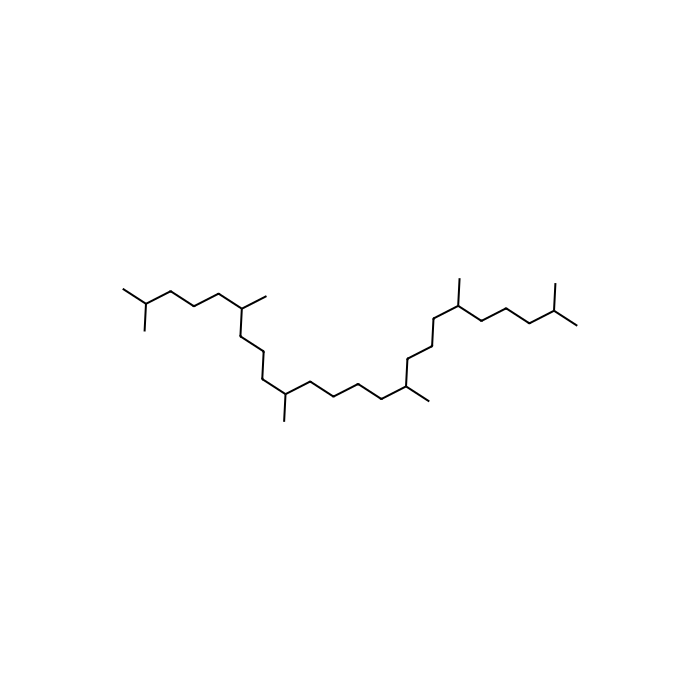
Squalane - ≥98%, used for 角鲨烷已被用于:作为溶剂合成二苯甲酰甲基三乙铵铕(目前已知最亮的摩擦发光材料);作为润滑剂用于吸附在氧化铁表面的脂肪酸表面活性剂膜。 various applications , CAS No.111-01-3

CAS: 111-01-3 Cat. No.: S141335 Formule: C30H62 Poids moléculaire: 422.81 Beilstein Registry Number: 776019 Numéro CE: 203-825-6
DISPONIBLE À COMMANDE
QUALITÉ & PURETÉ ≥98%
Synonyms
SQUALANE [II]|squalane-d62|SQUALANE [MART.]|Dodecahydrosqualene|SQUALANE [USP-RS]|Squalane; 2,6,10,15,19,23-Hexamethyltetracosane; perhydrosqualene|SQUALANE [WHO-DD]|Dodecahydrosqualene; Hexamethyltetracosane; Squalane; Tetracosane, 2,6,10,15,19,23-hexamethyl-, (all-E)-|Spinacane|Squalane (NF)|Hexamethyltetracosane|SQUALANE|Squalane N|Tetracosane,6,10,15,19,23-hexamethyl-|Hexamethyl tetracosane|SQUALANE [EP MONOGRAPH]|Robane|SQUALANE [EP IMPURITY]|Pripure 3759|Squalane [NF]|Cosbiol|Tetracosane, 2,6,10,15,19,23-hexamethyl-|2,10,15,19,23-Hexamethyltetracosane|Perhydrosqualene|Squalan|2,6,10,15,19,23-Hexamethyltetracosane|DH7|SQUALANE [INCI]|SQUALANE [VANDF]
Storage
A conserver entre 2 et 8°C
Shipped In
Glace humide
★
Taille
Allemagne (EU)
USA*
Prix
Qté
5ml
S141335-5ml
—
3 En stock
8,59€
25ml
S141335-25ml
—
1 En stock
17,27€
100ml
S141335-100ml
Sur commande · 8–12 semaines
38,96€
500ml
S141335-500ml
Sur commande · 8–12 semaines
208,17€
Enter a quantity for the sizes you want to add.

Vue d’ensemble

Les squalènes microfluidisés sont des adjuvants efficaces qui provoquent des réponses immunitaires à la fois humorales et cellulaires.
Le squalane a été utilisé : comme solvant dans la synthèse de l'Europium dibenzoylmethide triethylammonium, le matériau triboluminescent (TL) le plus brillant connu ; comme lubrifiant pour les films de tensioactifs d'acides gras adsorbés sur des surfaces d'oxyde de fer ; comme lubrifiant pour les films de tensioactifs d'acides gras adsorbés sur des surfaces d'oxyde de fer

Spécifications

Synonymes
SQUALANE [II] | squalane-d62 | SQUALANE [MART.] | Dodecahydrosqualene | SQUALANE [USP-RS] | Squalane; 2,6,10,15,19,23-Hexamethyltetracosane; perhydrosqualene | SQUALANE [WHO-DD] | Dodecahydrosqualene; Hexamethyltetracosane; Squalane; Tetracosane, 2,6,10,15,19,23-hexamethyl-, (all-E)- | Spinacane | Squalane (NF) | Hexamethyltetracosane | S Afficher plus
Spécifications et pureté
≥98%
Application
角鲨烷已被用于:作为溶剂合成二苯甲酰甲基三乙铵铕(目前已知最亮的摩擦发光材料);作为润滑剂用于吸附在氧化铁表面的脂肪酸表面活性剂膜。
Conditions de stockage de stockage
A conserver entre 2 et 8°C
Expédié en
Glace humide
Pureté
≥98%
Noms et identifiants
Pubchem Sid
Pubchem Sid Url
https://pubchem.ncbi.nlm.nih.gov/substance/504751572
SMILES
CC(C)CCCC(C)CCCC(C)CCCCC(C)CCCC(C)CCCC(C)C
IUPAC Name
2,6,10,15,19,23-hexamethyltetracosane
InChIKey
PRAKJMSDJKAYCZ-UHFFFAOYSA-N
InChI
1S/C30H62/c1-25(2)15-11-19-29(7)23-13-21-27(5)17-9-10-18-28(6)22-14-24-30(8)20-12-16-26(3)4/h25-30H,9-24H2,1-8H3
Isomères SMILES
CC(C)CCCC(C)CCCC(C)CCCCC(C)CCCC(C)CCCC(C)C
WGK Allemagne
3
RTECS
XB6070000
CAS alternatif
111-01-4
Poids moléculaire
422.81
Beilstein
776019
Reaxys
776019

Données avancées

Taxonomic Classification

Taxonomy Tree

KingdomOrganic compounds
SuperclassLipids and lipid-like molecules
ClassePrenol lipids
SubclassTriterpenoids
Intermediate Tree Nodes Not available
Direct ParentTriterpenoids
Alternative Parents Branched alkanes  
Molecular FrameworkAliphatic acyclic compounds
Substituents Triterpenoid - Branched alkane - Acyclic alkane - Saturated hydrocarbon - Alkane - Hydrocarbon - Aliphatic acyclic compound
DescriptionThis compound belongs to the class of organic compounds known as triterpenoids. These are terpene molecules containing six isoprene units.
External Descriptors Not available
Structure 3D
Modèle de structure chimique interactif


Mécanismes d'action
Certificats (CoA, COO, BSE/TSE et tableau d'analyse)
C of A & Other Certificates(BSE/TSE, COO):
Analytical Chart:

Find and download the COA for your product by matching the lot number on the packaging.

29 results found

Lot NumberCertificate TypeDateArticle
J2616098J2616098Certificate of AnalysisJul 22, 2026 S141335
G2613627G2613627Certificate of AnalysisJul 22, 2026 S141335
G2613626G2613626Certificate of AnalysisJul 22, 2026 S141335
G2613613G2613613Certificate of AnalysisJul 22, 2026 S141335
G2613612G2613612Certificate of AnalysisJul 22, 2026 S141335
I2518485I2518485Certificate of AnalysisSep 26, 2025 S141335
I2518482I2518482Certificate of AnalysisSep 26, 2025 S141335
I2518479I2518479Certificate of AnalysisSep 26, 2025 S141335
I2518473I2518473Certificate of AnalysisSep 26, 2025 S141335
F2504511F2504511Certificate of AnalysisJun 09, 2025 S141335
F2504512F2504512Certificate of AnalysisJun 09, 2025 S141335
F2504510F2504510Certificate of AnalysisJun 09, 2025 S141335
F2504509F2504509Certificate of AnalysisJun 09, 2025 S141335
B2511374B2511374Certificate of AnalysisFeb 21, 2025 S141335
I2418670I2418670Certificate of AnalysisSep 27, 2024 S141335
I2418662I2418662Certificate of AnalysisSep 27, 2024 S141335
I2418661I2418661Certificate of AnalysisSep 27, 2024 S141335
A2411789A2411789Certificate of AnalysisJan 23, 2024 S141335
A2411800A2411800Certificate of AnalysisJan 23, 2024 S141335
L2320458L2320458Certificate of AnalysisDec 25, 2023 S141335
L2320459L2320459Certificate of AnalysisDec 25, 2023 S141335
L2320468L2320468Certificate of AnalysisDec 25, 2023 S141335
I2127335I2127335Certificate of AnalysisMay 24, 2023 S141335
I2127334I2127334Certificate of AnalysisMay 24, 2023 S141335
I2127332I2127332Certificate of AnalysisMay 24, 2023 S141335
B23111167B23111167Certificate of AnalysisFeb 22, 2023 S141335
B23111166B23111166Certificate of AnalysisFeb 22, 2023 S141335
B23111165B23111165Certificate of AnalysisFeb 22, 2023 S141335
A2330458A2330458Certificate of AnalysisFeb 03, 2023 S141335
Propriétés chimiques et physiques
SolubilitéNot miscible or difficult to mix in water. Chloroform, Hexanes (Slightly). Soluble in ether, chloroform, benzene, slightly soluble in ethanol, acetone, methanol, insoluble in water
Indice de réfraction1.45-1.452
Point d'éclair (°F)424.4 °F
Point d'éclair (°C)218 °C
Point d'ébullition (°C)350 °C
Point de fusion (°C)-38 °C
Poids moléculaire422.8
XLogP314.700
Hydrogen Bond Donor Count0
Hydrogen Bond Acceptor Count0
Rotatable Bond Count21
Exact Mass422.485 Da
Monoisotopic Mass422.485 Da
Topological Polar Surface Area0.000 Ų
Heavy Atom Count30
Formal Charge0
Complexity308.000
Isotope Atom Count0
Defined Atom Stereocenter Count0
Undefined Atom Stereocenter Count4
Defined Bond Stereocenter Count0
Undefined Bond Stereocenter Count0
The total count of all stereochemical bonds0
Covalently-Bonded Unit Count1
Sécurité et dangers (GHS)
Pictogramme(s)
Signal
Warning
Mentions de danger

H315:Causes skin irritation

H319:Causes serious eye irritation

H335:May cause respiratory irritation

H413:May cause long lasting harmful effects to aquatic life

Conseils de prudence

P261:Avoid breathing dust/fume/gas/mist/vapors/spray.

P264:Wash hands [and …] thoroughly after handling.

P271:Use only outdoors or in a well-ventilated area.

P273:Avoid release to the environment.

P280:Wear protective gloves/protective clothing/eye protection/face protection.

P321:Specific treatment (see ... on this label).

P302+P352:IF ON SKIN: wash with plenty of water.

P304+P340:IF INHALED: Remove person to fresh air and keep comfortable for breathing.

P305+P351+P338:IF IN EYES: Rinse cautiously with water for several minutes. Remove contact lenses if present and easy to do - continue rinsing.

P362+P364:Take off contaminated clothing and wash it before reuse.

P405:Store locked up.

P403+P233:Store in a well-ventilated place. Keep container tightly closed.

P501:Dispose of contents/container to an approved waste disposal plant.

P264+P265:Wash hands [and …] thoroughly after handling. Do not touch eyes.

P337+P317:If eye irritation persists: Get medical help.

P332+P317:If skin irritation occurs: Get medical help.

P319:Get medical help if you feel unwell.

WGK Allemagne
3
RTECS
XB6070000
Reaxys
776019
FAQ et articles
Nanowires: Properties, Preparation Routes, and Process Selection (Comprehensive Analysis of Top-Down and Bottom-Up Approaches with Recommended Aladdin Reagents)
Why Limonene Can Soften Greasy Soils Yet Is Difficult to Dissolve in Water: Understanding the Cleaning Mechanism and Formulation Applications of Naturally Derived Solvents from Molecular Structure
Understanding Ceramides from the Perspective of the Stratum Corneum Lipid Barrier: Moisturizing and Barrier-Repair Mechanisms, Ingredient Selection, and Formulation Research Considerations
Mechanistic Analysis of Topical Glutathione in Skincare: Cellular Redox Regulation, Skin Delivery Challenges, and SLN-Based Delivery Strategies
Tocopherols in the Vitamin E Family: How They Block the Chain Reaction of Lipid Peroxidation in Skin Lipids
Analysis of Hydrolyzed Pearl as a Cosmetic Raw Material: Preparation Process, Active Components, and Skincare Formulation Applications
Antioxidant Mechanisms, Stability, and Delivery Strategies of Resveratrol in Skincare Research
How Do Collagen Peptides Act on the Skin? From Surface Hydration and Percutaneous Delivery to Fibroblasts and Collagen Homeostasis
The Moisturizing and Low-Moisture Protective Mechanisms of Trehalose: From Its α,α-1,1 Structure and Hydration Dynamics to In Vitro Skin Barrier Research
Mechanism of Action of Porous Silica in Oil-Control Loose Powder: Pore Structure, Capillary Imbibition, and Surface Modification
Anti-Photoaging Potential of Artemia Extract: UV-Induced Damage Cascades, HSP70-Related Stress Protection, and GP4G Metabolic Insights
Structure, Stratum Corneum Distribution, and Stratum Corneum Conditioning Mechanism of Capryloyl Salicylic Acid: Barrier Effects and Safety Evaluation
Potential Mechanisms of Tea Polyphenols in Oily, Acne-Prone Skin: Effects of EGCG on Sebum Production, Lipid Peroxidation, and Inflammatory Responses
Gentiana Root Extract and Gentiopicroside: Chemical Composition, Antioxidant and Inflammation-Modulating Mechanisms, and Their Potential Effects on Skin Barrier Homeostasis
Mechanism of Action of Tranexamic Acid in Pigmentation Care: From the Plasmin System to Regulation of Inflammation-Driven Pro-Melanogenic Signaling
How Coenzyme Q10 Acts on the Skin: Mitochondrial Electron Transfer, Antioxidant Protection of Membrane Lipids, and Lipid-Carrier Delivery
Mechanistic Basis of Acetyl Hexapeptide-8 in the Management of Expression Lines: SNARE Complex Interference, Constraints on Percutaneous Delivery, and Combination Strategies
Solid Supports in Packed Gas Chromatography Columns: Definition, Mechanisms of Action, Classification, and Selection
How Ectoine Regulates Skin Hydration: Zwitterionic Structure, Preferential Hydration, and Barrier-Support Mechanisms
Structure, Emollient and Moisturizing Effects, and Source Identification of Squalane: From Complete Hydrogenation of Squalene to Stable Isotope Analysis
Citations of This Product
Calculateurs de solution
Avis

Avis des clients

Souhaitez-vous que nous vous envoyions un message lorsque des réductions seront disponibles?

Me rappeler plus tard

Merci ! Veuillez vérifier votre boîte de réception e-mail pour confirmer.

Oups ! Les notifications sont désactivées.