≥99% for sensitive chromatographic and analytical workflows requiring minimal baseline interference.
🌡
Storage & shipping
Store at -20°C Ships Ice chest + Ice pads Check lot-specific COA for exact specifications.
📋
Quality documents
SDS, COA, datasheet, and spec sheet available for download. Lot-specific COA accessible via lot number lookup.
📚
Literature proof
Cited in 0 peer-reviewed publications across chromatography, organic synthesis, and cross-coupling reactions.
Vue d’ensemble
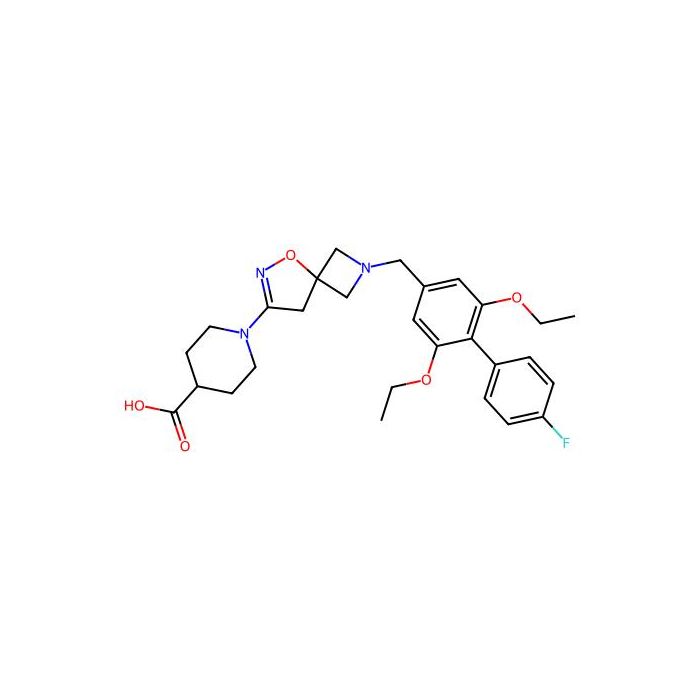
SSTR5 antagonist 1 (compound 25a) is a selective and orally available somatostatin receptor subtype 5 ( SSTR5 ) antagonist with IC 50 s of 9.6 and 57 nM for hSSTR5 and mSSTR5 , respectively
In Vitro
SSTR5 antagonist 1 (compound 25a) (30 μM) inhibits hERG activity by 5.6%. SSTR5 antagonist 1 (10 μM) shows highly selective inhibitory effect on SSTR5 over SSTR1-4, with inhibition rates of 11%, 8%, 14%, 10%. SSTR5 antagonist 1 (1 μM; 15 min and 30 min) exhibits good metabolic stability toward both human and mouse microsomes with in vitro CLint value of <10 μL/min/kg (HLM) and 19 μL/min/kg (MLM), respectively. MCE has not independently confirmed the accuracy of these methods. They are for reference only.
In Vivo
SSTR5 antagonist 1 (compound 25a) (1 mg/kg; p.o.; single dose) is orally available with acceptable plasma exposure in mice in pharmacokinetic screening and exhibits excellent solubility (260 μg/mL, pH=6.8) . SSTR5 antagonist 1 (100 mg/kg; p.o.; single dose; measured at 0-120 min) augments insulin secretion in a glucose-dependent manner and lowers blood glucose concentration in high-fat diet fed C57BL/6J mice . SSTR5 antagonist 1 (1, 3, 10, and 30 mg/kg; p.o.; single dose) shows dose-dependent effect on glucose excursion measured during the oral glucose tolerance test in HFD fed C57BL/6J mice . Pharmacokinetic profiles in male ICR mouse (8-week-old) Route Dose (mg/kg) CL total (mL/h/kg) V ss (mL/kg) MRT (h) iv 0.1 1761 3052 1.7 / Route Dose (mg/kg) C max (ng/mL) T max (h) AUC 0-8 h (ng·h/mL) F (%) po 1 74.8 2.0 332 58 MCE has not independently confirmed the accuracy of these methods. They are for reference only. Animal Model: High-fat diet fed C57BL/6J mice Dosage: 100 mg/kg Administration: Oral gavage; single dose; monitored over 2 h Result: Showed the maximum efficacy superior to that of 10 mg/kg Glibenclamide and comparable to that of 30 mg/kg Alogliptin . Augmented insulin secretion in a glucose-dependent manner and displayed a blood glucose-lowering effect, indicating its anti-diabetic efficacy in vivo.
SSTR5 antagonist 1 (compound 25a) is a selective and orally available somatostatin receptor subtype 5 ( SSTR5 ) antagonist with IC 50 s of 9.6 and 57 nM for hSSTR5 and mSSTR5 , respectively.
Conditions de stockage de stockage
Store at -20°C
Expédié en
Ice chest + Ice pads
Ce produit nécessite l'expédition en chaîne froide. Les services terrestres et autres services économiques ne sont pas disponibles.
This compound belongs to the class of organic compounds known as biphenyls and derivatives. These are organic compounds containing to benzene rings linked together by a C-C bond.
External Descriptors
Not available
1. Djoumbou Feunang Y, Eisner R, Knox C, Chepelev L, Hastings J, Owen G, Fahy E, Steinbeck C, Subramanian S, Bolton E, Greiner R, and Wishart DS. ClassyFire: Automated Chemical Classification With A Comprehensive, Computable Taxonomy. Journal of Cheminformatics, 2016, 8:61.
Certificats (CoA, COO, BSE/TSE et tableau d'analyse)
C of A & Other Certificates(BSE/TSE, COO):
Analytical Chart:
Propriétés chimiques et physiques
Solubilité
DMSO : 90 mg/mL (175.92 mM; Need ultrasonic)
Poids moléculaire
511.600 g/mol
XLogP3
1.100
Hydrogen Bond Donor Count
1
Hydrogen Bond Acceptor Count
8
Rotatable Bond Count
9
Exact Mass
511.248 Da
Monoisotopic Mass
511.248 Da
Topological Polar Surface Area
83.800 Ų
Heavy Atom Count
37
Formal Charge
0
Complexity
790.000
Isotope Atom Count
0
Defined Atom Stereocenter Count
0
Undefined Atom Stereocenter Count
0
Defined Bond Stereocenter Count
0
Undefined Bond Stereocenter Count
0
The total count of all stereochemical bonds
0
Covalently-Bonded Unit Count
1
Calculateurs de solution
Molarity Calculator
Determine the necessary mass, volume, or concentration for preparing a solution.
Dilution Calculator
Determine the dilution needed to prepare a stock solution.
Reconstitution Calculator
Avis
Avis des clients
Application Protocols
No tested applications or protocols are provided for this specific item.
Recommended dilutions, assay formats, and controls: Not specified for this item; refer to CoA/Spec Sheet and the primary literature on SSTR5 pharmacology for method development.
Users should optimize concentration ranges, incubation times, and vehicle percentages for their specific cell lines or biochemical systems.
For any available internal validation data, please contact us with the SKU (S648964).
Biological Roles
Scope: The following summarizes the biology of the intended target (SSTR5) and the role of antagonists as research probes. It is general background, not a guarantee of item-specific performance.
Target overview (literature): Somatostatin receptor 5 (SSTR5) is a Class A GPCR in the somatostatin receptor family (SSTR1–5). It couples predominantly to Gi/o proteins, typically reducing adenylyl cyclase activity upon activation. SSTR5 is implicated in regulating endocrine secretion and neuronal signaling.
Antagonist utility (research context): SSTR5-selective antagonists serve as pharmacological tools to dissect receptor subtype contributions in complex systems, enable pathway deconvolution in cells/tissues expressing multiple SSTR subtypes, and support structure–activity relationship (SAR) benchmarking alongside agonists and partial agonists.
Selectivity considerations: Subtype selectivity within the SSTR family is often challenging due to conserved binding pockets. Experimental confirmation using counter-screens against SSTR1–4 is standard in high-quality pharmacology programs.
Assay modalities (general): cAMP inhibition reversal assays, β-arrestin recruitment, Ca2+ mobilization in engineered systems, radioligand displacement, BRET-based signaling, and label-free impedance approaches can be used to characterize antagonism.
Research-use note: This product is designated for research use only and is not intended for diagnostic, therapeutic, or in vivo clinical applications.
Buffer Applications
Not typically applicable. This product is a small-molecule bioactive, not a buffering agent.
Practical note (general): If preparing aqueous working solutions, use an appropriate assay buffer (e.g., HEPES- or phosphate-based) and introduce the compound from a concentrated organic stock (commonly DMSO) with rapid mixing to prevent precipitation. Maintain consistent vehicle percentages across controls and treated samples.
Green Alternatives
As a specific bioactive ligand rather than a process solvent or commodity reagent, the concept of a “green alternative” is not directly applicable.
Sustainability considerations (general):
Solvent choice for dissolution and assay preparation has the largest green impact here. Prefer lower-toxicity, lower-volume solvent use, and minimize DMSO concentration while maintaining solubility.
Waste minimization: Prepare concentrated stocks to reduce solvent waste; aliquot to avoid freeze–thaw cycles and disposal of degraded materials.
If synthesizing this compound in-house, consider greener solvent swaps and telescoped steps based on your route; however, no route-specific advice can be given without structural details.
Pharmaceutical Uses
No formulation or excipient roles are specified for this item, and it is supplied strictly for research use only.
Context (general, non-clinical):
Small-molecule GPCR antagonists are frequently used as discovery research probes to validate targets, benchmark assay performance, and support SAR. Any discussion of therapeutic use is outside the scope of this listing and is not endorsed.
If formulating for preclinical in vitro studies, selection of vehicle (e.g., DMSO stock into assay buffer), control matching, and stability verification are typical considerations.
Compliance reminder: Not for human or veterinary use. No pharmacopeial status is claimed for this item.
Physical Properties
Item-specific physicochemical specifications are not provided in this record.
Appearance: Not specified for this item; refer to CoA/Spec Sheet.
Molecular Weight: Not specified for this item; refer to CoA/Spec Sheet.
Molecular Formula: Not specified for this item; refer to CoA/Spec Sheet.
Melting point: Not specified for this item; refer to CoA/Spec Sheet.
Boiling point: Not specified for this item; refer to CoA/Spec Sheet.
Density: Not specified for this item; refer to CoA/Spec Sheet.
Solubility: Not specified for this item; refer to CoA/Spec Sheet.
logP/logD: Not specified for this item; refer to CoA/Spec Sheet.
pKa: Not specified for this item; refer to CoA/Spec Sheet.
Refractive index: Not applicable/Not specified for a solid tool compound; refer to CoA/Spec Sheet if applicable.
General guidance (literature-informed, not item-specific):
Small-molecule GPCR ligands are often supplied as crystalline or amorphous solids and are typically soluble in polar aprotic organic solvents (e.g., DMSO, DMF) with variable aqueous solubility depending on ionization state and salt form.
If solubility data are absent, perform a tiered solubility screen at small scale (DMSO → DMF → ethanol/MeOH → aqueous buffer with cosolvent) and verify by LC–MS or HPLC.
Avoid prolonged exposure to elevated temperatures during dissolution; warm gently if needed and sonicate briefly to aid dissolution.
Quality and Grades
Item-specific grade and purity are not listed in this record.
Grade/Purity: Not specified for this item; refer to CoA/Spec Sheet.
Context and expectations (general):
Research-use small-molecule library compounds are typically supplied at research grade, suitable for discovery biology, screening, and mechanistic studies. Purity is commonly controlled by LC–MS/HPLC area% and identity confirmed by MS and, where available, NMR.
UV/fluorescence background, water content, residual solvents, and inorganic residues are not specified for this item; consult CoA if these attributes are critical for your assay (e.g., low-UV applications).
Batch-to-batch considerations: Bioassay performance can be sensitive to salt form, polymorphism, and residual moisture. Verify form and purity on receipt if your application is potency- or SAR-critical.
Documentation recommendations:
Request the latest CoA/Spec Sheet for this specific lot for: analytical method, purity (% area), identity confirmation (MS, NMR), counterion/salt form, and any stabilizers.
If you require enhanced grade (e.g., >98% HPLC, salt exchange, or custom packaging), contact us for feasible customization options.
Reaction and Applications
This product is a bioactive small-molecule tool (SSTR5 antagonist) rather than a synthetic reagent. Consequently, classical synthetic reaction applications (e.g., cross-couplings, condensations) are not typically relevant for end users.
If you intend to derivatize or conjugate this molecule, please obtain the full structural information (SMILES/InChI, functional groups) from the CoA to assess feasible transformations.
For analytical and pharmacological applications, see the Biological Roles and Target Specificity sections.
No manufacturer-provided synthetic application notes are available for this item.
Reaction Conditions
Not applicable for typical use. This product is not supplied as a reagent for performing chemical reactions.
General laboratory handling conditions (non-reaction):
Dissolution: Prepare concentrated stocks in anhydrous DMSO or other suitable solvent after confirming solubility.
Working solutions: Dilute into assay medium immediately before use; maintain consistent vehicle controls.
Stability checks: Verify short-term solution stability under your assay conditions by LC–MS or HPLC.
No literature reaction parameters are relevant without a disclosed structure.
Safety and Handling
Safety data specific to this item are not provided in the listing and should be confirmed on the SDS.
GHS Classification, Signal Word, H-Statements, Pictograms: Not specified for this item; refer to SDS.
Primary risk domain: Uncharacterized small organic molecule; handle as a potentially harmful laboratory chemical.
General laboratory precautions (non-item-specific):
PPE: Wear lab coat, safety glasses, and appropriate chemical-resistant gloves. Work in a certified chemical fume hood when weighing, dissolving, or transferring powders/solutions.
Inhalation/ingestion/skin contact: Avoid dust/aerosol formation; prevent skin and eye contact. Wash thoroughly after handling.
Storage incompatibilities: Until specific reactivity is known, segregate from strong oxidizers, strong acids/bases, and reactive reducing agents.
Thermal/light sensitivity: Unknown for this item. As a precaution, minimize exposure to heat and strong light during handling and storage.
Spill response: For small spills, absorb with inert material and collect in a chemical waste container. Ventilate area; avoid dust generation.
First aid overview: If inhaled, move to fresh air; if on skin, wash with soap and water; if in eyes, rinse cautiously with water for several minutes; if ingested, rinse mouth. Seek medical attention as needed.
Authoritative source: Always consult the product’s SDS for definitive hazard classification, exposure limits, and recommended controls.
Solvent Selection
No item-specific solubility data are provided.
General guidance for small-molecule GPCR antagonists (literature-informed, not item-specific):
Primary stock solvent: DMSO is typically preferred due to broad solvency and assay compatibility at ≤0.1% v/v final concentration in many cell-based formats.
Secondary options: DMF, acetonitrile, ethanol, or methanol may be suitable depending on polarity and ionization state. Buffered aqueous vehicles often require a cosolvent or cyclodextrin if intrinsic solubility is low.
pH and salt form: If provided as a free base/acid, solubility may increase upon converting to an appropriate salt. Absent such details, perform a small pH-solubility screen.
Selection tips:
For biochemical assays: Use anhydrous DMSO stocks (e.g., 10 mM), then dilute into assay buffer with immediate mixing to prevent precipitation.
For cellular assays: Limit DMSO to the lowest feasible percentage; include vehicle controls matching the highest solvent content.
For in vitro stability studies: Pair solvent with compatible containers (glass preferred). Assess adsorption losses for very lipophilic molecules.
DMF/ACN: Good solvency; stronger extraction of plastics; confirm biocompatibility.
EtOH/MeOH: Volatile, simpler removal; may affect membrane integrity at higher %.
Storage and Reconstitution
Storage conditions (item-specific):
Store at −20°C.
Shipped in: Ice chest + ice pads.
Additional practical guidance (general, not item-specific):
Protect from moisture and repeated freeze–thaw. If supplied as a solid, allow the container to equilibrate to room temperature in a desiccated environment before opening to minimize moisture uptake.
Reconstitution: In the absence of solubility data, prepare a small test solution in anhydrous DMSO to assess solubility. If soluble, typical screening stocks are 10–50 mM in DMSO. Filter through a 0.22 µm PTFE filter if particulate is present.
Aliquoting: Divide stock into single-use aliquots to avoid multiple freeze–thaw cycles. Store aliquots tightly sealed at −20°C (or as otherwise stated on the CoA).
Stability: Solution stability and freeze–thaw tolerance are not specified for this item; confirm by LC–MS/HPLC over the intended storage horizon.
Container compatibility: Prefer borosilicate glass vials with PTFE-lined caps for long-term DMSO stocks.
Always defer to the CoA/SDS for any item-specific instructions that supersede the general guidance above.
Structure and Identity
Brief overview: This item is a small-molecule research tool annotated as a somatostatin receptor 5 (SSTR5) antagonist. Detailed structural descriptors are not provided in the current product record.
CAS: 1628741-91-2
PubChem CID: 90423921
InChIKey: 366766 (as provided; note that typical InChIKeys are 27 characters — verify on the CoA/SDS)
SMILES: Not specified for this item; refer to CoA/Spec Sheet.
Molecular Formula: Not specified for this item; refer to CoA/Spec Sheet.
Molecular Weight: Not specified for this item; refer to CoA/Spec Sheet.
Structural features (general guidance):
Item-specific 2D structure and functional groups are not available in this listing. Many SSTR5 ligands in literature are heteroaromatic, hydrogen-bonding competent scaffolds tailored for GPCR binding, but the exact features for this compound are not specified here.
Without SMILES/InChI, chemoinformatics and derived properties (e.g., cLogP, TPSA) cannot be computed here. Consult the Certificate of Analysis (CoA) for definitive identity attributes and spectral data (NMR, LC–MS) if available.
Synthetic Utility
This product is offered as a ready-to-use bioactive tool compound rather than a synthetic building block.
Without structural disclosure (SMILES/functional groups), it is not feasible to recommend derivatizations, coupling handles, or protection strategies.
If you plan analog synthesis or conjugation, request the structure or utilize orthogonal analytical methods (LC–MS, NMR) to assign functional groups and identify feasible points of modification.
For synthetic method development, please refer to the CoA or contact us regarding availability of a disclosed structure or related intermediates.
Target Specificity
Item-specific target designation based on product name:
Intended target: Somatostatin receptor 5 (SSTR5)
Modality: Antagonist (functional inhibition of receptor activity)
Details not provided for this item:
Potency (e.g., IC50/Ki), functional assay system, species selectivity, and off-target profile are not specified; refer to CoA/Spec Sheet or primary references if supplied.
General note: SSTR5 belongs to the somatostatin GPCR family (SSTR1–5). Subtype selectivity should be verified empirically using appropriate counter-screens.
Foire aux questions
What is the purity of this product?
This product is supplied at ≥99% purity (chemical assay). Lot-specific values are stated on the Certificate of Analysis.
How should this product be stored?
Store at ?20 °C. Freezer storage is required to maintain the specified shelf life.
How is this product shipped?
This product ships in an insulated container with ice pads. Unpack on arrival and transfer it to the storage condition stated above.
What are the CAS number, molecular formula and molecular weight?
The CAS Number is 1628741-91-2, the molecular formula is C28H34FN3O5, and the molecular weight is 511.59 g/mol. InChIKey UQRAIIGEZLINAT-UHFFFAOYSA-N.
What documentation is provided?
Available product documentation, including Certificates of Analysis (COA), Safety Data Sheets (SDS), and specification sheets, is shown in the product document area. Document availability and access follow the current site policy.
Nous utilisons des cookies pour garantir le bon fonctionnement du site et, lorsque cela est autorisé, pour améliorer votre expérience. Vous pouvez gérer vos préférences à tout moment dans les Paramètres. Pour en savoir plus, consultez notre Politique relative aux cookies.
Souhaitez-vous que nous vous envoyions un message lorsque des réductions seront disponibles?
Me rappeler plus tard
Merci ! Veuillez vérifier votre boîte de réception e-mail pour confirmer.
Products are supplied to verified businesses, institutions, and qualified professionals for research and development use only. Not for use in humans, animals, diagnosis, or therapy.