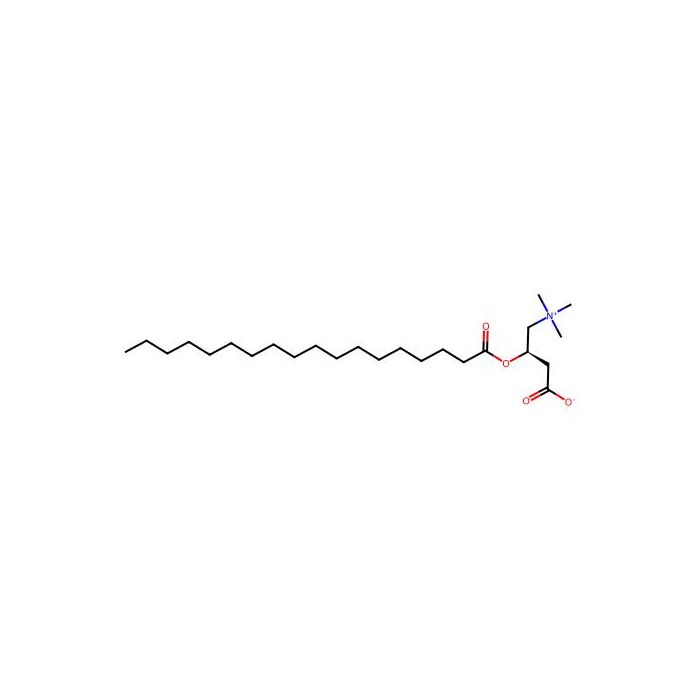
This compound belongs to the class of organic compounds known as acyl carnitines. These are organic compounds containing a fatty acid with the carboxylic acid attached to carnitine through an ester bond.
External Descriptors
Fatty acyl carnitines
1. Djoumbou Feunang Y, Eisner R, Knox C, Chepelev L, Hastings J, Owen G, Fahy E, Steinbeck C, Subramanian S, Bolton E, Greiner R, and Wishart DS. ClassyFire: Automated Chemical Classification With A Comprehensive, Computable Taxonomy. Journal of Cheminformatics, 2016, 8:61.
Certificats (CoA, COO, BSE/TSE et tableau d'analyse)
C of A & Other Certificates(BSE/TSE, COO):
Analytical Chart:
Propriétés chimiques et physiques
Poids moléculaire
427.700 g/mol
XLogP3
8.800
Hydrogen Bond Donor Count
0
Hydrogen Bond Acceptor Count
4
Rotatable Bond Count
21
Exact Mass
427.366 Da
Monoisotopic Mass
427.366 Da
Topological Polar Surface Area
66.400 Ų
Heavy Atom Count
30
Formal Charge
0
Complexity
426.000
Isotope Atom Count
0
Defined Atom Stereocenter Count
1
Undefined Atom Stereocenter Count
0
Defined Bond Stereocenter Count
0
Undefined Bond Stereocenter Count
0
The total count of all stereochemical bonds
0
Covalently-Bonded Unit Count
1
Calculateurs de solution
Molarity Calculator
Determine the necessary mass, volume, or concentration for preparing a solution.
Dilution Calculator
Determine the dilution needed to prepare a stock solution.
Reconstitution Calculator
Avis
Avis des clients
Application Protocols
No item-specific validated protocols are provided in the Product Data. The following general, research-use-only guidance reflects common laboratory practice for acylcarnitine standards.
LC-MS/MS quantitation (general):
Stock solution: prepare at 1–10 mM in methanol or acetonitrile (optionally 0.1% formic acid). Filter if needed using low-binding PTFE filters.
Working solution: dilute into initial LC mobile phase (e.g., 50:50 water:MeOH with 0.1% formic acid) to 0.1–10 µM. Keep organic content ≥20% to prevent precipitation.
Internal standard: include a stable isotope-labeled stearoylcarnitine when performing absolute quantitation.
Chromatography: reversed-phase C18 or HILIC can be used; optimize gradient and temperature for separation from isobaric acylcarnitines.
Biochemical assays (general):
Prepare DMSO stocks (10–50 mM) and dilute slowly into assay buffer to ≤1% DMSO final to mitigate aggregation. Maintain pH 6.5–7.5.
Stability notes:
Avoid repeated freeze–thaw of stock solutions; aliquot upon first preparation.
Monitor for hydrolysis by LC-MS over time, especially in basic media or at elevated temperature.
Biological Roles
General/literature overview (no clinical claims):
Metabolic intermediate: Stearoylcarnitine is the C18:0 long-chain acylcarnitine formed by transfer of the stearoyl group from stearoyl‑CoA to carnitine, catalyzed by carnitine palmitoyltransferase-1 (CPT1) on the outer mitochondrial membrane and CPT2 on the inner membrane.
Fatty acid transport: Acylcarnitines facilitate translocation of long-chain fatty acids across the mitochondrial membranes for β‑oxidation by converting acyl‑CoA thioesters into membrane-permeable zwitterionic esters and back again.
Membrane interactions: The amphiphilic structure promotes association with lipid bilayers and lipoproteins; chain length modulates partitioning, micellization, and protein binding.
Analytical biomarker context: Levels of specific acylcarnitines, including stearoylcarnitine, are profiled in research settings to study pathway flux, enzyme activities, and nutrient utilization. Such measurements support biochemical research only and are not diagnostic claims.
Enzymatic turnover: Hydrolyzable ester bond is susceptible to carnitine acyltransferases and esterases; equilibrium between acyl‑CoA and acylcarnitine pools is tightly regulated by CoA availability and mitochondrial transport systems.
These roles summarize the biochemical context for research use of stearoylcarnitine as a standard or probe molecule.
Buffer Applications
Not typically used as a buffering agent. Stearoylcarnitine lacks a conjugate acid/base pair with a useful pKa window for buffering. For experiments involving this analyte:
Prepare in assay buffers that maintain neutral to mildly acidic pH to mitigate ester hydrolysis (e.g., phosphate or HEPES). The choice of buffer should be driven by your assay and detection method.
Include a modest proportion of organic cosolvent (e.g., 10–30% methanol or acetonitrile) if needed to keep the compound in solution without surfactants.
For dedicated buffering needs, select established systems (phosphate, HEPES, MOPS, ammonium formate/acetate for LC-MS) according to the target pH and analytical compatibility.
Green Alternatives
As a defined biochemical/analyte, stearoylcarnitine itself is not replaceable by a “greener” reagent without altering the scientific target. However, greener choices can be made for solvents and workflows.
Prefer aqueous-organic mobile phases with methanol over acetonitrile when chromatographic performance permits; methanol has a better green profile and broader availability from bio-sourced feedstocks.
Use ethanol or isopropanol for initial dissolution where LC-MS sensitivity allows, reducing reliance on DMSO.
Reduce solvent volumes via microelution SPE plates and microflow LC.
Implement cold storage at 2–8°C instead of frozen shipments whenever stability allows—this item is shipped on wet ice per product data, which aligns with reduced energy demands relative to dry ice.
Illustrative comparison (general):
Methanol vs ACN in LC-MS: MeOH is greener but may increase backpressure and sometimes reduces sensitivity for certain adducts; ACN offers lower viscosity and sharper peaks. Choose based on method performance.
Ethanol vs DMSO for stock solutions: ethanol is greener and less persistent but may offer lower solubility; DMSO provides maximal solvation with potential assay interference.
Adopt solvent recycling where compatible with bioanalytical validation requirements.
Pharmaceutical Uses
No therapeutic or clinical use is claimed or implied for this product. Research use only.
Reference standard: may be employed as a system suitability or calibration standard in pharmaceutical metabolomics and process-biochemistry investigations where monitoring of long-chain acylcarnitines is required.
Excipient status: stearoylcarnitine is not a common pharmaceutical excipient. It is used primarily as a biochemical reference material.
Stability considerations: if incorporated into research formulations (e.g., spiked matrices), maintain neutral to mildly acidic conditions and limit exposure to high pH to avoid ester cleavage.
Any compendial status, if applicable, would be cited on the CoA/Spec Sheet; none is specified in the provided data.
Physical Properties
Item-specific numerical specifications are not provided in the product data. Where helpful, typical literature descriptors are noted for context and method development only.
Item-specific (from Product Data):
Appearance: Not specified for this item; refer to CoA/Spec Sheet.
Molecular weight: Not specified for this item; refer to CoA/Spec Sheet.
General/literature physical characteristics of long-chain acylcarnitines (C18:0):
Physical form: typically a waxy solid or powder; amphiphilic with a high hydrophobic moment due to the stearoyl chain.
Solubility: often soluble in polar organic solvents (methanol, ethanol, acetonitrile) and DMSO; exhibits limited intrinsic solubility in pure water but may disperse or form micelles/aggregates in buffered saline, especially with mild surfactants or organic cosolvent. Exact values depend on counter-ions, water content, and form; determine empirically for your lot.
pKa/logP: The molecule is a zwitterion (quaternary ammonium permanently charged; carboxylate deprotonated under neutral conditions). Apparent distribution behavior is strongly solvent- and aggregation-dependent; report experimental values from your method validation rather than assuming database values.
Stability: ester bond is susceptible to hydrolysis under strong basic conditions and to enzymatic cleavage (carboxylesterases); relatively stable in dry, neutral to mildly acidic organic media at 2–8°C.
Always verify batch-specific properties in the CoA/Spec Sheet prior to quantitative work.
Quality and Grades
Item-specific grade and purity are not provided in the product data.
Grade/Purity: Not specified for this item; refer to CoA/Spec Sheet.
Guidance on typical quality considerations for acylcarnitines:
Research/reagent grade: commonly supplied for metabolomics, lipidomics, and biochemical assays. Key attributes include identity confirmation (1H/13C NMR, HRMS), low residual solvents, and controlled moisture.
LC-MS suitability: for quantitative LC-MS/MS, lots are often assessed for isotopic purity, adduct profile, and low non-volatile residue. When the grade indicates “LC-MS” or “analytical standard,” expect minimized background and documented assay purity; verify on the CoA.
Stabilizers: acylcarnitines generally do not require stabilizers; however, trace acidification (e.g., formic acid in methanol) can improve solution stability for LC-MS use. If a stabilizer is present, it will be listed on the CoA; none is specified here.
Impurity considerations: monitor for hydrolysis products (stearic acid and carnitine), partial isomerization (if chiral purity is relevant), and residual inorganic salts. Establish acceptance criteria aligned with your method.
Recommendation: consult the batch CoA for assay (%) or area% purity, water content, residual solvents, and chiral specification (if applicable) before use in quantitative workflows.
Reaction and Applications
This product is principally used as a biochemical/analytical standard rather than as a general-purpose synthetic reagent. Relevant application domains include:
Metabolomics/lipidomics (literature): used as a reference or calibration standard for profiling long-chain acylcarnitines by LC-MS/MS, aiding quantitation and method validation.
Enzymology (literature): substrate or product in studies of carnitine palmitoyltransferases (CPT1/2) and carnitine acyltransferases; stearoyl-CoA + carnitine ⇌ stearoylcarnitine + CoA.
Transport and partitioning studies (literature): probe for membrane interactions, micellization behavior, and the effect of acyl chain length on zwitterion amphiphiles.
Practical notes:
Avoid base during sample prep to limit ester hydrolysis to stearic acid and carnitine. Maintain neutral to mildly acidic conditions for solutions.
For LC-MS: minimize adsorption by using low-binding plastics or silanized glass; include 0.01–0.1% formic acid to improve peak shape and ionization consistency. Typical MRM transitions and collision energies are method-specific—optimize empirically with your instrument.
Internal standards: pair with stable isotope-labeled analogs when absolute quantitation is required.
This section expands on general manufacturer-listed research use; no item-specific applications were provided in the Product Data.
Reaction Conditions
Because this material is used mainly as an analyte/standard, there are no item-specific “synthetic reaction conditions.” The following general/literature conditions relate to its chemical interconversion:
Chemical hydrolysis: ester cleavage can occur under basic conditions (e.g., aqueous NaOH or methanolic K2CO3), producing stearic acid and carnitine; temperature acceleration is typical, but gentle conditions are recommended to avoid side reactions on the betaine moiety. Acidic hydrolysis is slower; strong acid can lead to side reactions and is generally avoided.
Enzymatic transesterification: CPT1/2 or carnitine acetyltransferases mediate reversible exchange between acyl‑CoA and acylcarnitine in buffered aqueous media (pH ~7–8) with Mg2+/CoA present; optimize temperature (e.g., 25–37°C) per enzyme source and activity. Reaction times range from minutes to hours depending on enzyme loading.
LC-MS sample prep: dissolution in MeOH or ACN (often 0.1% formic acid), optional sonication, dilution into aqueous mobile phase. Keep solutions cold and protected from light to improve longevity.
Note: The above are general guidelines from literature practices. Validate on small scale and track conversion by LC-MS or TLC where applicable.
Safety and Handling
Hazard information for this specific item is not provided in the product data; consult the SDS for authoritative guidance.
Item-specific (from Product Data):
GHS classification: Not specified for this item; refer to SDS.
Signal word / H-statements / pictograms: Not specified for this item; refer to SDS.
General guidance for handling acylcarnitines in research settings:
Expected hazards: low volatility, low flammability as a solid; may cause eye, skin, or respiratory irritation. Avoid ingestion and inhalation of dust.
PPE: laboratory coat, safety glasses, and appropriate gloves (e.g., nitrile). Use a dust mask or handle in a fume hood if powders are prone to aerosolization.
Handling: minimize exposure to moisture; the ester can hydrolyze under basic conditions. Avoid prolonged exposure to elevated temperatures. Use clean, dry tools to prevent cross-contamination.
Incompatibilities: strong bases and strong acids (can accelerate hydrolysis); strong oxidizers. For solutions in organic solvents, observe the solvent’s flammability and toxicity precautions.
First aid (overview): in case of contact, rinse skin/eyes with water for at least 15 minutes; remove contaminated clothing. If inhaled, move to fresh air. If ingested, rinse mouth and seek medical attention. Provide SDS to medical personnel.
Waste: dispose of solids/solutions according to institutional and local regulations for organic laboratory chemicals.
Always defer to the product SDS for specific hazard classification and emergency measures.
Solvent Selection
Stearoylcarnitine is amphiphilic: a polar quaternary ammonium carnitine headgroup joined to a hydrophobic C18 tail. Solvent selection should address both dissolution and downstream analytical compatibility.
General/literature guidance:
Polar organic solvents: methanol, ethanol, isopropanol, acetonitrile, and DMSO typically dissolve acylcarnitines well. Methanol or methanol with 0.1% formic acid is commonly used for LC-MS sample preparation.
Aqueous media: limited intrinsic solubility in pure water; may disperse in buffered saline or water with a small fraction of organic cosolvent (10–50% MeOH/ACN) or with mild ionic strength. Sonication can aid dissolution.
Nonpolar solvents: poor solubility in alkanes and ethers due to the ionic headgroup.
Selection hints:
Quantitative LC-MS/MS: dissolve in MeOH or ACN (with 0.1% formic or acetic acid as needed), then dilute with water/aqueous mobile phase. Maintain consistent organic content to prevent precipitation.
Biochemical assays: DMSO stock (10–50 mM) followed by slow dilution into assay buffer containing 1–5% DMSO or 10–20% MeOH to avoid aggregation.
Comparison (general):
Methanol: best balance of solubility and LC-MS compatibility.
DMSO: highest solvating power; use minimal percentages to avoid assay interference.
Acetonitrile: good for precipitation-based sample cleanup and autosampler stability; may require acidification for robustness.
Additional handling guidance (general best practice for acylcarnitines):
Protect from moisture. Keep container tightly closed. Use desiccant in secondary containment when feasible.
For long-term solution storage, prepare aliquots in methanol or acetonitrile (optionally 0.1% formic acid) and store at 2–8°C. For extended storage, freezing at ≤−20°C can further limit hydrolysis; assess stability by LC-MS.
Reconstitution: choose a polar organic solvent (MeOH, ACN, or DMSO) to prepare a concentrated stock. If aqueous working solutions are required, add stock slowly to vigorously stirred buffer containing 10–30% organic cosolvent to avoid precipitation.
Freeze–thaw: minimize cycles; thaw on ice and mix gently. Discard aliquots if turbidity or significant degradation is observed.
Note: Any item-specific specifications (e.g., water content, assay, stabilizers) are not provided here—refer to the CoA/Spec Sheet for definitive instructions tailored to the supplied lot.
Structure and Identity
Stearoylcarnitine is a long-chain acylcarnitine formed by esterification of carnitine’s 3-hydroxyl group with stearic acid (C18:0). The molecule is a zwitterionic quaternary ammonium betaine bearing a long, saturated aliphatic chain.
SKU: S768915
Product name: Stearoylcarnitine
CAS: 25597-09-5
Category: Small molecules and compound library
Molecular formula: Not specified for this item; refer to CoA/Spec Sheet.
Molecular weight: Not specified for this item; refer to CoA/Spec Sheet.
InChIKey: 87368 (as provided in product data)
SMILES: Not specified for this item; refer to CoA/Spec Sheet.
Structural features (general/literature):
Functional groups: quaternary ammonium (trimethylated), ester linkage (fatty acyl to carnitine), terminal carboxylate (betaine inner salt), and a C18 saturated hydrocarbon chain (stearoyl).
Topology: amphiphilic—polar carnitine headgroup and hydrophobic stearoyl tail; often exhibits self-association/micellar tendencies in aqueous media depending on concentration and ionic strength.
Stereochemistry: naturally derived carnitine is (R)-configured at the chiral center; commercial listings may specify L-/D- or racemic material—specification for this item is not provided here (refer to CoA/Spec Sheet).
Synthetic Utility
Stearoylcarnitine is generally not used as a building block in classical synthetic organic chemistry. Nonetheless, in biochemical and derivatization contexts (general/literature):
Functional handles: the ester bond can be hydrolyzed (yielding stearic acid and carnitine); the terminal carboxylate of carnitine can, in protected forms, be derivatized for analytical tagging.
Derivatization for analytics: reagents such as dansyl chloride or other amine-reactive tags are not applicable due to the quaternary ammonium; however, oxazoline/imidazole-based derivatizations of carboxylates or acyl exchange reactions can be used for specialized workflows.
Enzymatic transformations: carnitine acyltransferases catalyze reversible acyl exchange with acyl‑CoAs, enabling isotope tracing and enzyme kinetics studies.
From a retrosynthetic perspective, stearoylcarnitine arises from esterification of carnitine with stearic acid derivatives (e.g., stearoyl chloride or stearoyl‑NHS) under mild conditions while preserving the quaternary ammonium; protecting-group strategies for the carboxylate may be required in chemical syntheses.
Target Specificity
Not applicable—this product is a small molecule standard, not a biological affinity reagent. There is no antigen, epitope, clone, or isotype associated with this item.
Foire aux questions
What is the purity of this product?
This product is supplied at ≥98% purity (chemical assay). Lot-specific values are stated on the Certificate of Analysis.
How should this product be stored?
Store at 2–8 °C. Refrigerated storage is required to maintain the specified shelf life.
How is this product shipped?
This product ships chilled on wet ice. Unpack on arrival and transfer it to the storage condition stated above.
What are the CAS number, molecular formula and molecular weight?
The CAS Number is 25597-09-5, the molecular formula is C25H49NO4, and the molecular weight is 427.66 g/mol. InChIKey FNPHNLNTJNMAEE-HSZRJFAPSA-N.
What documentation is provided?
Available product documentation, including Certificates of Analysis (COA), Safety Data Sheets (SDS), and specification sheets, is shown in the product document area. Document availability and access follow the current site policy.
Nous utilisons des cookies pour garantir le bon fonctionnement du site et, lorsque cela est autorisé, pour améliorer votre expérience. Vous pouvez gérer vos préférences à tout moment dans les Paramètres. Pour en savoir plus, consultez notre Politique relative aux cookies.
Souhaitez-vous que nous vous envoyions un message lorsque des réductions seront disponibles?
Me rappeler plus tard
Merci ! Veuillez vérifier votre boîte de réception e-mail pour confirmer.
Products are supplied to verified businesses, institutions, and qualified professionals for research and development use only. Not for use in humans, animals, diagnosis, or therapy.