GRADE & PURITYMoligand™?Moligand™ — Aladdin's line of ligands and bioactive small molecules. Use for receptor, pathway, and binding studies needing defined small-molecule tools.10 mM in DMSO
Moligand™, 10 mM in DMSO Moligand™ for sensitive chromatographic and analytical workflows requiring minimal baseline interference.
🌡
Storage & shipping
Store at -80°C Ships Dry ice packs + Cold packs Check lot-specific COA for exact specifications.
📋
Quality documents
SDS, COA, datasheet, and spec sheet available for download. Lot-specific COA accessible via lot number lookup.
📚
Literature proof
Cited in 0 peer-reviewed publications across chromatography, organic synthesis, and cross-coupling reactions.
Vue d’ensemble
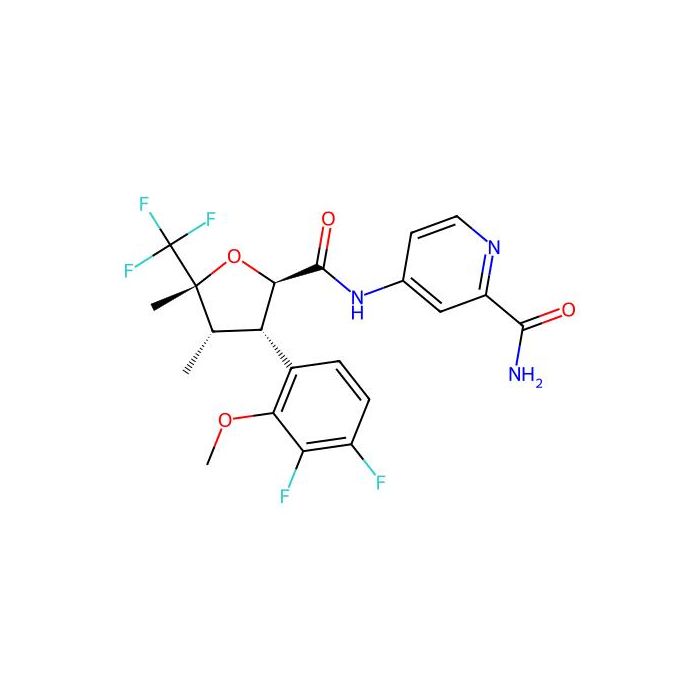
Suzetrigine (VX-548) is an orally active and highly selective Na V 1.8 inhibitor that acts as an analgesic. Suzetrigine is also a blocker of sodium channel protein type 10 subunit alpha. Suzetrigine is promising for research of acute pain after abdominoplasty and bunionectomy.
Specifications
Spécifications et pureté
Moligand™, 10 mM in DMSO
Conditions de stockage de stockage
Store at -80°C
Expédié en
Dry ice packs + Cold packs
Ce produit nécessite l'expédition en chaîne froide. Les services terrestres et autres services économiques ne sont pas disponibles.
Grade
Moligand™
Noms et identifiants
Poids moléculaire
473.39
Documentation
📋 Safety Data Sheet (SDS)
Comprehensive hazard, handling, storage, and regulatory compliance document.
Certificats (CoA, COO, BSE/TSE et tableau d'analyse)
C of A & Other Certificates(BSE/TSE, COO):
Analytical Chart:
Calculateurs de solution
Molarity Calculator
Determine the necessary mass, volume, or concentration for preparing a solution.
Dilution Calculator
Determine the dilution needed to prepare a stock solution.
Reconstitution Calculator
Avis
Avis des clients
Application Protocols
No item-specific, tested application protocols are provided in the Product Data for this SKU. The following is general guidance for handling small-molecule library compounds in discovery assays.
General HTS/assay workflow (non-item-specific)
Stock preparation: Dissolve in anhydrous DMSO to 10–20 mM. Vortex/sonicate briefly. Record exact concentration.
Aliquoting: Dispense single-use aliquots (e.g., 10–50 µL) in low-bind, inert tubes or 384-well source plates. Store at −80°C. Avoid repeated freeze–thaw cycles.
Serial dilution: Prepare intermediate plates in DMSO, then backfill with assay buffer to reach final solvent ≤1% v/v (or assay-specific limit). Include vehicle controls.
Plate handling: Use fresh tips to avoid cross-contamination; seal plates to prevent DMSO evaporation and water uptake.
QC: Confirm identity/purity against CoA by LC–MS when establishing a new lot. Track stability by periodic re-test.
If orthogonal readouts are required
For fluorescence assays, check intrinsic fluorescence/absorbance of the compound to avoid spectral overlap. Include detergent controls to rule out aggregation-based inhibition.
Item-specific dilutions, positive controls, and instrument settings: Not specified for this item; refer to your assay SOPs.
Biological Roles
No target, pathway, or mode-of-action details are provided in the Product Data for this SKU. Therefore, no specific biological roles can be ascribed in this listing.
General guidance for establishing biological context (non-clinical)
In vitro characterization: Determine activity profiles across relevant target panels (enzymes, GPCRs, ion channels) using orthogonal assay formats to rule out interference.
Counter-screens and artifacts: Evaluate fluorescence/absorbance interference, redox cycling, aggregation (detergent-sensitive activity), and reactivity with nucleophiles/electrophiles as appropriate for the assay technology.
Physicochemical triage: From the structure (when available), compute cLogP, TPSA, pKa, and solubility to anticipate permeability and binding kinetics, then align assay conditions (e.g., protein concentration, DMSO %) accordingly.
Stability: Assess chemical and metabolic stability in assay buffers and microsomes/S9 fractions if relevant to your research. Track potential hydrolysis/oxidation by LC–MS.
Limitations
Without disclosed structure or MoA, any assignment of biological function would be speculative and is not provided here. Research use only; not for human or veterinary applications.
Buffer Applications
This product is a small-molecule library compound and is not a buffering agent. Therefore, standard buffer system guidance (e.g., phosphate, Tris, HEPES recipes and pH ranges) is not typically applicable.
Practical note
If used in biochemical assays, prepare the compound in a suitable solvent (commonly DMSO) and dilute into your chosen assay buffer, keeping the final organic solvent percentage consistent across controls and test wells.
Verify compound stability in the specific buffer matrix (pH, ionic strength, co-factors) using LC–MS or HPLC.
Item-specific buffer-related properties (pKa, buffering capacity): Not specified for this item; refer to CoA/Spec Sheet if available.
Green Alternatives
Because this SKU is a research-use small molecule rather than a solvent or reagent, greenness considerations center on solvent choice and handling during dissolution, storage, and assay preparation.
Greener solvent strategy (general guidance)
Prefer DMSO and ethanol where compatible; minimize use of DMF, NMP, and dichlorinated solvents.
Use micro-scale dissolution and accurate aliquoting to reduce waste. Employ sealed, low-dead-volume plates/tubes to limit DMSO uptake of water.
Comparison of common dissolution media (general)
DMSO: High solvency, low volatility; broadly acceptable in assays at ≤1–2% v/v. EHS profile comparatively favorable among polar aprotics.
Ethanol/IPA: Renewable feedstocks available; higher volatility can aid removal but may perturb biological systems at modest %.
PEG 400/propylene glycol: Useful co-solvents for poorly soluble materials in in vivo formulation development; for research-only use and outside the scope of this listing’s intended applications.
Cyrene/2-MeTHF: Emerging greener alternatives for synthetic workups; rarely used as assay vehicles but may assist in intermediate processing.
Operational greening
Implement plate-based serial dilutions to minimize solvent volumes.
Consolidate shipments and use dry ice judiciously; promptly transfer to −80°C to avoid reshipments.
Item-specific green data (E-factor, life-cycle, etc.): Not specified for this item; refer to CoA/Spec Sheet if available.
Pharmaceutical Uses
No pharmaceutical excipient role, compendial status, or formulation guidance is provided for this SKU. This product is supplied strictly for research use only and is not intended for human or veterinary use, API manufacturing, or clinical applications.
Potential non-clinical uses (general)
Analytical reference material: May be used to develop and qualify non-clinical analytical methods (e.g., LC–MS) once identity/purity are established via CoA.
Discovery tool compound: Can serve in early discovery assays or target validation studies; any preformulation experiments remain research-only.
Regulatory note
Do not incorporate into drug products or clinical materials. No pharmacopeial monograph or GMP status is indicated. For GLP studies, ensure the lot-specific CoA provides the characterization data required by your QA unit.
Item-specific data
Excipient status, ICH/compendial compliance, residual solvent limits, and elemental impurity assessments: Not specified for this item; refer to CoA/Spec Sheet if applicable.
Physical Properties
Only item-specific values reported in Product Data are listed. All other fields are not specified for this item; refer to CoA/Spec Sheet.
Appearance: Not specified for this item; refer to CoA/Spec Sheet.
State at RT: Not specified (typical library compounds may be supplied as solids or film; verify on CoA).
Melting point (literature/computed): Not available here; consult CoA or literature for this CAS.
Boiling point (literature): Not available.
Density (literature): Not available.
Refractive index: Not applicable unless liquid; not specified.
Solubility: Not specified. For screening work, DMSO is commonly used to prepare stock solutions; confirm solubility empirically.
logP/logD, pKa, TPSA (literature/computed): Not available in this listing.
UV-Vis characteristics: Not specified for this item; refer to CoA/Spec Sheet for any UV cutoff or extinction data.
Practical notes (general guidance, not item-specific)
For unknown solids, start solubility screening with anhydrous DMSO, DMF, ethanol, and aqueous buffers with co-solvent (≤1–2% DMSO in final assay).
For purity/identity checks, LC–MS (ESI±) and 1H NMR are standard. If the CoA lists LC–MS purity, align your method (column/mobile phase) accordingly.
Hygroscopicity and hydrate/solvate formation can impact massing; equilibrate to desiccated RT before weighing.
Quality and Grades
Grade/Purity: Moligand™ (Product Data)
What Moligand™ typically signifies (general description)
Intended use: Small-molecule/ligand screening grade designed for discovery workflows (HTS, fragment expansion, chemogenomics). Emphasis is on confirmed identity and practical purity suitable for in vitro assays.
Typical QC package (general, not item-specific): LC–MS identity/purity, 1H NMR as needed, and lot traceability. Exact tests for this SKU are Not specified for this item; refer to CoA/Spec Sheet.
Impurities/stabilizers: Not specified for this item; refer to CoA/Spec Sheet. If stabilizers or salt forms are used, they will be declared on the CoA.
How to interpret grade in practice
For screening and SAR: Moligand grade is appropriate for primary/secondary assays when accompanied by CoA-confirmed identity. For mechanistic or quantitative PK work, you may require additional orthogonal purity data (qNMR, water/volatile content) and polymorph/salt form confirmation.
Documentation: Request and retain the lot-specific CoA for regulatory or publication needs; it provides the authoritative specifications for identity and purity.
Additional notes specific to this listing
Molecular formula/weight and appearance are not provided in Product Data and should be obtained from the CoA for method setup and accurate mass calculations.
Reaction and Applications
This product is supplied as a research-use small molecule (Moligand grade) and is not primarily intended as a synthetic reagent. Consequently, traditional reaction-chemistry applications (e.g., Grignard, cross-coupling) are not typically applicable.
Screening and profiling: Use as a test article in biochemical, cellular, or biophysical assays to probe pathways or targets of interest. Maintain rigorous plate-mapping and compound management practices to avoid cross-contamination and freeze–thaw degradation.
SAR enablement: If Suzetrigine acts as a hit or tool compound in your system, downstream analog selection can be guided by computed physicochemical properties (cLogP, TPSA, HBD/HBA) and simple metabolite risk assessments (soft spots, aromatic oxidation, dealkylation). Obtain or compute these from the structure once available.
Analytical reference: May serve as a reference standard for LC–MS method development once purity and identity are documented on the CoA.
Not specified for this item
Named-reaction usage, catalyst compatibility, and reactivity trends are not applicable without structural information. For synthetic elaboration or derivatization, secure the full structural record (SMILES/InChI) and consult literature for this specific chemotype.
Reaction Conditions
Not applicable in the traditional sense: Suzetrigine is provided as a research-use small molecule, not as a reagent for performing named reactions or catalysis.
Assay preparation conditions (general guidance)
Stock solutions: Prepare 10–50 mM stocks in anhydrous DMSO under dry, inert conditions if the compound is moisture/air sensitive (status not specified here). Filter if necessary through 0.2 µm PTFE.
Working concentrations: Typical biochemical assays employ 0.1–30 µM test concentrations with a constant final DMSO content (often 0.1–1% v/v). Optimize per assay.
Temperature: Prepare and handle at ambient temperature unless the compound is known to be thermally labile; minimize prolonged exposure to elevated temperatures.
Light sensitivity: If aromatic or known photosensitive motifs are present (not specified here), use amber vials and reduced light.
Quality controls
Include vehicle controls matched for solvent percentage. Use positive/negative control ligands where available.
Verify concentration by UV (if chromophore known) or quantitative NMR/LC–MS against an internal standard.
Item-specific reaction/catalysis conditions: Not specified for this item; refer to CoA/Spec Sheet and literature if you intend to use the compound synthetically.
Safety and Handling
GHS/CLP fields in Product Data are not populated for this item; consult the SDS for authoritative hazard classification.
Signal word: Not specified for this item; refer to SDS.
H-statements and pictograms: Not specified for this item; refer to SDS.
General laboratory precautions for small-molecule research materials
Handle in a certified chemical fume hood with standard PPE: lab coat, safety glasses, and appropriate chemically resistant gloves (e.g., nitrile). Avoid inhalation of dust or aerosols and skin/eye contact.
Storage incompatibilities: Until specific hazards are known, segregate from strong oxidizers, strong acids/bases, and reactive reducing agents. Keep container tightly closed under inert, dry conditions.
Thermal history: This item ships on dry ice/cold packs and is specified to be stored at −80°C (Product Data). Minimize freeze–thaw cycles by aliquoting.
First aid (overview; see SDS): In case of skin/eye contact, rinse with water for at least 15 minutes and seek medical attention. If inhaled, move to fresh air. If swallowed, rinse mouth; do not induce vomiting unless directed by medical personnel.
Spill response: Avoid dust generation. Cover with inert absorbent, collect mechanically, and dispose according to institutional chemical waste procedures.
Waste: Treat as organic laboratory chemical waste unless SDS indicates otherwise.
Research use only: Not for human or veterinary use (Product Data).
Solvent Selection
Item-specific solubility parameters are not provided; refer to the CoA/Spec Sheet. The guidance below is general best practice for small-molecule library compounds.
Primary stock preparation
DMSO (anhydrous) is the default solvent for 10–50 mM primary stocks due to broad solvency and assay compatibility at ≤1–2% final concentration.
If DMSO is unsuitable, screen DMF, ethanol, 2-propanol, or mixed aqueous buffers with co-solvent. For bases/acids, adjust pH to favor ionization if compatible with your assay.
Miscibility and polarity considerations (general)
For neutral/lipophilic compounds, co-solvent systems (DMSO/H2O, EtOH/H2O) can aid dissolution. Surfactant-free systems are preferred for biophysical assays.
For ionic/salt forms, direct dissolution in buffer may be feasible; verify stability.
Small comparison (general)
DMSO: very polar aprotic, high bp, miscible with water; widely accepted in biochemical assays.
DMF/NMP: strong solvency but less favored due to toxicity; use only if necessary and keep final % low.
Ethanol/IPA: greener and volatile; useful for less polar compounds but may affect protein stability at >1–2%.
Practical tips
Warm to RT and vortex/sonicate briefly; avoid prolonged heating. Filter through 0.2 µm PTFE if particulate persists and the compound is not adsorptive.
Record exact solvent composition and final % in assay to ensure reproducibility.
Storage and Reconstitution
Item-specific storage and shipping conditions are provided in Product Data; reconstitution guidance below is general best practice for small-molecule library compounds.
Item-specific facts (from Product Data)
Storage: Store at −80°C.
Shipping: Shipped on dry ice packs + cold packs.
General reconstitution guidance (not item-specific)
Equilibrate the sealed container to room temperature in a desiccator before opening to prevent moisture condensation.
For solid materials or films: Dissolve in anhydrous DMSO to prepare a concentrated stock (e.g., 10–50 mM). If solubility is limited, consider DMF or ethanol as secondary options; verify assay compatibility.
Filter through 0.2 µm PTFE if particulates remain and adsorption losses are acceptable.
Prepare single-use aliquots, label with concentration, solvent, lot, and date.
Storage after reconstitution
Store aliquots at −80°C in tightly sealed, chemically compatible vials/plates. Protect from light if photosensitive (status not specified).
Avoid repeated freeze–thaw cycles; thaw on ice or at RT just before use.
Not specified for this item; refer to CoA/Spec Sheet
Appearance, molecular formula/weight, hydrate/salt form, and stability limits (light, air, moisture). Obtain these to finalize your handling SOPs.
Research use only: not for human or veterinary use.
Structure and Identity
Item-specific identifiers provided for this SKU are limited. Where a field is blank, it is not specified for this item; refer to CoA/Spec Sheet.
Product name: Suzetrigine (research-use small molecule)
CAS: 2649467-58-1 (Product Data)
InChIKey: Not specified for this item; refer to CoA/Spec Sheet.
SMILES: Not specified for this item; refer to CoA/Spec Sheet.
Molecular formula: Not specified for this item; refer to CoA/Spec Sheet.
Molecular weight: Not specified for this item; refer to CoA/Spec Sheet.
Synonyms/registry: Not specified for this item; refer to CoA/Spec Sheet.
Structural features
Functional groups, ring systems, and stereochemistry: Not specified in Product Data. Without a structure string, no authoritative description can be given. Please consult the CoA/SDS or request structural documentation if needed for method development or regulatory filings.
2D/3D description
Due to the absence of structural strings (SMILES/InChI), a textual 2D description cannot be provided for this listing. If your workflow requires structural alerts (e.g., PAINS, reactive substructures) or physicochemical descriptors (cLogP, TPSA), contact Technical Support for the compound record associated with this CAS or supply your in-house structure file for analysis.
Provenance note
This item is supplied as part of Aladdin’s small-molecule/compound library portfolio under Moligand grade; identity and lot-specific data are traceable via the CoA.
Synthetic Utility
This SKU represents a final small molecule for screening rather than a synthetic building block or reagent. Consequently, classical synthetic utility guidance (functional group transformations, protecting group strategies) is not applicable without structural disclosure.
General possibilities (when structure is available)
Derivatization: If pursuing SAR, common vector points include heteroatom substituents, aryl/heteroaryl replacements, or side-chain modifications guided by docking or ligand efficiency metrics.
Conjugation: Tool-compound derivatization to biotin, fluorophores, or linkers for pull-downs or cellular imaging may be feasible if functional handles exist.
Best practices
Obtain the structure (SMILES/InChI) and any salt/polymorph information from the CoA or supplier before planning semisynthesis or probe derivatization.
Item-specific reactivity, protecting-group compatibility, and named-reaction suitability: Not specified for this item; refer to CoA/Spec Sheet.
Target Specificity
Target, pathway, and binding data are not provided in the Product Data for this SKU.
Known targets/affinities, Ki/IC50 values, and selectivity panels: Not specified for this item; refer to CoA/Spec Sheet or primary literature if available for this CAS.
Species cross-reactivity: Not applicable; this is not a biological macromolecule.
Guidance for researchers (general)
Establish target engagement with orthogonal methods (biochemical potency vs. cellular target engagement assays such as CETSA, NanoBRET, or thermal shift).
Confirm specificity using counter-screens against close homologs and off-target risk panels.
Note: Research use only. No claims are made regarding biological activity or therapeutic suitability.
Foire aux questions
How should this product be stored?
Store at ?80 °C. Ultra-low temperature storage is required to maintain the specified shelf life.
What is Moligand??
Moligand? is one of Aladdin Scientific's premium product lines, formulated for high-purity applications across multiple workflows. Compared to standard grades in the same workflow, Moligand? products typically offer tighter specifications, more rigorous QC, and stronger lot-to-lot consistency.
How is this product shipped?
This product ships frozen with dry ice and cold packs. Unpack on arrival and transfer it to the storage condition stated above; handle dry ice with insulated gloves in a ventilated area.
What are the CAS number, molecular formula and molecular weight?
The CAS Number is 2649467-58-1, the molecular formula is C21H20N3O4F5, and the molecular weight is 473.39 g/mol.
What documentation is provided?
Available product documentation, including Certificates of Analysis (COA), Safety Data Sheets (SDS), and specification sheets, is shown in the product document area. Document availability and access follow the current site policy.
Need help choosing the grade?
Our grade selection guide covers purity, stabilizer status, and application suitability for all variants in our catalog.
Nous utilisons des cookies pour garantir le bon fonctionnement du site et, lorsque cela est autorisé, pour améliorer votre expérience. Vous pouvez gérer vos préférences à tout moment dans les Paramètres. Pour en savoir plus, consultez notre Politique relative aux cookies.
Souhaitez-vous que nous vous envoyions un message lorsque des réductions seront disponibles?
Me rappeler plus tard
Merci ! Veuillez vérifier votre boîte de réception e-mail pour confirmer.
Products are supplied to verified businesses, institutions, and qualified professionals for research and development use only. Not for use in humans, animals, diagnosis, or therapy.