QUALITÉ & PURETÉMoligand™?Moligand™ — Aladdin's line of ligands and bioactive small molecules. Use for receptor, pathway, and binding studies needing defined small-molecule tools.≥98%(HPLC)
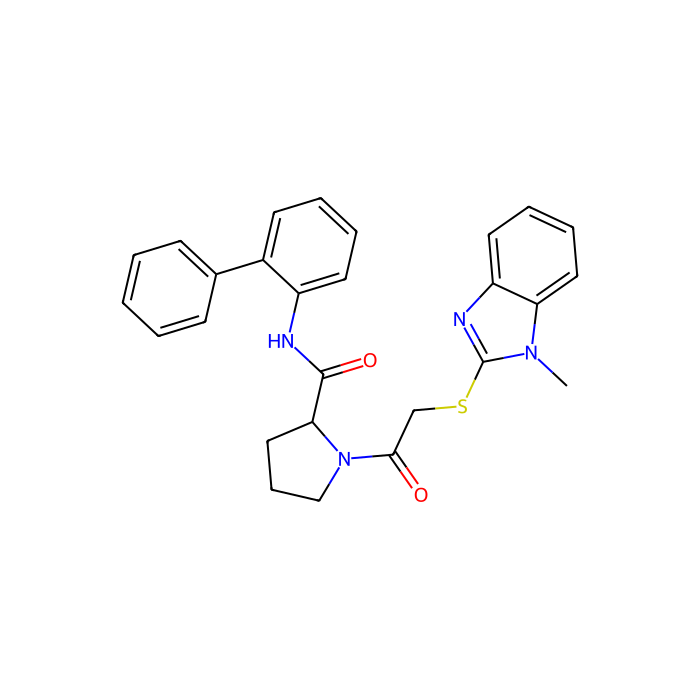
Product Describtion: TCS 1102 is a potent, dual orexin receptor antagonist (Ki values are 0.2 and 3 nM for OX2 and OX1 receptors respectively). IC50 value: 0.2 nM (Ki, OX2 receptor); 3 nM (Ki, OX1 receptor) ;Target: OX2 and OX1 receptor TCS-1102 (10 and 20 mg/kg, i.p.) were found to decrease fear and anxiety in rats 14 days after exposure to footshock.Furthermore, TCS-1102 (10 mg/kg, i.p.) was found to have anxiolytic effects that were specific for HR when tested in the elevated T-maze.
This compound belongs to the class of organic compounds known as proline and derivatives. These are compounds containing proline or a derivative thereof resulting from reaction of proline at the amino group or the carboxy group, or from the replacement of any hydrogen of glycine by a heteroatom.
External Descriptors
Not available
1. Djoumbou Feunang Y, Eisner R, Knox C, Chepelev L, Hastings J, Owen G, Fahy E, Steinbeck C, Subramanian S, Bolton E, Greiner R, and Wishart DS. ClassyFire: Automated Chemical Classification With A Comprehensive, Computable Taxonomy. Journal of Cheminformatics, 2016, 8:61.
Solvent:DMSO, Max Conc. mg/mL: 47.06, Max Conc. mM: 100; Solvent:ethanol, Max Conc. mg/mL: 47.06, Max Conc. mM: 100
Poids moléculaire
470.600 g/mol
XLogP3
4.900
Hydrogen Bond Donor Count
1
Hydrogen Bond Acceptor Count
4
Rotatable Bond Count
6
Exact Mass
470.178 Da
Monoisotopic Mass
470.178 Da
Topological Polar Surface Area
92.500 Ų
Heavy Atom Count
34
Formal Charge
0
Complexity
715.000
Isotope Atom Count
0
Defined Atom Stereocenter Count
1
Undefined Atom Stereocenter Count
0
Defined Bond Stereocenter Count
0
Undefined Bond Stereocenter Count
0
The total count of all stereochemical bonds
0
Covalently-Bonded Unit Count
1
Calculateurs de solution
Molarity Calculator
Determine the necessary mass, volume, or concentration for preparing a solution.
Dilution Calculator
Determine the dilution needed to prepare a stock solution.
Reconstitution Calculator
Avis
Avis des clients
Application Protocols
Item-specific facts (from Product Data)
No validated application protocols (e.g., assay formats, concentrations, or procedural steps) are provided for this item.
General workflow suggestions (for small-molecule screening; not item-specific)
Prepare a 10–50 mM DMSO stock; filter if necessary (0.22 µm PTFE) to remove particulates.
Perform a solubility/stability pretest at working concentrations across your assay buffer(s) and temperature/time profile.
Run a pilot dose–response (e.g., 10-point, 1:3 or 1:2 serial dilution) to identify active ranges and potential bell-shaped curves.
Include controls: vehicle control, known active comparator (if applicable), and orthogonal readouts to flag assay interference.
Record batch/lot, stock age, and freeze–thaw count in the ELN for reproducibility.
For any item-specific instructions, consult the CoA/Spec Sheet supplied with your lot.
Biological Roles
Item-specific facts (from Product Data)
No biological target, pathway, or mode of action is specified for this item.
General guidance for research use of unidentified/unspecified tool compounds
Without a confirmed structure and annotated pharmacology, TCS 1102 should be treated as an exploratory research small molecule. Do not infer biological roles or therapeutic relevance.
If used in assays, implement orthogonal readouts and rigorous controls to distinguish on-target effects from assay interference or nonspecific toxicity.
Once structural data and literature associations are confirmed (via CoA/Spec or vendor portal), consult primary references to understand any reported target selectivity, potency (IC50/EC50), and off-target profiles.
Important note
This product is labeled for research use only and is not intended for diagnostic, clinical, or veterinary applications.
Buffer Applications
Applicability
TCS 1102 is a small-molecule research compound, not a buffering agent. It is not typically used to establish or maintain pH.
Assay-related buffer considerations (general)
Vehicle control: Maintain constant DMSO (or other solvent) percentage across all buffer conditions.
Protein-containing buffers: Include 0.05–0.1% BSA to reduce nonspecific binding and adsorption to plastics if compound loss is suspected.
Detergent: A low level of non-ionic detergent (e.g., 0.01–0.05% Tween-20) can mitigate aggregation artifacts in enzyme or receptor assays.
pH and ionic strength: Optimize based on the biological target; absent item-specific pKa information, avoid extreme pH to minimize compound degradation.
Specifications
No buffer pKa or capacity parameters are provided for this item; refer to CoA/Spec Sheet for any available solubility/pH notes.
Green Alternatives
Context
As a discrete research compound, TCS 1102 itself does not have a “green substitute” in the way a common solvent or reagent would. However, greener handling can be applied to its use and formulation.
Greener handling suggestions (general; not item-specific specifications)
Solvent choice: Prefer DMSO or ethanol over high-toxicity polar aprotic solvents when assay-compatible. If DMF/NMP are necessary for dissolution, use at the lowest feasible percentage and consider rapid dilution into aqueous media.
Micro-scale operations: Conduct screening at micromolar concentrations and minimal volumes to reduce chemical footprint and waste.
Waste minimization: Consolidate DMSO-containing assay waste and coordinate with institutional hazardous waste programs to optimize disposal.
Energy efficiency: Store in high-efficiency −20°C freezers; batch retrievals to reduce door-open time.
Comparison of common stock solvents (general)
DMSO: Broad solubility, relatively benign profile, miscible with water; often preferred for screening stocks.
Ethanol: Renewable feedstock potential; limited solubility for highly lipophilic chemotypes.
DMF/NMP: Excellent solvency but higher toxicological concern; avoid when possible or minimize use.
Documentation
Capture solvent selection rationale in ELNs to support green chemistry metrics (e.g., solvent selection guides) for your project.
Pharmaceutical Uses
Applicability
This product is offered strictly for research use as part of a small-molecule library. It is not an approved excipient or active pharmaceutical ingredient.
General R&D formulation context (not item-specific specifications)
Early discovery: Compounds like this are formulated as DMSO stocks for in vitro screening and, if properties allow, may be assessed in simple vehicles for exploratory in vivo research under appropriate approvals. No such use is specified or endorsed here.
Preformulation assessment: If progression is contemplated, evaluate solubility, stability, and compatibility with common vehicles (e.g., PEG400/saline, cyclodextrins) in accordance with institutional guidelines. Do not extrapolate to clinical use.
Regulatory note
No pharmacopeial monograph or compendial status is indicated. Any GMP-relevant specifications, impurity controls, or residual solvent limits are not provided for this item.
Physical Properties
Item-specific facts (from Product Data)
Physical state/appearance: Not specified for this item; refer to CoA/Spec Sheet.
Molecular weight: Not specified for this item; refer to CoA/Spec Sheet.
Solubility, melting point, boiling point, density, logP, pKa, refractive index: Not specified for this item; refer to CoA/Spec Sheet.
General/literature guidance for small-molecule library compounds (not specifications)
Stock solutions: Most discovery-tool small molecules are formulated at 10–50 mM in anhydrous DMSO for screening. Confirm solubility and stability before committing to large stocks.
Aqueous handling: When diluting DMSO stocks into aqueous buffers, keep final DMSO ≤0.1–1% v/v for biochemical assays and ≤0.1–0.5% v/v for sensitive cell systems, as appropriate to your assay.
Hygroscopicity/photo-lability: Many heteroaromatic or conjugated scaffolds can be light- and/or air-sensitive; store frozen, desiccated, and protected from light until use.
Stability: Minimize freeze–thaw cycles by aliquoting; assess solution stability by LC–MS over your experimental time frame.
Recommendations
Determine experimental solubility by incremental addition of solvent with visual inspection and LC–MS verification.
If poor DMSO solubility is encountered, consider co-solvents (DMF, 1-methyl-2-pyrrolidone) or formulate with gentle heating (<40°C) and sonication; verify that no decomposition occurs.
Quality and Grades
Item-specific facts (from Product Data)
Grade/Purity: Moligand™
What Moligand™ typically signifies (general program description; not item-specific specifications)
Moligand indicates inclusion in a curated small-molecule/compound library intended for discovery research (biochemical/cellular screening, target engagement, mechanism studies). Compounds are generally provided with lot-traceable documentation and are suitable for hit finding, SAR exploration, and probe development workflows.
Typical program-level quality elements may include identity confirmation by LC–MS and/or NMR and chromatographic purity evaluation; however, exact test methods, thresholds, and stabilizers (if any) are lot-specific.
Critical notes for this item
Exact purity percentage, analytical methods (e.g., HPLC area %, NMR), water/peroxide/metal limits, and UV specifications: Not specified for this item; refer to CoA/Spec Sheet.
Stabilizers/inhibitors: Not specified for this item; refer to CoA/Spec Sheet.
Best practices
On receipt, verify identity/purity against the CoA using in-house LC–MS or HPLC to ensure fitness for your assay.
If low-UV applications (HPLC/UPLC at 210–254 nm) are planned, confirm baseline characteristics with a test chromatogram from your own system, as UV cutoff is not specified for this item.
Reaction and Applications
Item-specific facts (from Product Data)
Manufacturer applications: Not specified beyond inclusion in a small-molecule/compound library.
How this product is typically used (general guidance for library/tool compounds)
Screening and target engagement: Employed as a chemical probe candidate in biochemical assays (enzyme activity, receptor binding) or phenotypic cell assays to generate primary hits or validate pathways.
SAR and profiling: Use as a starting point in structure–activity relationship studies by analog comparison, when structural information becomes available from the CoA or vendor portal.
Orthogonal assay confirmation: Evaluate activity in multiple assay modalities (biochemical vs cellular, target-based vs phenotypic) to reduce false positives due to assay interference.
ADME triage: Conduct solubility, stability (chemical and metabolic), and permeability assays early to assess suitability as a probe.
Assay implementation tips (general)
DMSO management: Keep final DMSO concentration consistent across wells/conditions; include vehicle controls.
Aggregation control: Include low detergent (e.g., 0.01% Triton X-100) or BSA to mitigate promiscuous aggregation if assay artifacts are suspected.
Redox/fluorescence interference: Run counter-screens for redox cycling (e.g., HRP/Amplex) and optical interference (absorbance/fluorescence) when working near UV–Vis/fluorophore ranges.
Note: No target, mechanism, or reaction chemistry is specified for this item. For mechanistic studies, consult primary literature once the structure is confirmed.
Reaction Conditions
Not typically applicable
This product is a discrete research compound, not a reagent or catalyst. No synthetic or catalytic reaction conditions are specified for its use.
General guidance for assay preparation (not reaction conditions)
Stock preparation: Dissolve in anhydrous DMSO to a convenient concentration (e.g., 10–50 mM), then aliquot and store at −20°C.
Assay dosing: Dilute into assay buffer to the desired working concentration, keeping final DMSO constant across conditions and controls.
Quality checks: Verify concentration by UV–Vis if chromophore is present or by quantitative NMR/LC–MS as appropriate.
Item-specific conditions
None provided; refer to CoA/Spec Sheet for any lot-specific handling notes.
Safety and Handling
Item-specific facts (from Product Data)
GHS signal word, hazard statements, pictograms, classification: Not specified for this item; refer to SDS.
Storage: Store at −20°C; shipped cold (ice chest + ice pads).
General safety guidance (not a substitute for SDS)
PPE: Laboratory coat, nitrile gloves, and safety glasses as minimum. Upgrade to splash goggles/face shield if preparing concentrated solutions or using pressurized systems.
Engineering controls: Handle powders/aliquots in a fume hood to avoid inhalation and to control solvent vapors during solution prep.
Incompatibilities: Until specific functional groups are known, avoid strong oxidizers and strong acids/bases; do not mix with reactive metal hydrides. Keep away from ignition sources when using flammable solvents (DMSO itself is low volatility but co-solvents may be flammable).
First aid (general):
Inhalation: Move to fresh air; seek medical attention if symptoms persist.
Skin/eye contact: Rinse with water for at least 15 minutes; remove contaminated clothing; seek medical advice for irritation.
Ingestion: Rinse mouth; do not induce vomiting; seek medical attention.
Spill response: Absorb liquid spills with inert material; for solids, avoid dust formation, gently sweep under fume hood; dispose per institutional chemical waste procedures.
Special risks: Unknown peroxide formation tendency or sensitization potential; therefore, keep quantities small, label clearly, and consult SDS upon receipt for definitive hazard data.
Always defer to the product’s SDS for authoritative hazard and response information.
Solvent Selection
Item-specific facts (from Product Data)
Solubility profile: Not specified for this item; refer to CoA/Spec Sheet.
General guidance for small-molecule library compounds (not specifications)
Primary solvent: Anhydrous DMSO is the default for discovery compounds due to broad solvating power and biological assay compatibility at low percentages.
Alternative solvents: DMF, NMP, ethanol, methanol can assist with dissolution; confirm assay compatibility and cytotoxicity of co-solvents.
Aqueous dilution: Add DMSO stock to vigorously stirred buffer to avoid local supersaturation; include carrier protein (e.g., 0.1% BSA) or non-ionic surfactant (e.g., 0.01–0.05% Tween-20) where nonspecific adsorption or precipitation is observed.
pH effects: If the compound is ionizable, solubility can vary with pH. Without pKa data for this item, perform a small pH-solubility screen (e.g., pH 5.5, 7.4, 9.0) to optimize assay media.
Quick comparison (general)
DMSO: Highest success rate for dissolution; low volatility; biologically tolerated at ≤0.1–1% v/v.
DMF/NMP: Strong solvents; check toxicity and plastic compatibility; use sparingly.
EtOH/MeOH: Volatile, easier to remove; lower solvating power for polyaromatics.
Practical tips
Warm gently (≤40°C) and sonicate to aid dissolution; filter 0.22 µm if needed.
Prepare single-use aliquots to minimize freeze–thaw and moisture uptake.
Storage and Reconstitution
Item-specific facts (from Product Data)
Storage conditions: Store at −20°C.
Shipping: Ice chest with ice pads.
Appearance: Not specified for this item; refer to CoA/Spec Sheet.
General best practices (not specifications)
As-received solid: Keep container tightly closed under dry, inert conditions (desiccant recommended). Protect from light until the structure and photostability are known.
Aliquoting: Upon first opening, divide into single-use aliquots in inert vials (glass preferred) to minimize moisture uptake and freeze–thaw cycles.
Reconstitution: Prepare concentrated stock in anhydrous DMSO (typical 10–50 mM). Gently warm (≤40°C) and sonicate to aid dissolution if needed; avoid prolonged heating. Verify complete dissolution visually and by a quick analytical check if critical.
Storage of solutions: Store DMSO stocks at −20°C or −80°C in tightly sealed vials. Use within a timeframe established by your own stability checks (e.g., periodic LC–MS).
Handling notes: Allow frozen vials to equilibrate to room temperature before opening to prevent condensation ingress. Return unused aliquots promptly to cold storage.
Specifications not provided
Exact solubility, stability window, and recommended maximum freeze–thaw cycles: Not specified for this item; refer to CoA/Spec Sheet.
Structure and Identity
Brief overview
This product is supplied as part of Aladdin’s Moligand small-molecule/compound library offerings and is intended for research use only.
Item-specific facts (from Product Data)
Product name: TCS 1102 (SKU: T287352)
CAS: 916141-36-1
Category: Small molecule/compound library (Moligand)
Storage: Store at −20°C; shipped in ice chest with ice pads
InChIKey: Not specified for this item; refer to CoA/Spec Sheet. (Note: the value “445392” in Product Data does not match the standard InChIKey format.)
SMILES: Not specified for this item; refer to CoA/Spec Sheet.
Molecular formula: Not specified for this item; refer to CoA/Spec Sheet.
Molecular weight: Not specified for this item; refer to CoA/Spec Sheet.
General/literature notes
Structural features, ring systems, and functional groups cannot be described without a verified structure. If you require structural descriptors (2D depiction, SMILES, InChI/InChIKey), please request the current CoA/Spec sheet or confirm via a trusted database using the CAS (916141-36-1) or the catalog’s internal reference.
Practical identification tips
Verify identity by LC–MS and 1H NMR against reference spectra from the CoA when first received.
Retain lot-specific documentation for audit trails and reproducibility.
Synthetic Utility
Applicability
TCS 1102 is supplied as a finished small molecule for screening and is not presented as a synthetic reagent or building block.
General considerations (when structural information becomes available)
If the structure contains handle(s) amenable to diversification (e.g., aryl halide, boronate, nitrile, amide), analog synthesis routes may be devised for SAR. Without verified structure, no specific transformations can be recommended.
Protecting-group and chemoselectivity strategies would be dictated by the functional groups present; consult the CoA/structure before attempting derivatization.
Practical guidance
For custom analog work, confirm unambiguous structure by 1D/2D NMR and HRMS prior to route design.
Establish impurity profiles and stability-indicating analytical methods early to support iterative synthesis.
Target Specificity
Item-specific facts (from Product Data)
No target, selectivity profile, species reactivity, or mode of action is provided for this item.
Guidance
If you intend to use TCS 1102 as a putative tool compound, obtain or confirm the structure and then consult peer-reviewed literature or trusted databases for any reported target associations tied to CAS 916141-36-1.
Independently verify activity in your system with appropriate positive controls, counter-screens, and dose–response analysis.
Foire aux questions
What is the purity of this product, and how is it determined?
This product is supplied at ≥98% purity, determined by HPLC. Lot-specific values are stated on the Certificate of Analysis.
What is Moligand??
Moligand? is one of Aladdin Scientific's premium product lines, formulated for high-purity applications across multiple workflows. Compared to standard grades in the same workflow, Moligand? products typically offer tighter specifications, more rigorous QC, and stronger lot-to-lot consistency.
How should this product be stored?
Store at ?20 °C. Freezer storage is required to maintain the specified shelf life.
How is this product shipped?
This product ships in an insulated container with ice pads. Unpack on arrival and transfer it to the storage condition stated above.
What are the CAS number, molecular formula and molecular weight?
The CAS Number is 916141-36-1, the molecular formula is C??H??N?O?S, and the molecular weight is 470.59 g/mol. InChIKey YSBGRVXJEMSEQY-DEOSSOPVSA-N.
What documentation is provided?
Available product documentation, including Certificates of Analysis (COA), Safety Data Sheets (SDS), and specification sheets, is shown in the product document area. Document availability and access follow the current site policy.
Besoin d'aide pour choisir la qualité ?
Notre guide de sélection des qualités couvre la pureté, le statut du stabilisant et l'adéquation à l'application pour toutes les variantes de notre catalogue.
Nous utilisons des cookies pour garantir le bon fonctionnement du site et, lorsque cela est autorisé, pour améliorer votre expérience. Vous pouvez gérer vos préférences à tout moment dans les Paramètres. Pour en savoir plus, consultez notre Politique relative aux cookies.
Souhaitez-vous que nous vous envoyions un message lorsque des réductions seront disponibles?
Me rappeler plus tard
Merci ! Veuillez vérifier votre boîte de réception e-mail pour confirmer.
Products are supplied to verified businesses, institutions, and qualified professionals for research and development use only. Not for use in humans, animals, diagnosis, or therapy.

 L2419317