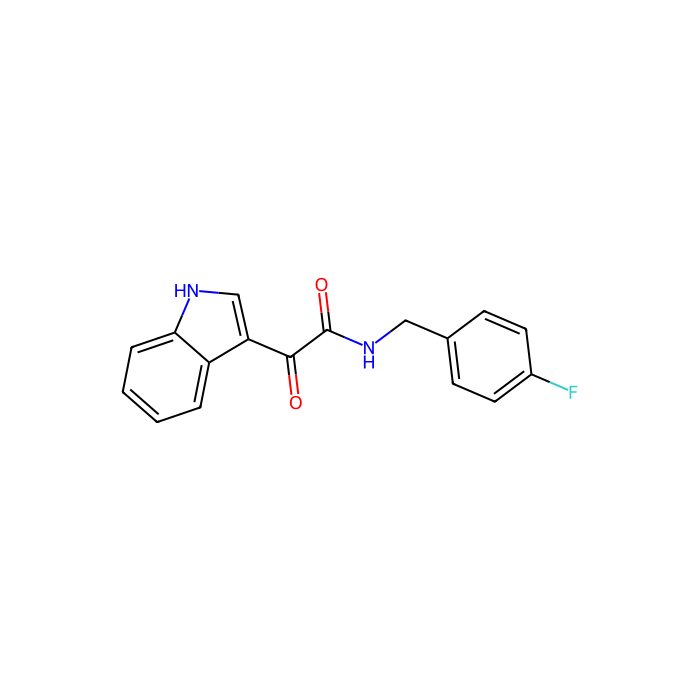
TCS 1105 - ≥99%(HPLC) , CAS No.185391-33-7

CAS: 185391-33-7 Cat. No.: T286790 Formule: C17H13FN2O2 Poids moléculaire: 296.3 PubChem CID: 2986030
DISPONIBLE À COMMANDE
QUALITÉ & PURETÉ ≥99%(HPLC)
Synonyms
N-(4-fluorobenzyl)-2-(1H-indol-3-yl)-2-oxoacetamide|N-[(-4-Fluorophenyl)methyl]-α-oxo-1H-indole-3-acetamide
Storage
Store at -20°C
Shipped In
Ice chest + Ice pads
★
Taille
Allemagne (EU)
USA*
Prix
Qté
5mg
T286790-5mg
—
3 En stock
122,26€
10mg
T286790-10mg
—
3 En stock
219,45€
25mg
T286790-25mg
—
3 En stock
482,38€
50mg
T286790-50mg
—
3 En stock
918,85€
100mg
T286790-100mg
—
3 En stock
1 735,39€
250mg
T286790-250mg
Sur commande · 8–12 semaines
2 950,23€
Enter a quantity for the sizes you want to add.

Spécifications

Synonymes
N-(4-fluorobenzyl)-2-(1H-indol-3-yl)-2-oxoacetamide | N-[(-4-Fluorophenyl)methyl]-α-oxo-1H-indole-3-acetamide
Spécifications et pureté
≥99%(HPLC)
Mécanismes biochimiques et physiologiques
GABAAbenzodiazepine receptor (BZR) ligand. Acts as an agonist atα2and antagonist atα1benzodiazepine receptors (Kivalues are 118 and 245 nM respectively). Anxiolytic agent lacking sedative activity.
Conditions de stockage de stockage
Store at -20°C
Expédié en
Ice chest + Ice pads
Ce produit nécessite l'expédition en chaîne froide. Les services terrestres et autres services économiques ne sont pas disponibles.
Pureté
≥99%(HPLC)
Noms et identifiants
Pubchem Sid
Pubchem Sid Url
https://pubchem.ncbi.nlm.nih.gov/substance/504762266
SMILES
C1=CC=C2C(=C1)C(=CN2)C(=O)C(=O)NCC3=CC=C(C=C3)F
IUPAC Name
N-[(4-fluorophenyl)methyl]-2-(1H-indol-3-yl)-2-oxoacetamide
InChIKey
VWCCHJFFYCGXFL-UHFFFAOYSA-N
InChI
1S/C17H13FN2O2/c18-12-7-5-11(6-8-12)9-20-17(22)16(21)14-10-19-15-4-2-1-3-13(14)15/h1-8,10,19H,9H2,(H,20,22)
Isomères SMILES
C1=CC=C2C(=C1)C(=CN2)C(=O)C(=O)NCC3=CC=C(C=C3)F
PubChem CID
2986030
Poids moléculaire
296.3

Données avancées

Taxonomic Classification

Taxonomy Tree

KingdomOrganic compounds
SuperclassOrganoheterocyclic compounds
ClasseIndoles and derivatives
SubclassIndoles
Intermediate Tree Nodes Not available
Direct ParentIndoles
Alternative Parents Aryl ketones  Fluorobenzenes  Substituted pyrroles  Aryl fluorides  Vinylogous amides  Heteroaromatic compounds  Secondary carboxylic acid amides  Azacyclic compounds  Organopnictogen compounds  Organonitrogen compounds  Organofluorides  Organic oxides  Hydrocarbon derivatives  
Molecular FrameworkAromatic heteropolycyclic compounds
Substituents Indole - Aryl ketone - Fluorobenzene - Halobenzene - Aryl fluoride - Aryl halide - Monocyclic benzene moiety - Benzenoid - Substituted pyrrole - Heteroaromatic compound - Vinylogous amide - Pyrrole - Carboxamide group - Secondary carboxylic acid amide - Ketone - Carboxylic acid derivative - Azacycle - Organonitrogen compound - Organooxygen compound - Organic nitrogen compound - Hydrocarbon derivative - Organic oxide - Carbonyl group - Organopnictogen compound - Organic oxygen compound - Organohalogen compound - Organofluoride - Aromatic heteropolycyclic compound
DescriptionThis compound belongs to the class of organic compounds known as indoles. These are compounds containing an indole moiety, which consists of pyrrole ring fused to benzene to form 2,3-benzopyrrole.
External Descriptors Not available
Structure 3D
Modèle de structure chimique interactif


Cibles associées (humaines)
GABRA2 Tclin GABA receptor alpha-2 subunit (271 Activities)
Activity TypeRelationActivity valueUnitsAction TypeJournalPubMed IddoiAssay Aladdin ID
Cibles associées (non humaines)
Mus musculus (284745 Activities)
Activity TypeRelationActivity valueUnitsAction TypeJournalPubMed IddoiAssay Aladdin ID
Gabrp GABA-A receptor; anion channel (5731 Activities)
Activity TypeRelationActivity valueUnitsAction TypeJournalPubMed IddoiAssay Aladdin ID
Gabrg2 GABA-A receptor; alpha-1/beta-2/gamma-2 (554 Activities)
Activity TypeRelationActivity valueUnitsAction TypeJournalPubMed IddoiAssay Aladdin ID
Mécanismes d'action
Certificats (CoA, COO, BSE/TSE et tableau d'analyse)
C of A & Other Certificates(BSE/TSE, COO):
Analytical Chart:

Find and download the COA for your product by matching the lot number on the packaging.

5 results found

Lot NumberCertificate TypeDateArticle
I2219280I2219280Certificate of AnalysisJul 10, 2025 T286790
I2219281I2219281Certificate of AnalysisJul 10, 2025 T286790
I2219282I2219282Certificate of AnalysisJul 10, 2025 T286790
I2219354I2219354Certificate of AnalysisJul 10, 2025 T286790
I2219355I2219355Certificate of AnalysisJul 10, 2025 T286790
Propriétés chimiques et physiques
SolubilitéSolvent:DMSO, Max Conc. mg/mL: 29.63, Max Conc. mM: 100; Solvent:ethanol, Max Conc. mg/mL: 5.93, Max Conc. mM: 20
Poids moléculaire296.290 g/mol
XLogP33.200
Hydrogen Bond Donor Count2
Hydrogen Bond Acceptor Count3
Rotatable Bond Count4
Exact Mass296.096 Da
Monoisotopic Mass296.096 Da
Topological Polar Surface Area62.000 Ų
Heavy Atom Count22
Formal Charge0
Complexity421.000
Isotope Atom Count0
Defined Atom Stereocenter Count0
Undefined Atom Stereocenter Count0
Defined Bond Stereocenter Count0
Undefined Bond Stereocenter Count0
The total count of all stereochemical bonds0
Covalently-Bonded Unit Count1
Calculateurs de solution
Avis

Avis des clients

Application Protocols

No manufacturer-validated protocols are provided for this item. The following general steps apply to small-molecule use in research settings (non-item-specific):

  • Stock preparation: Dissolve in dry DMSO to 10–50 mM. Vortex and, if needed, sonicate briefly. Record exact concentration by weight-in or quantitative NMR.
  • Working solutions: Dilute into assay buffer or media to the required concentration, maintaining final DMSO ≤0.1–1% v/v as assay compatibility allows. Mix thoroughly to avoid localized precipitation.
  • Filtration: If sterility or particulate-free solutions are required, filter through 0.22 µm PTFE (organic) or PES (aqueous) membranes; pre-rinse filters to minimize adsorption.
  • Controls: Include vehicle-only controls and, where applicable, a positive control compound with a well-defined response.
  • Documentation: Record lot number, storage history, and number of freeze–thaw cycles for data traceability.
Biological Roles

Item-specific biological target(s) or mechanism(s) of action for TCS 1105 are not provided in the product data. No claims are made regarding biological activity. For research planning, consult primary literature using the CAS (185391-33-7) or PubChem CID (2986030) to determine any reported targets, pathways, and assay systems.

General considerations for small-molecule tool compounds (not item-specific):

  • Target engagement: Verify binding or functional modulation via orthogonal assays (biochemical potency, biophysical confirmation such as SPR/DSF, and cellular readouts).
  • Selectivity profiling: Employ broad panels (e.g., kinases, GPCRs, ion channels as relevant) to assess off-target activity and establish a clean mechanism.
  • ADME liabilities: Assess solubility, chemical stability (pH 2–9), microsomal stability, and permeability (PAMPA/Caco-2) when relevant to in vitro biology.
  • Aggregation/artifacts: Screen for colloidal aggregation and redox interference; include detergent controls and assay counter-screens.

Research use only: This product is not intended for human or animal therapeutic use, clinical diagnostics, or in vivo administration without appropriate ethical and regulatory approvals.

Buffer Applications

TCS 1105 is not a buffering agent, and no item-specific pKa data are provided. Consequently, it is not typically used to establish or maintain buffer pH.

Practical notes for incorporating small molecules into buffers (general guidance):

  • Prepare a concentrated stock in DMSO or ethanol, then dilute into the target buffer while vortexing to minimize precipitation. Keep the final organic solvent fraction within assay-tolerated limits (often ≤0.1–1% v/v).
  • If precipitation occurs on dilution, consider: raising ionic strength slightly, adding a non-ionic surfactant (e.g., 0.01–0.05% Tween 80), or using cyclodextrin complexes (e.g., 2–10% w/v HP-β-CD) to enhance apparent solubility.
  • Filter sterilization: Use 0.22 µm PTFE (for organic-rich vehicles) or PES (for aqueous vehicles) if sterile solutions are required. Verify compound recovery, as adsorption can occur.
  • Avoid extreme pH unless stability has been demonstrated; hydrolysis or isomerization risks are unknown for this item.
Green Alternatives

Because TCS 1105 is a discrete small-molecule research chemical (not a solvent or bulk reagent), the primary “green chemistry” considerations relate to solvent and process choices during handling, analysis, and any derivative synthesis rather than to substituting the molecule itself.

Greener practice suggestions (general, not item-specific):

  • Prefer low-toxicity, biorenewable solvents where compatible with solubility and stability: 2-MeTHF instead of THF, CPME or EtOAc instead of CH2Cl2, propylene carbonate or Cyrene in place of DMF/DMSO in some contexts.
  • Minimize solvent volumes via microscale reactions and high-throughput solubility screens.
  • Use aqueous workups with brine-sparing techniques and solid-supported scavengers to reduce chlorinated waste.
  • Adopt UPLC with shorter columns and water-rich mobile phases to reduce acetonitrile consumption.

Illustrative comparison (literature, general):

  • THF vs 2-MeTHF: Similar polarity and ether functionality; 2-MeTHF offers improved stability to peroxide formation and is partially biorenewable, but can have higher UV background.
  • DCM vs EtOAc/CPME: EtOAc/CPME reduce chlorinated emissions; EtOAc is readily biodegradable, though it has higher flammability and different selectivity.

Always balance green metrics with data quality, safety, and the specific solubility/stability profile of the compound.

Pharmaceutical Uses
  • Formulation/excipient status: Not specified for this item; no pharmacopeial monograph indicated. This product is offered strictly for research use only.

Context for researchers (general, non-item-specific):

  • Tool compounds are often employed in pre-formulation screens to understand solubility, stability, and compatibility with excipients; data are used for in vitro or exploratory studies, not for clinical use.
  • If dissolution enhancement is needed for in vitro dosing, consider solid dispersion approaches (polymer carriers), salt/cocrystal screening (if ionizable or coformer-compatible), or inclusion complexes (cyclodextrins).
  • For any in vivo or translational work (not covered by this listing), ensure material is sourced with appropriate quality attributes (impurity profiling, residual solvents, endotoxin/bioburden controls) and approvals.

No therapeutic claims are made. This product is not intended for human or veterinary administration or diagnostic use.

Physical Properties

Item-specific physico-chemical properties are not provided in the product data. The following fields should be confirmed on the CoA/Spec Sheet or via primary literature:

  • Melting point: Not specified for this item; refer to CoA/Spec Sheet.
  • Boiling point: Not specified for this item; refer to CoA/Spec Sheet.
  • Density: Not specified for this item; refer to CoA/Spec Sheet.
  • Solubility profile (water/organic): Not specified for this item; refer to CoA/Spec Sheet.
  • Partition coefficient (logP/logD): Not specified for this item; refer to CoA/Spec Sheet.
  • pKa(s): Not specified for this item; refer to CoA/Spec Sheet.
  • Refractive index: Not applicable for solids; if liquid, not specified.

General guidance (literature/practice, not item-specific):

  • Many drug-like small molecules are sparingly soluble in water but dissolve well in polar aprotic solvents (DMSO, DMF) and moderately in alcohols or chlorinated solvents.
  • If aqueous work is required, prepare a concentrated DMSO stock (e.g., 10–50 mM) and dilute into buffer, keeping final DMSO ≤0.1–1% v/v as assay tolerance allows.
  • For unknown ionization, measure UV-pH solubility or perform a cosolvent gradient screen (water/MeOH/ACN/IPA) to identify a working vehicle.
  • Validate concentration by UV-Vis or quantitative NMR if an extinction coefficient is unavailable.
Quality and Grades
  • Grade/purity: Not specified for this item; refer to CoA/Spec Sheet.

Interpreting common grades (general guidance):

  • Research grade: Suitable for exploratory laboratory use; specifications focus on identity/purity but may not include trace impurity profiling.
  • HPLC grade solvents/reagents: Low UV background and particulate; used when chromatographic detection is sensitive to impurities.
  • Analytical reagent (AR) or ACS grade: Meet compendial specifications for many assays; trace metals and moisture often controlled.

What to verify for this item:

  • Identity confirmation: 1H/13C NMR, HRMS, and where relevant, HPLC/UPLC purity profile and retention time versus reference.
  • Residual solvents, water content (KF), and inorganic residue: Not specified for this item; consult CoA if critical for your application.
  • Stabilizers/inhibitors: Not specified for this item; refer to CoA/Spec Sheet. If none are listed, assume the solid/liquid is provided neat.

Recommendations:

  • If using in quantitative biology or materials studies, request the latest CoA with batch-specific purity, assay method, and chromatographic conditions.
  • For long studies, retain a retain-sample and document chain-of-custody, storage conditions, and any reprocessing (drying, recrystallization) performed in-house.
Reaction and Applications

No item-specific reactivity or application notes are provided. Given that TCS 1105 is supplied as a research-use small molecule rather than a commodity reagent, it is not typically employed as a general-purpose catalyst, solvent, or stoichiometric reagent in synthesis.

General research uses (non-item-specific):

  • Tool compound workflows: preparation of DMSO stocks for biochemical or cell-based assays, target engagement studies, and structure–activity relationship (SAR) comparisons against analogs.
  • Analytical characterization: LC–MS and HPLC method development for purity assessment, stability-indicating assays, and metabolite profiling if used in biological matrices.
  • Formulation screening: Solubility and stability mapping across vehicles to support in vitro dosing or materials compatibility testing.

Practical tips:

  • Confirm identity and purity by orthogonal methods (NMR, LC–MS, FTIR) before biological testing.
  • Establish a freeze–thaw management plan (aliquoting) and a light/moisture control strategy to avoid drift in assay potency.
  • If derivatives are to be synthesized for SAR, retain an unmodified reference vial to benchmark activity and chromatographic behavior across batches.
Reaction Conditions

No item-specific reaction conditions are applicable because TCS 1105 is not provided as a reagent for a defined transformation. If synthetic modification is undertaken for research purposes, adopt standard, literature-based conditions aligned to the functional groups present (once known), for example:

  • Cross-coupling (literature, general): Pd(0/II) catalysts (e.g., Pd(PPh3)4, Pd2(dba)3/XPhos), bases (K2CO3, Cs2CO3), and solvents (2-MeTHF, dioxane, toluene, CPME) at 60–110 °C.
  • Amide coupling: Carbodiimide (EDC/HOBt) or uronium reagents (HATU, TBTU) in DMF/MeCN with DIPEA at 0–25 °C.
  • Reductive amination: NaBH3CN or BH3·THF in MeOH/THF with molecular sieves at 0–25 °C.
  • Heteroaromatic N-oxidation/reduction and late-stage functionalization methods should be selected based on the confirmed scaffold.

All conditions above are generic literature guidance and must be tailored only after the compound’s structure and compatibility are known.

Safety and Handling
  • GHS/CLP classification: Not specified for this item; refer to SDS.
  • Signal word and H-statements: Not specified for this item; refer to SDS.
  • Pictograms: Not specified for this item; refer to SDS.

General laboratory precautions (good practice, not item-specific):

  • Handle in a fume hood with appropriate PPE: lab coat, safety glasses, and suitable chemically resistant gloves (e.g., nitrile). Avoid inhalation of dust/aerosols and skin contact.
  • Prevent environmental release; collect waste in appropriate organic waste streams per institutional and local regulations.
  • Storage incompatibilities cannot be confirmed without a structure; as a precaution, segregate from strong oxidizers and acids/bases until specific incompatibilities are known.
  • First aid (overview; defer to SDS for authoritative guidance):
    • Inhalation: Move to fresh air; seek medical attention if symptoms persist.
    • Skin/eye contact: Flush with water for at least 15 minutes; remove contaminated clothing; obtain medical advice.
    • Ingestion: Rinse mouth; do not induce vomiting unless directed by medical personnel; seek medical attention.
  • Spill response: Cover solids with inert absorbent, avoid dust generation, collect mechanically; decontaminate area with suitable solvent/detergent per SDS.
  • Thermal/photolytic sensitivity unknown; protect from heat and light as a precaution until stability is established.
Solvent Selection

Item-specific solubility is not provided. The following is a practical, non-item-specific approach for small-molecule dissolution and handling:

  • Primary stock solvents

    • DMSO: First-line solvent for many neutral/ionizable drug-like molecules; prepare 10–50 mM stocks.
    • DMF or NMP: Useful when DMSO solubility is limited; consider toxicity and assay compatibility.
    • Ethanol/Isopropanol: Appropriate for some lipophilic compounds; watch precipitation on aqueous dilution.
  • Cosolvent and vehicle strategies

    • Aqueous buffers with 0.1–1% DMSO or ethanol; add organic last under vortex to minimize precipitation.
    • For challenging solubility, include surfactants (e.g., 0.01–0.1% Tween 80) or complexing agents (hydroxypropyl-β-cyclodextrin, 2–10% w/v), subject to assay tolerance.
  • Selection considerations

    • Target assay modality (biochemical vs. cell-based) dictates vehicle tolerance; validate final solvent percentage for cytotoxicity or assay interference.
    • If the compound is basic/acidic (unknown here), mild pH adjustment can improve solubility; avoid extreme pH unless stability is demonstrated.
  • Quick screening panel

    • Water, PBS, MeOH, ACN, IPA, DCM, EtOAc, THF, toluene. Observe for clarity, color change, and stability over 24–48 h at room temperature and 4 °C.
Storage and Reconstitution
  • Storage conditions (item-specific): Store at -20 °C. Shipped in ice chest with ice pads. Protect from moisture and excessive heat. Keep container tightly closed.
  • Stability: Batch-specific stability data are not provided; refer to CoA/Spec Sheet. Until known, minimize exposure to light and air.
  • Reconstitution (general guidance):
    • For solid material: Allow vial to equilibrate to room temperature in a desiccator before opening to prevent condensation. Dissolve in dry DMSO (typical 10–50 mM stock); alternative solvents include DMF or ethanol if compatible.
    • For liquids/oils (if applicable): Mix thoroughly; if viscosity is high, gently warm to room temperature or 30–40 °C briefly before aliquoting.
  • Aliquoting: Prepare single-use aliquots to avoid repeated freeze–thaw cycles. Store aliquots at -20 °C in inert, moisture-tight vials (amber recommended if light sensitivity is suspected).
  • Handling notes: Use dry, inert tools; purge headspace with nitrogen/argon after each use when feasible. Label with date of opening and track cumulative time at room temperature.
  • Disposal: Follow institutional guidelines for organic chemical waste. Decontaminate work surfaces and tools after handling.

Research use only.

Structure and Identity
  • Item-specific identifiers (as provided)

    • CAS: 185391-33-7
    • SKU: T286790 (TCS 1105)
    • PubChem CID: 2986030
    • InChIKey: 389994 (note: this does not follow the typical 27-character InChIKey format; verify on the CoA/SDS)
    • SMILES: Not specified for this item; refer to CoA/Spec Sheet.
    • Molecular formula: Not specified for this item; refer to CoA/Spec Sheet.
    • Molecular weight: Not specified for this item; refer to CoA/Spec Sheet.
  • Structural features

    • Detailed 2D/3D structural information (ring systems, functional groups, stereocenters) is not supplied in the product data. Consult the CoA/SDS or authoritative databases (using the CAS or CID) for the definitive structure.
  • Descriptive notes

    • TCS 1105 is presented here as a research-use small molecule. Without an explicit structure, we cannot characterize potential functional motifs (e.g., heteroaromatics, amide/urea linkages, halogens) or predict physicochemical behavior beyond general guidance. Verification against an authenticated reference standard is recommended before use in quantitative studies.
Synthetic Utility

No structure or functional group information is provided, so we cannot assert specific reactivity or named-reaction participation for TCS 1105.

General guidance for working with unknown/unspecified small molecules:

  • If derivatization is planned (e.g., for SAR or probe development), first elucidate or confirm the structure by comprehensive spectroscopic methods (1D/2D NMR, HRMS, MS/MS, and where appropriate, single-crystal X-ray).
  • Map functional handles (e.g., anilines, phenols, carboxylates, nitriles, heteroaromatic nitrogens) to design tractable synthetic routes for analogs (acylations, sulfonylations, Buchwald–Hartwig, Suzuki–Miyaura, reductive aminations, etc.).
  • For bioconjugation or immobilization, introduce linkers via amide/ester formation or click-chemistry motifs (azide/alkyne) after confirming the core scaffold tolerates such modifications.
  • Establish stability-indicating analytical methods to monitor transformations and avoid unintended degradants during synthesis, purification, and storage.
Target Specificity

Target, mechanism, species reactivity, and any selectivity profile are not provided for this item. No clone/isotype information applies (this is not a biologic). For studies that require a defined target profile, consult primary literature using CAS 185391-33-7 or PubChem CID 2986030, and validate in-house with appropriate controls and orthogonal assays.

Foire aux questions

What is the purity of this product, and how is it determined?
This product is supplied at ≥99% purity, determined by HPLC. Lot-specific values are stated on the Certificate of Analysis.
How should this product be stored?
Store at ?20 °C. Freezer storage is required to maintain the specified shelf life.
How is this product shipped?
This product ships in an insulated container with ice pads. Unpack on arrival and transfer it to the storage condition stated above.
What are the CAS number, molecular formula and molecular weight?
The CAS Number is 185391-33-7, the molecular formula is C17H13FN2O2, and the molecular weight is 296.3 g/mol. InChIKey VWCCHJFFYCGXFL-UHFFFAOYSA-N.
What documentation is provided?
Available product documentation, including Certificates of Analysis (COA), Safety Data Sheets (SDS), and specification sheets, is shown in the product document area. Document availability and access follow the current site policy.

Souhaitez-vous que nous vous envoyions un message lorsque des réductions seront disponibles?

Me rappeler plus tard

Merci ! Veuillez vérifier votre boîte de réception e-mail pour confirmer.

Oups ! Les notifications sont désactivées.