≥97% pour les flux de travail chromatographiques et analytiques sensibles nécessitant une interférence de ligne de base minimale.
🌡
Stockage & expédition
Protected from light,Store at -20°C,Argon charged Expédition Ice chest + Ice pads. Consultez le COA spécifique au lot pour les spécifications exactes.
📋
Documents qualité
SDS, COA, fiche technique et fiche de spécifications disponibles au téléchargement. COA spécifique au lot accessible via la recherche par numéro de lot.
📚
Preuve documentaire
Cité dans 0 publications à comité de lecture couvrant la chromatographie, la synthèse organique et les réactions de couplage croisé.
Vue d’ensemble
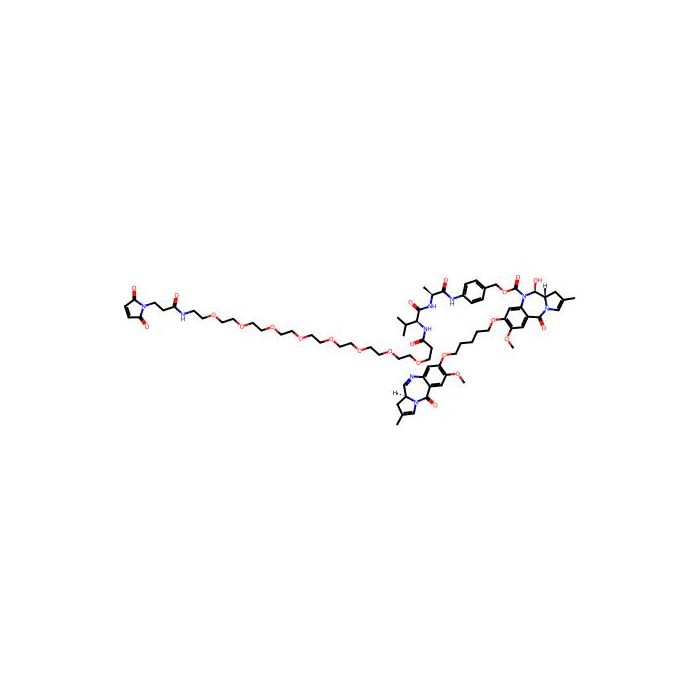
Tesirine (SG3249) is an antibody-drug conjugate (ADC) pyrrolobenzodiazepine (PBD) dimer payload. Tesirine combines potent antitumor activity with desirable physicochemical properties such as favorable hydrophobicity and improved conjugation characteristics. SG3199 is the released warhead component of the ADC payload Tesirine. SG3199 retains picomolar activity in a panel of cancer cell lines. PBD dimers are highly efficient DNA minor groove cross-linking agents with potent cytotoxicity
In Vitro
SG3199 is the released warhead component of the ADC payload Tesirine. SG3199 inhibits K562, NCIN87, BT474, and SKBR3 cancer cells with IC 50 s of 150 pM, 20 pM, 1 nM and 320 pM. MCE has not independently confirmed the accuracy of these methods. They are for reference only.
Form:Solid
IC50& Target:Pyrrolobenzodiazepines
Spécifications
Spécifications et pureté
≥97%
Mécanismes biochimiques et physiologiques
Tesirine (SG3249) is an antibody-drug conjugate (ADC) pyrrolobenzodiazepine (PBD) dimer payload. Tesirine combines potent antitumor activity with desirable physicochemical properties such as favorable hydrophobicity and improved conjugation characteristic
Conditions de stockage de stockage
Protected from light,Store at -20°C,Argon charged
Expédié en
Ice chest + Ice pads
Ce produit nécessite l'expédition en chaîne froide. Les services terrestres et autres services économiques ne sont pas disponibles.
Certificats (CoA, COO, BSE/TSE et tableau d'analyse)
C of A & Other Certificates(BSE/TSE, COO):
Analytical Chart:
Propriétés chimiques et physiques
Solubilité
DMSO : 200 mg/mL (133.63 mM; Need ultrasonic)
Poids moléculaire
1496.600 g/mol
XLogP3
1.600
Hydrogen Bond Donor Count
5
Hydrogen Bond Acceptor Count
24
Rotatable Bond Count
49
Exact Mass
1495.7 Da
Monoisotopic Mass
1495.7 Da
Topological Polar Surface Area
367.000 Ų
Heavy Atom Count
107
Formal Charge
0
Complexity
2970.000
Isotope Atom Count
0
Defined Atom Stereocenter Count
5
Undefined Atom Stereocenter Count
0
Defined Bond Stereocenter Count
0
Undefined Bond Stereocenter Count
0
The total count of all stereochemical bonds
0
Covalently-Bonded Unit Count
1
Calculateurs de solution
Molarity Calculator
Determine the necessary mass, volume, or concentration for preparing a solution.
Dilution Calculator
Determine the dilution needed to prepare a stock solution.
Reconstitution Calculator
Avis
Avis des clients
Application Protocols
No item-specific, vendor-validated application protocols are provided. The following is a literature-style example for research use; optimize per your system.
Example: Cysteine-directed conjugation to an IgG
Antibody preparation: Exchange antibody into 50 mM phosphate or histidine buffer, pH 6.5–6.8, 5–10 mg/mL.
Partial reduction: Add TCEP to 1 mM final; incubate 30 min at 37°C. Desalt into fresh buffer to remove TCEP.
Payload stock: Dissolve Tesirine in anhydrous DMSO at 5–20 mM. Protect from light.
Conjugation: Add Tesirine stock dropwise to antibody to reach 2–8 eq per interchain disulfide, keeping DMSO ≤10% v/v. Incubate 1–2 h at room temp with gentle mixing.
Quench: Add cysteine (5–10 mM) for 20 min to consume unreacted maleimide.
Purification: Purify by size-exclusion chromatography or diafiltration into formulation buffer (e.g., histidine/sucrose). Filter 0.22 µm.
Analytics: Determine DAR by HIC; confirm mass by native MS; check aggregates by SEC; assay free payload by LC–MS.
Notes:
Maintain pH ≤7.0 during conjugation to limit maleimide hydrolysis.
Work under low light; use amberware.
Dispose of all materials as cytotoxic waste.
This example is provided for general guidance only and is not product-validated.
Biological Roles
This product is intended strictly for research use. No clinical or therapeutic claims are made.
Literature/general context for the payload class:
Mechanism: PBD dimers bind within the DNA minor groove and form interstrand crosslinks at specific sequences, preventing replication and transcription.
Linker biology: The Val–Cit dipeptide is susceptible to lysosomal cathepsin B cleavage after internalization of the ADC into target cells. PABC then undergoes 1,6-elimination to self-immolate, releasing the active PBD dimer.
Selectivity principle in ADCs: Tesirine itself is not target-selective; biological selectivity arises from the antibody component that directs the conjugate to target cells via antigen recognition.
Intracellular trafficking (general): Following antibody binding and endocytosis, ADCs enter endo/lysosomal compartments where cleavage occurs; liberated payload diffuses to the nucleus and exerts its effect.
Experimental considerations:
Off-target risks: free payload can be highly cytotoxic; rigorous purification of conjugates and control of free-drug levels are essential in cell-based work.
Serum stability: linker design aims for plasma stability with intracellular lability; verify stability in your biological matrix before critical studies.
All uses must comply with institutional safety protocols for handling potent cytotoxics.
Buffer Applications
This material is not a buffering reagent and is not used to control pH directly.
Context for use in bioconjugation (literature/general):
Conjugation buffers: mildly acidic to neutral buffers (e.g., 50 mM phosphate, PBS, histidine, or acetate at pH 6.5–7.0) help minimize maleimide hydrolysis while maintaining antibody integrity.
Avoid amine-rich buffers (e.g., high Tris concentrations) during the conjugation step, as primary amines can react with maleimides and reduce thiol-specificity.
Reducing conditions: for partial reduction of antibody disulfides, TCEP is commonly used in acetate/phosphate buffer at pH 6.0–6.5, followed by buffer exchange before adding Tesirine to limit carryover of reductant.
Formulation: after conjugation, ADCs are often formulated in histidine/sucrose/trehalose buffers for stability (research practice); optimize per your protein.
These are general guidelines only; adapt buffer composition to your bioconjugation platform and stability requirements.
Green Alternatives
Greener practice considerations relate primarily to solvent and process choices rather than substitution of the payload itself (which is inherently cytotoxic by design).
Opportunities (literature/general):
Solvent selection:
Replace DMF with high-purity water co-solvent systems leveraging DMSO at minimal percentages when protein stability permits.
Consider acetonitrile/water systems for analytics instead of halogenated solvents.
Process intensification:
Conduct conjugations at higher concentrations to reduce solvent volumes and downstream diafiltration water usage.
Implement single-use consumables to minimize cleaning solvents for cytotoxic campaigns.
Alternative linkers (contextual comparison, literature):
Non-cleavable linkers (e.g., thioether-based) can reduce byproducts but alter biological release mechanisms.
Alternative cleavable motifs (e.g., glucuronide, disulfide, or β-glucuronidase-sensitive linkers) may change stability/tox profile; tradeoffs include different enzyme dependence and plasma stability.
Tradeoffs:
PBD dimer potency is associated with high hazard and strict containment requirements; there is no direct “green” substitute that preserves identical performance. Improvements typically come from greener solvents, lower volumes, and better containment/engineering controls.
Implement institutional green-chemistry policies focusing on solvent choice, energy-efficient cold storage, and minimized rework through robust analytical controls.
Pharmaceutical Uses
For research use only. Not for human or veterinary use.
Process/formulation context (literature/general):
Role: Tesirine serves as a cytotoxic linker–payload for constructing investigational antibody–drug conjugates (ADCs) during discovery and process development research.
Conjugation modality: cysteine-directed thiol–maleimide chemistry to generate thioether-linked ADCs with a cathepsin-cleavable Val–Cit–PABC release mechanism.
Analytical controls: development programs typically monitor DAR distribution (HIC/Native MS), free-drug content (SEC/HPLC), and stability (accelerated and real-time) under ICH-like conditions during preclinical formulation studies.
Excipient status: Tesirine is not an excipient; it is an active, highly potent small molecule used only as a conjugated payload in research ADCs.
Handling classification: treat as a potent cytotoxic compound under strict containment; many organizations manage such compounds under HPAPI (highly potent API) procedures.
No pharmacopoeial monograph is applicable for this item. All work should comply with institutional controls for cytotoxic/HPAPI materials and applicable regulations for handling and disposal in research settings.
Physical Properties
Item-specific physicochemical specifications are not provided in the current listing. Refer to the CoA/Spec Sheet for definitive values.
Typical/literature guidance for this class (PBD-dimer linker–payloads; non-binding):
Physical state: usually obtained as an amorphous solid or lyophilized solid.
Solubility (literature/general): readily soluble in anhydrous polar aprotic solvents such as DMSO and DMF; sparingly soluble to insoluble in water; limited solubility in alcohols; poor solubility in nonpolar hydrocarbons.
Partitioning: highly lipophilic payload region with polar/peptidic linker often yields overall amphiphilic behavior; tends to associate with proteins and hydrophobic matrices.
Stability considerations (literature/general):
Maleimide can hydrolyze to maleamic acid in aqueous media, especially at pH > 7.5, reducing thiol reactivity.
The Val–Cit–PABC unit is susceptible to proteolytic cleavage; long exposures to crude lysates or serum may lead to premature degradation.
PBD dimers are light sensitive and can undergo degradation; protection from light is recommended.
Do not treat the above as specifications. If exact values such as melting point, water content, UV cutoff, or logP are required, consult the product’s CoA/Spec Sheet.
Quality and Grades
Grade/Purity: Not specified for this item; refer to CoA/Spec Sheet.
Interpretation and context (general):
ADC linker–payloads are typically supplied at high chemical purity to minimize off-target conjugation and to ensure consistent drug-to-antibody ratio (DAR). When a “conjugation grade” or “bioconjugation grade” is indicated on a CoA, it often implies stringent limits on hydrolysis products (e.g., maleamic acid), uncontrolled diastereomers, residual metals/solvents, and bioburden.
UV profile and LC purity: Many users require low-UV impurity baselines and high HPLC area percent for release testing. If this is critical to your process, confirm on the CoA.
Stabilizers: If present, stabilizers would be listed on the CoA/Spec Sheet. None are specified here. The product listing notes inert-atmosphere packaging (argon charged), which is consistent with preserving maleimide integrity and limiting moisture/light exposure.
Recommendations:
Upon receipt, verify identity and purity by LC–MS and analytical HPLC using your qualified methods.
If DAR control is critical, assess maleimide content (e.g., by NMR or HPLC assay of maleamic acid) prior to conjugation.
For regulated workflows, request batch-specific CoA and, if needed, verification data (residual solvents, water content, endotoxin/bioburden, and elemental impurities), as applicable to your internal specifications.
Reaction and Applications
Primary application domain (research use): construction of antibody–drug conjugates (ADCs) via cysteine-directed conjugation.
Key reaction chemistry (literature/general):
Thiol–maleimide conjugation: Michael addition of antibody cysteine thiols (generated by partial reduction of interchain disulfides using TCEP or DTT) to the maleimide terminus forms a stable thioether. Reaction is typically carried out at pH 6.5–7.0 to balance reactivity and minimize maleimide hydrolysis.
Cleavable trigger: Val–Cit (cathepsin B–sensitive) and PABC self-immolation release the free PBD dimer inside lysosomes following ADC internalization and enzymatic cleavage.
Payload action (mechanistic, literature): PBD dimers bind in the DNA minor groove and form interstrand crosslinks, leading to potent cytotoxicity.
Practical considerations:
Control of DAR: adjust equivalents and reduction conditions to target desired DAR (e.g., 2–4). Over-reduction can disrupt antibody structure.
Buffer and co-solvent: maintain ≤10% DMSO during conjugation to preserve antibody stability. Use degassed buffers if protein oxidation is a concern; oxygen exclusion is less critical for the conjugation step but helps limit payload degradation.
Quenching: residual maleimide can be quenched with cysteine or N-acetylcysteine after conjugation, followed by purification (SEC, diafiltration).
Analytics: verify DAR distribution by native MS or HIC; confirm free payload removal by SEC; monitor residual maleimide hydrolysis products by LC–MS.
Note: These are literature-based best practices; optimize for each antibody system.
Reaction Conditions
General/literature guidance for cysteine-directed conjugation of Tesirine to antibodies (optimize per system):
Antibody reduction: partially reduce interchain disulfides with TCEP (0.5–5 mM) at pH 6.0–6.5, 25–37°C for 15–60 min, then desalt/buffer-exchange to remove excess reductant.
Conjugation buffer: phosphate, histidine, or acetate buffer at pH 6.5–7.0. Maintain low oxygen and protect from light. Include ≤10% DMSO to aid solubility if needed.
Reagent stoichiometry: 2–10 molar equivalents of Tesirine per reduced interchain disulfide, depending on desired DAR and antibody reactivity.
Temperature/time: 20–25°C for 1–4 h; monitor progress by HIC or LC–MS. Gentle mixing to avoid aggregation.
Quench: add excess cysteine or N-acetylcysteine (e.g., 5–10 mM) to consume residual maleimide, 10–30 min at room temperature.
Purification: SEC or TFF/diafiltration into formulation buffer; remove low-MW species and free payload.
Analytical checkpoints: UV–Vis A280 for protein concentration, HIC for DAR distribution, native MS for mass confirmation, SEC for aggregates, LC–MS for free payload.
Notes and pitfalls:
Maleimide hydrolysis accelerates above pH 7.5; minimize time in basic buffers.
Avoid excess reductant carryover to prevent over-reduction and maleimide consumption.
Evaluate stability of conjugates for thiosuccinimide exchange; consider conditions that promote ring opening if improved stability is desired (literature practice).
These conditions are provided as general literature guidance, not as item-specific specifications.
Safety and Handling
Hazard classification for this specific item is not listed here. Always consult the SDS for authoritative safety information.
Item-specific safety data:
GHS Classification: Not specified for this item; refer to CoA/Spec Sheet.
Signal word / H-statements / Pictograms: Not specified for this item; refer to SDS.
General safety guidance for PBD-dimer ADC payloads (literature/general):
Potent cytotoxic DNA crosslinker. Handle as a highly hazardous substance in a controlled environment (chemical fume hood or cytotoxic cabinet) with restricted access.
Engineering controls: use closed systems for weighing and solution prep when possible; work over absorbent pads; dedicated tools for cytotoxics.
Incompatibilities: avoid strong acids/bases that may degrade linkers; avoid nucleophiles that can consume the maleimide; protect from light and moisture.
Spill/Exposure response: evacuate nonessential personnel; use cytotoxic spill kits; decontaminate with appropriate detergents/oxidants according to institutional protocols. For exposure, rinse affected area with water and seek medical attention; bring SDS.
Waste: collect as cytotoxic/chemotherapy waste following local regulations.
Storage and shipping (item-specific):
Store at −20°C, protected from light, under inert gas (argon charged).
Shipped cold in ice chest with ice pads.
Solvent Selection
Tesirine behaves as a hydrophobic, functionally complex small molecule with a peptide-based cleavable linker and a thiol-reactive terminus.
General/literature guidance:
Primary stock solvents: anhydrous DMSO is typically preferred; DMF is an alternative. These solvents maintain maleimide reactivity and solubilize the payload efficiently.
Aqueous media: poor intrinsic solubility is common; if aqueous use is required, prepare concentrated DMSO stock solutions and dilute into buffered media immediately prior to conjugation, keeping final DMSO ≤10% v/v where compatible with protein stability.
Buffer compatibility: mildly acidic to neutral buffers (e.g., PBS pH 6.5–7.0, histidine, or acetate) help minimize maleimide hydrolysis and undesired thioether exchange. Avoid amine-rich buffers (e.g., high Tris) that can compete in Michael-type reactions.
Dielectric/polarity (qualitative): polar aprotic; strong H-bond acceptor solvents (DMSO/DMF) favor dissolution of both peptide linker and PBD payload.
Comparison (literature/general):
DMSO: best solvating power; may affect protein stability at higher %.
DMF: good solvency; more difficult to remove; protein compatibility considerations.
Acetonitrile: limited solubility for some lots; can be used as co-solvent for analytical work.
Practical tips:
Filter DMSO stocks (0.2 µm PTFE) to remove particulates; store aliquots at −20°C under inert gas, protected from light.
Use freshly opened, anhydrous solvents to limit maleimide hydrolysis.
Store at −20°C, protected from light, under argon (argon charged).
Shipped in ice chest with ice pads.
General handling and reconstitution (literature/general):
Allow container to equilibrate to room temperature in the dark before opening to minimize condensation.
Open under dry, inert atmosphere if possible. Reseal promptly; flush headspace with argon or nitrogen.
Prepare concentrated stocks in anhydrous DMSO (e.g., 5–20 mM). Filter if needed (0.2 µm PTFE). Aliquot into amber vials to avoid repeated freeze–thaw.
Storage of solutions: keep DMSO stocks at −20°C to −80°C, protected from light and moisture. Avoid multiple freeze–thaw cycles; thaw quickly and keep on ice during use.
Aqueous working solutions should be prepared immediately before use and not stored, as maleimide hydrolysis can occur, especially above pH 7.5.
Stability testing and retest dates should be established internally. For batch-specific parameters (purity, water content, residual solvents, stabilizers), consult the CoA/Spec Sheet.
Research use only.
Structure and Identity
Tesirine is a highly potent, bifunctional small-molecule payload-linker designed for antibody–drug conjugate (ADC) research. It couples a DNA-crosslinking pyrrolobenzodiazepine (PBD) dimer to a cysteine-reactive linker system.
Chemical name: Tesirine (also known in literature as SG3249; PBD-dimer–Val–Cit–PABC–maleimide type linker-payload)
CAS: 1595275-62-9
CID: 73672523
Molecular formula: Not specified for this item; refer to CoA/Spec Sheet.
Molecular weight: Not specified for this item; refer to CoA/Spec Sheet.
SMILES: Not specified for this item; refer to CoA/Spec Sheet.
InChIKey: Not specified for this item; refer to CoA/Spec Sheet.
Structural features (general/literature description):
PBD dimer core bearing two electrophilic imine/acetals that form sequence-selective, minor-groove DNA interstrand crosslinks (literature).
Cathepsin B–cleavable dipeptide linker (Val–Cit) with a p-aminobenzyloxycarbonyl (PABC) self-immolative spacer that releases the PBD dimer in lysosomes (literature).
Terminal maleimide (or closely related thiol-reactive moiety) enabling Michael addition to reduced cysteine residues on proteins (literature).
2D structure in words (literature): a central PBD dimer (two fused benzodiazepine subunits) attached via a carbamate/urethane-based PABC to a Val–Cit dipeptide, which is further connected through a flexible spacer to a maleimide ring for cysteine-selective conjugation.
Synthetic Utility
Tesirine is primarily a bioconjugation reagent rather than a general synthetic intermediate; however, understanding its functional elements helps in custom conjugation strategy design.
Functional groups and reactivity (literature/general):
Maleimide (or equivalent thiol-reactive group): undergoes rapid Michael addition with thiols at near-neutral pH to form thioethers; sensitive to hydrolysis to maleamic acid.
Val–Cit–PABC cleavable unit: stable in plasma-like conditions but cleaved by lysosomal cathepsin B; PABC self-immolates to liberate the payload.
PBD dimer: highly electrophilic centers poised for DNA crosslinking upon release; generally kept masked within the linker–payload to reduce off-target reactivity prior to release.
Utility in workflow:
Antibody mapping: enables evaluation of cysteine conjugation patterns and DAR optimization in candidate antibodies.
Linker engineering: serves as a benchmark cleavable linker for comparing stability vs. release kinetics with alternative triggers (e.g., disulfide, glucuronide).
Payload benchmarking: PBD dimers provide a high-potency standard to stress-test internalization and trafficking hypotheses in ADC research.
Limitations:
Extreme potency demands stringent containment and analytical controls.
Maleimide hydrolysis and thiosuccinimide exchange can alter conjugate stability; consider post-conjugation ring-opening strategies if relevant to your platform (literature topic).
Target Specificity
Not applicable to this standalone linker–payload. Tesirine has no inherent biological target specificity on its own.
Context (literature/general):
In ADCs, target specificity is conferred exclusively by the antibody component, which binds a selected antigen. Tesirine provides the cytotoxic payload and cleavable linker; it does not determine antigen recognition, clone, isotype, or species reactivity.
For target-related information, refer to the specific antibody used in your conjugate.
Foire aux questions
What is the purity of this product?
This product is supplied at ≥97% purity (chemical assay). Lot-specific values are stated on the Certificate of Analysis.
How should this product be stored?
Store at ?20 °C, protected from light, under argon. It is supplied under an argon blanket; reseal under inert gas after each use.
How is this product shipped?
This product ships in an insulated container with ice pads. Unpack on arrival and transfer it to the storage condition stated above.
What are the CAS number, molecular formula and molecular weight?
The CAS Number is 1595275-62-9, the molecular formula is C75H101N9O23, and the molecular weight is 1496.65 g/mol.
What documentation is provided?
Available product documentation, including Certificates of Analysis (COA), Safety Data Sheets (SDS), and specification sheets, is shown in the product document area. Document availability and access follow the current site policy.
Nous utilisons des cookies pour garantir le bon fonctionnement du site et, lorsque cela est autorisé, pour améliorer votre expérience. Vous pouvez gérer vos préférences à tout moment dans les Paramètres. Pour en savoir plus, consultez notre Politique relative aux cookies.
Souhaitez-vous que nous vous envoyions un message lorsque des réductions seront disponibles?
Me rappeler plus tard
Merci ! Veuillez vérifier votre boîte de réception e-mail pour confirmer.
Products are supplied to verified businesses, institutions, and qualified professionals for research and development use only. Not for use in humans, animals, diagnosis, or therapy.