Determine the necessary mass, volume, or concentration for preparing a solution.
| Activity Type | Relation | Activity value | Units | Action Type | Journal | PubMed Id | doi | Assay Aladdin ID |
|---|

≥98% pour les flux de travail chromatographiques et analytiques sensibles nécessitant une interférence de ligne de base minimale.
Store at -20°C Expédition Ice chest + Ice pads. Consultez le COA spécifique au lot pour les spécifications exactes.
SDS, COA, fiche technique et fiche de spécifications disponibles au téléchargement. COA spécifique au lot accessible via la recherche par numéro de lot.
Cité dans 0 publications à comité de lecture couvrant la chromatographie, la synthèse organique et les réactions de couplage croisé.
Information
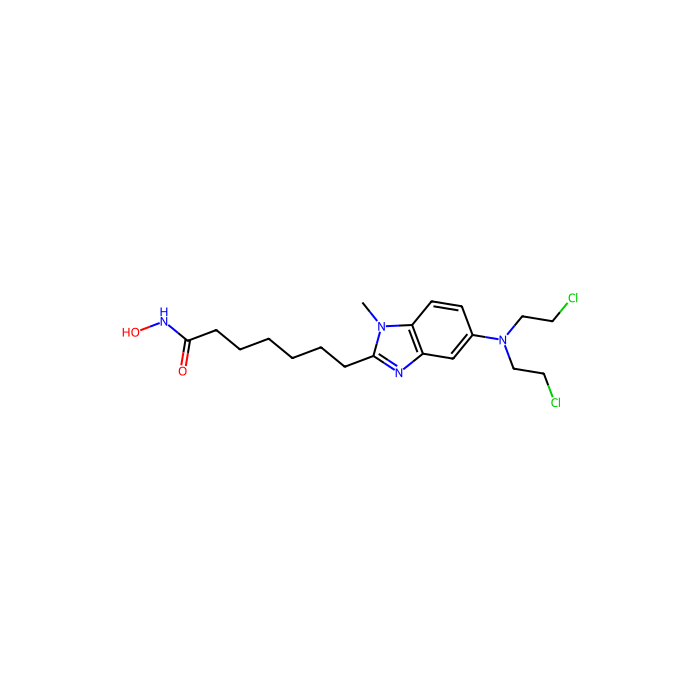
Tinostamustine(EDO-S101) is a first-in-classalkylating deacetylaseinhibitor with IC50 values of 9 nM, 9 nM, 25 nM and 107 nM for HDAC1, HDAC2, HDAC3 and HDAC8 (Class 1 HDACs) respectively and 6 nM, 72 nM for HDAC6 and HDAC10 (Class II HDACs).
Targets
HDAC6 (Cell-free assay); HDAC1 (Cell-free assay); HDAC2 (Cell-free assay); HDAC3 (Cell-free assay); HDAC10 (Cell-free assay) 31723,6 nM; 9 nM; 9 nM; 25 nM; 72 nM
In vitro
The IC50s of EDO-S101 range between 5-13 μM in 8 myeloma cell lines. EDO-S101 has significant synergistic cytotoxicity with the proteasome inhibitors bortezomib and carfilzomib across all cell types tested. EDO-S101 induces strong protein and histone acetylation and is a strong inducer of pIRE-1, the key activator protein of the UPR in MM cells.
Cell Research(from reference)
Cell lines:HL-60 cells
Concentrations:4 μM
Incubation Time:0, 6, 12, 18, 24h
Document complet couvrant les dangers, la manipulation, le stockage et la conformité réglementaire.
<<<<<<< HEAD Télécharger la SDS → ======= Télécharger la SDS → >>>>>>> release248-p3Données qualité spécifiques au lot. Saisissez votre numéro de lot pour récupérer le COA exact.
Rechercher le COA →Résumé de référence rapide des spécifications et applications du produit.
Voir la fiche technique →Attributs de qualité complets et critères d'acceptation pour cette qualité.
Voir la fiche de spécifications →Taxonomy Tree
| Kingdom | Organic compounds |
|---|---|
| Superclass | Organoheterocyclic compounds |
| Classe | Benzimidazoles |
| Subclass | Not available |
| Intermediate Tree Nodes | Not available |
| Direct Parent | Benzimidazoles |
| Alternative Parents | Nitrogen mustard compounds Dialkylarylamines N-substituted imidazoles Benzenoids Heteroaromatic compounds Hydroxamic acids Amino acids and derivatives Azacyclic compounds Organopnictogen compounds Organochlorides Organic oxides Hydrocarbon derivatives Carbonyl compounds Alkyl chlorides |
| Molecular Framework | Aromatic heteropolycyclic compounds |
| Substituents | Benzimidazole - Dialkylarylamine - Tertiary aliphatic/aromatic amine - Nitrogen mustard - Benzenoid - N-substituted imidazole - Heteroaromatic compound - Imidazole - Azole - Tertiary amine - Hydroxamic acid - Amino acid or derivatives - Azacycle - Carboxylic acid derivative - Organic nitrogen compound - Organic oxygen compound - Organopnictogen compound - Organic oxide - Hydrocarbon derivative - Organooxygen compound - Organonitrogen compound - Organochloride - Organohalogen compound - Carbonyl group - Amine - Alkyl halide - Alkyl chloride - Aromatic heteropolycyclic compound |
| Description | This compound belongs to the class of organic compounds known as benzimidazoles. These are organic compounds containing a benzene ring fused to an imidazole ring (five member ring containing a nitrogen atom, 4 carbon atoms, and two double bonds). |
| External Descriptors | Not available |
| Activity Type | Relation | Activity value | Units | Action Type | Journal | PubMed Id | doi | Assay Aladdin ID |
|---|
| Activity Type | Relation | Activity value | Units | Action Type | Journal | PubMed Id | doi | Assay Aladdin ID |
|---|
| Activity Type | Relation | Activity value | Units | Action Type | Journal | PubMed Id | doi | Assay Aladdin ID |
|---|
| Activity Type | Relation | Activity value | Units | Action Type | Journal | PubMed Id | doi | Assay Aladdin ID |
|---|
Find and download the COA for your product by matching the lot number on the packaging.
| Lot Number | Certificate Type | Date | Article |
|---|---|---|---|
 A2412678 | Certificate of Analysis | Oct 13, 2025 | T414166 |
| A2412679 | Certificate of Analysis | Oct 13, 2025 | T414166 |
| A2412680 | Certificate of Analysis | Oct 13, 2025 | T414166 |
| A2412681 | Certificate of Analysis | Oct 13, 2025 | T414166 |
| A2412683 | Certificate of Analysis | Oct 13, 2025 | T414166 |
| A2412684 | Certificate of Analysis | Oct 13, 2025 | T414166 |
| A2412685 | Certificate of Analysis | Oct 13, 2025 | T414166 |
| A2412686 | Certificate of Analysis | Oct 13, 2025 | T414166 |
| A2412687 | Certificate of Analysis | Oct 13, 2025 | T414166 |
| A2412677 | Certificate of Analysis | Oct 13, 2025 | T414166 |
| F2316298 | Certificate of Analysis | Mar 04, 2025 | T414166 |
| F2316328 | Certificate of Analysis | Mar 04, 2025 | T414166 |
| F2316326 | Certificate of Analysis | Mar 04, 2025 | T414166 |
| F2316325 | Certificate of Analysis | Mar 04, 2025 | T414166 |
| F2316324 | Certificate of Analysis | Mar 04, 2025 | T414166 |
| F2316317 | Certificate of Analysis | Mar 04, 2025 | T414166 |
| F2316316 | Certificate of Analysis | Mar 04, 2025 | T414166 |
| F2316315 | Certificate of Analysis | Mar 04, 2025 | T414166 |
| F2316314 | Certificate of Analysis | Mar 04, 2025 | T414166 |
| I2525085 | Certificate of Analysis | Nov 14, 2023 | T414166 |
| F2316329 | Certificate of Analysis | May 15, 2023 | T414166 |
| Solubilité | Solubility (25°C) In vitro DMSO: 14 mg/mL (33.7 mM); Ethanol: 2 mg/mL (4.81 mM); Water: Insoluble; |
|---|---|
| DMSO (mg/mL) Solubilité maximale | 14 |
| DMSO (mM) Solubilité maximale | 33.7057010785824 |
| Eau (mg/mL) Solubilité maximale | <1 |
| Poids moléculaire | 415.400 g/mol |
| XLogP3 | 3.600 |
| Hydrogen Bond Donor Count | 2 |
| Hydrogen Bond Acceptor Count | 4 |
| Rotatable Bond Count | 12 |
| Exact Mass | 414.159 Da |
| Monoisotopic Mass | 414.159 Da |
| Topological Polar Surface Area | 70.400 Ų |
| Heavy Atom Count | 27 |
| Formal Charge | 0 |
| Complexity | 438.000 |
| Isotope Atom Count | 0 |
| Defined Atom Stereocenter Count | 0 |
| Undefined Atom Stereocenter Count | 0 |
| Defined Bond Stereocenter Count | 0 |
| Undefined Bond Stereocenter Count | 0 |
| The total count of all stereochemical bonds | 0 |
| Covalently-Bonded Unit Count | 1 |
Item-specific validated applications, recommended dilutions, and controls: Not specified for this item; refer to CoA/Spec Sheet or internal SOPs.
General workflow suggestions (literature/general)
These are non-validated, literature-style outlines. Optimize conditions for your platform and consult institutional guidelines.
Nature of the compound (literature/general)
Roles in cellular studies (literature/general)
Selectivity considerations (literature/general)
All statements above describe research/biochemical utility only. No clinical or medical claims are made. Consult primary literature for quantitative potency and isoform data.
This compound is a small-molecule research tool and does not function as a buffering agent.
No defined pKa-based buffer systems are applicable to this item.
This product is a targeted research compound rather than a process solvent or commodity reagent. “Green alternatives” are therefore more about handling media and vehicles than replacing the compound itself.
Greener solvent choices for stock/assay preparation (literature/general)
Operational green chemistry practices
Comparison (general)
No therapeutic, diagnostic, or clinical claims are made for this product. It is supplied strictly for research use only.
Formulation context in research (literature/general)
Pharmacopeial status
Item-specific specs (from Product Data)
Literature/general expectations (for planning only; confirm experimentally)
Note: Use these literature/general notes only for preliminary planning. For specifications required in regulated or quantitative work, consult the item’s CoA/Spec Sheet and SDS.
Item-specific grade/purity (from Product Data)
Interpreting common grades (general guidance)
Practical recommendations
Applicability as a reagent
Research applications (literature/general)
Practical notes
For synthetic transformations or building-block applications, this molecule is not typically selected; see the Synthetic Utility section for context.
This product is a bioactive probe rather than a synthetic reagent; standard “reaction conditions” are not typically applicable.
All quantitative conditions (concentrations, exposure times) must be derived from primary literature or pilot experiments; they are not specified for this item.
Item-specific hazard data (from Product Data)
General safety guidance (literature/general for alkylating/HDAC-inhibiting research chemicals)
Always defer to the current SDS and institutional cytotoxic handling procedures for authoritative guidance.
Item-specific solubility data: Not specified for this item; refer to CoA/Spec Sheet.
Literature/general guidance for tinostamustine and similar amphiphilic bioactives
Practical tips
All solvent choices should be validated in pilot experiments for the specific biological system.
Item-specific instructions (from Product Data)
Reconstitution (general guidance)
Handling and stability (general)
Always consult the product’s CoA and SDS for definitive storage stability, re-test intervals, and any specific cautions for this lot.
A bifunctional small molecule combining a DNA-alkylating nitrogen mustard and a hydroxamic-acid HDAC inhibitor pharmacophore (commonly referenced in the literature as EDO-S101).
Item-specific identifiers (from Product Data)
Structural features (literature/general)
2D structure description (literature/general)
Tinostamustine itself is not typically used as a synthetic intermediate; it is a finalized, functionally complex probe molecule. Nonetheless, understanding its functionality informs derivatization and analogue synthesis (literature/general):
Reactive motifs and implications
Retrosynthetic considerations
Derivatization strategies
For routine synthesis tasks, choose simpler building blocks; employ tinostamustine primarily as a research probe.
Item-specific target data: Not specified for this item; refer to CoA/Spec Sheet and primary literature.
Literature/general context
Users should consult peer-reviewed studies for quantitative target profiles relevant to their system.