≥98% for sensitive chromatographic and analytical workflows requiring minimal baseline interference.
🌡
Storage & shipping
Store at -20°C Ships Ice chest + Ice pads Check lot-specific COA for exact specifications.
📋
Quality documents
SDS, COA, datasheet, and spec sheet available for download. Lot-specific COA accessible via lot number lookup.
📚
Literature proof
Cited in 0 peer-reviewed publications across chromatography, organic synthesis, and cross-coupling reactions.
Vue d’ensemble
Information
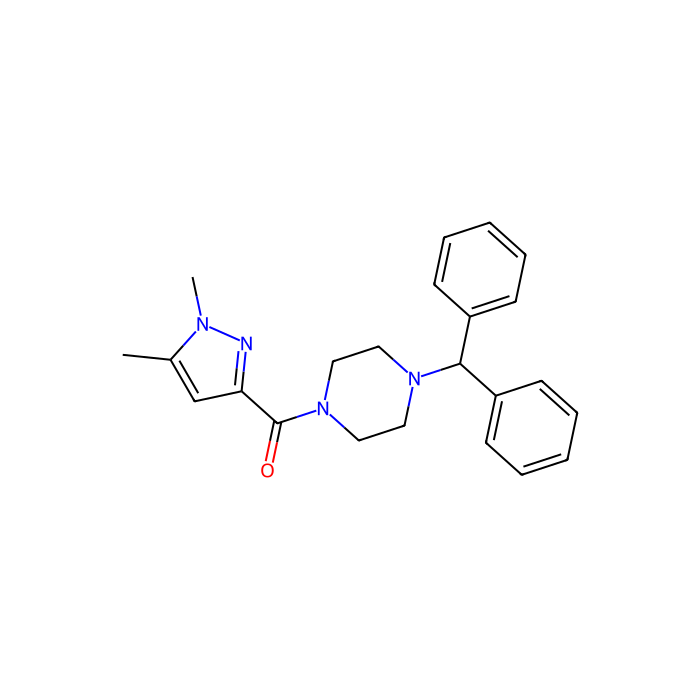
TLX agonist 1 (CCRP2, SUN23314) is a modulator oforphan nuclear receptor tailless (TLX, NR2E1)with EC50 of 1.0 μM and Kd of 650 nM. TLX agonist 1 (CCRP2, SUN23314) binds to recombinant TLX protein and enhances TLX transcriptional repressive activity.
Specifications
Synonymes
CCRP2 | SUN23314
Spécifications et pureté
≥98%
Conditions de stockage de stockage
Store at -20°C
Expédié en
Ice chest + Ice pads
Ce produit nécessite l'expédition en chaîne froide. Les services terrestres et autres services économiques ne sont pas disponibles.
This compound belongs to the class of organic compounds known as diphenylmethanes. These are compounds containing a diphenylmethane moiety, which consists of a methane wherein two hydrogen atoms are replaced by two phenyl groups.
External Descriptors
Not available
1. Djoumbou Feunang Y, Eisner R, Knox C, Chepelev L, Hastings J, Owen G, Fahy E, Steinbeck C, Subramanian S, Bolton E, Greiner R, and Wishart DS. ClassyFire: Automated Chemical Classification With A Comprehensive, Computable Taxonomy. Journal of Cheminformatics, 2016, 8:61.
Determine the necessary mass, volume, or concentration for preparing a solution.
Dilution Calculator
Determine the dilution needed to prepare a stock solution.
Reconstitution Calculator
Avis
Avis des clients
Application Protocols
No vendor-validated application protocols, tested assay types, or recommended dilutions are provided for this item in the Product Data.
Guidance
Consult peer-reviewed literature for TLX reporter assays, coactivator recruitment (e.g., TR-FRET), or cell-based transcriptional assays to design appropriate protocols for your system.
Establish dosing regimens via concentration–response studies and include vehicle controls. Validate readouts with orthogonal assays where feasible.
For any specific, validated protocol parameters (assay format, cell lines, reporter constructs, incubation times), please refer to the CoA/Spec Sheet or contact us.
Biological Roles
General information on the biological target TLX (NR2E1) — not item-specific
TLX (also known as NR2E1) is an orphan nuclear receptor that functions predominantly as a transcriptional regulator. It can recruit corepressors and coactivators to modulate gene expression involved in neural stem cell maintenance, proliferation, and neurogenesis.
In developmental and adult contexts, TLX influences processes such as self-renewal of neural stem/progenitor cells, regulation of neurogenic niches, and repression/activation of specific neuronal differentiation programs.
TLX signaling intersects with chromatin remodeling machinery, histone deacetylases, and co-regulator complexes, positioning it as a nodal factor in epigenetic control of lineage decisions.
Agonism of TLX in research settings is used to probe transcriptional activation paradigms, delineate receptor–cofactor interaction surfaces, and map downstream transcriptomic changes via RNA-seq/ChIP-seq.
How a TLX agonist is used as a probe (general)
Acts as a chemical tool to bias the conformational ensemble of TLX toward coactivator-compatible states, enabling functional assays (e.g., reporter gene upregulation) and structural studies (e.g., NMR, crystallography if feasible) of the ligand-binding domain.
Supports target validation by correlating chemical modulation with genetic perturbations (knockdown/knockout or overexpression), strengthening causal links between TLX activity and observed phenotypes.
Note
The specific potency, selectivity, and mode of action for this item are not provided here and should be established experimentally.
Buffer Applications
This product is a small-molecule TLX agonist used as a research probe and does not serve as a buffering agent. Consequently, standard buffer formulation guidance (pH ranges, buffer capacity, recipes) is not applicable.
Practical note
When formulating working solutions for biochemical or cell-based assays, prepare in your assay’s buffer system (e.g., PBS, HEPES-buffered media) with minimal organic co-solvent consistent with solubility and biological compatibility. Include solvent-only vehicle controls to distinguish compound effects from buffer/co-solvent effects.
Green Alternatives
Context
As a bioactive probe, TLX agonist 1 is not a process solvent or commodity reagent where greener substitutions are typically evaluated. Nevertheless, greener handling can focus on solvent choices and waste minimization during assay preparation.
General greener practices (not item-specific)
Prefer water-based assay buffers with minimal DMSO (≤0.1–0.5% v/v) consistent with solubility and biological tolerance.
If organic co-solvent is required, consider ethanol over DMF where compatible, due to a more favorable environmental and toxicological profile.
Use microscale assay formats (384/1536-well) to reduce compound and solvent consumption.
Consolidate freeze–thaw cycles by preparing single-use aliquots, limiting product loss and waste.
Illustrative comparison (general)
DMSO: High solvency, widely used; moderate environmental impact; manage hygroscopicity and disposal.
Ethanol: Renewable-source option possible; higher volatility but generally greener; may be cytotoxic at higher percentages.
DMF/DMAC/NMP: Effective solvents but less desirable from a green chemistry perspective; avoid in routine bioassays when alternatives suffice.
Note
No greener “substitute compound” is proposed because specificity to TLX is the primary consideration; choose solvents and workflows that minimize environmental footprint while maintaining assay integrity.
Pharmaceutical Uses
Scope
This product is supplied strictly for research use only and is not intended for human or veterinary use, diagnostics, or as an active pharmaceutical ingredient.
Typical roles in pharmaceutical R&D (general; not item-specific)
Reference tool compound: Employed as a positive control in TLX-focused screening cascades, assay development, and mechanism-of-action studies.
QC/analytical standard: Used to qualify assay performance across runs and sites by monitoring response factors and dynamic range.
Chemical biology probe: Supports target validation, structure–activity relationship (SAR) exploration, and phenotypic deconvolution when combined with genetic tools.
Formulation context (research)
Stocks are commonly prepared in DMSO at defined concentrations (e.g., 10 mM), then diluted into assay-compatible vehicles at low final DMSO percentages. Exact solubility and stability for this item are not specified; verify experimentally.
Regulatory note
No pharmacopeial status or compendial monograph is indicated. Any GMP-related or clinical manufacturing uses are out of scope for this product.
Physical Properties
Item-specific facts (from Product Data)
Appearance: Not specified for this item; refer to CoA/Spec Sheet.
Molecular weight: Not specified for this item; refer to CoA/Spec Sheet.
Literature/general expectations for small-molecule nuclear receptor ligands (not item-specific)
Physical state: Frequently isolated as off-white solids or films; actual form for this item is not specified.
Solubility: Many receptor ligands are DMSO-soluble at 10–50 mM stock levels; aqueous solubility commonly limited without co-solvent. Verify experimentally for this item.
Partitioning: Such ligands often exhibit moderate-to-high lipophilicity (cLogP 2–5), which can influence cell permeability and nonspecific binding; exact logP/logD for this item is not specified.
pKa: If heteroatoms are present, weakly basic or neutral behavior is common; exact pKa(s) are not specified for this item.
Thermal properties (bp/mp): Not specified for this item; refer to CoA/Spec Sheet.
Density, refractive index: Not applicable/typically unreported for solids; not specified here.
Practical guidance
Prepare small-scale solubility screenings in DMSO, ethanol, and aqueous buffer with 0.1–1% DMSO. Record any precipitation over 24–48 h at working concentrations.
For analytical method development (HPLC/UPLC), start with a generic reversed-phase method (C18, 5–60% acetonitrile in water with 0.1% formic acid) and adjust based on observed retention; exact UV profile is not specified for this item.
Quality and Grades
Item-specific facts
Grade/purity: Not specified for this item; refer to CoA/Spec Sheet.
General guidance on research-grade small molecules (not item-specific)
Research-grade screening compounds are commonly supplied at ≥95% purity by HPLC with supporting chromatograms and, where applicable, NMR and MS data. However, the exact release specifications for this item are not provided here.
UV purity thresholds and low-residual-solvent specifications may be applied for bioassay suitability; exact residual solvent/metals limits are not specified for this item.
Batch-to-batch documentation: For bioactive ligands, vendors often provide a lot-specific CoA including identification (MS), purity (HPLC/UPLC), and water content (Karl Fischer) when relevant. For this item, please consult the current CoA.
Best practices
Verify identity and purity in-house when results are workflow-critical (e.g., orthogonal HPLC, LC–MS). For sensitive assays, a brief pre-drying (e.g., in vacuo, ambient temperature) may help ensure accurate massing, if consistent with stability.
If your application requires specialized grades (e.g., salt form control, specific polymorph, stringent residual solvent limits), contact us to discuss custom QC or to obtain the detailed specification for TLX agonist 1.
Reaction and Applications
Applicability to chemical synthesis
This product is a bioactive small molecule intended as a TLX (NR2E1) receptor agonist for research; it is not generally used as a reagent or solvent in preparative organic chemistry. Therefore, conventional reaction applications (e.g., cross-couplings, Grignard reactions) are not typically relevant.
Relevant research applications (general, not item-specific)
Target engagement: Useful as a tool compound for cellular or biochemical assays interrogating TLX activation (e.g., reporter gene assays, coactivator recruitment TR-FRET, or fluorescence polarization).
Pathway modulation: Employed in hypothesis-driven studies on TLX-regulated transcriptional networks in neural or stem cell models.
Assay development: Reference ligand for validating assay dynamic range, Z′ factor optimization, and positive-control benchmarking.
Practical notes
Prepare a fresh DMSO stock solution; filter if necessary through 0.22 µm PTFE to remove particulates. Confirm absence of aggregation artifacts (e.g., using detergent controls or DLS) in biophysical assays.
Incorporate vehicle controls and a concentration-response design (typically ≥8 half-log dilutions) to derive potency metrics (EC50) where applicable.
For synthetic chemistry uses of this molecule as a substrate or building block, consult primary literature; such applications are not standard for this product.
Reaction Conditions
Not typically applicable. TLX agonist 1 is a research probe, not a reagent for running chemical reactions. Consequently, there are no standard synthetic reaction conditions associated with this product.
Assay preparation conditions (general, not item-specific)
Stock preparation: Dissolve in anhydrous DMSO to an appropriate concentration (e.g., 10–50 mM) after verifying solubility; filter if particulate is observed.
Working solution: Dilute into assay buffer or media to the desired concentration with final DMSO generally ≤0.1–0.5% v/v to minimize biological interference.
Stability checks: Assess short-term stability at room temperature and long-term at 4°C/−20°C in relevant matrices; monitor by LC–MS or HPLC.
Note: These are general laboratory practices for small molecules and are not item-specific protocols. Refer to your internal SOPs and validate conditions for your system.
Safety and Handling
Item-specific safety data
GHS classification: Not specified for this item; refer to SDS.
Signal word, pictograms, H-statements: Not specified for this item; refer to SDS.
Storage: Store at −20°C (per Product Data). Shipped with ice chest + ice pads.
General laboratory precautions (not item-specific; defer to SDS for authoritative guidance)
Handle in a fume hood or well-ventilated area to minimize exposure to dust/aerosols. Avoid inhalation, ingestion, and skin/eye contact.
Incompatibilities: Until specific data are available, avoid strong oxidizers and strong acids/bases. Do not mix with unknowns. Keep away from ignition sources if using organic solvents during reconstitution.
First aid (general): In case of skin/eye contact, rinse with plenty of water for at least 15 minutes; remove contaminated clothing. If inhaled, move to fresh air. If ingested, rinse mouth; do not induce vomiting. Seek medical attention for any exposure.
Spill response: Absorb small spills with inert material (e.g., vermiculite), collect for disposal, and decontaminate area. Prevent environmental release.
Waste disposal: Dispose according to institutional and local regulations for organic laboratory chemicals.
Notes
Always consult the item-specific SDS prior to first use. Absent hazard classification in this listing should not be interpreted as absence of hazard.
Solvent Selection
Item-specific facts
No solubility data are provided for this item; refer to CoA/Spec Sheet.
General guidance for small-molecule receptor ligands (not item-specific)
Primary stock solvent: DMSO is typically preferred due to broad solvency and compatibility with biochemical and cell-based assays.
Secondary solvents: Ethanol or DMF can serve where DMSO is unsuitable; aqueous buffers often require co-solvent (0.1–1% DMSO or ethanol) and surfactant (e.g., 0.01% Tween 20) to maintain solubility.
Aqueous vehicles: Use isotonic, pH-buffered media (e.g., PBS, HBSS, or cell culture media) with minimized organic co-solvent to avoid assay interference.
Selection considerations
Polarity/logP: Without item-specific logP, begin with DMSO screening at 10–50 mM. If precipitation occurs upon dilution, titrate co-solvent and consider complexation vehicles (cyclodextrins) as appropriate to your assay.
Stability: Protect from light and moisture until stability is established. Avoid repeated heating cycles.
Adsorption: Hydrophobic ligands may adsorb to plastics; use low-binding tubes or glass where feasible.
Quick comparison (general)
DMSO: Highest solvency; can affect some enzymes/cells above 0.5–1% v/v.
Ethanol: Good solvency; volatility can alter dosing; cytotoxicity above ~0.5–1% v/v.
DMF: Strong solvency; use sparingly in bioassays due to cytotoxicity.
Always verify solubility and compatibility empirically for this specific item.
Storage and Reconstitution
Item-specific facts
Storage conditions: Store at −20°C.
Shipping: Ice chest + ice pads (keep cold during transit).
General best practices (not item-specific)
Protect from light and moisture. Upon receipt, allow the sealed container to equilibrate to room temperature before opening to prevent condensation.
Reconstitution: If supplied as a solid, dissolve in anhydrous DMSO to prepare a concentrated stock (e.g., 10–50 mM) after confirming solubility; if supplied in solution, verify concentration before aliquoting. Exact solubility for this item is not specified; verify experimentally.
Aliquoting: Prepare single-use aliquots to avoid repeated freeze–thaw cycles. Store aliquots at −20°C or below in tightly sealed, chemically compatible vials (glass recommended for hydrophobic compounds).
Stability: Short-term handling at room temperature should be minimized. For long-term storage, periodic re-analysis (HPLC/LC–MS) is recommended to confirm integrity. No item-specific stability window is provided.
Thawing/handling: Thaw on ice when practical. Mix thoroughly and inspect for precipitation before dilution into assay media. If precipitation occurs, gently warm to room temperature and sonicate briefly, or adjust co-solvent fraction.
Always consult the item’s CoA/Spec Sheet and SDS for lot-specific instructions and safety information.
Structure and Identity
Item-specific facts (from Product Data)
Product name: TLX agonist 1 (SKU: T412441)
CAS: 958323-31-4
PubChem CID: 2738508
InChIKey: 344021 (as provided)
SMILES: Not specified for this item; refer to CoA/Spec Sheet.
Molecular formula: Not specified for this item; refer to CoA/Spec Sheet.
Molecular weight: Not specified for this item; refer to CoA/Spec Sheet.
Category: Small molecules and compound libraries (全部 / 可售 / 小分子和化合物库)
Research use: For research use only
General/literature context
TLX agonist 1 is presented as a small-molecule agonist targeting the nuclear receptor TLX (NR2E1). Specific structural features are not provided in this listing. Many TLX ligands reported in literature are heteroaromatic scaffolds with hydrogen-bond donors/acceptors compatible with the ligand-binding domain of orphan nuclear receptors.
2D structure description (general)
Not available for this item. In absence of the SMILES/InChI, please consult the CoA/Spec Sheet or reference databases (e.g., PubChem CID 2738508) to retrieve the exact 2D structure, functional groups, and stereochemistry if any.
Notes
Where exact identifiers (SMILES, formula, MW) are operationally important (e.g., for mass-spec tracking or analytical method setup), confirm against the current CoA/Spec Sheet for this specific lot.
Synthetic Utility
This item is supplied as a defined bioactive small molecule and is not positioned as a synthetic intermediate or building block. Accordingly, classic synthetic utility discussions (e.g., functional group interconversions, named-reaction participation) are not typically applicable.
General considerations (not item-specific)
Derivatization for SAR: In medicinal chemistry programs, analogs of a TLX agonist may be prepared to probe the ligand-binding domain’s structure–activity relationships. Such efforts would be bespoke and guided by the disclosed structure, which is not provided here.
Probe optimization: If used as a starting point for chemical optimization, typical strategies include modulation of lipophilicity, H-bond donor/acceptor counts, and vector exploration to improve potency, selectivity, and ADME properties.
If your intent is to use this compound synthetically (e.g., as a coupling partner or scaffold), please consult primary literature and obtain the full structural details (SMILES, functional groups) from the CoA/Spec Sheet or authoritative databases before planning transformations.
Target Specificity
Item-specific facts
Nominal target inferred from name: TLX (NR2E1), an orphan nuclear receptor. No additional specificity panel, off-target profile, or selectivity data are provided in this listing.
General notes (not item-specific)
Nuclear receptor agonists may exhibit activity across related receptors depending on scaffold. Empirical profiling (e.g., panel assays, transcriptomics) is recommended to establish selectivity.
Confirm TLX-dependence using genetic controls (e.g., TLX knockout/knockdown or overexpression) alongside chemical controls.
Data availability
Specific potency (EC50), efficacy (% activation), and counter-screen outcomes are not specified for this item; refer to CoA/Spec Sheet and primary literature for details if available.
Foire aux questions
What is the purity of this product?
This product is supplied at ≥98% purity (chemical assay). Lot-specific values are stated on the Certificate of Analysis.
How should this product be stored?
Store at ?20 °C. Freezer storage is required to maintain the specified shelf life.
How is this product shipped?
This product ships in an insulated container with ice pads. Unpack on arrival and transfer it to the storage condition stated above.
What are the CAS number, molecular formula and molecular weight?
The CAS Number is 958323-31-4, the molecular formula is C23H26N4O, and the molecular weight is 374.5 g/mol. InChIKey SSGJAUSSGPIZEE-UHFFFAOYSA-N.
What documentation is provided?
Available product documentation, including Certificates of Analysis (COA), Safety Data Sheets (SDS), and specification sheets, is shown in the product document area. Document availability and access follow the current site policy.
Nous utilisons des cookies pour garantir le bon fonctionnement du site et, lorsque cela est autorisé, pour améliorer votre expérience. Vous pouvez gérer vos préférences à tout moment dans les Paramètres. Pour en savoir plus, consultez notre Politique relative aux cookies.
Souhaitez-vous que nous vous envoyions un message lorsque des réductions seront disponibles?
Me rappeler plus tard
Merci ! Veuillez vérifier votre boîte de réception e-mail pour confirmer.
Products are supplied to verified businesses, institutions, and qualified professionals for research and development use only. Not for use in humans, animals, diagnosis, or therapy.

 I2620095