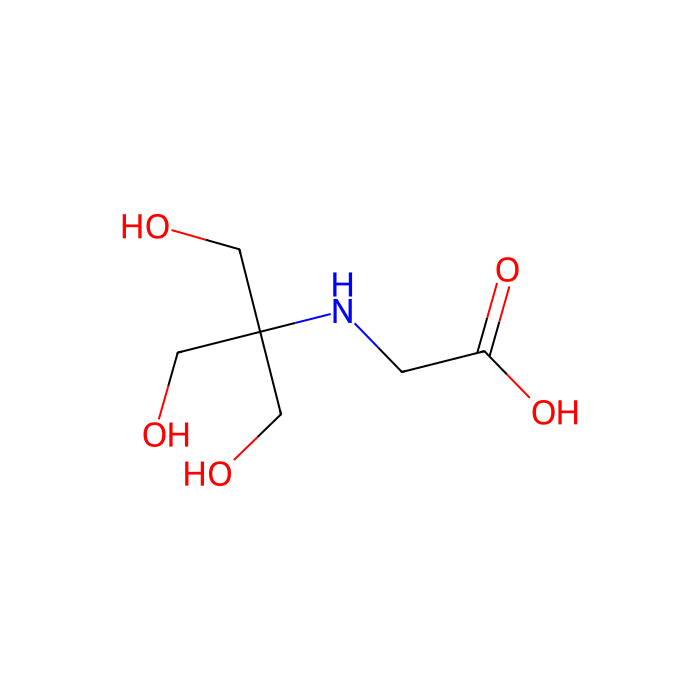
Tricine - ≥99% , CAS No.5704-04-1

CAS: 5704-04-1 Cat. No.: T100350 Formule: C6H13NO5 Poids moléculaire: 179.17 Beilstein Registry Number: 1937804 Numéro CE: 227-193-6 PubChem CID: 79784
DISPONIBLE À COMMANDE
QUALITÉ & PURETÉ ≥99%
Synonyms
2-(1,3-dihydroxy-2-(hydroxymethyl)propan-2-ylamino)acetic acid|2-{[1,3-dihydroxy-2-(hydroxymethyl)propan-2-yl]amino}acetic acid|N-[2-hydroxy-1,1-bis(hydroxymethyl)ethyl]glycine|2,6,6-Trimethyl-2-cyclohexen-1-carboxaldehyde|11beta-Hydroxy-4-androstene-3,17-dione|2-{[2-HYDROXY-1,1-BIS(HYDROXYMETHYL)ETHYL]AMINO}ACETIC ACID|n-(tris(hydroxymethyl)methyl)glycine|TRICINE [MI]|{[2-hydroxy-1,1-bis(hydroxymethyl)ethyl]ammonio}acetate|Tricine|([2-Hydroxy-1,1-bis(hydroxymethyl)ethyl]amino)acetic acid #|N-(Tri(hydroxymethyl)methyl)glycine|Stearoyl coenzyme A|n-(2-hydroxy-1,1-bis(hydroxymethyl)ethyl)glycine|VLS|Androstane, (5.alpha.)-|Glycine, N-[2-hydroxy-1,1-bis(hydroxymethyl)ethyl]-|2-[[1,3-dihydroxy-2-(hydroxymethyl)propan-2-yl]amino]acetic acid|N-Tris(hydroxymethyl)methylglycine|Glycine, N-(2-hydroxy-1,1-bis(hydroxymethyl)ethyl)-|N-[Tris(hydroxymethyl)methyl]glycine|N-[1,3-dihydroxy-2-(hydroxymethyl)propan-2-yl]glycine|U 1258|D-(+)-Arabinitol|2-((1,3-Dihydroxy-2-(hydroxymethyl)propan-2-yl)amino)aceticacid|2-((1,3-Dihydroxy-2-(hydroxymethyl)propan-2-yl)amino)acetic acid
Storage
Room temperature
Shipped In
Normal
★
Taille
Allemagne (EU)
USA*
Prix
Qté
5g
T100350-5g
—
1 En stock
8,59€
25g
T100350-25g
—
En stock ≥10
15,53€
100g
T100350-100g
—
4 En stock
43,30€
500g
T100350-500g
—
3 En stock

99,70€

150,03€
Enregistrer 50,33 € (33.55%)
Enter a quantity for the sizes you want to add.

Vue d’ensemble

Tricine is an organic derivative of tris and glycine used in buffer solutions. It is a zwitterionic amino acid with a useful buffering range of pH 7.4-8.8 and is one of Good's buffering agents; Good first prepared tricine to buffer chloropast reactions. A zwitterionic amino acid with a buffering range of pH 7.4-8.8. Due to a low negative charge and a high ionic strength, Tricine is very useful for electrophoretic separation of small molecular weight proteins in the range of 1 to 100 kDa. Tricine is a commonly used electrophoresis buffer and is also used in resuspension of cell pellets. It has a lower negative charge than glycine allowing it to migrate faster. In addition its high ionic strength causes more ion movement and less protein movement. This allows for low molecular weight proteins to be separated in lower percent acrylamide gels. Tricine has been documented in the separation of proteins in the range of 1 to 100 kDa by electrophoresis.[2] The tricine buffer at 25 mmol/L was found to be the most effective buffer among the ten tested for ATP assays using firefly luciferase.[3] Tricine has also been found to be an effective scavenger of hydroxyl radicals in a study of radiation-induced membrane damage. Buffer component for separation of low molecular weight peptides. A zwitterionic buffer useful in the pH range of 7.4-8.8. Has a pKa of 8.05 at 25°C.
A buffer component for separation of low molecular weight peptides.

Spécifications

Synonymes
2-(1,3-dihydroxy-2-(hydroxymethyl)propan-2-ylamino)acetic acid | 2-{[1,3-dihydroxy-2-(hydroxymethyl)propan-2-yl]amino}acetic acid | N-[2-hydroxy-1,1-bis(hydroxymethyl)ethyl]glycine | 2,6,6-Trimethyl-2-cyclohexen-1-carboxaldehyde | 11beta-Hydroxy-4-androstene-3,17-dione | 2-{[2-HYDROXY-1,1-BIS(HYDROXYMETHYL)ETHYL]AMINO}ACETIC ACID | n-(tri Afficher plus
Spécifications et pureté
≥99%
Conditions de stockage de stockage
Room temperature
Expédié en
Normal
Pureté
≥99%
Noms et identifiants
Pubchem Sid
Pubchem Sid Url
https://pubchem.ncbi.nlm.nih.gov/substance/488185772
SMILES
C(C(=O)O)NC(CO)(CO)CO
IUPAC Name
2-[[1,3-dihydroxy-2-(hydroxymethyl)propan-2-yl]amino]acetic acid
InChIKey
SEQKRHFRPICQDD-UHFFFAOYSA-N
InChI
1S/C6H13NO5/c8-2-6(3-9,4-10)7-1-5(11)12/h7-10H,1-4H2,(H,11,12)
Isomères SMILES
C(C(=O)O)NC(CO)(CO)CO
WGK Allemagne
3
PubChem CID
79784
Poids moléculaire
179.17
Beilstein
1937804
Reaxys
1937804

Données avancées

Taxonomic Classification

Taxonomy Tree

KingdomOrganic compounds
SuperclassOrganic acids and derivatives
ClasseCarboxylic acids and derivatives
SubclassAmino acids, peptides, and analogues
Intermediate Tree Nodes Amino acids and derivatives - Alpha amino acids and derivatives
Direct ParentAlpha amino acids
Alternative Parents Amino acids  1,2-aminoalcohols  Monocarboxylic acids and derivatives  Dialkylamines  Carboxylic acids  Primary alcohols  Organopnictogen compounds  Organic oxides  Hydrocarbon derivatives  Carbonyl compounds  
Molecular FrameworkAliphatic acyclic compounds
Substituents Alpha-amino acid - 1,2-aminoalcohol - Amino acid - Carboxylic acid - Secondary aliphatic amine - Monocarboxylic acid or derivatives - Secondary amine - Organic nitrogen compound - Primary alcohol - Organooxygen compound - Organonitrogen compound - Hydrocarbon derivative - Organic oxide - Organopnictogen compound - Carbonyl group - Amine - Organic oxygen compound - Alcohol - Aliphatic acyclic compound
DescriptionThis compound belongs to the class of organic compounds known as alpha amino acids. These are amino acids in which the amino group is attached to the carbon atom immediately adjacent to the carboxylate group (alpha carbon).
External Descriptors tricine
Structure 3D
Modèle de structure chimique interactif


Certificats (CoA, COO, BSE/TSE et tableau d'analyse)
C of A & Other Certificates(BSE/TSE, COO):
Analytical Chart:

Find and download the COA for your product by matching the lot number on the packaging.

21 results found

Lot NumberCertificate TypeDateArticle
B2303844B2303844Certificate of AnalysisNov 18, 2026 T100350
B2303839B2303839Certificate of AnalysisNov 18, 2026 T100350
J2227390J2227390Certificate of AnalysisAug 04, 2026 T100350
J2227363J2227363Certificate of AnalysisAug 04, 2026 T100350
J2227359J2227359Certificate of AnalysisAug 04, 2026 T100350
G2610599G2610599Certificate of AnalysisJul 13, 2026 T100350
G2610600G2610600Certificate of AnalysisJul 13, 2026 T100350
G2610601G2610601Certificate of AnalysisJul 13, 2026 T100350
C2620504C2620504Certificate of AnalysisMar 31, 2026 T100350
C2620505C2620505Certificate of AnalysisMar 31, 2026 T100350
F2208107F2208107Certificate of AnalysisMar 11, 2026 T100350
A2604562A2604562Certificate of AnalysisJan 12, 2026 T100350
B2223729B2223729Certificate of AnalysisDec 10, 2025 T100350
B2223730B2223730Certificate of AnalysisDec 10, 2025 T100350
H2507518H2507518Certificate of AnalysisAug 15, 2025 T100350
H2507685H2507685Certificate of AnalysisAug 15, 2025 T100350
J2514021J2514021Certificate of AnalysisAug 15, 2025 T100350
K2429502K2429502Certificate of AnalysisDec 05, 2024 T100350
K2429503K2429503Certificate of AnalysisDec 05, 2024 T100350
F2208108F2208108Certificate of AnalysisFeb 26, 2022 T100350
B2223840B2223840Certificate of AnalysisFeb 26, 2022 T100350
Propriétés chimiques et physiques
SolubilitéSoluble in water (89.6 g/l) at 20 °C.
Point de fusion (°C)172 °C
Poids moléculaire179.17
XLogP3-5.100
Hydrogen Bond Donor Count5
Hydrogen Bond Acceptor Count6
Rotatable Bond Count6
Exact Mass179.079 Da
Monoisotopic Mass179.079 Da
Topological Polar Surface Area110.000 Ų
Heavy Atom Count12
Formal Charge0
Complexity137.000
Isotope Atom Count0
Defined Atom Stereocenter Count0
Undefined Atom Stereocenter Count0
Defined Bond Stereocenter Count0
Undefined Bond Stereocenter Count0
The total count of all stereochemical bonds0
Covalently-Bonded Unit Count1
Sécurité et dangers (GHS)
WGK Allemagne
3
Reaxys
1937804
Index Merck
9651
FAQ et articles
Citations of This Product
Calculateurs de solution
Avis

Avis des clients

Souhaitez-vous que nous vous envoyions un message lorsque des réductions seront disponibles?

Me rappeler plus tard

Merci ! Veuillez vérifier votre boîte de réception e-mail pour confirmer.

Oups ! Les notifications sont désactivées.