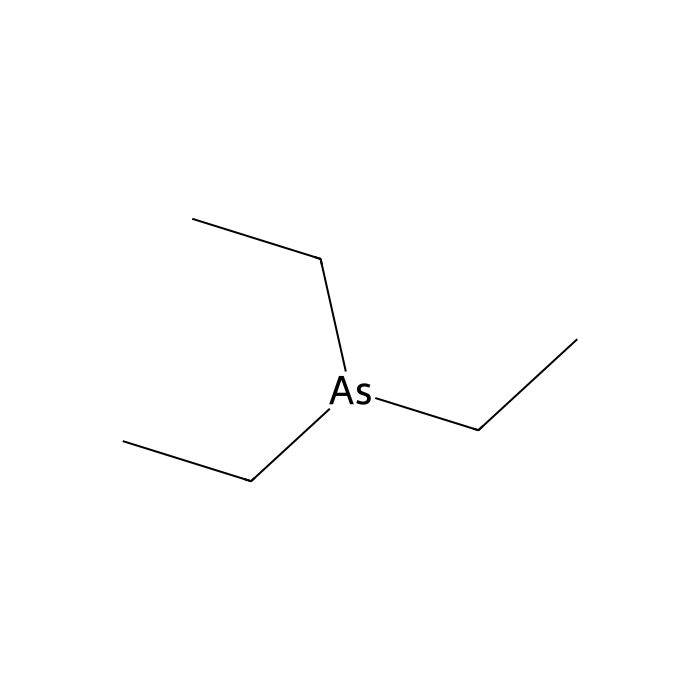
This compound belongs to the class of organic compounds known as trialkylarsanes. These are organoarsenic compounds containing a trivalent arsenic atom linked to three alkyl groups.
External Descriptors
Not available
1. Djoumbou Feunang Y, Eisner R, Knox C, Chepelev L, Hastings J, Owen G, Fahy E, Steinbeck C, Subramanian S, Bolton E, Greiner R, and Wishart DS. ClassyFire: Automated Chemical Classification With A Comprehensive, Computable Taxonomy. Journal of Cheminformatics, 2016, 8:61.
Certificats (CoA, COO, BSE/TSE et tableau d'analyse)
C of A & Other Certificates(BSE/TSE, COO):
Analytical Chart:
Propriétés chimiques et physiques
Sensibilité
air sensitive
Point d'ébullition (°C)
140°C
Point de fusion (°C)
-91°C
Poids moléculaire
162.100 g/mol
XLogP3
Hydrogen Bond Donor Count
0
Hydrogen Bond Acceptor Count
0
Rotatable Bond Count
3
Exact Mass
162.039 Da
Monoisotopic Mass
162.039 Da
Topological Polar Surface Area
0.000 Ų
Heavy Atom Count
7
Formal Charge
0
Complexity
25.700
Isotope Atom Count
0
Defined Atom Stereocenter Count
0
Undefined Atom Stereocenter Count
0
Defined Bond Stereocenter Count
0
Undefined Bond Stereocenter Count
0
The total count of all stereochemical bonds
0
Covalently-Bonded Unit Count
1
Calculateurs de solution
Molarity Calculator
Determine the necessary mass, volume, or concentration for preparing a solution.
Dilution Calculator
Determine the dilution needed to prepare a stock solution.
Reconstitution Calculator
Avis
Avis des clients
Application Protocols
No biological assay protocols (WB, IHC, IF, FC, etc.) are applicable to this small-molecule reagent. For chemical use:
Review the Reaction & Applications and Reaction Conditions tabs for general laboratory guidance.
For air-free transfers, standard Schlenk/glovebox protocols are appropriate: purge glassware, use inert gas overpressure for cannula/needle transfers, and verify solvent dryness and O2 content.
All procedures must be adapted to your specific experimental design and carried out under institutional safety guidelines. Refer to the SDS before use.
Biological Roles
Triethylarsine is a synthetic organoarsenic compound with no established beneficial physiological role. The points below summarize general biochemical considerations for organoarsines; they are not clinical statements.
Lack of natural role: Unlike trace elements such as zinc or copper, trivalent organoarsenic compounds are not known to serve as cofactors in normal biochemistry.
Toxicodynamics (general): Trivalent arsenic centers are soft Lewis acids/bases capable of interacting with thiol-containing biomolecules (e.g., cysteine residues, glutathione). Such interactions can disrupt protein function and redox homeostasis.
Metabolism (general): Biotransformation pathways for arsenic species can involve oxidation to pentavalent forms, methylation, and conjugation, with species- and matrix-dependent toxicokinetics. Organoarsines may undergo oxidative degradation to arsenic oxides.
Cellular stress: Exposure to arsenic compounds can induce oxidative stress responses and perturb mitochondrial function (literature).
Laboratory relevance:
Experimental controls: When used as a ligand or chemical probe in biochemical model systems, verify that observed effects are due to the intended chemical interaction rather than nonspecific arsenic toxicity.
No medical, diagnostic, or therapeutic applications are implied by this listing. For work involving biological systems, follow institutional biosafety and chemical safety policies and consult the SDS.
Buffer Applications
Triethylarsine is not a buffering reagent and is not used to prepare aqueous buffer systems. It is hydrophobic and air/oxidation sensitive, and is generally incompatible with the conditions typical of biological buffers.
For aqueous pH control, select dedicated buffer systems (e.g., phosphate, HEPES, MOPS, Tris). This product is not applicable in that context.
If trace amounts are present in an organic/aqueous biphasic experiment, anticipate partitioning into the organic phase and potential oxidation; design controls accordingly.
Green Alternatives
Because triethylarsine contains arsenic, its life-cycle and EHS profile are of high concern. Consider whether the desired chemical function (ligand/soft donor or arsenic source) can be met by less hazardous alternatives.
Comparison (general/literature):
Function: Soft donor ligand for transition metals
Possible alternatives: Tertiary phosphines (e.g., PPh3, PCy3), dialkylbiaryl phosphines, and N-heterocyclic carbenes (NHCs) often deliver comparable or superior catalytic outcomes with substantially lower toxicological concerns than organoarsines.
Possible alternatives: Tertiarybutylarsine (TBA) and trimethylarsine have been explored as safer alternatives to arsine gas; selection is governed by process safety and regulatory frameworks. If arsenic can be avoided altogether, reevaluate the materials system.
Sustainability and safety trade-offs:
Hazard reduction: Eliminating arsenic-containing reagents is the most impactful green choice when technically feasible.
Process simplification: Phosphine or NHC ligand systems can reduce waste streams associated with arsenic-containing byproducts and simplify waste handling.
Regulatory/waste: Arsenic-bearing wastes require specialized disposal; alternative ligands often ease compliance.
Decision guidance:
Define the performance metric (e.g., catalytic rate, selectivity, volatility) and screen non-arsenic ligands first. Resort to organoarsines only when necessary and under appropriate EHS controls.
This section provides general guidance; it does not alter the product’s specification or intended research-only use.
Pharmaceutical Uses
This product is supplied strictly for research use only and is not intended for human or veterinary use.
Excipient/formulation role: None. Triethylarsine is an organoarsenic compound and is not used as a pharmaceutical excipient.
Pharmacopeial status: Not monographed in common pharmacopeias as an excipient.
Process chemistry note (general): In specialized research settings, organoarsines may appear as ligands or reagents in homogeneous catalysis for small-molecule synthesis. Any use would be confined to early discovery or methodology studies with stringent controls and complete purge of arsenic residues.
Given the toxicological profile of arsenic compounds, their presence in pharmaceutical manufacturing is generally avoided. Where a ligand or soft donor is required in catalysis, non-arsenic alternatives (phosphines, NHCs) are typically preferred.
Physical Properties
Item-specific numeric specifications are not provided for this catalog entry. Consult the CoA/Spec Sheet for release specifications. The following are general/literature descriptors for triethylarsine and should not be construed as item specifications.
Appearance (literature): Colorless to pale liquid; characteristic garlic-like odor typical of organoarsines.
Boiling point: Not specified for this item; refer to CoA/Spec Sheet. (Literature values vary by source.)
Melting point: Not specified for this item; refer to CoA/Spec Sheet.
Density: Not specified for this item; refer to CoA/Spec Sheet.
Refractive index: Not specified for this item; refer to CoA/Spec Sheet.
Solubility (literature): Poorly soluble in water; miscible with many nonpolar/weakly polar organic solvents (e.g., alkanes, toluene, ethers, chlorinated solvents). Hydrolytic stability toward neutral water is better than arsine (AsH3) but air/oxidant sensitive.
Partitioning (qualitative, literature): Expected hydrophobic behavior due to three alkyl substituents; extracts into organic phase.
pKa/pKb: Not typically tabulated; behaves as a neutral Lewis base (lone pair donor) rather than a Brønsted base in water.
Notes on handling-related properties (general):
Air sensitivity: Can oxidize to the corresponding arsine oxide; rate depends on conditions and headspace oxygen.
Volatility: Organic liquid with measurable vapor pressure—use in a fume hood; minimize vapor exposure.
For precise numeric property values controlling your process (bp, density, UV cut-off, etc.), use the batch CoA.
Quality and Grades
Grade/Purity: Not specified for this item; refer to CoA/Spec Sheet.
Stabilizers/Inhibitors: Not specified for this item; refer to CoA/Spec Sheet.
Context for this chemical class (general guidance):
For sensitive organometallic/coordination applications, users often require tight limits on oxidation state impurities (e.g., corresponding arsine oxide) and on volatile bases/acids that can poison catalysts. Review the CoA for assay method (e.g., GC, NMR) and impurity profiles.
If used as a ligand precursor, trace halides, peroxides, and water can affect complexation kinetics and metal catalyst activity. Where relevant, vendors may report Karl Fischer water and GC area % assay; absence here means: Not specified for this item; refer to CoA/Spec Sheet.
UV-Vis transparency cutoffs, metal content, and stabilizer details are application-dependent (e.g., electronics vs. synthesis). For this listing, such parameters are: Not specified for this item; refer to CoA/Spec Sheet.
Practical recommendations:
Verify the assay and any reported oxide content on your batch CoA before critical uses.
If ultra-low oxygen content is required, consider brief purification (e.g., distillation under inert gas) as permitted by your safety protocols and local regulations.
Reaction and Applications
Triethylarsine functions primarily as a soft Lewis base and ligand in coordination/organometallic chemistry and as a precursor to arsenic-containing derivatives.
Common applications (literature/general):
Ligand for transition metals: Forms complexes with late transition metals (e.g., Pd, Pt, Ni, Au), modulating steric/electronic properties compared to phosphines. Useful in studying ligand effects on oxidative addition/reductive elimination and in homogeneous catalysis models.
Precursor to arsine oxides: Controlled oxidation affords triethylarsine oxide (Et3AsO), a handle for further transformations (e.g., halide activation to form quaternary arsonium salts under strong electrophiles).
Quaternization/Arsonium salt formation: Alkylation with strong alkyl halides or Meerwein salts gives R4As+ species; arsonium salts can serve as phase-transfer agents or synthetic intermediates (specialized).
Semiconductor chemistry: Trialkylarsines have seen use as arsenic precursors in MOCVD/MOVPE research; selection depends on volatility/safety requirements (handled by specialists under strict controls).
Practical tips:
Air-free technique: Employ Schlenk/glovebox methods; exclude O2 and moisture to limit oxidation to Et3AsO.
Monitoring: 1H/13C NMR and, where available, 75As NMR can track ligand coordination or oxidation state changes; GC can quantify residual arsines/oxides.
Workup: Avoid strong oxidants/halogens during quench; segregate arsenic-containing waste and comply with hazardous waste regulations.
Note: Catalytic performance and substrate scope are metal- and system-specific; consult the primary literature for your transformation of interest.
Reaction Conditions
General, literature-based guidance for handling triethylarsine in synthesis; optimize for your specific system. These are not product specifications.
Atmosphere: Inert gas (N2/Ar). Employ Schlenk or glovebox techniques to limit oxidation.
Solvents: Dry, degassed toluene, benzene, xylene, hexanes/heptane, DCM, or anhydrous ethers (Et2O, THF). Choice depends on desired donor background and solubility of partners.
Temperature: Typical ligand coordination/complexation is conducted from 0 °C to ambient. Thermal ligand substitutions or catalytic runs may range to 60–100 °C depending on metal system stability.
Stoichiometry: 1.0–3.0 equiv relative to metal precursor in complexation screens; catalytic systems often use 1–4 ligands per metal center.
Time: Minutes to hours for ligand exchange at room temperature; longer for less labile systems.
Workup: Maintain inert conditions during solvent removal to avoid oxidation; if oxidation is desired (to Et3AsO), controlled O2 or peroxide exposure can be used in a separate, well-ventilated setup.
Monitoring: NMR (1H/13C, optionally 75As), IR for metal–ligand bands (system-dependent), and GC/GC–MS for free ligand quantification.
Safety overlays:
Avoid strong oxidants/halogens during reactions unless intentionally performing oxidation or halogenation steps.
Use well-ventilated hoods; minimize headspace oxygen; consider oxygen indicators in gloveboxes.
For cross-coupling or homogeneous catalysis where arsine ligands are substituted for phosphines, consult primary literature for the specific metal/ligand/substrate set.
Safety and Handling
The following complements, but does not replace, the SDS. Always consult the SDS for authoritative hazard information for this specific item.
GHS Classification: Not specified for this item; refer to SDS.
Signal Word / H-Statements / Pictograms: Not specified for this item; refer to SDS.
General hazards for trialkylarsines (literature/experience):
Toxicity: Organoarsenicals can be highly toxic by inhalation, ingestion, and skin absorption. Avoid all exposure; use closed handling or well-ventilated fume hood.
Flammability/combustion: Combustible liquid. Combustion/thermal decomposition may release arsenic oxides which are extremely hazardous.
Air/oxidant sensitivity: Gradual oxidation to the corresponding arsine oxide; avoid air and strong oxidizers. Incompatibles include oxidizing agents, halogens, and strong electrophiles/alkylating agents.
PPE and engineering controls (best practice):
Containment: Certified chemical fume hood or glovebox/Schlenk line for air-free transfers.
Hygiene: No eating/drinking; wash hands and exposed skin thoroughly after handling.
First-aid overview (general):
Inhalation: Move to fresh air; seek medical attention immediately. Provide oxygen if trained.
Skin/eye contact: Immediate decontamination with copious water for ≥15 min; remove contaminated clothing; obtain medical attention.
Ingestion: Rinse mouth; do not induce vomiting; seek urgent medical care.
Spill/fire response (general):
Small spills: Absorb with inert material; collect for hazardous waste. Maintain ventilation; avoid generating vapors.
Fire: Use dry chemical, CO2, or foam. Fire-fighters should wear SCBA; arsenic oxides may form.
Solvent Selection
Triethylarsine is itself a hydrophobic organosoluble reagent rather than a routine chromatography/mobile-phase solvent. Selection of a medium for handling or reaction should consider air sensitivity and Lewis basicity.
General solvent compatibility (literature):
Miscibility: Expected to be miscible with many nonpolar to moderately polar organic solvents (e.g., hexanes, toluene, benzene, diethyl ether, THF, DCM). Poor water solubility.
Polarity class: Nonpolar to weakly polar, neutral Lewis base donor (soft base). Can coordinate to very Lewis-acidic species; avoid strongly electrophilic media if unintentional coordination is problematic.
Complexation/ligand exchange with metals: Aromatic hydrocarbons or chlorinated solvents often provide good solubility while limiting competing donor effects; ethers can increase donor competition.
Purification by distillation: Select high-purity, low-peroxide solvents; ensure rigorously dry apparatus and inert atmosphere.
Brief comparison (general):
Hydrocarbons (hexanes/toluene): Lowest coordinating background, good for kinetic studies of complexation.
Ethers (Et2O/THF): Convenient but more coordinating; may alter metal speciation.
Chlorinated (DCM): Good solvation; monitor for possible halide introduction in sensitive systems.
Always verify solvent dryness and oxygen content for air-sensitive work. For solvent-grade specifications applicable to your workflow, consult solvent suppliers’ data; they are not specified for this item.
Container: Keep tightly closed in a compatible, airtight container. For best longevity, store under inert gas to limit oxidation to the arsine oxide.
Light/Oxygen/Moisture: Protect from air/oxidants. Normal laboratory light is usually acceptable, but minimizing exposure can reduce secondary reactions.
Stabilizers: Not specified for this item; refer to CoA/Spec Sheet.
Reconstitution: Not applicable; supplied neat (no reconstitution required). If stock solutions are prepared, use dry, oxygen-free organic solvents (e.g., toluene, hexanes) under inert atmosphere and store in sealed vials with headspace purged with N2/Ar.
Freeze–thaw: Not typically relevant; avoid unnecessary temperature cycling. Focus on excluding oxygen and moisture.
Shelf life: Not specified for this item; refer to CoA/Spec Sheet.
Inventory management tips:
Dedicate PTFE-lined caps or crimp-sealed septa vials for repeated needle-access under inert gas.
Periodically check for signs of oxidation (e.g., change in odor/behavior, formation of higher polarity impurity by GC or NMR) and replace material if out of specification.
Research Use Note: For research use only.
Structure and Identity
Triethylarsine is a tertiary organoarsine featuring three ethyl groups bound to arsenic.
SKU: T282563
Product Name: Triethylarsine
CAS: 617-75-4
PubChem CID: 69242 (literature)
InChIKey: 410145 (provided; format appears non-standard)
SMILES: Not specified for this item; refer to CoA/Spec Sheet.
Molecular Formula: C6H15As (literature)
Molecular Weight: ≈162.10 g/mol (literature)
Structural features (general chemistry/literature):
Functional class: Trialkylarsine (tertiary arsine), a soft Lewis base with a stereochemically active lone pair on As.
Connectivity: Arsenic atom bonded to three primary alkyl (ethyl) groups; no heteroatoms other than As.
Geometry: Approx. trigonal pyramidal at As (sp3-like with a lone pair), analogous to trialkylphosphines but with a larger, more polarizable pnictogen center.
Reactivity motif: Susceptible to air oxidation to the corresponding arsine oxide (Et3As→Et3AsO) and to quaternization with strong alkylating agents (Et3As→Et3AsR+).
2D description in words (general): three ethyl chains radiate from a central arsenic; the As center bears a nonbonding electron pair, giving a pyramidal topology when depicted in 3D.
Synthetic Utility
Triethylarsine offers a set of transformations characteristic of tertiary arsines, serving both as a ligand and as a substrate for derivatization.
Key reactivity elements (literature/general):
Soft Lewis base/ligand: Coordinates to late transition metals (Pd, Pt, Ni, Au, etc.), enabling tuning of catalytic cycles. Compared with phosphines, arsines are generally softer and more polarizable, affecting oxidative addition and reductive elimination kinetics.
Oxidation chemistry: Controlled oxidation affords the corresponding arsine oxide (Et3AsO). Further activation (e.g., with halogenating agents) can lead to reactive intermediates for substitution chemistry.
Quaternization: Reaction with strong alkylating agents yields quaternary arsonium salts (R4As+ X–), which can be isolated and potentially used as phase-transfer catalysts or as leaving-group precursors in substitution chemistry.
Ligand exchange: In situ ligand substitution on metal complexes can be used to screen catalyst performance; Et3As provides a distinct electronic profile relative to P-based ligands.
Practical considerations:
Air-free protocols minimize formation of Et3AsO, which alters ligand properties.
Stoichiometry: Use slight ligand excess to drive complexation; remove unbound ligand by evaporation or washing under inert conditions.
Analytics: 1H/13C NMR and MS confirm integrity; 75As NMR (where available) can provide direct evidence of As environment.
Not applicable. This product is a small-molecule organoarsenic reagent, not an antibody, enzyme, or affinity reagent. No antigen/epitope specificity, clone, isotype, or species reactivity applies.
We use cookies to ensure the website functions properly and, where permitted, to improve your experience. You can manage your preferences at any time in Settings. Learn more in our Cookie Policy.
Shall we send you a message when we have discounts available?
Remind me later
Thank you! Please check your email inbox to confirm.
Products are supplied to verified businesses, institutions, and qualified professionals for research and development use only. Not for use in humans, animals, diagnosis, or therapy.