UltraBio™ Multiplex Amplification Mix - BioReagent,DNase, RNase free,PCR Reagent,Suitable for molecular biology,for DNA and RNA applications,2.5μL/T

Cat. No.: FP1508887
DISPONIBLE À COMMANDE
GRADE & PURITY Suitable for molecular biology ? Molecular-biology grade — free of nucleases and contaminants that degrade DNA/RNA. Use in cloning, PCR, and nucleic-acid work needing clean reagents. BioReagent ? BioReagent grade — tested suitable for life-science and molecular-biology use. Use for cell culture, assays, and biochemical work needing biological compatibility. DNase, RNase free ? Free of DNase and RNase activity to keep DNA and RNA intact. Use in nucleic-acid extraction, PCR, and storage where degradation is a risk. PCR Reagent ? PCR grade — nuclease-free, inhibitor-free reagents for reliable amplification. Use in PCR/qPCR where contaminants would block or bias amplification. for DNA and RNA applications ? For nucleic-acid (DNA & RNA) applications — nuclease-controlled across both. Use in workflows handling DNA and RNA together where degradation is a risk. 2.5μL/T
Storage
Store at -20°C,Avoid repeated freezing and thawing
Shipped In
Ice chest + Ice pads
Application
Multiplex PCR, PCR
★
Size
Allemagne (EU)
USA*
Price
Qty
24T
FP1508887-24T
Sur commande · 8–12 semaines
78,01€
96T
FP1508887-96T
Sur commande · 8–12 semaines
216,85€
Enter a quantity for the sizes you want to add.
🧪

Why this grade

BioReagent,DNase, RNase free,PCR Reagent,Suitable for molecular biology,for DNA and RNA applications,2.5μL/T BioReagent,DNase, RNase free,for DNA and RNA applications,PCR Reagent,Suitable for molecular biology for sensitive chromatographic and analytical workflows requiring minimal baseline interference.

🌡

Storage & shipping

Store at -20°C,Avoid repeated freezing and thawing Ships Ice chest + Ice pads Check lot-specific COA for exact specifications.

📋

Quality documents

SDS, COA, datasheet, and spec sheet available for download. Lot-specific COA accessible via lot number lookup.

📚

Literature proof

Cited in 0 peer-reviewed publications across chromatography, organic synthesis, and cross-coupling reactions.

Vue d’ensemble

UltraBio™ Multiple Amplification Mix is a universal multiplex amplification reagent that can be used for constructing multiplex amplicon libraries for microbial/genetic mutation detection. It is compatible with ultra-multiplex amplification, with a primer number range of 1 to 1500, amplicon length range of 100 to 1800 bp, GC content range of 13% to 75%, and a minimum template input amount of 1 ng. 

   The reagent undergoes strict background microbe quality control to minimize false positives from non-specific amplification. 

   Rigorous functional validation ensures high stability and reproducibility, making it ideal for NGS-based multiplex targeted amplification in microbial/genetic mutation detection.

Catalog

Component

24T

96T

Storage

FP1508887

UltraBio™ Multiplex Amplification Mix

60 μL

240 μL

-20℃

Self-Supplied Materials

1. Instruments

    PCR thermal cycler, Pipettes, Magnetic stand, Microcentrifuge, Vortex mixer, Agarose gel electrophoresis system, UV gel imaging system, Agilent Bioanalyzer 2100 (or equivalent).

2. Reagents

    Agarose, 1× TAE buffer, Nucleic acid dye, DNA marker, Ampure XP beads (or equivalent), Freshly prepared 80% ethanol, Nuclease-free water.

3. Consumables

    1.5 mL microcentrifuge tubes, 0.2 mL PCR tubes, DNase/RNase-free pipette tips.

Protocol

I. Multiplex Amplification & Product Verification

  1. Reagent Preparation

    • Thaw UltraBio™ Multiplex Amplification Mix on ice.

    • Vortex briefly and centrifuge before use.

  2. Reaction Setup (10 μL Standard Volume)

  3. Component
    Volume per Reaction
    Final Concentration
    UltraBio™ Multiplex Amplification mix
    2.5 μL
    4x
    Primer Mix
    1 μL20nM (2.5~100nM)
    Template DNA
    X μL
    10ng (1~100ng)
    Nuclease-free water
    Up to10 μL
    /
    Total
    10 μL/

Note:

  • Total reaction volume can be scaled to 10–50 μL (adjust mix proportionally).

  • Primer concentration and annealing temperature (T) should be optimized for each panel.

  1. Mixing & Centrifugation

    • Vortex gently and centrifuge briefly to collect liquid.

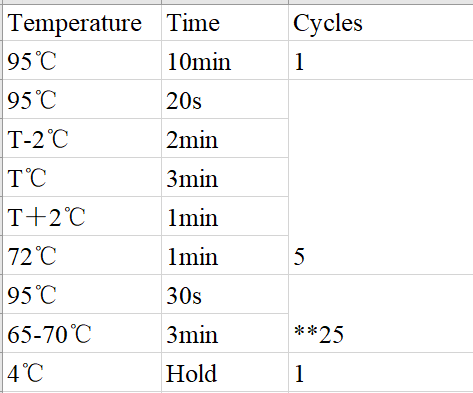
  2. PCR Cycling Program

*T: Annealing temperature depends on primer panel (optimize empirically).
Cycle number: Adjust based on template input (default: 25 cycles).

  1. Product QC: Analyze amplification success via 2% agarose gel electrophoresis or Agilent 2100 Bioanalyzer.

II. Amplicon Purification (Ampure XP Beads)

  1. Bead Equilibration

    • Warm Ampure XP beads to room temperature; vortex thoroughly.

  2. Bead Binding

    • Dilute PCR products to 50 μL with nuclease-free water.

    • Add 60 μL beads (1.2× ratio), vortex, and incubate 5 min at RT.

  3. Wash Steps

    • Place tubes on a magnetic stand for 3–5 min; discard supernatant.

    • Wash twice with 200 μL fresh 80% ethanol (30 sec per wash).

    • Air-dry beads for 2–3 min until matte.

  4. Elution

    • Resuspend beads in 22 μL nuclease-free water; incubate 2 min at RT.

    • Transfer 20 μL supernatant to a new PCR tube.

    • Store purified products at –20°C.

Specifications

Spécifications et pureté
BioReagent,DNase, RNase free,PCR Reagent,Suitable for molecular biology,for DNA and RNA applications,2.5μL/T
Stabilité et stockage
Store at -20℃ long term (12 months). Avoid freeze/thaw cycle. Upon receipt, it is recommended to aliquot.
Conditions de stockage de stockage
Store at -20°C,Avoid repeated freezing and thawing
Expédié en
Ice chest + Ice pads
Ce produit nécessite l'expédition en chaîne froide. Les services terrestres et autres services économiques ne sont pas disponibles.
Grade
BioReagent, DNase, RNase free, for DNA and RNA applications, PCR Reagent, Suitable for molecular biology

Documentation

📋 Safety Data Sheet (SDS)

Comprehensive hazard, handling, storage, and regulatory compliance document.

Download SDS →

✅ Certificate of Analysis (COA)

Lot-specific quality data. Enter your lot number to retrieve the exact COA.

Look up COA →

📊 Datasheet

Quick-reference summary of product specifications and applications.

View datasheet →

🔬 Specification Sheet

Full quality attributes and acceptance criteria for this grade.

View spec sheet →

Advanced Data

Certificats (CoA, COO, BSE/TSE et tableau d'analyse)
C of A & Other Certificates(BSE/TSE, COO):
Analytical Chart:

Find and download the COA for your product by matching the lot number on the packaging.

2 results found

Lot NumberCertificate TypeDateArticle
ZJ26F0333671Certificate of AnalysisMar 31, 2026 FP1508887
ZJ26F0333670Certificate of AnalysisMar 31, 2026 FP1508887
FAQ et articles
Calculateurs de solution
Avis

Avis des clients

Foire aux questions

What does BioReagent mean?
BioReagent indicates that the product has been processed and tested for biological and biochemical applications. Specifications may include endotoxin limits, microbial controls, sterility, low DNase/RNase/protease activity, and verified biological activity where relevant.
What does DNase, RNase free mean?
DNase, RNase free indicates that the product has been processed and tested for sensitive nucleic acid and protein workflows. Typical specifications include low or undetectable nuclease/protease activity, low endotoxin, controlled microbial limits and high lot-to-lot reproducibility.
How should this product be stored?
Store at ?20 °C. Avoid repeated freeze–thaw cycles. Aliquot into single-use volumes before freezing.
How is this product shipped?
This product ships in an insulated container with ice pads. Unpack on arrival and transfer it to the storage condition stated above.
What documentation is provided?
Available product documentation, including Certificates of Analysis (COA), Safety Data Sheets (SDS), and specification sheets, is shown in the product document area. Document availability and access follow the current site policy.

Shall we send you a message when we have discounts available?

Remind me later

Thank you! Please check your email inbox to confirm.

Oops! Notifications are disabled.