≥99% for sensitive chromatographic and analytical workflows requiring minimal baseline interference.
🌡
Storage & shipping
Store at -20°C Ships Ice chest + Ice pads Check lot-specific COA for exact specifications.
📋
Quality documents
SDS, COA, datasheet, and spec sheet available for download. Lot-specific COA accessible via lot number lookup.
📚
Literature proof
Cited in 0 peer-reviewed publications across chromatography, organic synthesis, and cross-coupling reactions.
Vue d’ensemble
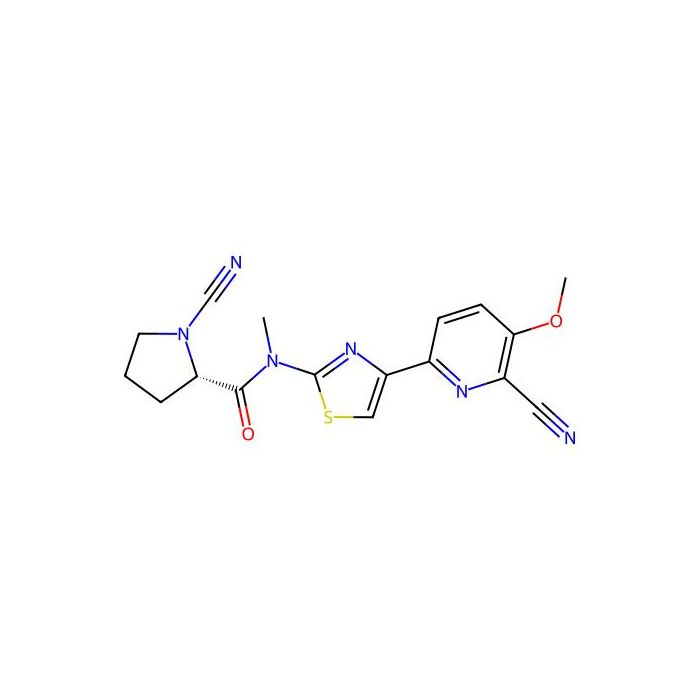
USP30 inhibitor 11 is a selective and potent ubiquitin specific peptidase 30 (USP30) inhibitor with an IC 50 of 0.01 µΜ, the example 83 extracted from patent WO2017009650A1. USP30 inhibitor 11 is used for the study of cancer and conditions involving mitochondrial dysfunction
In Vitro
USP30 is a 517 amino acid protein which is found in the mitochondrial outer membrane. It is the sole deubiquitylating enzyme bearing a mitochondrial addressing signal and has been shown to deubiquitylate a number of mitochondrial proteins. USP30 inhibitor 11 (0.01-30 µΜ; λ Ex =540 nm; λ Em =590 nm) inhibits USP30 biochemical activity with an IC 50 of 0.01 µΜ in a USP30 biochemical IC 50 assay. MCE has not independently confirmed the accuracy of these methods. They are for reference only.
Form:Solid
IC50& Target:IC50: 0.01 µΜ (USP30)
Specifications
Spécifications et pureté
≥99%
Mécanismes biochimiques et physiologiques
USP30 inhibitor 11 is a selective and potent ubiquitin specific peptidase 30 (USP30) inhibitor with an IC 50 of 0.01 µΜ, the example 83 extracted from patent WO2017009650A1. USP30 inhibitor 11 is used for the study of cancer and conditions involving mitoc
Conditions de stockage de stockage
Store at -20°C
Expédié en
Ice chest + Ice pads
Ce produit nécessite l'expédition en chaîne froide. Les services terrestres et autres services économiques ne sont pas disponibles.
Certificats (CoA, COO, BSE/TSE et tableau d'analyse)
C of A & Other Certificates(BSE/TSE, COO):
Analytical Chart:
Calculateurs de solution
Molarity Calculator
Determine the necessary mass, volume, or concentration for preparing a solution.
Dilution Calculator
Determine the dilution needed to prepare a stock solution.
Reconstitution Calculator
Avis
Avis des clients
Application Protocols
No tested applications, assay formats, or recommended dilutions are provided in the Product Data for this item.
Statement of record: Not specified for this item; refer to CoA/Spec Sheet.
Please consult validated literature protocols relevant to USP30 enzymology or cell-based pathway studies and adapt them under your institutional SOPs. This section intentionally avoids prescriptive protocols in the absence of item-specific validation.
Biological Roles
Context for the biochemical target (general literature background; not item-specific claims):
USP30 is a mitochondrial outer membrane deubiquitinase (DUB) that removes ubiquitin from substrates on mitochondria. It counteracts Parkin- and PINK1-driven ubiquitination events, thereby modulating mitophagy (the selective autophagic turnover of mitochondria).
By trimming ubiquitin chains on mitochondrial proteins, USP30 can influence organelle quality control, mitochondrial dynamics, and cellular responses to mitochondrial depolarization.
In biochemical assays, USP30 activity is commonly profiled using ubiquitin-based fluorogenic substrates (e.g., Ub-AMC) or activity-based probes; cellular assays may monitor mitophagy reporters, ubiquitin chain accumulation on mitochondrial proteins, and related pathway readouts.
For any small-molecule annotated as a “USP30 inhibitor,” validation typically involves enzymatic IC50 determination, selectivity profiling against a panel of DUBs, and orthogonal confirmation in cells. None of those values are provided in the Product Data for this item.
Important note: The above describes the biological function of the enzyme USP30 in general. No therapeutic or clinical claims are made for this product. Item-specific potency, selectivity, and cellular activity of “USP30 inhibitor 11” are not specified; consult the CoA/Spec Sheet or primary literature associated with the CAS if available.
Buffer Applications
Not typically applicable. This product is not a buffering agent and is not intended to formulate buffer systems. For assay use, choose standard biological buffers (e.g., HEPES, Tris, phosphate) compatible with your enzyme or cell system and with the solvent vehicle (commonly low-percentage DMSO). Item-specific buffer compatibility is not specified; refer to CoA/Spec Sheet and your assay’s validated conditions.
Green Alternatives
This product is a bioactive screening compound rather than a process solvent or commodity reagent.
Applicability:
Green-chemistry substitution frameworks are less relevant here because the compound is used at milligram-to-micromole scale for discovery assays, not bulk synthesis.
Environmental considerations (general):
Minimize solvent volumes in stock preparation and assay plates.
Favor aqueous buffers with minimal DMSO content where assay-compatible. Opt for microplate formats that reduce plastic waste and enable efficient liquid handling.
Dispose of unused solutions according to institutional hazardous waste guidelines to prevent environmental release.
If your use-case is medicinal chemistry optimization or scale-up synthesis of this scaffold, consider applying green chemistry metrics to the synthetic route (e.g., solvent selection guides, E-factor, energy consumption). However, route-level alternatives cannot be recommended without the disclosed structure.
Pharmaceutical Uses
Not applicable for this catalog item. USP30 inhibitor 11 is provided strictly for research use only and is not intended for human or veterinary use, diagnostic procedures, or as an excipient. No pharmacopeial status, formulation role, or manufacturing use is specified for this item. Any evaluation of developability, ADME, or formulation behavior must be performed independently in a research context and is outside the scope of this product listing.
Physical Properties
Item-specific values (provided):
None. Boiling point, melting point, density, refractive index, pKa/logP, and solubility are not reported in the Product Data.
Statement of record for this item:
Melting point: Not specified for this item; refer to CoA/Spec Sheet.
Boiling point: Not specified for this item; refer to CoA/Spec Sheet.
Density: Not specified for this item; refer to CoA/Spec Sheet.
Refractive index: Not specified for this item; refer to CoA/Spec Sheet.
Solubility: Not specified for this item; refer to CoA/Spec Sheet.
pKa/logP: Not specified for this item; refer to CoA/Spec Sheet.
General guidance (literature/practice, not item-specific):
Many screening compounds are supplied as solids intended for dissolution in polar aprotic solvents (e.g., DMSO) to make 10–50 mM stocks for biochemical or cell-based assays. Actual solubility can vary widely with scaffold and salt form.
If solubility is uncertain, perform a small-scale solubility check across DMSO, DMF, ethanol, and aqueous buffers containing co-solvent (e.g., 0.1–1% DMSO) and/or surfactant where compatible with the assay. Avoid strong acids/bases unless the compound is known to be stable to those conditions.
Where hygroscopicity or polymorphism is suspected, equilibrate samples in a desiccator and verify mass by back-weighing.
Quality and Grades
Item-specific quality/purity information:
Grade/Purity: Not specified for this item; refer to CoA/Spec Sheet.
Appearance: Not specified for this item; refer to CoA/Spec Sheet.
Interpretation and expectations (general guidance for library/screening compounds):
Screening-library compounds are typically supplied with analytical identity confirmation (e.g., LC–MS and/or 1H NMR) and a chromatographic purity threshold (often ≥95% by HPLC/UPLC), but the exact threshold for this item is not provided here.
If a stabilizer, counter-ion, or salt form is used, it should be disclosed on the CoA/Spec Sheet. Absence of such notation in the Product Data does not confirm absence in the material.
For high-sensitivity applications (biophysical assays, SPR, Tm shift, kinetic DUB assays), request or review: purity by HPLC with UV traces, LC–MS (m/z and isotope pattern), water content (KF), and residual solvent profile. For photo/air-sensitive scaffolds, ask for light/oxygen exposure guidance.
If low-UV-absorbing solvent grades or endotoxin limits are needed (e.g., for certain biophysical measurements), specify these requirements at time of order so that appropriate documentation can be provided.
Conclusion: Use the lot-specific CoA to set acceptance criteria and to document purity/identity prior to screening or follow-up studies.
Reaction and Applications
This item is a screening small molecule intended as a biochemical tool rather than a synthetic reagent.
Synthetic/chemical reaction use:
Not typically applicable. The compound is not positioned as a reagent or catalyst for named synthetic transformations.
Research applications (non-clinical; general guidance):
May be employed in biochemical assays that measure deubiquitinase activity (e.g., fluorogenic ubiquitin substrates) or in cell-based studies of pathways where USP30 function is implicated. Assay design, concentrations, and controls must be established empirically and with appropriate orthogonal readouts.
Practical considerations:
Verify identity/purity prior to biological testing. Establish DMSO stock concentration based on actual solubility and maintain constant vehicle percentages across controls.
Use serial dilutions to define potency ranges; incorporate counterscreens to assess off-target assay interference (e.g., redox cycling, fluorescence quenching, aggregation).
Item-specific application claims or potencies (IC50/Ki, selectivity): Not specified for this item; refer to CoA/Spec Sheet and the primary literature if available for the same CAS.
Reaction Conditions
Not applicable. USP30 inhibitor 11 is not intended to be used as a reagent in chemical transformations, and no synthetic or catalytic reaction conditions apply to this item. If the compound is to be used in biochemical assays, follow validated enzymology or cell biology protocols for the specific assay format and consult the CoA/Spec Sheet for any stability notes.
Safety and Handling
GHS/SDS information in Product Data:
Signal word: Not specified for this item; refer to CoA/Spec Sheet.
H-Statements: Not specified for this item; refer to CoA/Spec Sheet.
GHS classification and pictograms: Not specified for this item; refer to CoA/Spec Sheet.
General laboratory precautions (non-item-specific; defer to SDS once available):
Use in a chemical fume hood. Avoid inhalation of dust/aerosols and contact with skin or eyes.
PPE: lab coat, safety glasses, appropriate chemically resistant gloves (e.g., nitrile). Change gloves regularly and after contamination.
Handling: Minimize exposure to ambient moisture and heat. Cap vials promptly to limit atmospheric water uptake and oxidation. When preparing DMSO stocks, avoid needle-stick injuries and wipe external vial surfaces.
Incompatibilities: Unknown for this specific item. As a general rule for organic small molecules, avoid strong oxidizers and strong acids/bases unless stability is verified.
First aid (general): In case of skin contact, wash with soap and water. Eye contact: rinse cautiously with water for several minutes and seek medical attention. Inhalation: move to fresh air; obtain medical attention if symptoms occur. Ingestion: rinse mouth; do not induce vomiting; seek medical attention.
Waste: Dispose according to institutional and local regulations for organic chemical waste. Do not release to the environment.
Always consult the item’s SDS for authoritative hazard classifications and response guidance.
Solvent Selection
Item-specific solvent/solubility data are not provided for USP30 inhibitor 11. The following are general, non-item-specific practices for small-molecule screening compounds:
Primary stock solvent:
DMSO is the default choice for discovery compounds due to broad solvating power and compatibility with biochemical and cell-based assays at low final percentages (typically ≤0.1–0.5% v/v in assay).
Co-solvents and alternates:
DMF and NMP offer similar solvating power but are less common in biological assays. Ethanol or isopropanol can be used for some scaffolds with improved aqueous tolerance.
Aqueous vehicles:
Phosphate or HEPES buffers can accept small DMSO fractions. Consider adding non-ionic surfactants (e.g., 0.01–0.05% Tween 20 or Pluronic F-68) to mitigate aggregation, if appropriate for the assay.
Practical tips:
Determine kinetic solubility and aggregation propensity at the intended assay pH and ionic strength. Filter or centrifuge stocks to remove particulates before dilution.
Avoid freeze–thaw of DMSO stocks when possible; aliquot to single-use vials.
Selection versus alternatives:
Choose DMSO when structural information and ionization state are unknown. If basic or acidic functionality is suspected and compatible with the assay, buffered aqueous stocks may be attempted after verifying stability.
Item-specific solubility and solvent compatibility: Not specified for this item; refer to CoA/Spec Sheet.
Storage and Reconstitution
Item-specific conditions (from Product Data):
Storage: Store at -20°C.
Shipping: Ice chest + ice pads.
Additional guidance (general best practice; not item-specific specifications):
Upon receipt: Allow the sealed container to equilibrate to room temperature in a desiccator before opening to minimize moisture condensation. If supplied as a solid, promptly subdivide into single-use aliquots under dry conditions.
Reconstitution: Not specified for this item; refer to CoA/Spec Sheet. In many discovery workflows, compounds are dissolved in anhydrous DMSO to prepare 10–50 mM stocks; actual achievable concentration depends on true solubility and stability.
Aliquoting: Prepare small, single-use aliquots to avoid repeated freeze–thaw. If using DMSO stocks, store tightly capped, protected from light if the compound is photosensitive (not specified here).
Stability: No stability profile is provided. Where feasible, verify stability by periodic LC–MS/HPLC checks after storage. Avoid prolonged exposure to ambient light, oxygen, and moisture unless stability is known.
Handling temperature: Keep on cold packs during transfers when practicable; return to -20°C storage after use. For short-term bench work, minimize time at room temperature.
Always follow the lot-specific CoA/Spec Sheet for definitive reconstitution solvents, concentration limits, and stability windows if provided.
Structure and Identity
Brief overview: This product is supplied as a research small-molecule screening compound labeled “USP30 inhibitor 11,” intended for discovery and assay use.
Item-specific identifiers (from Product Data):
CAS: 2067332-64-1
Product Name: USP30 inhibitor 11
SKU: U649599
Category: Small molecules and compound libraries (研究/筛选用途)
Molecular formula: Not specified for this item; refer to CoA/Spec Sheet.
Molecular weight: Not specified for this item; refer to CoA/Spec Sheet.
SMILES: Not specified for this item; refer to CoA/Spec Sheet.
InChIKey: Not specified for this item; refer to CoA/Spec Sheet.
Structural features (general note):
The specific 2D/3D structure, functional groups, and stereochemistry are not disclosed in the provided data. As a consequence, structural descriptors (rings, heteroatoms, HBA/HBD counts, etc.) cannot be summarized here for this item.
Practical implication: Without structural data, solubility, ionization behavior, and handling may vary; verify the Certificate of Analysis (CoA) for definitive identity and any lot-specific analytical data (NMR, LC–MS, HPLC purity profiles) if provided with the shipment.
Synthetic Utility
Not typically applicable. This product is a bioactive small molecule supplied for screening and mechanistic studies, not as a reagent or building block for routine synthesis.
Because the molecular structure and functional groups are not disclosed in the Product Data, no guidance can be provided regarding reactivity, derivatization, or participation in named reactions.
If your objective is scaffold optimization or SAR expansion, obtain the full structural information and consider custom synthesis or analog procurement through medicinal chemistry services; then apply standard retrosynthetic and functional group interconversion strategies appropriate to the disclosed scaffold.
Target Specificity
Item-specific target data provided: None.
Although the product name suggests activity against USP30, no validated specificity, potency (IC50/Ki), selectivity panel data, or off-target profile are provided in the Product Data for this item.
Statement of record: Not specified for this item; refer to CoA/Spec Sheet.
For rigorous research, confirm target engagement via orthogonal assays (e.g., enzymatic inhibition with multiple substrates, activity-based probe competition, and cellular pathway readouts) using independently sourced controls. These are general considerations and do not constitute item-specific performance claims.
Foire aux questions
What is the purity of this product?
This product is supplied at ≥99% purity (chemical assay). Lot-specific values are stated on the Certificate of Analysis.
How should this product be stored?
Store at ?20 °C. Freezer storage is required to maintain the specified shelf life.
How is this product shipped?
This product ships in an insulated container with ice pads. Unpack on arrival and transfer it to the storage condition stated above.
What are the CAS number, molecular formula and molecular weight?
The CAS Number is 2067332-64-1, the molecular formula is C17H16N6O2S, and the molecular weight is 368.41 g/mol.
What documentation is provided?
Available product documentation, including Certificates of Analysis (COA), Safety Data Sheets (SDS), and specification sheets, is shown in the product document area. Document availability and access follow the current site policy.
Nous utilisons des cookies pour garantir le bon fonctionnement du site et, lorsque cela est autorisé, pour améliorer votre expérience. Vous pouvez gérer vos préférences à tout moment dans les Paramètres. Pour en savoir plus, consultez notre Politique relative aux cookies.
Souhaitez-vous que nous vous envoyions un message lorsque des réductions seront disponibles?
Me rappeler plus tard
Merci ! Veuillez vérifier votre boîte de réception e-mail pour confirmer.
Products are supplied to verified businesses, institutions, and qualified professionals for research and development use only. Not for use in humans, animals, diagnosis, or therapy.