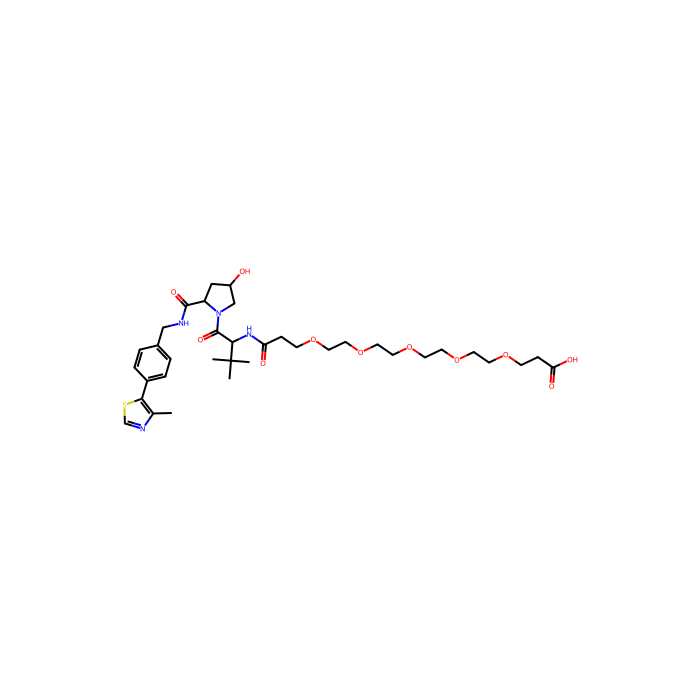
Functionalized von-Hippel-Lindau (VHL) protein ligand for PROTAC®research and development; incorporates an E3 ligase ligand plus a PEG5 linker with terminal carboxylic acid ready for conjugation to a target protein ligand. Part of a range of functionaliz
Conditions de stockage de stockage
Store at -20°C,Argon charged
Expédié en
Ice chest + Ice pads
Ce produit nécessite l'expédition en chaîne froide. Les services terrestres et autres services économiques ne sont pas disponibles.
Determine the necessary mass, volume, or concentration for preparing a solution.
Dilution Calculator
Determine the dilution needed to prepare a stock solution.
Reconstitution Calculator
Avis
Avis des clients
Application Protocols
No vendor-tested biological application protocols are provided for this item in the Product Data.
General synthetic workflow (literature/general) for assembling a PROTAC using this intermediate:
Step 1: Pre-activate the terminal acid as an NHS ester in dry DMF (EDC•HCl/NHS, rt, 1 h) under argon.
Step 2: Add an amine-bearing target ligand and DIPEA; stir at rt to 40 °C until LC–MS indicates completion.
Step 3: Work up by dilution with water and extraction or proceed directly to reverse-phase prep HPLC.
Step 4: Characterize by 1H/13C NMR, HRMS, and analytical HPLC.
For bioconjugation contexts, adapt buffer systems (pH 7.5–8.5) and include organic cosolvent to maintain solubility. Always validate on small scale before scale-up.
Biological Roles
Scope: This section addresses biochemical context for VH032-derived ligands in research. No medical or clinical claims are made.
General/literature context:
E3 ligase engagement: VH032 is a well-characterized small-molecule ligand for the VHL E3 ubiquitin ligase complex (recognizing the hypoxia-inducible factor binding pocket). When incorporated into bifunctional degraders, it recruits VHL to a protein of interest.
Ternary complex formation: The PEG5 linker modulates spatial orientation and flexibility, influencing cooperativity between VHL and the target-ligand complex, which can affect degradation profiles in cell-based assays.
Permeability/solubility balance: PEGylation increases polarity and aqueous compatibility but can reduce passive permeability; the overall construct’s physicochemical properties dictate cellular uptake.
Non-specific interactions: PEG segments can attenuate nonspecific protein binding relative to purely hydrophobic linkers, potentially benefiting selectivity in cellular systems.
Important notes for users:
The current item is a synthetic intermediate and not intended for biological administration. Any cellular experiments should employ fully assembled conjugates and appropriate controls.
Binding affinity and cellular performance depend on the complete degrader’s architecture; VH032 headgroup stereochemistry is critical for VHL recognition.
Buffer Applications
Not typically applicable. VH 032 amide-PEG5-acid is a small-molecule intermediate rather than a buffering agent.
Practical note (literature/general):
If used in aqueous bioconjugation after pre-activation to an NHS ester, reactions are commonly performed in mildly basic buffers (e.g., phosphate, HEPES, or bicarbonate, pH ~7.5–8.5) with an organic cosolvent (DMF/DMSO) to maintain solubility. Buffer selection should minimize nucleophiles that compete with the amine coupling partner.
Green Alternatives
While VH 032 amide-PEG5-acid itself is not replaceable for VHL recruitment, aspects of its use can be made greener by solvent/reagent choices.
Greener choices (literature/general):
Solvents:
Replace DMF with Cyrene, dimethyl carbonate, or 2-MeTHF when compatible with coupling chemistry. NMP alternatives include NEP or propylene carbonate for certain activations.
For workups, use EtOAc/heptane systems rather than chlorinated solvents where feasible.
Coupling reagents:
Consider water-compatible EDC•HCl with OxymaPure in mixed aqueous/organic media to reduce hazardous waste from carbodiimide ureas.
Enzymatic amidation or peptide coupling in aqueous buffers may be possible for select amines, though scope is narrower.
Energy and process:
Room-temperature couplings with efficient activation lower energy demand; microwave-assisted protocols can shorten reaction times, reducing solvent exposure.
Comparison snapshot (general):
DMF vs Cyrene: Cyrene is biorenewable and has lower toxicity potential; however, reactivity profiles and solubility can differ, and water sensitivity still applies.
DCM vs 2-MeTHF: 2-MeTHF reduces chlorinated solvent use and often supports extractions and some couplings; note higher water miscibility and peroxides risk over time.
Trade-offs:
Solubility of PEGylated materials and activation efficiency may necessitate traditional polar aprotic solvents. Pilot small-scale experiments are recommended to validate greener swaps.
Pharmaceutical Uses
This product is supplied for research use only. No clinical or therapeutic use is intended or implied.
General formulation/manufacturing context (literature/general):
Role: synthetic intermediate for the assembly of bifunctional molecules (e.g., PROTACs) during lead discovery and optimization.
Excipient status: PEG-derived segments are common in excipients, but this specific molecule is not an approved excipient and is not used as a standalone formulation component.
Process considerations: For scale-up synthesis of degraders, attention is paid to residual reagents (carbodiimides, ureas), solvent class selection (per ICH Q3C), and control of stereochemistry. Purification typically employs reverse-phase preparative chromatography due to polarity and polyfunctionality.
Documentation: For cGMP-related work, the fully assembled final compounds would require separate qualification; this intermediate does not carry pharmacopeial monographs.
Physical Properties
Item-specific specifications:
Appearance: Not specified for this item; refer to CoA/Spec Sheet.
Molecular weight: Not specified for this item; refer to CoA/Spec Sheet.
Molecular formula: Not specified for this item; refer to CoA/Spec Sheet.
Melting point, boiling point, density, refractive index, pKa, logP/logD: Not specified for this item; refer to CoA/Spec Sheet.
Literature/general expectations for VH032–PEG5–acid analogs (guidance only, not item specifications):
Physical state: typically a white to off-white solid or foam; hygroscopic tendency can be moderate due to PEG chain.
Solubility profile: generally soluble in polar aprotic organic solvents (DMSO, DMF, NMP) and alcohols (MeOH, EtOH); limited solubility in nonpolar solvents; aqueous solubility depends on ionization of the terminal acid and the hydrophobicity of the VH032 headgroup.
Ionization: terminal carboxylic acid is deprotonatable; pKa for simple aliphatic carboxylates is commonly ~4–5 (literature, generic acids), but actual value depends on the full scaffold.
Stability: amide is robust to neutral/weakly acidic conditions; PEG segments are generally stable but can undergo oxidative degradation under harsh conditions.
Practical notes:
Prepare stock solutions in dry DMSO or DMF for conjugation work; dilute into reaction medium immediately prior to use.
Avoid extended heating in strongly acidic or basic media to minimize potential PEG cleavage or isomerization of sensitive motifs.
Quality and Grades
Item-specific grade/purity: Not specified for this item; refer to CoA/Spec Sheet.
Interpretation and expectations:
Research reagent quality: For linker–ligand intermediates used in PROTAC synthesis, typical quality control includes HPLC purity and HRMS/LC–MS identity confirmation. If your workflow requires stringent absorbance baselines (e.g., analytical HPLC), consider requesting a UV trace and impurity profile.
Stereochemical integrity: VH032-derived ligands are stereodefined. Confirm enantiomeric and diastereomeric purity on the CoA, as mismatched stereochemistry can reduce VHL binding in final constructs.
Water/solvent content: PEGylated materials can retain residual solvents/water; Karl Fischer or residual solvent data may be provided on the CoA. If unspecified, perform in-house checks when coupling efficiency is critical.
Metal content: Usually not a concern for small-molecule linkers unless metal-mediated steps are used upstream; if needed for sensitive biology, request ICP data.
What the provided storage implies:
Argon-charged, −20 °C storage suggests attention to long-term stability and moisture/oxygen exclusion during warehousing. Maintain similar conditions after receipt.
Documentation:
For batch-specific specifications (purity %, residual solvents, identity), rely on the CoA/Spec Sheet accompanying SKU V288765.
Reaction and Applications
Focus: VH 032 amide-PEG5-acid is designed as a modular E3 ligase (VHL) recruiting element for PROTAC/CLIPTAC/Ligand-Directed Chemistry, featuring a conjugation-ready terminal carboxyl group.
Common applications (literature/general):
PROTAC assembly: couples to amine-bearing target ligands (kinase inhibitors, bromodomain ligands, etc.) to form a ternary complex recruiter via amide bond formation.
Linker diversification: the PEG5 spacer modulates polarity, solubility, and entropic/entropic contributions to ternary complex formation; serves as a mid-length flexible linker often used when PEG3 is too short and PEG7 too long.
Surface immobilization: after activation to NHS ester, enables attachment to amine-functionalized resins or surfaces to study VHL engagement.
Practical tips:
Pre-activation: Convert the terminal acid to its NHS ester (EDC/NHS or DCC/NHS in dry DMF or DCM/DMF) to improve coupling efficiency to sterically hindered amines. Isolate or perform in situ.
Bases and additives: DIPEA or NMM are standard; add HOAt/HOBt surrogates (Oxyma) to minimize racemization on sensitive amines (note: observe safety guidance with azabenzotriazoles).
Water control: Maintain anhydrous conditions during activation to avoid hydrolysis of the active ester; desiccate glassware and sparge solvents if needed.
Stoichiometry: 1.2–1.5 equiv acid component or activating agent typically balances conversion and ease of purification (literature guidance).
Downstream evaluation:
Confirm product by LC–MS and 1H/13C NMR; assess purity by analytical HPLC with appropriate gradient (aqueous buffer/MeCN with 0.1% formic acid).
Reaction Conditions
General guidance for common couplings with a PEGylated terminal acid (literature/general; adjust per substrate):
Amide coupling to amines:
Solvent: dry DMF or NMP; 0.05–0.1 M substrate concentration.
Activation: HATU (1.1–1.5 equiv) or EDC•HCl (1.2–1.5 equiv) + Oxyma (1.2–1.5 equiv) or NHS (when forming isolable ester).
Base: DIPEA (2–4 equiv) or NMM (3–5 equiv).
Temperature/time: 20–40 °C, 1–16 h. Hindered partners may benefit from mild heating (50–60 °C) if stability permits.
Atmosphere: inert gas blanket (N2/Ar) to align with moisture-sensitive activation and product stability.
Conditions: 0 °C to rt, 0.5–2 h for activation; then add amine partner and base.
Workup and purification:
Quench carbodiimide reactions with aqueous buffer; remove urea by filtration/extraction.
Purify via reverse-phase prep HPLC; collect fractions by MS-tracking; lyophilize to obtain the product as a TFA- or formate-free material when volatile modifiers are used.
Analytical control:
Monitor by LC–MS; typical small-molecule couplings reach 60–95% conversion under these conditions depending on sterics/electronics (illustrative literature ranges, not item-specific guarantees).
Safety and Handling
Item-specific hazard information:
Signal word: Not specified for this item; refer to SDS.
H-statements, GHS classification, pictograms: Not specified for this item; refer to SDS.
From Product Data:
Storage: Store at −20 °C, argon charged.
Shipping: Ice chest + ice pads.
General laboratory safety guidance (not a substitute for the SDS):
PPE: wear lab coat, safety glasses, and appropriate chemically resistant gloves (e.g., nitrile). Work in a fume hood during weighing and solution preparation to avoid dust/aerosol exposure.
Handling: minimize exposure to ambient moisture and air to align with the argon-charged storage recommendation; recap vials promptly. Use dry, oxygen-free solvents for moisture-sensitive couplings.
Incompatibilities: strong oxidizers (PEG chains can be susceptible to oxidative degradation); strong bases/acids at elevated temperature can degrade PEG or amide linkages over time.
First aid overview: in case of contact, rinse skin/eyes with water for at least 15 minutes; if inhaled, move to fresh air; if ingested, seek medical attention. Follow institutional protocols.
Waste: dispose of residues and contaminated materials as organic hazardous waste according to local regulations.
Always consult the latest SDS for authoritative hazard classification, exposure limits, and response procedures. This product is for research use only.
Solvent Selection
Applicability: As a polar, PEGylated PROTAC intermediate with a terminal carboxylic acid, solvent choice strongly influences handling, activation, and coupling efficiency.
General solvent behavior (literature/general):
Polar aprotic: DMSO, DMF, and NMP typically provide excellent solubility and are preferred for amide couplings (carbodiimide or uronium reagents). These solvents also facilitate base solubilization (DIPEA, NMM).
Alcohols: MeOH and EtOH can dissolve PEG-containing compounds; however, they may compete or interfere with some activation chemistries (e.g., mixed anhydrides), and can form esters under carbodiimide conditions.
Aqueous media: Solubility increases upon deprotonation of the carboxyl group. For bioconjugations to amine-bearing biomolecules, buffered aqueous/DMF co-solvent systems are commonly used with NHS esters.
Nonpolar: Poor solubility is expected in alkanes and weakly polar ethers due to the polyether/ionizable nature.
Selection scenarios:
Amide coupling to small-molecule amines: dry DMF or NMP with DIPEA and HATU/EDC•HCl.
Pre-activation to NHS ester: DMF or DCM/DMF mixtures (anhydrous) with NHS and EDC or DCC.
Bioconjugation: aqueous phosphate or HEPES buffer (pH 7.5–8.5) with DMF/DMSO cosolvent after NHS-ester formation.
Comparison notes:
DMF vs NMP: NMP offers higher boiling point and sometimes improved solubility; DMF is easier to remove. Choose based on downstream workup and thermal profile.
Storage and Reconstitution
Item-specific instructions (from Product Data):
Storage conditions: Store at −20 °C, argon charged.
Shipping: Ice chest + ice pads.
Best practices (general):
Upon receipt: Allow the sealed container to equilibrate to room temperature before opening to prevent condensation. Open under inert atmosphere or in a dry box if available.
Aliquoting: If frequent use is expected, aliquot into moisture-tight vials under argon or nitrogen to minimize freeze–thaw and moisture ingress.
Solid handling: Keep desiccated when not in use. PEGylated solids can be hygroscopic; check mass quickly and reseal.
Reconstitution guidance (general, not item-specific specifications):
Prepare concentrated stocks in anhydrous DMSO or DMF (e.g., 10–100 mM) depending on solubility; filter through 0.2 μm PTFE if particulate is present.
For aqueous applications following activation (e.g., NHS ester coupling), dilute immediately before use into buffered media with minimal water exposure to avoid hydrolysis.
Stability considerations:
Avoid prolonged exposure to air, light, and moisture. Store solutions at −20 °C under inert gas; use within days to weeks depending on solvent and concentration. Discard if LC–MS indicates degradation.
Research use only: Not for human or veterinary use.
Structure and Identity
Brief: VH 032 amide-PEG5-acid is a PROTAC-oriented VHL-recruiting handle in which a VH032-derived ligand is tethered via an amide to a PEG5 spacer terminating in a carboxylic acid for downstream conjugation.
Item-specific facts (from Product Data):
CAS: 2172820-14-1
CID: 134184001
InChIKey: 434490 (provided as-is)
SMILES: Not specified for this item; refer to CoA/Spec Sheet.
Molecular formula: Not specified for this item; refer to CoA/Spec Sheet.
Molecular weight: Not specified for this item; refer to CoA/Spec Sheet.
General structural features (literature/general):
Functional groups: a tertiary amide linking the VH032 ligand to a discrete PEG5 chain; terminal carboxylic acid (–CO2H) for coupling; multiple ether oxygens from the PEG units.
Motif: VH032 is a hydroxyproline-based VHL ligand widely used in targeted protein degradation constructs; the PEG5 segment typically comprises five ethylene glycol repeats (–CH2–CH2–O–)5.
2D description: a polar, polyether chain connects a heteroatom-rich VHL-binding headgroup to an ionizable carboxylate tail. The architecture is modular, optimized for conjugation to amine-bearing warheads.
Notes:
Exact stereochemistry of the VH032 headgroup and precise substitution pattern should be confirmed from the CoA/Spec Sheet for this SKU.
Synthetic Utility
Key functionality:
Terminal carboxylic acid provides a versatile handle for derivatization to amides, esters, or activated intermediates (e.g., NHS esters, acid chlorides, mixed anhydrides).
The PEG5 spacer offers conformational flexibility and enhances solubility in polar media, aiding challenging couplings to hindered amines.
The VH032 headgroup serves as a VHL-binding element in bifunctional molecules.
Amide bond formation: HATU/HOAt (or Oxyma)/DIPEA in DMF; or EDC/NHS in DMF leading to NHS ester followed by coupling to an amine-bearing target ligand.
Click-enabled variants: Conversion of the acid to an azide-bearing linker via Curtius rearrangement to isocyanate, followed by trapping, or via carbonyldiimidazole (CDI) activation then installation of a propargyl/azido handle for modular assembly.
Supramolecular anchoring: Formation of esters to install photolabile or affinity tags for mechanistic studies.
Retrosynthetic perspective:
Disconnection at the amide linking PEG5 to VH032 allows independent optimization of (1) VHL-ligand synthesis and (2) PEG chain installation (e.g., from monoprotected PEG5 diamine/diol). Final step acid unveiling enables last-stage diversification to a broad set of warheads.
Workup and purification:
Due to polarity and multiple heteroatoms, reverse-phase chromatography (water/MeCN, 0.1% formic acid) or HILIC can provide clean separations from urea byproducts and unreacted coupling reagents.
Target Specificity
Not applicable for this product. VH 032 amide-PEG5-acid is a small-molecule intermediate, not a biological macromolecule or antibody with defined target-binding assay data provided in the Product Data.
General note (literature):
The VH032 headgroup is commonly used to engage the VHL E3 ligase in degrader design; however, target specificity of a final PROTAC depends on the paired target ligand and overall construct, not on this intermediate alone.
Foire aux questions
What is the purity of this product?
This product is supplied at ≥95% purity (chemical assay). Lot-specific values are stated on the Certificate of Analysis.
How should this product be stored?
Store at ?20 °C under argon. It is supplied under an argon blanket; reseal under inert gas after each use.
How is this product shipped?
This product ships in an insulated container with ice pads. Unpack on arrival and transfer it to the storage condition stated above.
What are the CAS number, molecular formula and molecular weight?
The CAS Number is 2172820-14-1, the molecular formula is C36H54N4O11S, and the molecular weight is 750.91 g/mol. InChIKey YDOJYEPMGKGKQV-ZLWRCJDJSA-N.
What documentation is provided?
Available product documentation, including Certificates of Analysis (COA), Safety Data Sheets (SDS), and specification sheets, is shown in the product document area. Document availability and access follow the current site policy.
Nous utilisons des cookies pour garantir le bon fonctionnement du site et, lorsque cela est autorisé, pour améliorer votre expérience. Vous pouvez gérer vos préférences à tout moment dans les Paramètres. Pour en savoir plus, consultez notre Politique relative aux cookies.
Souhaitez-vous que nous vous envoyions un message lorsque des réductions seront disponibles?
Me rappeler plus tard
Merci ! Veuillez vérifier votre boîte de réception e-mail pour confirmer.
Products are supplied to verified businesses, institutions, and qualified professionals for research and development use only. Not for use in humans, animals, diagnosis, or therapy.

 D2306340