GRADE & PURITYMoligand™?Moligand™ — Aladdin's line of ligands and bioactive small molecules. Use for receptor, pathway, and binding studies needing defined small-molecule tools.≥96%
Moligand™,≥96% Moligand™ for sensitive chromatographic and analytical workflows requiring minimal baseline interference.
🌡
Storage & shipping
Store at -20°C Ships Ice chest + Ice pads Check lot-specific COA for exact specifications.
📋
Quality documents
SDS, COA, datasheet, and spec sheet available for download. Lot-specific COA accessible via lot number lookup.
📚
Literature proof
Cited in 0 peer-reviewed publications across chromatography, organic synthesis, and cross-coupling reactions.
Vue d’ensemble
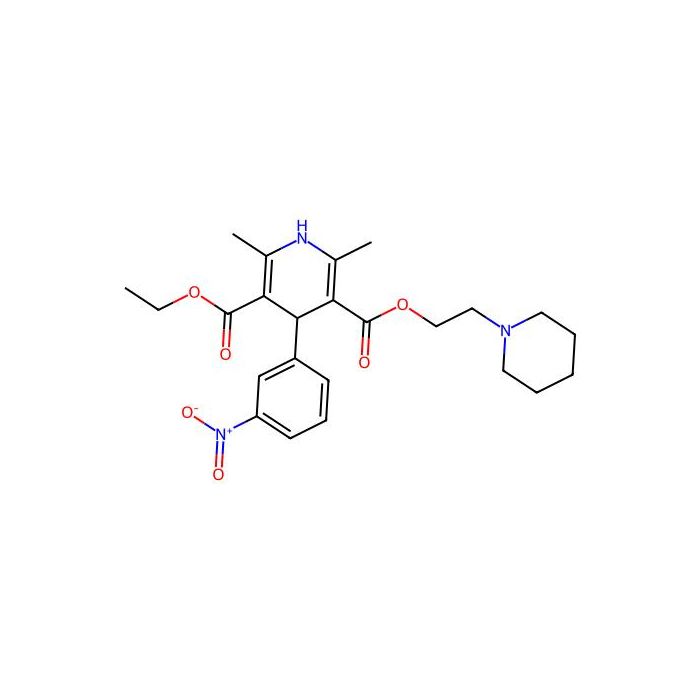
YS-201 is a dihydropyridine-type calcium channel antagonist. YS-201 has the potential for angina pectoris and hypertension treatment.
In Vivo
YS-201 (Diperdipine) markedly reduces systemic vascular resistance and improves stroke index and left ventricular ejection fraction. Mean pulmonary artery and wedge pressures are slightly increased as a possible consequence of enhanced venous return, whereas right atrial and left ventricular end-diastolic pressures are not significantly changed. Nevertheless, an increase in preload is clearly indicated by an augmented left ventricular end-diastolic volume index after administration of diperdipine . After intravenous and oral doses, absolute bioavailability is calculated to be 18.7%. Biliaryexcretion accounts for about 0.1% of the total clearance of diperdipine and does not contribute to the overall elimination of the drug. After intraportal administration, the bioavailable fraction of diperdipine is increasing up to 44.3% suggesting a prehepatic site of loss of the drug. The single application of diperdipine to mice and rats by gavage causes intolerance reactions starting at the lowest tested dose level of 200 mg/kg b.w. p.o. (mice) and at 250 mg/kg b.w. p.o. (rats). In the rat, toxic effects occur from 15 mg diperdipine/kg b.w./day p.o. onwards. MCE has not independently confirmed the accuracy of these methods. They are for reference only.
This compound belongs to the class of organic compounds known as dihydropyridinecarboxylic acids and derivatives. These are compounds containing a dihydropyridine moiety bearing a carboxylic acid group.
External Descriptors
Not available
1. Djoumbou Feunang Y, Eisner R, Knox C, Chepelev L, Hastings J, Owen G, Fahy E, Steinbeck C, Subramanian S, Bolton E, Greiner R, and Wishart DS. ClassyFire: Automated Chemical Classification With A Comprehensive, Computable Taxonomy. Journal of Cheminformatics, 2016, 8:61.
Determine the necessary mass, volume, or concentration for preparing a solution.
Dilution Calculator
Determine the dilution needed to prepare a stock solution.
Reconstitution Calculator
Avis
Avis des clients
Application Protocols
Item-specific (from Product Data)
No tested application protocols are provided.
General example workflow for small-molecule screening (for illustration; adapt to your assay)
Stock preparation: Dissolve the compound in anhydrous DMSO to 10–20 mM. Vortex and, if needed, sonicate briefly. Filter through 0.2 µm PTFE if particulate persists.
Working solutions: Dilute stocks into assay buffer or media to the desired concentrations, keeping final DMSO ≤0.5–1% v/v unless validated otherwise.
Controls: Include vehicle controls, positive controls (known actives), and orthogonal counterscreens to detect assay interference (e.g., redox, fluorescence quenchers, aggregators).
Plate handling: Use low-binding plates for hydrophobic compounds; pre-wet tips with dosing solution to improve accuracy at low volumes.
Data integrity: Record lot numbers, exact concentrations, and time-in-solution; confirm post-assay integrity by LC–MS when feasible.
Note
These are general best practices for library compounds and are not item-specific performance claims.
Biological Roles
Item-specific (from Product Data)
No biological function, pathway, or target information is provided for YS-201.
General considerations for library compounds (no clinical or therapeutic claims)
Potential roles explored experimentally can include modulation of enzyme activity, receptor binding, protein–protein interactions, or pathway perturbation, contingent on validated assay readouts.
Without a disclosed structure or known pharmacology, classify YS-201 as an investigational chemical probe candidate pending potency/selectivity profiling, off-target assessment, and cellular mechanism-of-action studies.
If ionizable or reactive motifs exist (unknown here), nonspecific effects (e.g., covalent adduction, redox activity, aggregation) should be ruled out via orthogonal counter-screens (detergent tests, dynamic light scattering, redox assays, glutathione reactivity).
Documentation
Any observed biological activity should be recorded with full experimental context (salt form, batch/lot, concentration, vehicle %, incubation time, pH, temperature) to enable reproducibility and comparison across lots.
Buffer Applications
Applicability
YS-201 is a small-molecule library member; it is not a buffering reagent. Therefore, buffer formulation guidance is generally not applicable.
Practical notes for assay buffers (general)
If dosing in aqueous buffers, prepare a concentrated DMSO stock and dilute into pre-warmed buffer with vigorous mixing to avoid precipitation; keep final DMSO ≤0.5–1% v/v unless your assay tolerates more.
Use surfactants (e.g., 0.01–0.05% Tween-20) only if compatible with the assay and compound; they can mitigate aggregation artifacts.
Maintain consistent ionic strength and pH across control and treated wells; DMSO can slightly depress apparent pH—verify with a calibrated meter for sensitive assays.
Item-specific values
pKa, solubility limits, and UV absorbance windows are not provided for this item; consult CoA/Spec Sheet before designing spectrophotometric assays.
Green Alternatives
Context
Without item-specific solubility/reactivity data, greener choices focus on solvent systems and handling practices for library compounds.
Greener solvent considerations (general)
Prefer water with minimal DMSO as cosolvent when assay-compatible.
For non-aqueous workflows, consider 2-MeTHF or ethyl acetate instead of chlorinated solvents for extractions/cleanup if the compound’s polarity permits.
Replace DMF/NMP with Cyrene or propylene carbonate for certain preparative steps, acknowledging viscosity and compatibility tradeoffs.
Comparison (general guidance, not item-specific specs)
DMSO vs. DMF: DMSO has favorable toxicological profile and broad solvency; DMF offers similar solvency but with higher regulatory burden.
2-MeTHF vs. THF: 2-MeTHF is bio-based, less volatile, and often suitable for workups; THF offers higher polarity but forms peroxides—manage accordingly.
EtOAc vs. DCM: EtOAc is less hazardous and renewable-sourced; DCM provides higher density and volatility but raises environmental/health concerns.
Operational practices
Use microscale assays to reduce solvent and compound consumption.
Implement closed vials/low-dead-volume plates to limit emissions.
Adopt solvent recycling for HPLC where permitted.
Note
Verify compound stability and analytical response in any alternative solvent before broad adoption.
Pharmaceutical Uses
Applicability
No pharmacopeial status or excipient role is provided for YS-201. As a Moligand™ screening compound, it is intended strictly for research use only and not for formulation in drug products.
General considerations (non-clinical)
If used in preclinical discovery research, typical activities include in vitro screening, hit validation, and early developability assessments (solubility, stability, permeability). These are research workflows and do not imply suitability for clinical or GMP use.
Documentation
For any pre-formulation type experiments (e.g., solubility in biorelevant media), record compound identity (including salt/solvate form), batch/lot, and analytical confirmation prior to data interpretation.
Physical Properties
Item-specific (from Product Data)
Appearance: Not specified for this item; refer to CoA/Spec Sheet.
Literature/computed properties (no item-specific specs implied)
Melting point, boiling point, density, refractive index, logP/logD, pKa, and UV cutoff: Not specified in the provided data. Retrieve from CoA/Spec Sheet or authoritative databases using CAS 108852-42-2 or CID 130588.
Practical guidance
Solubility screening workflow (general):
Begin with DMSO stock (e.g., 10–50 mM) and assess clarity after brief vortex/sonication.
If limited DMSO solubility is observed, test DMF or NMP; for aqueous work, use cosolvents (DMSO 0.1–1% v/v or cyclodextrins) as permitted by your assay.
For solid compounds of unknown polymorph, gently warm (≤40 °C) and sonicate to aid dissolution; avoid prolonged heating without stability data.
Hygroscopicity/volatility: Not specified; store sealed and equilibrate to room temperature before opening to minimize condensation.
Stability: Chemical and photostability not provided; minimize exposure to moisture, air, and light until stability is verified experimentally (TLC/HPLC monitoring).
Quality and Grades
Item-specific (from Product Data)
Grade/Purity designation: Moligand™
What Moligand™ typically implies (general, not item-specific specifications)
Intended use: Research-grade small-molecule ligands for screening, SAR, and probe development. Not for human or animal therapeutic use.
Characterization package: Typically includes identity confirmation (e.g., NMR/MS/HRMS) and purity by chromatography; exact tests and acceptance criteria are item-specific and should be confirmed on the CoA/Spec Sheet. No numeric purity is provided here.
Batch-to-batch consistency: Library-grade compounds are commonly produced and qualified to support screening reproducibility; however, users should verify identity/purity upon receipt for critical studies.
Stabilizers/additives: Not specified for this item; refer to CoA/Spec Sheet.
Practical QC recommendations
Upon receipt, record QC with orthogonal methods where feasible (e.g., HPLC-UV/ELSD, LC–MS, 1H NMR). Confirm salt form/solvate state.
For bioassays, prepare fresh DMSO stocks and track freeze–thaw cycles. If light- or air-sensitive behavior is suspected, use amber vials and inert gas backfill.
Reaction and Applications
Item-specific (from Product Data)
Manufacturer Applications: Not specified for this item beyond inclusion in a small-molecule/compound library.
Research uses (general for library ligands; no target claims)
Screening: Use YS-201 as a discrete test article in biochemical or cell-based assays for primary screening, counter-screening, and preliminary SAR.
Chemical biology: Potential probe candidate subject to validation (potency, selectivity, permeability, stability). Follow up with target deconvolution where appropriate (thermal shift, CETSA, chemoproteomics) after confirming reproducible activity.
Analytical: Serve as a reference analyte for method development (LC–MS retention behavior, ionization efficiency, stability profiling) when structure is known from CoA.
Practical tips
Prepare fresh DMSO stocks and minimize freeze–thaw. Record exact stock concentration and date.
Include vehicle controls and orthogonal readouts to flag assay interference (aggregation, fluorescence quenching, redox cycling). Use PAINS/REOS filters only as guidance; confirm experimentally.
Early ADME profiling (microsomal stability, PAMPA/MDCK permeability, solubility, and plasma protein binding) is recommended before extensive biology, pending availability of structure and sufficient material.
Note
No synthetic or named-reaction applications are claimed for this item; treat it primarily as a screening ligand unless structure-specific reactivity is established.
Reaction Conditions
Applicability
No synthetic or transformation use-cases are specified for YS-201, and the functional group profile is not provided. This section is therefore not typically applicable.
General notes (if later used as a substrate; literature-style guidance only)
Typical small-molecule manipulations (hydrogenation, cross-coupling, amide coupling, heterocycle functionalization) require solvent, catalyst, base/acid, and temperature selections tailored to the actual structure. Do not extrapolate conditions without verified functional groups.
Before attempting any reaction, confirm identity, purity, and stability. Run micro-scale trials and monitor by LC–MS/TLC.
Item-specific data
None available; consult CoA/Spec Sheet for any stability notes or transformation examples.
Safety and Handling
Item-specific (from Product Data)
GHS Classification: Not specified for this item; refer to SDS.
Signal Word: Not specified for this item; refer to SDS.
Hazard (H) Statements: Not specified for this item; refer to SDS.
Pictograms: Not specified for this item; refer to SDS.
Storage: Store at −20 °C (as provided). Shipped cold (ice chest + ice pads).
General laboratory safety (not a substitute for SDS)
PPE: Lab coat, safety glasses, and appropriate chemically resistant gloves (e.g., nitrile). Use within a fume hood to avoid inhalation of dusts/vapors/aerosols.
Handling: Avoid contact with skin/eyes; prevent inhalation of dust or mists. Use dedicated, labeled secondary containment for cold storage.
Incompatibilities: Unknown for this item. As a precaution, segregate from strong oxidizers/reducers and reactive acids/bases until specific incompatibilities are known.
First aid overview: In case of skin/eye contact, rinse with water for ≥15 min; remove contaminated clothing. If inhaled, move to fresh air. If ingested or upon any exposure with concerning symptoms, seek medical attention. Always follow the SDS.
Spills/waste: Absorb small spills with inert material; collect in compatible container for hazardous waste disposal per institutional and local regulations.
Stability hazards: No information on peroxide formation, self-reactivity, or sensitization is provided—do not assume absence of hazard. Verify by SDS before scale-up.
Solvent Selection
Item-specific (from Product Data)
No item-specific solubility or polarity parameters are provided.
General guidance for small-molecule screening compounds
Primary stock solvent: DMSO is the default for discovery libraries due to broad solvency and assay compatibility at low percentages.
Secondary solvents: DMF or NMP can dissolve recalcitrant scaffolds; ethanol, isopropanol, or acetonitrile may be suitable when water miscibility and lower toxicity are preferred.
Aqueous use: Employ cosolvent approaches (e.g., 0.1–1% DMSO v/v), or use solubilizing agents (cyclodextrins, mild surfactants) as assay-appropriate.
pH dependence: If ionizable groups are present (unknown here), solubility may improve by pH adjustment; confirm compound stability versus hydrolysis before strong pH shifts.
Comparison snapshot (general)
DMSO: Highest solvency; cell-compatible at ≤0.5–1% v/v.
Acetonitrile: Volatile, miscible with water; useful for HPLC and some assays.
Ethanol: Biologically tolerated in many setups; lower solvency for very lipophilic compounds.
2-MeTHF/EtOAc: Greener, less polar; suitable for extractions or non-aqueous work if compound is sufficiently lipophilic.
Tip
Start with a 10–20 mM DMSO stock, filter through 0.2 µm PTFE if needed, and verify concentration by UV or quantitative NMR when response factors are known.
Storage and Reconstitution
Item-specific (from Product Data)
Storage conditions: Store at −20 °C.
Shipping: Ice chest + ice pads.
Appearance: Not specified for this item; refer to CoA/Spec Sheet.
General guidance
Primary container: Keep tightly sealed in original amber vial. Allow to warm to room temperature in a desiccator before opening to minimize condensation.
Reconstitution: Prepare concentrated DMSO stock (e.g., 10–50 mM) under dry conditions. For aqueous use, dilute into buffer with vigorous mixing; consider brief sonication. Record solvent, concentration, and date.
Aliquoting: Divide stock into single-use aliquots to avoid repeated freeze–thaw. Store aliquots at −20 °C (or per stability data if available).
Stability: No item-specific stability, hygroscopicity, or light-sensitivity data are provided. Protect from light and moisture until confirmed otherwise by analytical monitoring (HPLC/LC–MS over time).
Disposal: Treat as hazardous chemical waste; follow institutional and local regulations.
Research use note
For research use only. Not for human or animal therapeutic or diagnostic use.
Structure and Identity
Item-specific (from Product Data)
Product Name: YS-201 (SKU: Y648299)
Catalog Category: Small molecules and compound libraries (小分子和化合物库)
CAS: 108852-42-2
PubChem CID: 130588
InChIKey: 195405 (as provided; verify on CoA/SDS for canonical key)
Grade/Purity: Moligand™
Molecular formula: Not specified for this item; refer to CoA/Spec Sheet.
Molecular weight: Not specified for this item; refer to CoA/Spec Sheet.
SMILES: Not specified for this item; refer to CoA/Spec Sheet.
General notes (chemistry context)
Structural features: Detailed 2D structure, functional groups, and stereochemistry are not provided in the product data. For experimental planning (e.g., solubility, protonation state), consult the compound’s CoA, spectral package, or trusted databases using the CAS or CID.
If chirality is present (unknown here), confirm enantiomeric/diastereomeric composition on the CoA prior to use in biological assays or chiral separations.
Synthetic Utility
Applicability
YS-201 is supplied as a small-molecule library compound. Without a disclosed structure or functional group information, it is not presented primarily as a synthetic building block or reagent.
General guidance (when structure is available from CoA)
If the scaffold is of interest for SAR, analog synthesis can proceed via diversification at known substitution vectors of the core. Plan protecting-group strategy, oxidation state management, and handle any heteroatom-labile motifs accordingly.
For analytical support during synthesis, establish a robust LC–MS and HPLC-UV method. Quantitative 1H NMR with internal standard can aid mass balance and purity tracking.
Should the structure contain reactive handles (e.g., aryl halides, boronates, amines, acids), standard cross-coupling or amide-bond formations may enable rapid analog generation—confirm actual functionality from the CoA before planning.
Target Specificity
Item-specific (from Product Data)
No target, epitope, or binding specificity information is provided for YS-201. This item is not an antibody or biologic; target specificity data are not applicable unless separately disclosed in associated assay documentation.
Guidance
If biological activity is observed, determine specificity via orthogonal profiling (panel screens, counterscreens against related target classes, thermal shift selectivity, chemoproteomics as appropriate). Document all conditions, lot numbers, and analytical confirmations.
Need help choosing the grade?
Our grade selection guide covers purity, stabilizer status, and application suitability for all variants in our catalog.
We use cookies to ensure the website functions properly and, where permitted, to improve your experience. You can manage your preferences at any time in Settings. Learn more in our Cookie Policy.
Shall we send you a message when we have discounts available?
Remind me later
Thank you! Please check your email inbox to confirm.
Products are supplied to verified businesses, institutions, and qualified professionals for research and development use only. Not for use in humans, animals, diagnosis, or therapy.

 H2627505