Human IgG (FITC) - Anticorpo di controllo isotipo, IgG

Cat. No.: Ab180315
Disponibile su ordine
QUALITÀ & PUREZZA ExactAb™ ? ExactAb™ — Aladdin's antibody line emphasizing precision and validated quality. Use for reliable, specificity-validated antibody applications. Validated ? Validated grade — performance confirmed in defined applications before release. Use when you want documented assurance the reagent works as stated. Ex:498nm ? Fluorescence excitation maximum at 498 nm — the wavelength of light that best excites this fluorophore. Match it to your instrument's laser or filter set for the strongest signal. Em:517nm ? Fluorescence emission maximum at 517 nm — the wavelength this fluorophore emits after excitation. Use it to pick the right detection filter and avoid channel cross-talk. See COA
Application
Flow Cytometry
Host species
Umano
Isotype
Human IgG
Conjugation
FITC
★
Dimensione
Germania (EU)
USA*
Prezzo
Qtà
10μg
Ab180315-10μg
—
Disponibile ≥10
27,68€
100μg
Ab180315-100μg
—
4 Disponibile
86,69€
500μg
Ab180315-500μg
—
1 Disponibile
173,46€
Enter a quantity for the sizes you want to add.
🧪
Perché questa qualità

ExactAb™, Validated, Ex:498nm, Em:517nm, See COA Em:517nm,Ex:498nm,ExactAb™,Validated per flussi di lavoro cromatografici e analitici sensibili che richiedono un'interferenza minima della linea di base.

🌡

Stoccaggio e spedizione

Store at 2-8°C,Protected from light,Do not freeze Spedizione Wet ice,Do not freeze. Consultare il COA specifico del lotto per le specifiche esatte.

📋

Documenti di qualità

SDS, COA, scheda tecnica e scheda delle specifiche disponibili per il download. COA specifico del lotto accessibile tramite ricerca per numero di lotto.

📚

Prova documentale

Citato in 0 pubblicazioni peer-reviewed su cromatografia, sintesi organica e reazioni di accoppiamento incrociato.

Panoramica

Application:
Flow: ≤0.5 μg/test
For flow cytometric staining, the suggested use of this reagent is ≤0.5 μg per million cells in 100 µL staining volume or 100 µL of whole blood.

Specifiche

Product Name
Human IgG (FITC) - Anticorpo di controllo isotipo, IgG
Sinonimi
FITC-conjugated Human Polyclonal antibody | FITC Human IgG - Isotype Control | Human IgG
Specifiche e purezza
ExactAb™, Validated, Ex:498nm, Em:517nm, See COA
Specie ospite
Umano
Coniugazione
FITC
Eccitazione (nm)
Blue Laser(488nm)
Emissione (nm)
517nm
Ex/Em(nm)
Ex:498nm;Em:517nm
Grado
Em:517nm, Ex:498nm, ExactAb™, Validated
Isotipo
IgG
Metodo di purificazione
Affinity chromatography
Concentrazione
See COA
Product Line
Prodotti biologici
Stoccaggio e spedizione
Condizioni di conservazione di stoccaggio
Store at 2-8°C,Protected from light,Do not freeze
Spedito in
Wet ice,Do not freeze
Stabilità e conservazione
The antibody solution should be stored undiluted between 2°C and 8°C, and protected from prolonged exposure to light. Do not freeze.
Immagini

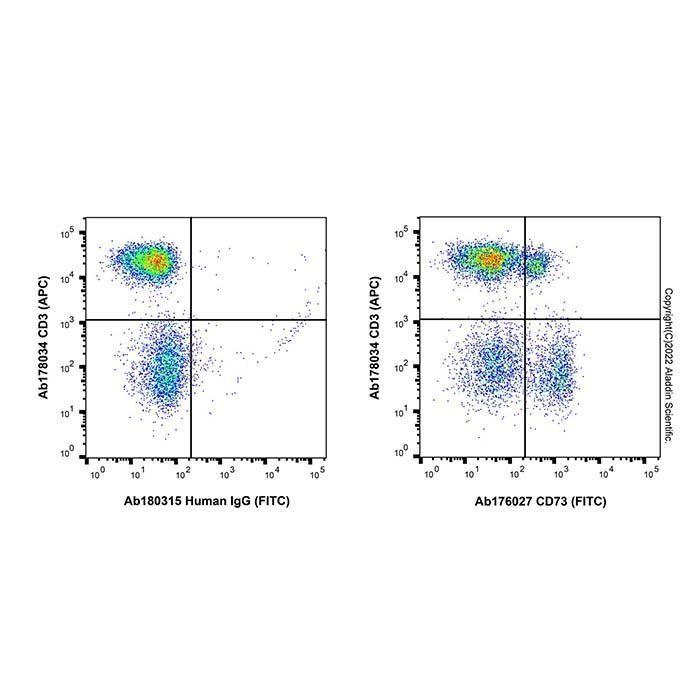
Human IgG (FITC) (Ab180315) - Flow Cytometry
Human peripheral blood lymphocytes are stained with Recombinant CD3 Antibody (APC) (Ab178034) and Recombinant CD73 Antibody (FITC) (Ab176027) (Right). Lymphocytes are stained with Recombinant CD3 Antibody (APC) (Ab178034) and Human IgG (FITC) (Ab180315) (Left).

Applicazione
Applicazione
Dilution info
Flow Cytometry

≤0.5μg/test

For flow cytometric staining, the suggested use of this reagent is ≤0.5 μg per million cells in 100 µL staining volume.

Documentazione

📋 Scheda di dati di sicurezza (SDS)

Documento completo su pericoli, manipolazione, stoccaggio e conformità normativa.

<<<<<<< HEAD Scarica SDS → ======= Scarica SDS → >>>>>>> release248-p3

✅ Certificato di analisi (COA)

Dati di qualità specifici del lotto. Inserisci il numero di lotto per recuperare il COA esatto.

Cerca COA →

📊 Scheda tecnica

Riepilogo di riferimento rapido delle specifiche e applicazioni del prodotto.

Visualizza scheda tecnica →

🔬 Scheda delle specifiche

Attributi di qualità completi e criteri di accettazione per questa qualità.

Visualizza scheda delle specifiche →

Dati avanzati

Certificati (CoA, COO, BSE/TSE e tabella di analisi)
C of A & Other Certificates(BSE/TSE, COO):
Analytical Chart:

Find and download the COA for your product by matching the lot number on the packaging.

4 results found

Lot NumberCertificate TypeDataOggetto
ZJ24F0707750ZJ24F0707750Certificate of AnalysisApr 17, 2026 Ab180315
ZJ24F0707751ZJ24F0707751Certificate of AnalysisApr 17, 2026 Ab180315
ZJ24F0707752ZJ24F0707752Certificate of AnalysisApr 17, 2026 Ab180315
ZJ24R0600725ZJ24R0600725Certificate of AnalysisJun 21, 2024 Ab180315
Domande frequenti e articoli
Calcolatori di soluzioni
Recensioni

Recensioni dei clienti

Application Protocols

Tested applications, recommended dilutions, and positive controls are not specified for this item; refer to the CoA/Spec Sheet.

General advice (non-specific; not product claims)

  • Validate application-specific conditions (dilution, incubation time, temperature) empirically in your system.
  • Include appropriate controls (isotype control, unstained, single-color compensation) when using FITC in multicolor assays.
  • Protect from light during all steps to preserve FITC signal.
Biological Roles

Contextual biology (for understanding and controls; not a therapeutic description)

  • Human IgG function (native molecule): Principal antibody class in serum responsible for opsonization, neutralization, and complement activation. Composed of variable Fab regions for antigen binding and a constant Fc region that can engage Fc receptors and complement C1q (functional engagement depends on context; conjugation can modulate interactions).
  • Structure: Two heavy and two light chains with inter- and intrachain disulfides. Glycosylation at Fc (Asn297 on most subclasses) influences effector interactions.
  • As a reagent: FITC-conjugated human IgG is commonly used as an isotype control or tracer in immunoassays to assess nonspecific binding, autofluorescence, and background signal in the green channel.
  • Fluorophore behavior: FITC fluorescence depends on microenvironment pH/polarity; can undergo photobleaching via singlet oxygen pathways. Antifade agents and oxygen scavengers mitigate bleaching.
  • Binding considerations: Degree and location of FITC labeling can, in general, influence antigen recognition and Fc interactions by steric or electrostatic effects; optimal labeling typically preserves binding while providing strong signal.

Item-specific biological attributes (not provided)

  • Antigen specificity, isotype subclass distribution, glycan profile, and degree of labeling are not specified for this item; refer to CoA/Spec Sheet for any available characterization.
Buffer Applications

While this product itself is an antibody reagent, it is used within standard biological buffer systems. The following are general, practice-oriented guidelines (not product specifications):

Common buffer systems

  • PBS (phosphate-buffered saline), pH 7.2–7.6: Widely used for antibody dilution and washing; isotonic and compatible with cells and tissues.
  • TBS (Tris-buffered saline), pH 7.4–7.6: Alternative to PBS; sometimes lower background in phospho-epitope work.
  • Blocking buffers: PBS/TBS supplemented with 1–5% BSA, nonfat dry milk, normal serum, or casein to reduce nonspecific binding.
  • Wash buffers: PBS/TBS with 0.05–0.1% Tween‑20 to decrease hydrophobic interactions and background.

Practical tips

  • pH and FITC: Maintain near-neutral pH during staining; acidic conditions quench FITC fluorescence.
  • Additives: Include carrier proteins (e.g., 0.1–1% BSA) for stability in dilutions. Avoid sodium azide if downstream involves peroxidase activity or live cells; compatibility with this item’s buffer is not specified.
  • Mounting media: Choose antifade formulations validated for FITC; verify that refractive index matches objective/immersion for imaging.

Recipes (general)

  • 1× PBS: 137 mM NaCl, 2.7 mM KCl, 10 mM Na2HPO4/1.8 mM KH2PO4, pH 7.4.
  • 1× TBS: 150 mM NaCl, 50 mM Tris, pH 7.5.

Note: The exact buffer composition, pH, and preservatives for SKU Ab180315 are not specified; consult the CoA/Spec Sheet.

Green Alternatives

While the environmental footprint of an IgG–FITC reagent is largely dictated by buffer systems, preservatives, and packaging, several greener choices and practices can reduce impact without compromising data quality.

Greener choices (general guidance)

  • Fluorophore selection: Modern dyes (e.g., Alexa Fluor 488, DyLight 488) can offer higher brightness and photostability, enabling lower reagent usage per assay, which reduces waste and solvent/consumable use. Tradeoff: typically higher cost.
  • Buffers: Use phosphate- or tris-based buffers prepared with ultrapure water; avoid heavy-metal-containing preservatives when feasible. Validate microbial control if omitting preservatives.
  • Blocking agents: Plant-derived blockers (e.g., soy protein hydrolysates) can substitute for animal serum in some workflows, reducing animal-derived inputs.
  • Microscopy media: Choose glycerol-based or water-based antifade reagents with low toxicity profiles; avoid toluene/xylene-based mounting media.

Operational practices

  • Minimize light and thermal stress to extend reagent lifespan, reducing reorders and packaging waste.
  • Right-size experiments: Titrate to the minimal effective antibody amount; micro-volume staining reduces buffer and plastic consumption.
  • Reuse/Recycle: Employ reusable glassware for buffer prep; recycle plastics where permitted by institutional policy.

Comparison snapshot (general)

  • FITC: Economical; pH sensitive; faster bleaching; ubiquitous filter sets.
  • AF488/Atto 488: Greater photostability/brightness (use less); narrower spectra for multiplexing; usually higher cost.
Pharmaceutical Uses

This product is designated for research use only and is not intended for use in humans or as an active pharmaceutical ingredient.

Relevant non-clinical, laboratory roles (general)

  • Analytical reagent: FITC–IgG can serve as a system-suitability control or reference tracer in assay development, method qualification, and QC of fluorescence-capable instruments (e.g., plate readers, flow cytometers), provided appropriate compendial or in-house standards are defined.
  • Process development: Useful as a surrogate for evaluating resin binding, recovery, and fluorescence detection during downstream process modeling.
  • Training and validation: Standardizing staining and compensation workflows in regulated labs when clinical materials are not required.

Regulatory considerations

  • Pharmacopeia status: No pharmacopeial monograph for this specific conjugate; not specified for this item.
  • Documentation: For use in GMP-adjacent settings, ensure change control, lot traceability, and suitability protocols are in place. Rely on the product’s CoA/SDS for documentation; additional qualification may be required by your QA/QC systems.

Limitations

  • Not an excipient, diagnostic, or therapeutic product.
  • Performance characteristics for any specific regulated method are not provided; users must establish fitness-for-use.
Physical Properties

This product is a protein–dye conjugate typically supplied in aqueous buffer. Classical physicochemical constants (bp, mp) are not applicable.

Item-specific properties (from Product Data)

  • Fluorescence (product-specific): Excitation 498 nm, Emission 517 nm.
  • Appearance: Not specified for this item; refer to CoA/Spec Sheet.

General/literature properties (for context; not specifications)

  • Protein solubility: Human IgG is highly soluble in isotonic aqueous buffers (e.g., PBS, TBS) near neutral pH; stability can depend on ionic strength and excipients (e.g., sugars, proteins).
  • FITC photophysics (literature): Typical excitation maximum ~495 nm, emission maximum ~519 nm; quantum yield and brightness depend on local environment and degree of labeling (DOL).
  • pH sensitivity: FITC fluorescence decreases under acidic conditions (protonation of phenolic groups), with optimal brightness typically at pH ~8.0–8.5 for free dye; on-protein behavior varies.
  • Aggregation behavior: Antibodies can self-associate under low ionic strength or at extremes of pH; adsorption to untreated glass/plastics may occur.
  • Refractive index / density / logP: Not applicable for macromolecular aqueous formulations.

Notes for practitioners

  • Maintain neutral pH (≈7.2–7.6) for immunoassays to balance IgG stability and FITC signal.
  • Avoid metal chelators or high concentrations of nucleophiles that can alter protein microenvironment; mild detergents (e.g., 0.05% Tween‑20) may reduce nonspecific binding.
Quality and Grades

Item-specific quality statements

  • Grade/Purity: ExactAb™, Validated (as provided). No additional numeric purity or buffer composition is specified for this item; refer to CoA/Spec Sheet.
  • Fluorophore performance: Ex:498 nm / Em:517 nm provided for this lot/product.

What these mean in practice (general guidance)

  • ExactAb™: Denotes a vendor-defined quality framework emphasizing consistent antigen/isotype identity, controlled bioconjugation, and lot-to-lot comparability. While the specific criteria are proprietary/not specified here, such designations typically include verification of protein integrity (SDS-PAGE), concentration by UV/Bradford, and conjugation checks (absorbance ratio). Refer to the CoA for the exact tests performed on this item.
  • Validated: Indicates the product has undergone application-relevant testing to confirm expected performance (e.g., fluorescence signal, binding competence); exact applications and acceptance criteria are not specified for this item.

Considerations for FITC–IgG reagents

  • Degree of labeling (DOL): Optimal DOL balances brightness and binding. Over-labeling can reduce affinity; under-labeling reduces signal. DOL is not specified for this item.
  • Low background: High-quality conjugates minimize free dye; confirm by size-exclusion or spin cleanup if needed.
  • UV/Vis profile: Typical conjugates show A280 (protein) and A495 (FITC). Quantitation formulas require extinction coefficients; values are application-dependent and not specified here.

Documentation

  • For method suitability, traceability, and release testing specific to SKU Ab180315, consult the CoA/Spec Sheet and SDS.
Reaction and Applications

This product is intended for fluorescence-based detection and quantification rather than chemical synthesis. Typical laboratory applications leverage the fluorescent FITC tag on an IgG backbone.

Common use cases (general guidance; not item-specific testing claims)

  • Immunofluorescence (IF)/Immunocytochemistry (ICC): Detect targets in fixed or live cells using fluorescence microscopy. FITC’s green emission pairs with DAPI or TRITC channels in two- or three-color imaging.
  • Flow cytometry (FC): Green channel detection for cell-surface or intracellular antigens. Use voltage/compensation settings matched to FITC spectra.
  • Immunohistochemistry (IHC‑IF): Fluorescent detection on tissue sections with appropriate antigen retrieval and autofluorescence controls.
  • ELISA with fluorescent readout (F-ELISA): As tracer or detection reagent where fluorescence improves sensitivity over chromogenic endpoints.
  • Isotype control: FITC‑labeled human IgG is commonly used to estimate nonspecific binding/background in multicolor panels (ensure species/isotype matching to primary antibodies).

Methodological notes

  • Minimize photobleaching: Work rapidly, in subdued light, with antifade mounting media. Use minimal laser power and short exposures.
  • Blocking & background: Include protein blockers (e.g., BSA, serum) and detergent washes to reduce nonspecific interactions.
  • Compensation: In multicolor experiments, include single-stain controls for accurate spectral compensation.

Important

  • Specific antigen reactivity, tested applications, concentrations, and positive controls are not specified for this item; consult the CoA/Spec Sheet and validate in-house.
Reaction Conditions

Classical reaction conditions (solvent, temperature, catalysts) are not applicable to this finished antibody–dye conjugate. However, for users planning immunoassay workflows, the following general experimental conditions are provided as non-specific guidance (not product claims):

  • Handling conditions: Work at 2–8°C when preparing dilutions for extended periods; perform staining/incubations at room temperature (RT, ~20–25°C) or 4°C as dictated by assay.
  • Incubation times (general): 20–60 minutes for flow cytometry stains at RT; 30–90 minutes (or overnight at 4°C) for IF/IHC with appropriate blocking.
  • Buffer conditions: Use PBS/TBS at pH 7.2–7.6 with 0.1–1% protein carrier and 0.05% Tween‑20 in washes to reduce background. Avoid acidic buffers which quench FITC signal.
  • Light control: Protect samples and reagent from light throughout setup and incubation to minimize photobleaching.
  • Controls: Include isotype controls, FMO (fluorescence minus one) controls, and single-color compensation controls for multicolor panels.

Important limitations

  • Specific working concentrations, tested applications, antigen targets, and positive controls for SKU Ab180315 are not specified; refer to the CoA/Spec Sheet and optimize empirically for your system.
Safety and Handling

Follow standard laboratory practices for handling protein reagents and light-sensitive fluorophores.

GHS/Regulatory

  • GHS classification / signal word / H-statements / pictograms: Not specified for this item; refer to SDS.
  • Research use: For research use only (as provided). Not for diagnostic or therapeutic use.

General hazards and precautions (practitioner guidance; defer to SDS)

  • Low expected acute toxicity for typical antibody buffers; however, preservatives (if present) may be hazardous. Buffer composition is not specified—consult CoA/SDS before use.
  • Light sensitivity: FITC is prone to photobleaching. Protect from light at all times (amber tubes, foil wrap) to preserve signal.
  • Temperature sensitivity: Do not freeze (per Product Data). Freeze–thaw can denature IgG and aggregate the conjugate.
  • Incompatibilities: Avoid strong acids/bases, oxidizers, and organic solvents that can denature proteins or quench fluorescein.

PPE and handling

  • Wear lab coat, safety glasses, and nitrile gloves. Handle in a clean area to prevent microbial contamination.
  • Use low-retention tips and protein-friendly plastics to minimize adsorption.

First aid (summary; consult SDS)

  • Skin/eye contact: Rinse with water for 15 minutes. Remove contaminated clothing.
  • Inhalation: Move to fresh air if aerosols generated; seek medical advice if symptoms persist.
  • Ingestion: Rinse mouth; seek medical advice.

Waste

  • Dispose according to institutional guidelines for aqueous biological/chemical waste; avoid release to drains if preservatives are present.
Solvent Selection

This product is an aqueous protein reagent; classical organic solvent selection is not applicable.

  • Primary medium: Neutral, isotonic aqueous buffers (e.g., PBS or TBS) are typical for IgG stability and FITC performance. Actual buffer for this item is not specified; refer to CoA/Spec Sheet.
  • Miscibility: Readily miscible with common biological buffers. Avoid high percentages of water-miscible organic solvents (e.g., >20% methanol, >10% DMSO), which can denature IgG and attenuate FITC fluorescence.
  • pH considerations: pH 7.2–7.6 commonly balances IgG stability and adequate FITC brightness; strongly acidic conditions quench FITC.
  • Additives: BSA (0.1–1%), gelatin, or casein can reduce nonspecific adsorption; nonionic detergents (e.g., 0.05% Tween‑20) can lower background in washes. Verify compatibility with downstream readouts.

When to choose FITC–IgG vs alternatives (general)

  • FITC advantages: Widely available filters (Ex/Em near 495/519 nm), economical, compatible with many microscopes and flow cytometers.
  • FITC limitations: Photobleaches faster than modern dyes; pH-sensitive; some autofluorescence in the green channel may require careful controls.
  • Alternatives: Alexa Fluor 488, Atto 488, or PE for brighter/photostable signals; choose based on instrument lasers/filters and multiplexing needs.

Practical tip

  • Match mounting medium and antifade reagents to FITC; some hardening media can refractively shift or quench signal. Always protect from light.
Storage and Reconstitution

Item-specific instructions (from Product Data)

  • Storage: Store at 2–8°C.
  • Light protection: Protect from light (FITC is light sensitive).
  • Do not freeze.
  • Shipping: Shipped on wet ice; do not freeze in transit.

Additional practical guidance (general; not item-specific specs)

  • Format: Supplied ready-to-use in aqueous buffer unless otherwise noted. Exact buffer composition, protein concentration, and preservatives are not specified for this item; refer to CoA/Spec Sheet.
  • Aliquoting: If frequent access is expected, prepare working aliquots under sterile conditions to minimize contamination and light exposure. Maintain 2–8°C storage.
  • Handling: Gently invert to mix; avoid vigorous vortexing or frothing. Use low-protein-binding tips and tubes to minimize adsorption losses.
  • Stability monitoring: Inspect visually for precipitation or unusual turbidity; a gradual decrease in fluorescence can indicate photobleaching or degradation.
  • Working solutions: Prepare immediately before use in compatible buffers (e.g., PBS/TBS with protein carrier). Discard unused working dilutions; do not return to stock.

For definitive shelf life, re-test intervals, and buffer details for SKU Ab180315, consult the CoA/Spec Sheet and SDS.

Structure and Identity

Human IgG (FITC) is a fluorescein-conjugated immunoglobulin G from human origin, supplied as a protein–fluorophore bioconjugate for fluorescence-based assays.

  • Biomolecule class: Immunoglobulin G (IgG), conjugated
  • Conjugate: Fluorescein isothiocyanate (FITC) covalently attached predominantly to ε-amino groups of lysine residues via a stable thiourea linkage (general bioconjugation chemistry)
  • Host/Isotype: Human IgG (isotype subclasses not specified for this item)
  • Conjugation ratio (F/P): Not specified for this item; refer to CoA/Spec Sheet.
  • Molecular formula / exact mass: Not applicable to heterogeneous proteins; not specified for this item; refer to CoA/Spec Sheet.
  • Molecular weight: Not specified for this item; refer to CoA/Spec Sheet. (Literature: intact human IgG monomer typically ~150 kDa.)
  • SMILES / InChI / InChIKey: Not applicable for intact antibodies; not specified for this item.
  • 2D structural description (words): A Y‑shaped tetrameric glycoprotein composed of two heavy and two light chains linked by disulfide bonds. FITC moieties are distributed on solvent-exposed lysines across Fc and Fab regions; the fluorescein core comprises a xanthene ring system with a pendant isothiocyanate-derived thiourea to protein.

Item-specific identity anchors

  • Product name: Human IgG (FITC)
  • SKU: Ab180315
  • Grade/Purity: ExactAb™, Validated, Ex:498 nm, Em:517 nm (as provided)
  • CAS / CID: Not specified for this item; refer to CoA/Spec Sheet.
Synthetic Utility

Not typically applicable. Human IgG (FITC) is a finished bioconjugate reagent intended for detection and assay workflows rather than as a building block or reagent in chemical synthesis.

Contextual notes for chemists (general)

  • Bioconjugation chemistry: FITC coupling to IgG proceeds via isothiocyanate–amine chemistry to form thiourea linkages under mildly basic conditions (commonly pH 8–9). While informative for those preparing custom conjugates, SKU Ab180315 is supplied already conjugated.
  • Downstream modifications: Additional chemical modifications (e.g., crosslinking, PEGylation) can perturb fluorescence and binding; such modifications are outside the scope of this product’s intended use and require revalidation.
  • Purification methods: Size-exclusion chromatography or desalting/spin columns are standard to remove free dye after conjugation; this background is provided for understanding but is not a specification for this item.

If your project requires a precursor for custom synthesis or alternative functional handles (e.g., amine-free, Fc-engineered IgG), consider sourcing unconjugated IgG or dye-activated esters separately and performing controlled labeling with in-house QC.

Target Specificity
  • Antigen/target: Not specified for this item; refer to CoA/Spec Sheet.
  • Species reactivity: Not specified for this item; refer to CoA/Spec Sheet.
  • Clone / isotype / subclass: Not specified for this item; refer to CoA/Spec Sheet.
  • Epitope: Not specified for this item; refer to CoA/Spec Sheet.
  • Host species: Human (IgG backbone; additional details not specified for this item).

Note: The product name indicates a human IgG molecule conjugated to FITC. If used as an isotype control, ensure species and isotype matching to your primary antibodies. For antigen-specific applications, consult the CoA/Spec Sheet to confirm target and validated reactivities, if applicable.

Domande frequenti

What does ExactAb? mean?
ExactAb? indicates the product has been validated for use in rigorous antibody validation workflows. Validation may include positive/negative control samples, signal-to-noise testing, and protocol-specific QC. Lot-specific test data is published on the Certificate of Analysis where available.
What does Validated mean?
Validated indicates the product has been validated for use in rigorous antibody validation workflows. Validation may include positive/negative control samples, signal-to-noise testing, and protocol-specific QC. Lot-specific test data is published on the Certificate of Analysis where available.
How should this product be stored?
Store at 2–8 °C, protected from light. Do not freeze. Freezing may cause irreversible damage to this material.
How is this product shipped?
This product ships chilled on wet ice. Unpack on arrival and transfer it to the storage condition stated above.
What documentation is provided?
Available product documentation, including Certificates of Analysis (COA), Safety Data Sheets (SDS), and specification sheets, is shown in the product document area. Document availability and access follow the current site policy.
Which species reactivity has this antibody been validated against?
Validated reactivity is listed on the PDP and on each lot's datasheet. We validate against the most commonly tested species for the target (Human IgG (FITC)); cross-reactivity in untested species may exist but is not guaranteed. Contact technical support for specific species inquiries.

Hai bisogno di aiuto per scegliere la qualità?

La nostra guida alla selezione delle qualità copre purezza, stato dello stabilizzatore e idoneità all'applicazione per tutte le varianti del nostro catalogo.

Visualizza la guida alle qualità Validated → Visualizza la guida alle qualità ExactAb™ → Visualizza la guida alle qualità Ex:498nm → Visualizza la guida alle qualità Em:517nm →

Prodotti correlati

Human IgG - Anticorpo di controllo isotipo, for WB,CLIA,LF,EIA,PRTIA various applications, generated in Human, >95%, IgG
Human IgG2-Kappa - Anticorpo di controllo isotipo, Human IgG2
Human IgG3-kappa - Anticorpo di controllo isotipo, Human IgG3
Human IgG1-kappa, anti-Spike RBD - Anticorpo di controllo isotipo, specific to Spike RBD, Human IgG1
Human IgG4-kappa - Anticorpo di controllo isotipo, IgG4
Human IgG (APC) - Anticorpo di controllo isotipo, IgG
Human IgG (PE) - Anticorpo di controllo isotipo, IgG
Human IgG1(P331S/E430G)-kappa, anti-HEL - Anticorpo di controllo isotipo, specific to HEL, Human IgG1(P331S/E430G)
Human IgG1(D265A/N297A)-kappa, anti-HEL - Anticorpo di controllo isotipo, specific to HEL, Human IgG1(D265A/N297A)
Human IgG1(K409R/E356D/M358L)-kappa, anti-HEL - Anticorpo di controllo isotipo, specific to HEL, Human IgG1(K409R/E356D/M358L)
Human IgG1(P329G/E356D/M358L)-kappa, anti-HEL - Anticorpo di controllo isotipo, specific to HEL, Human IgG1(P329G/E356D/M358L)
Human IgG1(F405L)-kappa, anti-HEL - Anticorpo di controllo isotipo, specific to HEL, Human IgG1(F405L)
Human IgG1(N297Q)-kappa, anti-HEL - Anticorpo di controllo isotipo, specific to HEL, Human IgG1(N297Q)
Human IgG (Biotin) - Anticorpo di controllo isotipo, IgG
Human IgG1(N297S)-kappa, anti-HEL - Anticorpo di controllo isotipo, specific to HEL, Human IgG1(N297S)
Human IgG1(E233A/L235A)-kappa, anti-HEL - Anticorpo di controllo isotipo, specific to HEL, Human IgG1(E233A/L235A)
Human IgG1(K214R/N297A)-kappa, anti-HEL - Anticorpo di controllo isotipo, specific to HEL, Human IgG1(K214R/N297A)
Human IgG1(K214R/L234A/L235A)-kappa, anti-HEL - Anticorpo di controllo isotipo, specific to HEL, Human IgG1(K214R/L234A/L235A)
Human IgG1(N297A/E356D/M358L)-kappa, anti-HEL - Anticorpo di controllo isotipo, specific to HEL, Human IgG1(N297A/E356D/M358L)
Human IgG1(L234F/L235E)-kappa, anti-HEL - Anticorpo di controllo isotipo, specific to HEL, Human IgG1(L234F/L235E)
Human IgG1(D265A)-kappa, anti-HEL - Anticorpo di controllo isotipo, specific to HEL, Human IgG1(D265A)
Human IgG1(K214R/L234F/L235E/P331S)-kappa, anti-HEL - Anticorpo di controllo isotipo, specific to HEL, Human IgG1(K214R/L234F/L235E/P331S)
Human IgG1(K214R/E356D/M358L)-kappa, anti-HEL - Anticorpo di controllo isotipo, specific to HEL, Human IgG1(K214R/E356D/M358L)
Human IgG1(L234A/L235A/G237A)-kappa, anti-HEL - Anticorpo di controllo isotipo, specific to HEL, Human IgG1(L234A/L235A/G237A)
Human IgG1(L234A/L235A/F405L)-kappa, anti-HEL - Anticorpo di controllo isotipo, specific to HEL, Human IgG1(L234A/L235A/F405L)
Human IgG1(D270N)-kappa, anti-HEL - Anticorpo di controllo isotipo, specific to HEL, Human IgG1(D270N)
Human IgG4(S228P)-kappa, anti-HEL - Anticorpo di controllo isotipo, specific to HEL, Human IgG4(S228P)
Human IgG1(N297A)-kappa, anti-HEL - Anticorpo di controllo isotipo, specific to HEL, Human IgG1(N297A)
Human IgG4(S228P/L235E/P329G)-kappa, anti-HEL - Anticorpo di controllo isotipo, specific to HEL, Human IgG4(S228P/L235E/P329G)
Human IgG1-lambda1, anti-Spike RBD - Anticorpo di controllo isotipo, specific to Spike RBD, Human IgG1
Human IgG1-lambda2, anti-Spike RBD - Anticorpo di controllo isotipo, specific to Spike RBD, Human IgG1
Human IgG1-kappa (AF405), anti-Spike RBD - Anticorpo di controllo isotipo, specific to Spike RBD
Human IgG1-kappa (AF647), anti-Spike RBD - Anticorpo di controllo isotipo, specific to Spike RBD
Human IgG1-kappa (APC), anti-Spike RBD - Anticorpo di controllo isotipo, specific to Spike RBD
Human IgG1-kappa (Biotin), anti-Spike RBD - Anticorpo di controllo isotipo, specific to Spike RBD
Human IgG1-kappa (AF700), anti-Spike RBD - Anticorpo di controllo isotipo, specific to Spike RBD
Human IgG1-kappa (FITC), anti-Spike RBD - Anticorpo di controllo isotipo, specific to Spike RBD
Human IgG1-kappa (AF555), anti-Spike RBD - Anticorpo di controllo isotipo, specific to Spike RBD
Human IgG (AF647) - Anticorpo di controllo isotipo
Human IgG (AF488) - Anticorpo di controllo isotipo
Human IgG (AF700) - Anticorpo di controllo isotipo
Human IgG (AF405) - Anticorpo di controllo isotipo
Human IgG (AF555) - Anticorpo di controllo isotipo

Desidera che le inviamo un messaggio quando avremo sconti disponibili?

Ricordamelo più tardi

Grazie! Controlli la sua casella di posta per confermare.

Ops! Le notifiche sono disabilitate.