QUALITÀ & PUREZZACarrier Free?Carrier-free — supplied without added carrier protein/stabilizer. Use when carriers (e.g. BSA) would interfere with conjugation or sensitive assays.ExactAb™?ExactAb™ — Aladdin's antibody line emphasizing precision and validated quality. Use for reliable, specificity-validated antibody applications.Azide Free?Azide-free — without sodium azide preservative. Use in conjugations, cell work, or assays where azide is toxic or inhibitory.Validated?Validated grade — performance confirmed in defined applications before release. Use when you want documented assurance the reagent works as stated.PBS Only?PBS-only formulation — supplied in phosphate-buffered saline with no other additives. Use when you need a clean PBS buffer free of stabilizers/carriers.≥95%(SDS-PAGE&SEC-HPLC)See COA
27.6 kDa (Light Chain) & 59.2 kDa (Heavy Chain), under reducing conditions; 208.4 kDa, under non-reducing conditions.
Metodo di purificazione
Protein A purified
Concentrazione
See COA
Product Line
Prodotti biologici
Stoccaggio e spedizione
Forma
Liquid
Condizioni di conservazione di stoccaggio
Store at -20°C,Avoid repeated freezing and thawing
Spedito in
Ice chest + Ice pads
Stabilità e conservazione
Store at 4°C short term (1-2 weeks). Store at -20°C long term (12 months). Upon receipt, it is recommended to aliquot. Avoid freeze/thaw cycle.
Immagini
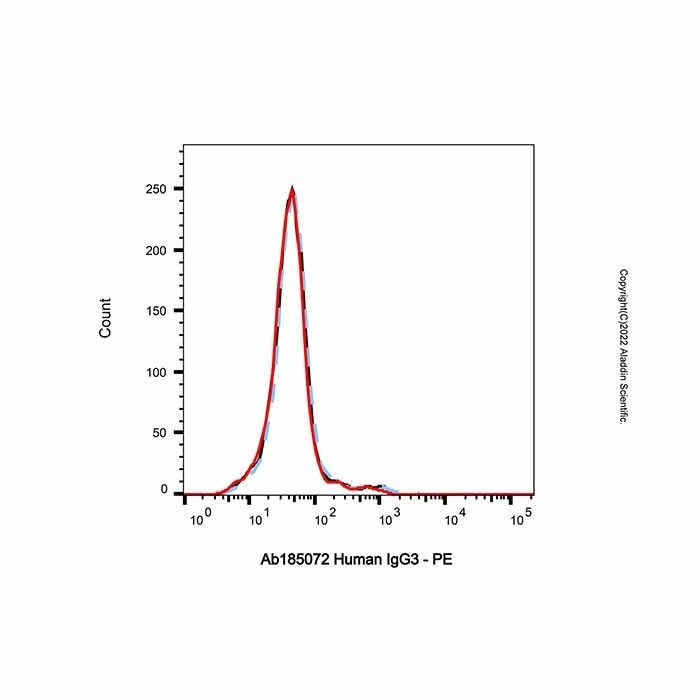
Human IgG3 (Ab185072) - Flow Cytometry Flow Cytometry analysis of Raji cells labelling Human IgG3 (red) with Human IgG3 (Ab185072). Goat Anti-Human IgG (PE) (Ab175838) at a dilution of 1/1000 was used as the secondary antibody. Blue - Isotype control, human IgG (Ab170213). Black - Unlabelled control, cells without incubation with primary antibody.
Applicazione
Applicazione
Dilution info
Functional Assay
Use at an assay dependent concentration.
Flow Cytometry
Use at an assay dependent concentration.
Dati avanzati
Certificati (CoA, COO, BSE/TSE e tabella di analisi)
C of A & Other Certificates(BSE/TSE, COO):
Analytical Chart:
Find and download the COA for your product by matching the lot number on the packaging.
Determine the necessary mass, volume, or concentration for preparing a solution.
Dilution Calculator
Determine the dilution needed to prepare a stock solution.
Reconstitution Calculator
Recensioni
Recensioni dei clienti
Application Protocols
Tested/validated applications for this specific item: Not specified for this item; refer to CoA/Spec Sheet.
General starting points (non-item-specific; adjust per your assay):
ELISA standard/control:
Coat capture at 0.5–2 µg/mL in carbonate buffer (pH 9.6), 2 h RT or overnight 4°C. Block with protein-free blocker. Detect with anti-human IgG subclass-specific secondary.
SDS-PAGE/Western blot control:
Load 100–200 ng per lane for Coomassie; 10–50 ng for WB detection with anti-human IgG. Use reducing and nonreducing conditions to assess integrity.
Flow cytometry secondary calibration:
Conjugate to fluorophores (DOL 2–4). Titrate starting at 0.5–2 µg/test. Include Fc block where applicable.
Bioconjugation:
Exchange into amine-free buffer prior to NHS-ester labeling; monitor DOL by A280/corresponding dye absorbance.
Always verify concentration, purity, and buffer for the specific lot and optimize empirically.
Biological Roles
General immunobiology of human IgG3 (literature; not item-specific claims):
Functional role:
IgG3 is a human IgG subclass optimized for potent effector functions, including complement activation via C1q binding and engagement of Fcγ receptors on immune cells.
The extended hinge region imparts high flexibility and increased avidity for multivalent antigens, at the expense of greater proteolytic sensitivity.
Effector interactions:
Strong classical complement pathway activation; efficient formation of membrane attack complexes on opsonized targets.
High-affinity interactions with several FcγRs (e.g., FcγRI/CD64, FcγRIIa/CD32a, FcγRIIIa/CD16a), promoting ADCP/ADCC in physiological contexts (literature variability across allotypes).
Structural/biochemical traits:
Distinct subclass allotypes (G3m markers) and polymorphisms can influence half-life, hinge length, and receptor binding.
Predominantly kappa light chains in humans (~60% κ vs ~40% λ overall; subclass distribution varies).
Experimental relevance:
Useful for dissecting Fc-mediated mechanisms, complement biology, and subclass-specific assay calibration.
IgG3 typically exhibits a shorter serum half-life than IgG1 due to FcRn interaction nuances, though sequence variants differ (literature).
Buffer Applications
Not typically applicable. This product is an antibody formulated in PBS and is not itself a buffering reagent.
Practical note: If your workflow requires different ionic strength or pH, perform buffer exchange (e.g., PBS → HEPES or TBS) using desalting columns or centrifugal ultrafiltration. Maintain neutral pH to preserve antibody conformation.
Green Alternatives
Azide-free advantage (item-specific): This antibody is supplied azide-free, avoiding sodium azide—a preservative with acute aquatic toxicity and potential for hazardous heavy-metal azide formation in plumbing. This aligns with greener lab practices and simplifies waste handling.
Buffer considerations (general):
PBS is widely accepted with low environmental impact compared to organic solvent systems.
For preservative needs in cell-incompatible contexts, consider low-toxicity alternatives (e.g., ProClin-type isothiazolinones), but only if compatible with your assay and institutional policies.
Process improvements (general, sustainability-focused):
Use room-temperature-stable cold chains only as validated; otherwise, minimize dry ice shipping where not required (this product ships cold packs per Product Data).
Implement miniaturized assays to reduce protein and plastic consumption.
Comparison snapshot (general):
Sodium azide–containing antibodies: Broad antimicrobial protection but hazardous/toxic; incompatible with HRP and live cells.
Azide-free (this item): Safer for HRP/live-cell workflows; requires aseptic handling or low-temperature storage to prevent bioburden.
Pharmaceutical Uses
No therapeutic or clinical use claims are made. For research use only (per Product Data).
May serve as a reference material for analytical method development (e.g., FcγR binding assays, complement activation ELISAs) or as a system suitability control for chromatography (Protein A/G).
Useful in platform development for conjugation chemistries (ADC prototyping, label optimization) in discovery settings.
Can assist in process characterization studies (e.g., leachables from protein A resins, host-cell protein interference models) using human IgG3 matrices.
Compliance note: If GMP or pharmacopeial status is required, verify specifications and certifications; this catalog item is for research use only.
Physical Properties
Item-specific measured properties: Not specified for this item; refer to CoA/Spec Sheet.
Formulation attributes from Product Data: Carrier Free; ExactAb™; Azide Free; Validated; PBS Only (buffered aqueous solution).
Literature/general properties for human IgG (for planning only; not item-specific specs):
Apparent molecular mass: ~150–170 kDa for IgG3 due to its longer hinge (heavy chain glycosylation can shift apparent MW on SDS-PAGE).
Isoelectric point (pI): Typically ~7–9 for human IgG3, but sequence- and glycoform-dependent (literature ranges).
Extinction coefficient (A280): A280 of 1.0 corresponds to ~0.7 mg/mL for generic IgG; equivalently, E1% 280 nm ≈ 13–15 (literature average; verify for the specific clone if available).
Solubility: Readily soluble in isotonic aqueous buffers (e.g., PBS). Sensitive to extremes of pH (<4 or >9) and to denaturants.
Stability considerations: Stability is influenced by buffer composition, ionic strength, temperature, and freeze–thaw history; surfactants (e.g., 0.01% polysorbate) are sometimes used to reduce interfacial stress in general antibody handling (not present here unless stated).
Quality and Grades
Item-specific quality statements from Product Data:
Carrier Free: No added carrier proteins (e.g., BSA/gelatin). Advantages: precise mass balance for conjugation and quantitative assays; reduced background from carrier contaminants.
ExactAb™: Brand/line designation indicating a characterized antibody format; consult CoA for specific analytical data (e.g., purity by SDS-PAGE, endotoxin if measured).
Azide Free: Suitable for applications incompatible with azide (e.g., live-cell, peroxidase-based systems, azide-sensitive conjugations). Avoids azide-related hazards.
Validated: The product has undergone internal qualification; specific validation datasets/applications are not provided here—refer to CoA/Spec Sheet.
PBS Only: Supplied in phosphate-buffered saline without additional excipients (no carrier proteins stated).
What these mean in practice:
Lower matrix complexity facilitates consistent labeling (e.g., NHS ester, maleimide) and analytical accuracy (e.g., protein A/G quantitation).
Azide-free formulation is compatible with HRP systems and cell-based assays where azide toxicity is a concern.
If low endotoxin or sterility are critical, verify item-specific limits on the CoA; not all research-use antibodies are tested for these unless stated.
Recommended verifications on receipt (best practice):
Confirm concentration, buffer composition, and purity on the CoA.
Assess integrity by nonreducing/reducing SDS-PAGE or SEC if your workflow requires defined aggregation state.
Reaction and Applications
As a human IgG3-κ reagent, applications are centered on immunoassay, binding, and bioconjugation workflows rather than small-molecule reactions.
Potential research uses (general; not item-specific claims):
Assay controls and standards in Fcγ receptor binding studies (IgG3 shows strong FcγR and C1q interactions; literature).
Development of isotype-aware assay systems (subclass discrimination, crosslinking behavior via extended hinge).
Calibration standards for protein A/G/A/G/L binding assessments (note: protein A has weaker affinity for human IgG3 relative to other subclasses; protein G binds IgG3 better; literature—validate empirically).
Conjugation to enzymes/fluorophores/biotin for detection or capture.
Bioconjugation “reactions” (general):
Lysine-targeted NHS ester labeling (pH 7.5–8.5) for fluorophores or haptens.
Cysteine-selective maleimide coupling post mild reduction or to engineered sulfhydryls.
Site-directed Fc glycoconjugation or enzymatic labeling (e.g., GlyCLICK, sortase) where applicable.
Practical tips:
Maintain gentle conditions (4–25°C, neutral pH). Avoid primary amines during NHS labeling; exclude thiols during maleimide reactions.
Perform buffer exchange before conjugation; analyze by SEC or SDS-PAGE to confirm integrity and DOL (degree of labeling).
Reaction Conditions
There are no small-molecule reaction conditions for this protein reagent. For bioconjugation and assay setup (general literature guidance; verify for your workflow):
NHS ester labeling (lysine-directed):
Buffer: Amine-free (e.g., 50–100 mM sodium bicarbonate or phosphate, pH 7.5–8.5).
Temperature/time: 20–25°C, 30–90 min; quench with Tris or glycine; purify by desalting/SEC.
Maleimide–thiol coupling (cysteine-directed):
Generate free thiols via mild reduction (e.g., TCEP ≤1 mM briefly) or target engineered cysteines.
Buffer: Degassed PBS or phosphate, pH 6.5–7.2 (limits maleimide hydrolysis).
Temperature/time: 4–25°C, 30–120 min; remove excess reagent by desalting/SEC.
Glycan-based conjugation:
Oxidize Fc glycans (NaIO4, low mM, 0–4°C, dark) → hydrazide/alkoxyamine ligation (pH ~5–6), followed by reduction (e.g., NaBH3CN; assess impact on Fc).
General assay setup:
Maintain protein concentration ≥0.2 mg/mL during handling to reduce adsorption.
Include stabilizers (e.g., 0.01% polysorbate 20) only if compatible and if not present initially (not specified for this item).
Safety and Handling
GHS/SDS details for this item: Not specified for this item; refer to SDS.
General laboratory safety for proteins/antibodies (good practice):
Handle as a biological laboratory reagent using aseptic technique. Wear appropriate PPE: lab coat, gloves, and eye protection.
Avoid aerosol generation and ingestion. Wash hands after handling.
Chemical hazards:
This product is azide-free (per Product Data), eliminating sodium azide–related acute toxicity and heavy metal azide formation risks common to azide-containing buffers.
Avoid mixing with oxidizing agents or proteases. Prevent microbial contamination.
Practical considerations for buffer compatibility:
Compatible with standard isotonic buffers: PBS, TBS, HEPES (if buffer exchange is performed). Maintain neutral pH (≈7.2–7.6) for stability.
Avoid strong acids/bases and chaotropes unless intentionally denaturing.
For conjugation, exchange into amine-free buffers (e.g., PBS → bicarbonate or phosphate without primary amines) prior to NHS ester coupling; for maleimide chemistry, ensure reducing agents are absent.
Comparison (general guidance):
PBS (supplied): Physiological ionic strength; good for storage and most immunoassays.
TBS: Sometimes preferred for alkaline phosphatase systems or when phosphate interferes.
HEPES: Good buffering near neutral pH for live-cell contexts; zwitterionic, minimal metal interaction.
If desalting/dialysis is needed: Use 10–50 kDa MWCO devices depending on target recovery; keep protein concentrations ≥0.2 mg/mL to limit adsorption.
Storage and Reconstitution
Item-specific storage from Product Data:
Store at -20°C. Avoid repeated freezing and thawing.
Shipped: Ice chest + ice pads (cold packs).
Formulation: PBS Only; Carrier Free; Azide Free.
Practical guidance:
Upon receipt, centrifuge briefly to collect contents. Inspect for turbidity or particulates; if observed, gently invert to resuspend—do not vortex.
Aliquot immediately to single-use volumes to minimize freeze–thaw cycles. For long-term storage, consider -80°C if compatible with your workflows (verify on CoA if any constraints are noted).
If concentration permits, store at ≥0.5 mg/mL to reduce adsorption; use low-protein-binding tubes.
For working stocks, store at 2–8°C and use within 1–2 weeks; add sterile stabilizers (e.g., 0.02% sodium azide or 0.01% polysorbate) only if compatible with your application—note this item is supplied azide-free.
Reconstitution: If provided lyophilized (not specified here), reconstitute with sterile PBS or water to the desired concentration, mix gently, and allow to equilibrate on ice. For this PBS liquid format, no reconstitution is required.
Documentation: For lot-specific concentration, purity, and any additional stabilizers, refer to the CoA/Spec Sheet.
Research Use Only: As stated in Product Data.
Structure and Identity
Brief overview: Human IgG3-κ is a human immunoglobulin G subclass 3 with a kappa light chain. It is a glycoprotein with a heterotetrameric architecture typical of IgG molecules.
Item-specific identifiers from Product Data:
SKU: Ab185072
Product Name: Human IgG3-kappa
CAS, CID, InChIKey, SMILES: Not specified for this item; refer to CoA/Spec Sheet.
Molecular formula and exact molecular weight: Not specified for this item; refer to CoA/Spec Sheet.
Structural features (general immunochemistry, literature):
Composition: 2 identical γ3 heavy chains (each ~50 kDa) and 2 identical κ light chains (each ~25 kDa), linked by disulfide bonds (heterotetramer, H2L2).
Domain architecture: Each heavy chain contains VH–CH1–hinge–CH2–CH3; each light chain contains VL–CL(κ). IgG3 has an extended, proline-rich hinge with multiple inter-heavy-chain disulfides.
Glycosylation: Conserved N-linked glycan at Asn297 in CH2 of each heavy chain; potential additional glycosites depending on sequence/clone (literature, varies by source).
Isotype/light chain: IgG3 isotype; kappa (κ) light chain subclass. No antigen specificity is provided for this item.
2D/primary structure (described): Two heavy chains paired via hinge disulfides; each heavy chain associates noncovalently and via a disulfide with one κ light chain. Fab arms (VH/VL + CH1/CL) form antigen-binding sites; Fc (CH2–CH3) mediates effector interactions (FcγR/C1q).
Synthetic Utility
Classical organic synthetic utility is not applicable to antibodies. However, IgG3-κ is a versatile scaffold for bioconjugation and biomaterials assembly (general guidance):
Reactive moieties:
Surface lysines (ε-NH2) for NHS ester coupling to fluorophores, haptens, or linkers.
Reduced interchain cystines or engineered cysteines for maleimide/thiol–ene chemistry.
Carbohydrate moieties at Fc (Asn297) for periodate-mediated aldehyde generation and oxime/hydrazone ligation (with care to maintain Fc integrity).
Named/established methods:
Sortase A transpeptidation (LPXTG tags), Fc glycan remodeling (EndoS2/GalT-Y289L), SPAAC/CuAAC after azide/alkyne installation.
Retrosynthetic value (biodesign):
Modular placement of reporters or payloads enables construction of immunoassays, biosensors, and targeted delivery prototypes.
Practical considerations:
Maintain functional integrity of antigen-binding/Fc regions; control degree of labeling (DOL 2–4 typical for detection) to avoid aggregation and loss of affinity.
Target Specificity
Antigen/epitope specificity: Not specified for this item; refer to CoA/Spec Sheet.
Clone, isotype confirmation, species reactivity, cross-reactivity: Not specified for this item; refer to CoA/Spec Sheet.
Notes: The product name indicates human IgG3-κ isotype; absent further details, treat as an isotype-defined antibody without declared antigen specificity.
Domande frequenti
What does ExactAb? mean?
ExactAb? indicates the product has been validated for use in rigorous antibody validation workflows. Validation may include positive/negative control samples, signal-to-noise testing, and protocol-specific QC. Lot-specific test data is published on the Certificate of Analysis where available.
What does Carrier Free mean?
Carrier Free indicates that the material has been processed and tested for specialty industrial processing. Specifications focus on the impurities that affect performance in that application — for example, metal content for electronics, particle size for batteries, refractive index for optics, or moisture content for moisture-sensitive processes.
How should this product be stored?
Store at ?20 °C. Avoid repeated freeze–thaw cycles. Aliquot into single-use volumes before freezing.
How is this product shipped?
This product ships in an insulated container with ice pads. Unpack on arrival and transfer it to the storage condition stated above.
What documentation is provided?
Available product documentation, including Certificates of Analysis (COA), Safety Data Sheets (SDS), and specification sheets, is shown in the product document area. Document availability and access follow the current site policy.
Which species reactivity has this antibody been validated against?
Validated reactivity is listed on the PDP and on each lot's datasheet. We validate against the most commonly tested species for the target (Human IgG3-kappa); cross-reactivity in untested species may exist but is not guaranteed. Contact technical support for specific species inquiries.
Hai bisogno di aiuto per scegliere la qualità?
La nostra guida alla selezione delle qualità copre purezza, stato dello stabilizzatore e idoneità all'applicazione per tutte le varianti del nostro catalogo.
Utilizziamo i cookie per garantire il corretto funzionamento del sito web e, ove consentito, per migliorare la tua esperienza. Puoi gestire le tue preferenze in qualsiasi momento nelle Impostazioni. Per saperne di più, consulta la nostra Cookie Policy.
Desidera che le inviamo un messaggio quando avremo sconti disponibili?
Ricordamelo più tardi
Grazie! Controlli la sua casella di posta per confermare.
Products are supplied to verified businesses, institutions, and qualified professionals for research and development use only. Not for use in humans, animals, diagnosis, or therapy.

 ZJ25F0723812