Determine the necessary mass, volume, or concentration for preparing a solution.
| Activity Type | Activity Value -log(M) | Mechanism of Action | Activity Reference | Publications (PubMed IDs) |
|---|

Moligand™, ≥98% Moligand™ for sensitive chromatographic and analytical workflows requiring minimal baseline interference.
Store at -20°C Ships Ice chest + Ice pads Check lot-specific COA for exact specifications.
SDS, COA, datasheet, and spec sheet available for download. Lot-specific COA accessible via lot number lookup.
Cited in 0 peer-reviewed publications across chromatography, organic synthesis, and cross-coupling reactions.
Information
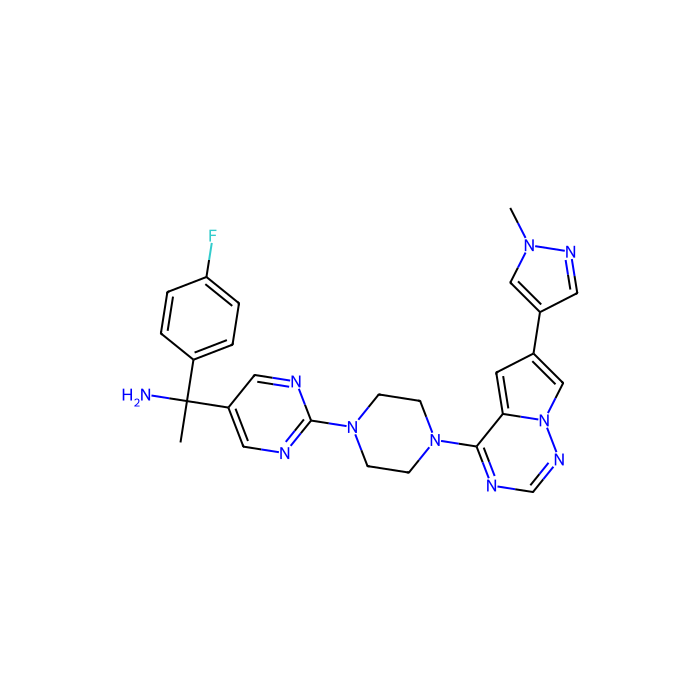
Avapritinib (BLU-285) is a small molecule kinase inhibitor that potently inhibitsPDGFRα D842Vmutant activity in vitro (IC50 = 0.5 nM) and PDGFRα D842V autophosphorylation in the cellular setting (IC50 = 30 nM); also a potent inhibitor of the analogousKit (c-Kit)mutation, D816V in Kit (c-Kit) Exon 17 (IC50 = 0.5 nM).
Targets
PDGFRα (D842V) ; c-Kit (D816V) 0.5 nM; 0.5 nM
In vitro
BLU-285 is a selective oral inhibitor that targets KIT Exon 17 and PDGFRα D842 activation loop mutants. Cellular assays measuring inhibition of KIT mutant autophosphorylation confirm the activity of BLU-285 against the KIT D816 mutants D816V (HMC1.2 cells, IC50 = 3 nM) and D816Y (P815 cells, IC50 = 22 nM) as well as other KIT Exon 17 mutants such as N822K (Kasumi cells, IC50 = 40 nM) found in treatment-refractory GIST.
In vivo
BLU-285 is a well-tolerated, orally bioavailable agent that achieves dose dependent tumor growth inhibition in a D816Y-driven xenograft model. A PK-PD-efficacy relationship with BLU-285 has been established demonstrating that tumor regression results from >90% target suppression and is observed with 30 mg/kg once daily dosing. With potent activity against PDGFRα D842V and KIT Exon 17 mutants, BLU-285 targets previously unaddressed genomic drivers of disease and provides promise for the treatment of PDGFRα D842V-driven GIST(gastrointestinal stromal tumor) or SM(systemic mastocytosis), where more than 90% of patients carry the KIT D816V mutation. Besides single agent activity, the highly selective BLU-285 offers an opportunity for combination with other agents in GIST to cover the entirety of KIT primary and resistance mutants.
Comprehensive hazard, handling, storage, and regulatory compliance document.
Download SDS →Lot-specific quality data. Enter your lot number to retrieve the exact COA.
Look up COA →Full quality attributes and acceptance criteria for this grade.
View spec sheet →Taxonomy Tree
| Kingdom | Organic compounds |
|---|---|
| Superclass | Organoheterocyclic compounds |
| Classe | Diazinanes |
| Subclass | Piperazines |
| Intermediate Tree Nodes | Not available |
| Direct Parent | N-arylpiperazines |
| Alternative Parents | Pyrrolo[2,1-f][1,2,4]triazines Dialkylarylamines Fluorobenzenes Aralkylamines Aminopyrimidines and derivatives Substituted pyrroles Imidolactams Aryl fluorides 1,2,4-triazines Pyrazoles Heteroaromatic compounds Azacyclic compounds Organopnictogen compounds Organofluorides Monoalkylamines Hydrocarbon derivatives |
| Molecular Framework | Aromatic heteropolycyclic compounds |
| Substituents | N-arylpiperazine - Pyrrolo[2,1-f][1,2,4]triazine - Dialkylarylamine - Aralkylamine - Halobenzene - Fluorobenzene - Aminopyrimidine - 1,2,4-triazine - Imidolactam - Benzenoid - Triazine - Substituted pyrrole - Pyrimidine - Monocyclic benzene moiety - Aryl halide - Aryl fluoride - Heteroaromatic compound - Pyrrole - Pyrazole - Azole - Azacycle - Organic nitrogen compound - Organopnictogen compound - Hydrocarbon derivative - Primary amine - Organonitrogen compound - Organofluoride - Organohalogen compound - Primary aliphatic amine - Amine - Aromatic heteropolycyclic compound |
| Descrição | This compound belongs to the class of organic compounds known as n-arylpiperazines. These are organic compounds containing a piperazine ring where the nitrogen ring atom carries an aryl group. |
| External Descriptors | Not available |
| Activity Type | Activity Value -log(M) | Mechanism of Action | Activity Reference | Publications (PubMed IDs) |
|---|
| Activity Type | Relation | Activity value | Units | Action Type | Journal | PubMed Id | doi | Assay Aladdin ID |
|---|
| Activity Type | Relation | Activity value | Units | Action Type | Journal | PubMed Id | doi | Assay Aladdin ID |
|---|
| Activity Type | Relation | Activity value | Units | Action Type | Journal | PubMed Id | doi | Assay Aladdin ID |
|---|
| Activity Type | Relation | Activity value | Units | Action Type | Journal | PubMed Id | doi | Assay Aladdin ID |
|---|
| Activity Type | Relation | Activity value | Units | Action Type | Journal | PubMed Id | doi | Assay Aladdin ID |
|---|
| Activity Type | Relation | Activity value | Units | Action Type | Journal | PubMed Id | doi | Assay Aladdin ID |
|---|
Find and download the COA for your product by matching the lot number on the packaging.
| Lot Number | Certificate Type | Data | Item |
|---|---|---|---|
 K2215213 K2215213 | Certificate of Analysis | Aug 23, 2024 | A414052 |
| K2215211 | Certificate of Analysis | Aug 11, 2022 | A414052 |
| K2215212 | Certificate of Analysis | Aug 11, 2022 | A414052 |
| K2215215 | Certificate of Analysis | Aug 11, 2022 | A414052 |
| K2215218 | Certificate of Analysis | Aug 11, 2022 | A414052 |
| K2215219 | Certificate of Analysis | Aug 11, 2022 | A414052 |
| K2215220 | Certificate of Analysis | Aug 11, 2022 | A414052 |
| K2215227 | Certificate of Analysis | Aug 11, 2022 | A414052 |
| K2215231 | Certificate of Analysis | Aug 11, 2022 | A414052 |
| Solubilidade | Solubility (25°C) In vitro DMSO: 100 mg/mL (200.57 mM); Water: Insoluble; Ethanol: Insoluble; |
|---|---|
| Peso molecular | 498.600 g/mol |
| XLogP3 | 1.900 |
| Hydrogen Bond Donor Count | 1 |
| Hydrogen Bond Acceptor Count | 9 |
| Rotatable Bond Count | 5 |
| Exact Mass | 498.24 Da |
| Monoisotopic Mass | 498.24 Da |
| Topological Polar Surface Area | 106.000 Ų |
| Heavy Atom Count | 37 |
| Formal Charge | 0 |
| Complexity | 752.000 |
| Isotope Atom Count | 0 |
| Defined Atom Stereocenter Count | 1 |
| Undefined Atom Stereocenter Count | 0 |
| Defined Bond Stereocenter Count | 0 |
| Undefined Bond Stereocenter Count | 0 |
| The total count of all stereochemical bonds | 0 |
| Covalently-Bonded Unit Count | 1 |
Our grade selection guide covers purity, stabilizer status, and application suitability for all variants in our catalog.
View Moligand™ grade guide →