
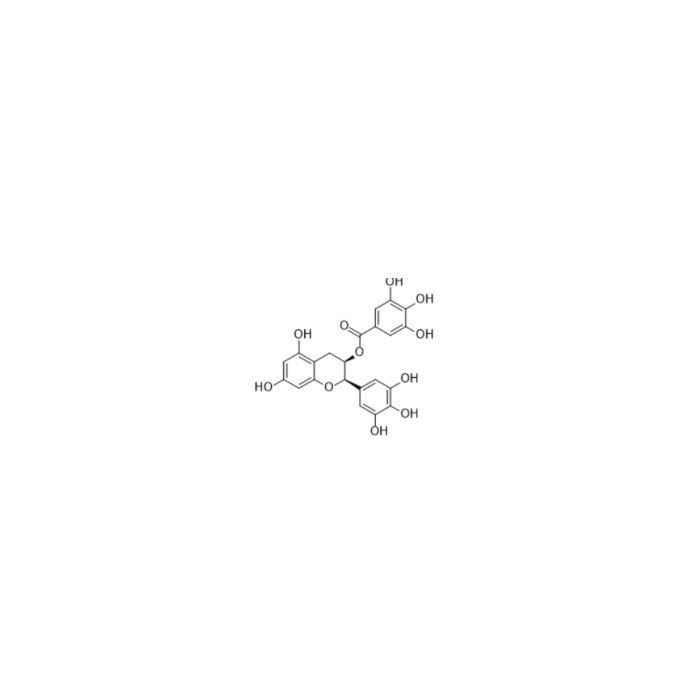
 J2610852
Determine the necessary mass, volume, or concentration for preparing a solution.
| Activity Type | Activity Value -log(M) | Mechanism of Action | Activity Reference | Publications (PubMed IDs) |
|---|
Information
(-)-Epigallocatechin Gallate(EGCG) is the main catechin extraction of green tea that inhibitstelomeraseandDNA methyltransferase. EGCG blocks the activation ofEGF receptorsandHER-2receptors. ECGG inhibits fatty acid synthase and glutamate dehydrogenase act
In vitro
(-)-Epigallocatechin gallate functions as a powerful antioxidant, preventing oxidative damage in healthy cells, but also as an antiangiogenic and antitumor agent and as a modulator of tumor cell response to chemotherapy. (-)-Epigallocatechin gallate shows multiple anticancer effects, such as anti-proliferation, anti-angiogenesis, transformation prevention of various cancer cells, cancer cell cycle arrest and inhibition of tumor metastasis. (-)-Epigallocatechin gallate exerts multi-anticancer effects through regulating several cancer-related cell signal pathways (regulated the function or the expression of key signal proteins, such as nuclear factor-κB, MAPKs and activator protein-1, EGFR, IGF, COX-2 signaling pathway, and so on.), effecting methylation of cancer genes and combination of ligand with membrane receptors. (-)-Epigallocatechin gallate also shows an immunomodulating effects. Several types of immune cells in both the innate and adaptive immune systems are known to be affected in varying degrees by (-)-Epigallocatechin gallate. Among them, the dramatic effect on T cell functions has been repeatedly demonstrated, including T cell activation, proliferation, differentiation, and production of cytokines. Studies using animal models of autoimmune diseases have reported disease improvement in animals treated with green tea/EGCG. (-)-Epigallocatechin gallate displays anti-infective properties. Antiviral activities of (-)-Epigallocatechin gallate with different modes of action have been demonstrated on diverse families of viruses, such as Retroviridae, Orthomyxoviridae and Flaviviridae and include important human pathogens like human immunodeficiency virus, influenza A virus and the hepatitis C virus.
In vivo
Cell Data
cell lines:
Concentrations:
Incubation Time:
Powder Purity:≥99%
| Activity Type | Activity Value -log(M) | Mechanism of Action | Activity Reference | Publications (PubMed IDs) |
|---|
| Activity Type | Activity Value -log(M) | Mechanism of Action | Activity Reference | Publications (PubMed IDs) |
|---|
| Activity Type | Activity Value -log(M) | Mechanism of Action | Activity Reference | Publications (PubMed IDs) |
|---|
| Activity Type | Activity Value -log(M) | Mechanism of Action | Activity Reference | Publications (PubMed IDs) |
|---|
| Activity Type | Activity Value -log(M) | Mechanism of Action | Activity Reference | Publications (PubMed IDs) |
|---|
| Activity Type | Activity Value -log(M) | Mechanism of Action | Activity Reference | Publications (PubMed IDs) |
|---|
| Activity Type | Activity Value -log(M) | Mechanism of Action | Activity Reference | Publications (PubMed IDs) |
|---|
| Activity Type | Activity Value -log(M) | Mechanism of Action | Activity Reference | Publications (PubMed IDs) |
|---|
| Activity Type | Activity Value -log(M) | Mechanism of Action | Activity Reference | Publications (PubMed IDs) |
|---|
| Activity Type | Activity Value -log(M) | Mechanism of Action | Activity Reference | Publications (PubMed IDs) |
|---|
| Activity Type | Activity Value -log(M) | Mechanism of Action | Activity Reference | Publications (PubMed IDs) |
|---|
| Activity Type | Activity Value -log(M) | Mechanism of Action | Activity Reference | Publications (PubMed IDs) |
|---|
| Activity Type | Activity Value -log(M) | Mechanism of Action | Activity Reference | Publications (PubMed IDs) |
|---|
| Activity Type | Activity Value -log(M) | Mechanism of Action | Activity Reference | Publications (PubMed IDs) |
|---|
| Solubilidade | Solubility (25°C) In vitro DMSO: 2 mg/mL (7.8 mM); Water: Insoluble; Ethanol: Insoluble; |
|---|---|
| Rotação específica [α] | -175.5 ° (C=1, EtOH) |
| Ponto de fusão (°C) | 212°C |
| Peso molecular | 458.4 |
| XLogP3 | 1.200 |
| Hydrogen Bond Donor Count | 8 |
| Hydrogen Bond Acceptor Count | 11 |
| Rotatable Bond Count | 4 |
| Exact Mass | 458.085 Da |
| Monoisotopic Mass | 458.085 Da |
| Topological Polar Surface Area | 197.000 Ų |
| Heavy Atom Count | 33 |
| Formal Charge | 0 |
| Complexity | 667.000 |
| Isotope Atom Count | 0 |
| Defined Atom Stereocenter Count | 2 |
| Undefined Atom Stereocenter Count | 0 |
| Defined Bond Stereocenter Count | 0 |
| Undefined Bond Stereocenter Count | 0 |
| The total count of all stereochemical bonds | 0 |
| Covalently-Bonded Unit Count | 1 |
H319:Causes serious eye irritation
H411:Toxic to aquatic life with long lasting effects
H302:Harmful if swallowed
H317:May cause an allergic skin reaction
H312:Harmful in contact with skin
H401:Toxic to aquatic life
P261:Avoid breathing dust/fume/gas/mist/vapors/spray.
P305+P351+P338:IF IN EYES: Rinse cautiously with water for several minutes. Remove contact lenses if present and easy to do - continue rinsing.
P273:Avoid release to the environment.
P280:Wear protective gloves/protective clothing/eye protection/face protection.
P302+P352:IF ON SKIN: wash with plenty of water.
P321:Specific treatment (see ... on this label).
P501:Dispose of contents/container to an approved waste disposal plant.
P264:Wash hands [and …] thoroughly after handling.
P270:Do not eat, drink or smoke when using this product.
P272:Contaminated work clothing should not be allowed out of the workplace.
P333+P313:IF SKIN irritation or rash occurs: Get medical advice/attention.
P362+P364:Take off contaminated clothing and wash it before reuse.
P391:Collect spillage.
P330:Rinse mouth.
P264+P265:Wash hands [and …] thoroughly after handling. Do not touch eyes.
P301+P317:IF SWALLOWED: Get medical help.
P317:Get emergency medical help.
P337+P317:If eye irritation persists: Get medical help.
O nosso guia de seleção de graus abrange pureza, estado do estabilizador e adequação à aplicação para todas as variantes do nosso catálogo.
Ver o guia de graus Moligand™ →