GAPDH Mouse mAb (HRP) - Primary antibody, specific to GAPDH

Cat. No.: Ab219251
Disponível para encomenda
GRAU & PUREZA ExactAb™ ? ExactAb™ — Aladdin's antibody line emphasizing precision and validated quality. Use for reliable, specificity-validated antibody applications. Validated ? Validated grade — performance confirmed in defined applications before release. Use when you want documented assurance the reagent works as stated. 0.5 mg/mL
Application
WB
Host species
Mouse
Reactive species
Human
Isotype
Mouse IgG1
Clone Number
B08/4A11
Conjugation
HRP
★
Tamanho
Alemanha (EU)
USA*
Preço
Qtd
10μl
Ab219251-10μl
Sob encomenda · 8–12 semanas
60,65€
50μl
Ab219251-50μl
Sob encomenda · 8–12 semanas
164,78€
100μl
Ab219251-100μl
Sob encomenda · 8–12 semanas
260,23€
1ml
Ab219251-1ml
Sob encomenda · 8–12 semanas
1735,39€
Enter a quantity for the sizes you want to add.
🧪
Por que este grau

ExactAb™, Validated, 0.5 mg/mL ExactAb™,Validated para fluxos de trabalho cromatográficos e analíticos sensíveis que exigem interferência mínima da linha de base.

🌡

Armazenamento e envio

Protected from light,Store at -20°C,Avoid repeated freezing and thawing Envio Ice chest + Ice pads. Consulte o COA específico do lote para obter as especificações exatas.

📋

Documentos de qualidade

SDS, COA, ficha técnica e folha de especificações disponíveis para download. COA específico do lote acessível por meio de pesquisa por número de lote.

📚

Comprovação documental

Citado em 0 publicações revisadas por pares nas áreas de cromatografia, síntese orgânica e reações de acoplamento cruzado.

Visão geral

Mouse anti Human GAPDH Antibody, Monoclonal (B08/4A11), could be used for WB.

Especificações

Product Name
GAPDH Mouse mAb (HRP) - Primary antibody, specific to GAPDH
Sinónimos
38 kDa BFA-dependent ADP-ribosylation substrate antibody | aging associated gene 9 protein antibody | Aging-associated gene 9 protein antibody | BARS-38 antibody | cb609 antibody | EC 1.2.1.12 antibody | Epididymis secretory sperm binding protein Li 162eP
Especificações e pureza
ExactAb™, Validated, 0.5 mg/mL
Espécie hospedeira
Mouse
Especificidade
GAPDH
Imunogénio
Recombinant full length human GAPDH
Controlo positivo
WB: HEK293, HeLa, Jurkat and K562 whole cell lysates
Conjugação
HRP
Grau
ExactAb™, Validated
Tipo de corrente de luz
kappa
Método de purificação
Protein A purified
Concentração
0.5 mg/mL
Product Line
Produtos biológicos
Armazenamento e envio
Condições de armazenamento de armazenamento
Protected from light,Store at -20°C,Avoid repeated freezing and thawing
Enviado em
Ice chest + Ice pads
Estabilidade e armazenamento
Store at -20°C. Protect from light. Avoid freeze/thaw cycles.
Imagens

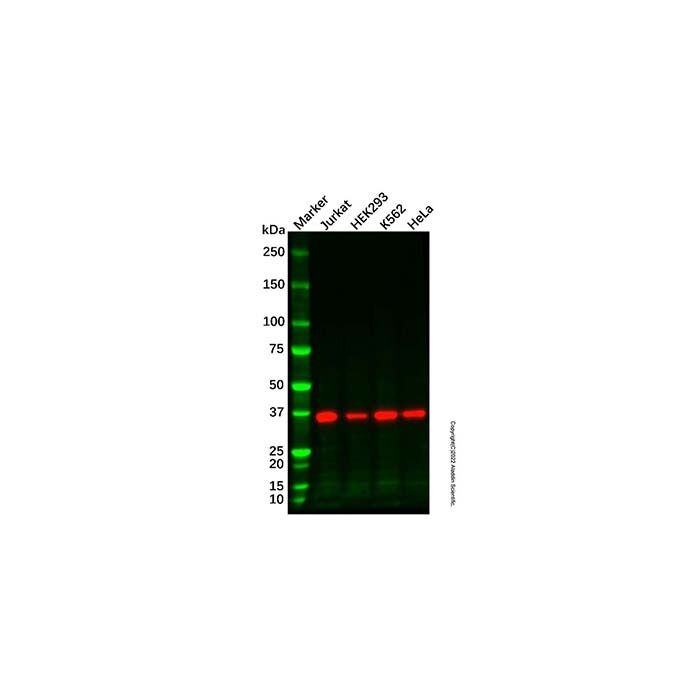
GAPDH Mouse mAb (HRP) (Ab219251) - Western Blot
All lanes: GAPDH Mouse mAb (HRP) (Ab219251) at 1/5000 dilution
Samples: Lysates at 20 µg per lane
Predicted band size: 35 kDa
Observed band size: 36 kDa
Exposure time: 7.5 s

Documentação

📋 Ficha de dados de segurança (FDS)

Documento abrangente sobre perigos, manuseamento, armazenamento e conformidade regulamentar.

<<<<<<< HEAD Baixar SDS → ======= Baixar SDS → >>>>>>> release248-p3

✅ Certificado de análise (COA)

Dados de qualidade específicos do lote. Introduza o número de lote para obter o COA exato.

Consultar COA →

📊 Ficha técnica

Resumo de referência rápida das especificações e aplicações do produto.

Ver ficha técnica →

🔬 Folha de especificações

Atributos de qualidade completos e critérios de aceitação para este grau.

Ver folha de especificações →

Dados avançados

Alvos associados (humanos)
GAPDH Tchem Glyceraldehyde-3-phosphate dehydrogenase (0 Activities)
Activity TypeActivity Value -log(M)Mechanism of ActionActivity ReferencePublications (PubMed IDs)
Certificados(CoA,COO,BSE/TSE e Mapa de Análise)
C of A & Other Certificates(BSE/TSE, COO):
Analytical Chart:

Find and download the COA for your product by matching the lot number on the packaging.

4 results found

Lot NumberCertificate TypeDataItem
ZJ25F0521866ZJ25F0521866Certificate of AnalysisMar 15, 2026 Ab219251
ZJ25F0521867ZJ25F0521867Certificate of AnalysisMar 15, 2026 Ab219251
ZJ25F0521868ZJ25F0521868Certificate of AnalysisMar 15, 2026 Ab219251
ZJ25F0521869ZJ25F0521869Certificate of AnalysisMar 15, 2026 Ab219251
FAQs e artigos
Calculadoras de soluções
Revisões

Avaliações dos Clientes

Application Protocols

Item-specific tested applications, recommended dilutions, incubation times, and positive controls are not specified for Ab219251; refer to the CoA/Spec Sheet. The following are general, literature-based starting points for HRP-conjugated anti-GAPDH antibodies and should be optimized by the user:

  • Western blot (general):
    • Sample: denatured whole-cell lysates (10–30 µg/lane).
    • Membrane: PVDF or nitrocellulose; block 1 h in 5% milk/BSA in TBS-T.
    • Antibody incubation: HRP-conjugated primary 1 h RT or overnight 4°C in blocking buffer; wash 3–5× with TBS-T.
    • Detection: chemiluminescent HRP substrate; image within minutes of development.
  • ELISA (general):
    • Coat plates with antigen or capture antibody, block with protein blocker, incubate with HRP-conjugated antibody, develop with TMB, stop with acid, read at 450 nm.
  • IHC/ICC (general):
    • Fix with PFA; optional antigen retrieval; block endogenous peroxidase with H2O2 (if chromogenic); incubate with HRP-conjugated antibody; develop with DAB; counterstain.

Controls (general): Include no-primary and isotype controls; verify band at ~36–38 kDa (GAPDH) in WB.

Note: Avoid azide in detection steps due to HRP inhibition. These guidelines are not product-specific instructions.

Biological Roles

Target antigen context (general literature):

  • GAPDH (glyceraldehyde-3-phosphate dehydrogenase) is a central glycolytic enzyme catalyzing the conversion of glyceraldehyde-3-phosphate to 1,3-bisphosphoglycerate with NAD+ reduction.
  • Beyond metabolism, GAPDH exhibits “moonlighting” functions, participating in nuclear RNA export, DNA repair, membrane trafficking, and stress responses. Its abundance and relatively stable expression in many cell types make it a common loading control in protein quantification workflows (general observation; expression can vary under certain conditions such as hypoxia, differentiation, or metabolic reprogramming).
  • Cellular localization: Predominantly cytosolic; can translocate to nucleus or membranes under specific stimuli (literature).
  • Molecular size: ~36–38 kDa monomer; functions as a tetramer in its native state (literature).

Relevance for assay design (general):

  • As a housekeeping protein, GAPDH signal intensity is frequently used to normalize Western blot lane loading; confirm stability of expression under your experimental conditions.
  • Species conservation is high, enabling cross-species detection by many anti-GAPDH antibodies; however, Ab219251’s species reactivity is not specified—verify with the CoA/Spec Sheet.

All biological role information above is provided as general background on the target (GAPDH) and is not an endorsement of specific performance characteristics of Ab219251.

Buffer Applications

This product is not a buffering agent. However, buffers are critical for optimal performance of HRP-conjugated antibodies.

  • General buffer guidance (literature; not item-specific):
    • Western blot/ELISA wash buffers: TBS-T or PBS-T (0.05–0.1% Tween-20) reduce nonspecific binding.
    • Blocking buffers: 5% nonfat dry milk or BSA in TBS-T/PBS-T; milk can contain peroxidase activity that may affect background with certain substrates—optimize accordingly.
    • HRP activity buffers: Avoid sodium azide during detection; maintain near-neutral pH (6.8–7.6) for robust enzyme activity.
    • Antigen retrieval for IHC: Citrate buffer pH ~6.0 or Tris-EDTA pH ~9.0 (literature) depending on fixation; optimize per tissue.

Item-specific buffer composition and recommended working/dilution buffers for Ab219251 are not specified; refer to the CoA/Spec Sheet.

Green Alternatives

While this is a biological reagent rather than a solvent/chemical, greener laboratory choices can be made around its use and detection chemistries.

  • Considerations (general):
    • Substrates: Choose safer, high-sensitivity chemiluminescent HRP substrates that minimize hazardous byproducts. Prefer aqueous, non-aromatic formulations when available; avoid DAB where feasible due to its hazardous classification.
    • Buffers: Use phosphate or Tris buffers prepared with purified water; avoid preservatives like sodium azide in large-scale workflows to reduce toxic waste, substituting with sterile filtration and low-temperature storage when compatible.
    • Waste minimization: Right-size reaction volumes and use micro-volume imaging to reduce substrate consumption and waste.
    • Reusability: Employ reusable, low-background imaging trays rather than single-use plastics when compatible with your workflow.

Comparison (general, qualitative):

  • HRP chemiluminescence vs chromogenic DAB
    • Sensitivity: High vs Moderate
    • Hazard profile: Typically lower vs Higher (DAB is hazardous)
    • Waste: Aqueous, less persistent vs Requires special disposal

These are general sustainability suggestions. Item-specific formulation details for Ab219251 are not specified; refer to the CoA/Spec Sheet for buffer/preservative information.

Pharmaceutical Uses

Not applicable. This HRP-conjugated monoclonal antibody is supplied strictly for research use only, as stated in the Product Data. It is not intended for diagnostic, therapeutic, or clinical applications.

  • General note (non-clinical): Antibodies may serve as analytical reagents in bioprocess development and quality control assays, but any use in regulated environments requires qualification specific to the intended method and is outside the scope of this product documentation.
Physical Properties

Antibodies and their enzyme conjugates are heterogeneous biological macromolecules; fixed small-molecule specifications (e.g., BP/MP) do not apply.

  • Item-specific values (this lot):
    • Molecular weight, isotype subclass, extinction coefficient, concentration, buffer composition: Not specified for this item; refer to CoA/Spec Sheet.
  • General/literature properties for context (non-item-specific):
    • IgG monomer apparent MW: ~150 kDa by SDS-PAGE (literature). HRP is ~40–45 kDa; conjugation increases apparent mass and hydrodynamic size.
    • Solubility: Readily soluble in aqueous buffers (PBS, TBS). Sensitive to extremes of pH and high ionic detergents (literature).
    • pI: Mouse IgG subclasses typically pI ~6–9; actual value varies by sequence and glycosylation (literature).
    • HRP activity is optimal near pH 6–7.5 and is inhibited by azide and strong chelators/reductants (literature).
    • Storage form: commonly supplied in stabilizing protein buffers with carrier proteins and preservatives; exact composition not provided here.

Note: Do not interpret the above literature values as specifications for Ab219251. For numerical specifications (concentration, buffer, preservative, HRP:IgG ratio), consult the CoA/Spec Sheet for this product/lot.

Quality and Grades
  • Item-specific grade (from Product Data): ExactAb™, Validated.
  • Interpretation and implications (general explanation; not a specification):
    • ExactAb™ typically denotes high lot-to-lot consistency and manufacturing under defined conditions to ensure reproducible binding and conjugation performance. It often implies traceable production records and stringent QC checkpoints (conceptual description).
    • “Validated” indicates the antibody has undergone performance verification against its intended antigen under representative assay conditions. The specific validation assays, sample panels, and acceptance criteria for Ab219251 are not listed here; refer to the CoA/Spec Sheet for details.
  • What to expect in QC documentation (typical for HRP-conjugated mAbs; not guaranteed unless stated on CoA):
    • Identity/host/isotype confirmation.
    • Purity by SDS-PAGE and/or SEC.
    • HRP activity and conjugation ratio checks.
    • Functional binding to GAPDH by an appropriate immunoassay.
  • Best practices stemming from quality status:
    • Use consistent blocking and detection chemistries during method transfer to preserve validated performance.
    • Record lot numbers for traceability; re-optimize dilutions upon lot changes as minor shifts can occur across conjugations.

For authoritative, item-specific QC attributes (buffer composition, preservative, binding titer, recommended dilutions), consult the CoA/Spec Sheet.

Reaction and Applications

Chemical reaction schemes are not applicable to antibody reagents. Instead, HRP-conjugated anti-GAPDH mAbs are used as affinity reagents in immunodetection workflows.

  • General/literature applications (not item-specific):
    • Western blotting: as a loading-control detector (anti-GAPDH) on denatured lysates; detection via HRP chemiluminescence.
    • ELISA: detection of GAPDH or as a control reagent in assay normalization.
    • Immunocytochemistry/Immunohistochemistry (ICC/IHC): visualization of GAPDH with chromogenic HRP substrates (e.g., DAB) in fixed cells/tissues.
    • Dot blots and slot blots for rapid checks of sample loading.
  • Practical tips (general):
    • Optimize antibody dilution empirically based on membrane type, blocking agent, and substrate sensitivity.
    • HRP is inhibited by azide; avoid azide-containing buffers in HRP enzymatic readouts. For storage, low azide can be acceptable, but switch to azide-free buffers before developing color/chemiluminescence.
    • For Western blots, confirm GAPDH band at the expected apparent MW (~36–38 kDa in many mammalian species; literature) and verify specificity with peptide competition or knockdown where needed.

Note: Specific validated applications and recommended dilutions for Ab219251 are not provided in the Product Data; consult the CoA/Spec Sheet for item-specific guidance.

Reaction Conditions

Not applicable to chemical synthesis. For HRP-based detection workflows, general conditions (literature) include:

  • Temperature: Room temperature incubation for primary/secondary antibody steps; cold (4°C) overnight incubations can improve specificity.
  • Buffers: PBS or TBS with 0.05–0.1% Tween-20 for washes; compatible blocking buffers (milk or BSA) depending on substrate/background.
  • Substrates: Chemiluminescent reagents for Western blot; TMB for ELISA; DAB for chromogenic IHC. Follow substrate manufacturer instructions for timing and quenching.
  • Timing: Typical antibody incubations range from 1 h at RT to overnight at 4°C; wash cycles 3–5× for 5–10 min each.

These are general literature practices and not item-specific recommendations for Ab219251. Optimize empirically for your platform.

Safety and Handling
  • GHS/SDS information (item-specific):
    • Signal word, hazard statements, pictograms, classification: Not specified for this item; refer to SDS.
  • General lab safety for antibody–HRP conjugates (literature guidance):
    • PPE: lab coat, gloves (nitrile), and eye protection when handling solutions and chemiluminescent/HRP substrates.
    • Avoid ingestion, inhalation of sprays/aerosols; handle in a clean area to prevent contamination.
    • HRP substrates (e.g., luminols, TMB, DAB) may be irritants, sensitizers, or potential mutagens; handle per their SDS and dispose as hazardous chemical waste.
    • Sodium azide (if present as preservative; not specified here) is highly toxic and forms heavy-metal azides in plumbing; collect and dispose per institutional guidance.
  • Incompatibilities/Deactivation (general):
    • HRP activity is inhibited by azide, high concentrations of reducing agents (e.g., excess DTT, βME), strong chelators, and harsh detergents.
    • Avoid microbial contamination; use aseptic technique for long-term storage aliquots.
  • First aid (general):
    • Skin/eye contact: rinse with water; remove contaminated clothing. Ingestion: rinse mouth; seek medical attention. Inhalation of aerosols: move to fresh air.

Always consult the product SDS and your institution’s EHS guidelines for authoritative hazard classification, handling, spill, and disposal procedures.

Solvent Selection

This product is an aqueous protein reagent, not a low-molecular-weight solute. Traditional organic solvent selection (polarity, dielectric constants) is not typically applicable.

  • Practical guidance (general):
    • Use physiological buffers such as PBS or TBS, with 0.05–0.1% Tween-20 for washing steps as appropriate for immunoassays.
    • Avoid strong organic solvents (acetone, acetonitrile, DMF, DMSO) that can denature proteins or quench HRP activity.
    • If dilution is needed, use the same buffer system supplied with the antibody or a validated assay buffer to maintain stability.

For item-specific buffer compatibility and formulation, refer to the CoA/Spec Sheet.

Storage and Reconstitution
  • Item-specific storage (from Product Data):
    • Store at −20°C.
    • Protect from light.
    • Avoid repeated freezing and thawing.
    • Shipment: Ice chest + ice pads.
  • Practical handling (general guidance):
    • Upon receipt, briefly centrifuge to collect liquid, inspect for container integrity, and record lot/receive date.
    • If the antibody is supplied in liquid form, aliquot into single-use portions using sterile, low-protein-binding tubes to minimize freeze–thaw cycles.
    • For HRP conjugates, store in the dark; HRP activity can diminish with light exposure and repeated thawing.
    • If lyophilized (not specified for this item), reconstitute with sterile, carrier-protein–containing buffer (e.g., PBS with 1% BSA or glycerol) according to the CoA/Spec Sheet; allow to dissolve gently on ice without vigorous vortexing.
    • Avoid sodium azide in working solutions used for HRP activity detection; if present in storage buffer (not specified), exchange into azide-free buffer prior to developing assays.
    • Recommended storage temperatures for working aliquots can range from 4°C (short term, days) to −20°C or below (long term, months), depending on buffer composition; follow the item-specific CoA/Spec Sheet.

Always refer to the CoA/Spec Sheet for formulation, concentration, and any stabilizers/preservatives unique to Ab219251.

Structure and Identity

This product is a mouse monoclonal antibody directly conjugated to horseradish peroxidase (HRP) that recognizes GAPDH (glyceraldehyde-3-phosphate dehydrogenase), widely used as a housekeeping/load-control antigen in protein detection workflows.

  • Item identity (from Product Data):
    • SKU: Ab219251
    • Name: GAPDH Mouse mAb (HRP)
    • Grade: ExactAb™, Validated
    • Host/Type: Mouse monoclonal antibody (HRP-conjugated)
    • Target: GAPDH (antigen)
  • Item-specific identifiers:
    • CAS, InChIKey, SMILES, CID, molecular formula, molecular weight: Not specified for this item; refer to CoA/Spec Sheet.
  • Structural description (general/literature):
    • Antibody core is an IgG with two heavy and two light chains forming a Y-shaped heterotetramer with antigen-binding Fab regions and an Fc region.
    • HRP is a glycoenzyme commonly conjugated to antibody lysine residues via amide linkers, yielding a heterogeneous mixture of enzyme-to-antibody ratios (literature concept).
    • The conjugate contains carbohydrate (from HRP) and disulfide bonds within IgG and HRP (general feature).
  • Epitope/clone/isotype: Not specified for this item; refer to CoA/Spec Sheet.

In 2D schematic terms (general), the molecule comprises: two antigen-binding domains at the Fab tips for GAPDH epitopes; an Fc stalk; and multiple HRP enzyme moieties attached through linker chemistry to available amines on the IgG surface.

Synthetic Utility

Not applicable. Antibodies are biological macromolecules used as affinity reagents rather than synthetic building blocks or reagents. For relevant information, see Reaction & Applications and Application Protocols for immunoassay use.

Target Specificity
  • Antigen: GAPDH (glyceraldehyde-3-phosphate dehydrogenase)
  • Antibody type: Mouse monoclonal antibody, HRP-conjugated (from Product Data)
  • Clone, epitope, isotype, species reactivity, cross-reactivity profile: Not specified for this item; refer to CoA/Spec Sheet.

General note (literature): GAPDH is highly conserved; many anti-GAPDH mAbs recognize epitopes present across multiple mammalian species. However, specificity is epitope- and clone-dependent. Confirm reactivity for your species/sample type with Ab219251’s CoA/Spec Sheet or by running appropriate positive/negative controls.

Perguntas frequentes

What does ExactAb? mean?
ExactAb? indicates the product has been validated for use in rigorous antibody validation workflows. Validation may include positive/negative control samples, signal-to-noise testing, and protocol-specific QC. Lot-specific test data is published on the Certificate of Analysis where available.
What does Validated mean?
Validated indicates the product has been validated for use in rigorous antibody validation workflows. Validation may include positive/negative control samples, signal-to-noise testing, and protocol-specific QC. Lot-specific test data is published on the Certificate of Analysis where available.
How should this product be stored?
Store at ?20 °C, protected from light. Avoid repeated freeze–thaw cycles. Aliquot into single-use volumes before freezing.
How is this product shipped?
This product ships in an insulated container with ice pads. Unpack on arrival and transfer it to the storage condition stated above.
What documentation is provided?
Available product documentation, including Certificates of Analysis (COA), Safety Data Sheets (SDS), and specification sheets, is shown in the product document area. Document availability and access follow the current site policy.
Which species reactivity has this antibody been validated against?
Validated reactivity is listed on the PDP and on each lot's datasheet. We validate against the most commonly tested species for the target (GAPDH Mouse mAb (HRP)); cross-reactivity in untested species may exist but is not guaranteed. Contact technical support for specific species inquiries.

Precisa de ajuda para escolher o grau?

O nosso guia de seleção de graus abrange pureza, estado do estabilizador e adequação à aplicação para todas as variantes do nosso catálogo.

Ver o guia de graus Validated → Ver o guia de graus ExactAb™ →

Produtos Relacionados

Goat Anti-Mouse IgG H&L Antibody - Secondary antibody, for ELISA,LF,GICA various applications, from Mouse, generated in Goat
Goat Anti-Mouse IgG H&L (HRP) - Secondary antibody, for WB,ELISA,IHC-P various applications, from Mouse, generated in Goat, IgG
Rabbit Anti-Mouse IgG H&L (HRP) - Secondary antibody, IgG
Recombinant GAPDH Antibody - Primary antibody, specific to GAPDH, Rabbit IgG
Rabbit Anti-Mouse IgG antibody - Secondary antibody
Goat Anti-Mouse IgG H&L (FITC) - Secondary antibody
Goat Anti-Mouse IgG H&L (TRITC) - Secondary antibody
Goat Anti-Mouse IgG H&L Antibody - Secondary antibody, Goat IgG
Goat Anti-Mouse IgG H&L (Cy5) - Secondary antibody
Goat Anti-Mouse IgG H&L (HRP) - Secondary antibody
Goat Anti-Mouse IgG H&L (Biotin) - Secondary antibody
GAPDH Mouse mAb - Primary antibody, specific to GAPDH, IgG1
Rabbit Anti-Mouse IgG (HRP) - Secondary antibody
Rabbit Anti-Mouse IgG (Biotin) - Secondary antibody
Goat Anti-Mouse IgG H&L (HRP) - Secondary antibody, Goat IgG
Goat Anti-Mouse IgG H&L (TRITC) - Secondary antibody, Goat IgG
Goat Anti-Mouse IgG H&L (Biotin) - Secondary antibody, Goat IgG
Goat Anti-Mouse IgG H&L (FITC) - Secondary antibody, Goat IgG
GAPDH Mouse mAb - Primary antibody, specific to GAPDH, IgG1
Goat Anti-Mouse IgG H&L (Cy5) - Secondary antibody, Goat IgG
Goat Anti-Mouse IgG H&L (PE) - Secondary antibody, Goat IgG
Goat Anti-Mouse IgG H&L (APC) - Secondary antibody, Goat IgG
Goat Anti-Mouse IgG H&L (Alkaline Phosphatase) - Secondary antibody, Goat IgG
Goat Anti-Mouse IgG H&L (AF405) - Secondary antibody, Goat IgG
Goat Anti-Mouse IgG H&L (AF647) - Secondary antibody, Goat IgG
Goat Anti-Mouse IgG H&L (AF555) - Secondary antibody, specific to Mouse IgG, Goat IgG
Goat Anti-Mouse IgG H&L (AF700) - Secondary antibody, specific to Mouse IgG, Goat IgG
Goat Anti-Mouse IgG H&L (PE-Cy5) - Secondary antibody, specific to Mouse IgG
Centrose patent anti-dysadherin (anti-Dysadherin) - Primary antibody, specific to FXYD5
Recombinant GAPDH Antibody - Primary antibody, specific to GAPDH
Goat Anti-Mouse IgG H&L (AF488) - Secondary antibody
Goat Anti-Mouse IgG H&L (PE-Cy7) - Secondary antibody
Goat Anti-Mouse IgG H&L (AF750) - Secondary antibody
Goat Anti-Mouse IgG H&L (AF546) - Secondary antibody
Goat Anti-Mouse IgG H&L (Oregon Green 488) - Secondary antibody
Goat Anti-Mouse IgG H&L (Cy3) - Secondary antibody
GAPDH Mouse mAb (Biotin) - Primary antibody, specific to GAPDH

Deseja que lhe enviemos uma mensagem quando tivermos descontos disponíveis?

Lembrar-me mais tarde

Obrigado! Por favor, verifique a sua caixa de entrada de e-mail para confirmar.

Ops! As notificações estão desativadas.