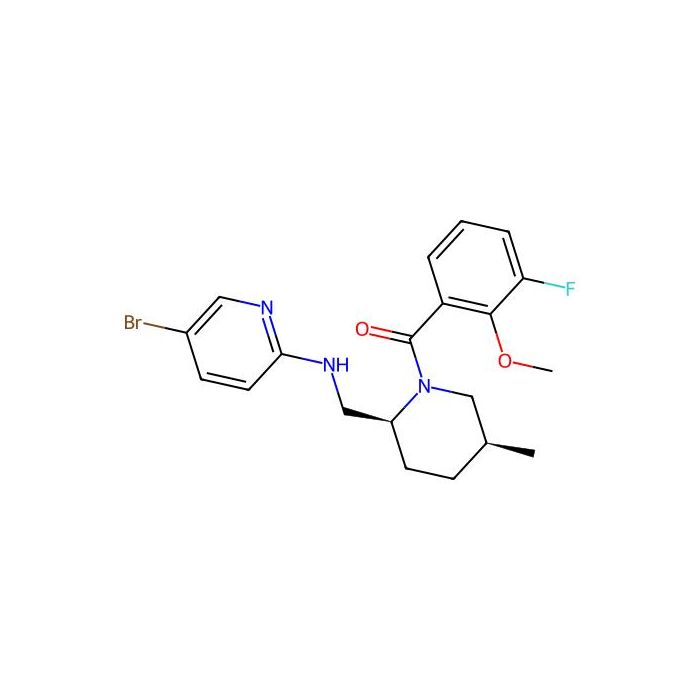
GSK1059865 - Moligand™,10mM in DMSO , CAS No.1191044-58-2

CAS: 1191044-58-2 Cat. No.: G654590 Fórmula: C20H23BrFN3O2 Peso molecular: 436.33 PubChem CID: 44463491
Disponível para encomenda
GRAU & PUREZA Moligand™ ? Moligand™ — Aladdin's line of ligands and bioactive small molecules. Use for receptor, pathway, and binding studies needing defined small-molecule tools. 10mM in DMSO
Storage
Store at -80°C
Shipped In
Dry ice packs + Cold packs
★
Tamanho
Alemanha (EU)
USA*
Preço
Qtd
1ml
G654590-1ml
Sob encomenda · 8–12 semanas
152,64€
Enter a quantity for the sizes you want to add.

Visão geral

GSK1059865 is a potent orexin 1 receptor antagonist.

In Vivo

Treatment with GSK1059865 significantly decreases ethanol drinking in a dose-dependent manner in CIE-exposed mice. In contrast GSK1059865 decreases drinking in air-exposed mice only at the highest dose used. There is no effect of GSK1059865 on sucrose intake . GSK1059865 (0.3 nM-10 nM) produces non-surmountable antagonism with a dose-dependent rightward shift of the OXA EC 50 and a concomitant decrease of the agonist maximal response. The calculated pK B value is 8.77±0.12 for GSK1059865. GSK1059865 (0.1-3.3 μM) produces a classical surmountable profile with parallel rightward shift of the OXA EC 50 without depression of the agonist maximal response. Intraperitoneal administration of GSK1059865 produces a region-dependent inhibition of yohimbine-induced relative cerebral blood volume response. The administration of GSK1059865 per se produces a weak relative cerebral blood volume increase in several brain regions. GSK1059865-pretreated animals exhibit slightly higher baseline mean arterial blood pressure values than controls. MCE has not independently confirmed the accuracy of these methods. They are for reference only.

IC50& Target:Orexin 1 receptor

Especificações

Especificações e pureza
Moligand™,10mM in DMSO
Mecanismos bioquímicos e fisiológicos
GSK1059865 is a potent orexin 1 receptor antagonist.
Condições de armazenamento de armazenamento
Store at -80°C
Enviado em
Dry ice packs + Cold packs
Este produto requer transporte de cadeia fria. Serviços terrestres e outros serviços econômicos não estão disponíveis.
Grau
Moligand™
Tipo de ação
ANTAGONIST
Nomes e identificadores
SMILES isoméricas
C[C@H]1CC[C@H](N(C1)C(=O)C2=C(C(=CC=C2)F)OC)CNC3=NC=C(C=C3)Br
PubChem CID
44463491
Peso molecular
436.33

Dados avançados

Alvos associados (humanos)
HCRTR1 Tclin Orexin receptor type 1 (0 Activities)
Activity TypeActivity Value -log(M)Mechanism of ActionActivity ReferencePublications (PubMed IDs)
HCRTR2 Tclin Orexin receptor type 2 (0 Activities)
Activity TypeActivity Value -log(M)Mechanism of ActionActivity ReferencePublications (PubMed IDs)
Certificados(CoA,COO,BSE/TSE e Mapa de Análise)
C of A & Other Certificates(BSE/TSE, COO):
Analytical Chart:
Calculadoras de soluções
Revisões

Avaliações dos Clientes

Application Protocols

No item-specific, validated application protocols are provided in this listing. The following general procedures are commonly used for small-molecule screening ligands:

Stock preparation and plating (general):

  • Warm vial in a desiccator to ambient temperature before opening to avoid condensation.
  • Prepare a 10–50 mM stock in anhydrous DMSO; record concentration precisely using gravimetric or volumetric methods.
  • Aliquot into low-bind tubes/plates (amber if light-sensitive) to single-use volumes; seal to prevent DMSO water uptake.

Assay dilution:

  • Dilute into assay buffer/media to achieve final DMSO of ≤0.1–1% v/v, confirmed to be tolerated by the assay system.
  • For serial dilutions, use intermediate DMSO stocks to maintain constant organic content across wells.

Controls and QC:

  • Include vehicle controls (matching DMSO), positive controls (mechanistically orthogonal when possible), and negative controls.
  • Verify compound integrity by LC–MS at start/end of campaign; monitor for degradation or adsorption losses.

Data integrity:

  • Track lot number, stock concentration, preparation date, and freeze–thaw history.

For any target-specific assay setup (e.g., enzyme kinetics, receptor binding), follow validated lab SOPs and consult the literature for conditions appropriate to the biological system under study.

Biological Roles

No specific biological function, pathway association, or target annotation is provided in this listing for GSK1059865.

General context for small-molecule research ligands:

  • Such compounds are used as chemical probes or tool molecules to interrogate biological pathways, enzymes, ion channels, transporters, or receptors in vitro or in cells.
  • Interpretation of phenotypic outcomes requires orthogonal validation (e.g., genetic knockdown/CRISPR, independent chemotypes) to mitigate off-target artifacts.
  • For cellular assays, monitor cytotoxicity (e.g., CellTiter-Glo, resazurin) alongside primary readouts to distinguish on-target effects from nonspecific perturbation.

Data needs before assigning roles:

  • Confirmed target(s), potency, and selectivity profile.
  • Permeability and efflux behavior (e.g., PAMPA, Caco-2) if cellular activity is sought.
  • Chemical stability in assay medium and metabolic stability in relevant fractions.

Until such data are established for the specific lot and use-case, GSK1059865 should be treated as a research compound with undefined biological roles. For any claims about mechanism or target, consult primary literature or internal profiling data.

Buffer Applications

This product is a small-molecule research ligand rather than a buffering agent. It does not define a pH regime or buffering capacity.

Practical guidance related to buffers (general):

  • Prepare compound stocks in DMSO, then dilute into assay buffers (e.g., HEPES, PBS, Tris) ensuring final DMSO levels are acceptable (commonly ≤0.1–1% v/v).
  • For ionizable compounds, modest pH adjustments or salt formation may improve aqueous solubility; verify chemical stability by LC–MS.

If a buffer recipe or specific pH stability profile is required, consult the CoA or perform a small-scale pH–stability screen (e.g., pH 5–9) under assay-relevant conditions.

Green Alternatives

As GSK1059865 is a screening ligand (not a process solvent or bulk reagent), “green alternatives” primarily relate to solvent and workflow choices rather than replacing the molecule itself.

Greener solvent strategies (general):

  • Prefer water-buffer systems with minimal DMSO when assay tolerance allows.
  • Use ethanol or 2-propanol as co-solvents instead of DMF/NMP when compatible with the assay and compound stability.
  • Consider biobased solvents such as Cyrene (dihydrolevoglucosenone) or 2-MeTHF for sample processing/extraction steps if compatible with the compound and analytics.

Illustrative comparison (general, not item-specific specs):

  • DMSO: Excellent solvency; broadly assay-compatible; good EHS profile but high COD in wastewater.
  • DMF/NMP: Strong solvency; regulatory scrutiny and worker exposure concerns—avoid if possible in routine screening.
  • Ethanol: Renewable routes available; good EHS; may affect membrane permeability in cells—validate concentrations.
  • Water (buffered): Ideal green medium; enable by salt formation or pH adjustment for ionizable compounds.

Operational improvements:

  • Miniaturize assays (low-volume plates) to reduce solvent consumption.
  • Use sealed plates to minimize VOC emissions and DMSO uptake of water.
  • Implement solvent recycling for analytical HPLC/UPLC where feasible.

Note: Compound replacement is usually not applicable for screening libraries; sustainability gains are driven by solvent choice, scale minimization, and waste management.

Pharmaceutical Uses

For research use only. Not for human or veterinary use.

Context for discovery and development workflows (general, not item-specific claims):

  • May serve as a reference or internal standard in analytical method development supporting medicinal chemistry programs.
  • Can be used in pre-formulation research (e.g., solubility screening in biorelevant media, pH–solubility profiling) to inform structure–property relationships during lead optimization.
  • Useful as a control article in in vitro pharmacology panels and selectivity profiling.

Not indicated as:

  • An active pharmaceutical ingredient (API), excipient, or GMP material.
  • A clinical-grade standard or material compliant with pharmacopeial monographs.

If GLP or regulated use is contemplated, obtain full characterization data (CoA, stability, impurity profile) and qualify the material per institutional SOPs.

Physical Properties

Item-specific measured properties:

  • Appearance: Not specified for this item; refer to CoA/Spec Sheet.
  • Molecular Weight (exact): Not specified for this item; refer to CoA/Spec Sheet.

Literature/computed data:

  • No peer-reviewed or database physical constants are summarized here because structural identifiers are not provided in this listing. Typical values such as melting point, logP, pKa, and solubility are highly structure-dependent and should not be inferred.

General expectations for small-molecule screening compounds (context, not item-specific specifications):

  • Solubility: Many screening ligands are soluble in DMSO at 10–50 mM stock concentrations; aqueous solubility varies widely with ionization state and substituents.
  • Form: Usually supplied as a solid or concentrate suitable for DMSO stock preparation; hygroscopicity and polymorph may vary.
  • Stability: Most small molecules are stable as dry solids when protected from moisture, light, and heat; hydrolytically or photolabile motifs (if present) would require additional care. Confirm with SDS/CoA.

Important: For any quantitative physical property (bp, mp, density, refractive index, UV cutoff, water/peroxide content, metal limits), this listing does not include item-specific values. Always consult the CoA/Spec Sheet for definitive specifications.

Quality and Grades
  • Grade/Purity: Moligand™ (item-specific)

What Moligand™ generally implies (context, not a guarantee of specific numbers):

  • Research screening ligand suitable for biochemical, cellular, or target-based assays.
  • Emphasis on identity confirmation (e.g., LC–MS/HRMS, 1H NMR) and assay-ready handling characteristics (e.g., compatibility with DMSO stock preparation). Exact tests and acceptance criteria are defined per lot.
  • Typical catalog expectations include high chemical purity and low residual solvents/metals appropriate for discovery research; however, exact purity %, water content, or residual limits are not provided here.

Item-specific details not listed in this record:

  • Assay method(s) and purity specification: Not specified for this item; refer to CoA/Spec Sheet.
  • Stabilizers/inhibitors: Not specified for this item; refer to CoA/Spec Sheet.
  • UV/LC characteristics for HPLC detection (cutoff, λmax): Not specified for this item; refer to CoA/Spec Sheet.

Practical notes for users:

  • Verify identity and purity from the CoA prior to use in critical studies.
  • For SAR or screening campaigns, prepare fresh DMSO stocks and record lot numbers to ensure traceability.
  • If low-UV absorbance or special impurity limits are required (e.g., for LC method development), contact technical support for lot-specific data.
Reaction and Applications

Primary intent: GSK1059865 (Moligand™) is offered as a research ligand/compound for discovery workflows rather than as a synthetic reagent.

Typical applications (general, discovery-focused):

  • Biochemical assays: Enzyme or receptor binding/functional assays to probe target engagement; evaluation of IC50/Ki/EC50 where applicable.
  • Cell-based assays: Phenotypic screens, pathway modulation, or target validation at carefully controlled DMSO concentrations.
  • ADME/Tox studies: Preliminary assessment of solubility, microsomal stability, permeability, or protein binding (where permitted by internal workflows).
  • Analytical reference: Use as a reference material for LC–MS/MS method development, retention time markers, or as a spike-in standard (with in-house qualification).

Not positioned for: Stoichiometric reagent roles (e.g., bases, oxidants, coupling reagents) or as a monomer/building block in synthesis unless independently validated.

Practical tips:

  • Establish stock stability in DMSO by short-term LC–MS monitoring (e.g., 0 and 24–72 h at ambient and 4°C).
  • Minimize freeze–thaw cycles; aliquot single-use volumes.
  • Record exact lot, preparation date, and dilution scheme for data integrity.

Important: Any specific biological target(s), mechanism(s) of action, or activity profiles for GSK1059865 are not provided in this listing. Users should consult primary literature or in-house profiling data before assigning mechanistic interpretations.

Reaction Conditions

This product is not sold as a reagent for chemical transformations; therefore, there are no item-specific reaction conditions to report.

If derivatization or analog generation is intended (general guidance only):

  • Solvents: Use dry polar aprotics (DMF/DMSO/MeCN) or green alternatives (2-MeTHF, aqueous micellar media) as compatible with the functional groups.
  • Atmosphere: Inert gas (N2/Ar) for air- or moisture-sensitive steps.
  • Temperatures: Typically 0–120°C depending on transformation; confirm thermal stability by DSC/TGA or by analytical monitoring.
  • Catalysis: Standard cross-coupling catalysts (Pd, Ni), amide couplings (carbodiimides, uronium reagents), or reductive aminations may apply only if corresponding handles exist in the structure.
  • Workup/purification: Silica gel chromatography, preparative HPLC for closely eluting impurities; confirm identity/purity by NMR and LC–MS.

Because the exact functional groups of GSK1059865 are not specified here, any reaction condition must be validated experimentally on small scale before scale-up.

Safety and Handling

Authoritative safety information is provided in the product SDS. The following is general laboratory guidance for small-molecule research ligands.

  • GHS/CLP classification: Not specified for this item; refer to SDS for signal word, hazard statements, and pictograms.
  • Primary hazards (general): Small organic molecules may present irritation, sensitization, or systemic toxicity hazards upon inhalation, ingestion, or skin/eye contact. Avoid aerosol generation and dust formation.
  • PPE: Laboratory coat, safety glasses with side shields, and appropriate chemically resistant gloves (e.g., nitrile). Use a certified chemical fume hood for weighing, dissolution, and aliquoting.
  • Engineering controls: Conduct manipulations in a fume hood; employ local exhaust during powder handling. Use a balance enclosure if available.
  • Storage incompatibilities: Until the structure is verified, segregate from strong oxidizers, strong acids/bases, and reactive metals. Protect from moisture and light unless the CoA indicates otherwise.
  • Thermal/light sensitivity: Store as directed below (−80°C). Warm only briefly to prepare aliquots; refreeze promptly.
  • First aid (general): In case of skin/eye contact, rinse with water for ≥15 minutes and seek medical attention. If inhaled, move to fresh air; if swallowed, rinse mouth and seek medical attention. Provide SDS to responders.
  • Spill & disposal: Avoid dust; collect with damp disposable towels or HEPA vacuum. Dispose of waste according to local regulations and the SDS.

Always defer to the product-specific SDS for definitive hazard classifications and first-aid measures.

Solvent Selection

Because structure-specific polarity and ionization are not provided in this listing, solvent recommendations are given as general best practices for small-molecule screening ligands.

  • Primary stock solvent: Dimethyl sulfoxide (DMSO) is the default for assay stocks due to broad solvating power and compatibility with biochemical/cell assays at ≤0.1–1% v/v final concentrations.
  • Secondary solvents for co-solubilization (general):
    • DMF or NMP for difficult-to-dissolve compounds (small volumes only; assess assay tolerance).
    • Ethanol or methanol for mixed aqueous-organic systems (evaluate protein compatibility).
    • Aqueous buffers adjusted for ionizable compounds (if pKa supports salt formation); consider adding 0.1–1% DMSO or 0.01% surfactant where appropriate.
  • Miscibility and polarity (general context): DMSO is miscible with water and most organics; DMF/NMP are polar aprotics; MeOH/EtOH are protic and water-miscible. Choose based on assay tolerance and compound stability.
  • Solubilization workflow (practical):
    1. Warm vial to ambient in a desiccator to avoid condensation.
    2. Prepare a 10–50 mM DMSO stock as a starting point.
    3. If insoluble, briefly sonicate or use gentle heating (<40°C) and consider co-solvent blends.
    4. Filter through 0.2 µm PTFE/nylon if particulate persists (check adsorption losses).
  • Avoid: High pH/strong base or strong acid unless stability is verified by LC–MS; prolonged heating; freeze–thaw cycles of DMSO stocks.

Note: For solvent cutoffs, pKa-dependent strategies, and long-term stability, consult the CoA and run a quick solubility/stability check by analytical HPLC or LC–MS.

Storage and Reconstitution

Item-specific conditions:

  • Storage Conditions: Store at −80°C (item-specific).
  • Shipped In: Dry ice packs + Cold packs (item-specific).

General best practices for small-molecule screening ligands:

  • Upon receipt: Keep sealed and frozen until equilibrated to −20 to −80°C storage. Avoid condensation by allowing the sealed container to warm to room temperature in a desiccator before opening.
  • Solid storage: If supplied as a solid, store desiccated, protected from light, at −20 to −80°C as indicated. Reseal promptly under dry inert gas if possible.
  • Solution storage: For DMSO stocks, prepare single-use aliquots (e.g., 10–50 mM) in low-bind tubes. Store at −80°C for long term; avoid repeated freeze–thaw cycles. For working stocks at −20°C, limit to short-term use (days to weeks) and verify stability by LC–MS.
  • Reconstitution (general):
    1. Thaw vial on ice or at room temperature briefly.
    2. Add dry DMSO to achieve desired molarity; gently vortex/sonicate to dissolve.
    3. If needed, adjust with co-solvent or buffer after confirming stability.
  • Stability notes: Actual shelf-life, light sensitivity, and aqueous stability are structure-dependent and not provided here. Confirm by analytical testing (HPLC/LC–MS) under your storage conditions.

Always refer to the lot-specific CoA and SDS for definitive guidance on storage, reconstitution, and stability.

Structure and Identity

Brief overview: GSK1059865 is a cataloged small-molecule research ligand from the Moligand™ collection intended for screening and chemical biology.

  • SKU: G654590
  • Product Name: GSK1059865
  • CAS: 1191044-58-2 (item-specific)
  • PubChem CID: 44463491 (item-specific)
  • InChIKey: Not specified for this item; refer to CoA/Spec Sheet.
  • SMILES: Not specified for this item; refer to CoA/Spec Sheet.
  • Molecular Formula: Not specified for this item; refer to CoA/Spec Sheet.
  • Molecular Weight: Not specified for this item; refer to CoA/Spec Sheet.

Structural features (general, based on compound type):

  • This product is supplied as a defined small molecule for screening; specific ring systems, functional groups, stereochemistry, and tautomeric state are not provided in the current listing. Consult the CoA/SDS for definitive structural identifiers.

2D structure description (general guidance):

  • Without SMILES/InChI, a precise 2D description cannot be provided here. For accurate depiction and atom-level features (aromaticity, heteroatom placement, protonation sites), please refer to the structure file associated with the CoA or a trusted database using the provided CAS or CID.
Synthetic Utility

GSK1059865 is supplied as a finished small-molecule ligand for screening and is not positioned as a general-purpose synthetic building block or reagent.

General considerations (when repurposing, not item-specific):

  • If functional handles (e.g., aryl halides, boronates, amines, acids) are present, derivatization for SAR expansion may be possible; however, the specific functional groups are not provided in this listing.
  • Before attempting transformations, confirm structure and purity and assess stability toward standard conditions (e.g., bases, acids, oxidants, metal-catalyzed couplings) via micro-scale tests.
  • For analog synthesis, develop concise protecting-group strategies consistent with any sensitive motifs identified in the CoA/structure file.

Primary value in most programs: As a comparator/control compound within a chemotype series, enabling benchmarking of potency, selectivity, and ADME against new analogs synthesized in-house.

Target Specificity

No target, pathway, or selectivity data are provided in this listing for GSK1059865.

  • Target/epitope: Not specified for this item; refer to CoA/Spec Sheet or primary literature.
  • Species reactivity/ortholog coverage: Not applicable without defined target information.
  • Assay-validated applications (e.g., enzyme class, receptor subtype): Not specified for this item.

Users are advised to verify intended target specificity using orthogonal assays and to consult published reports (if available) via the provided CAS (1191044-58-2) or CID (44463491).

Perguntas frequentes

What is Moligand??
Moligand? is one of Aladdin Scientific's premium product lines, formulated for high-purity applications across multiple workflows. Compared to standard grades in the same workflow, Moligand? products typically offer tighter specifications, more rigorous QC, and stronger lot-to-lot consistency.
How should this product be stored?
Store at ?80 °C. Ultra-low temperature storage is required to maintain the specified shelf life.
How is this product shipped?
This product ships frozen with dry ice and cold packs. Unpack on arrival and transfer it to the storage condition stated above; handle dry ice with insulated gloves in a ventilated area.
What are the CAS number, molecular formula and molecular weight?
The CAS Number is 1191044-58-2, the molecular formula is C20H23BrFN3O2, and the molecular weight is 436.33 g/mol.
What documentation is provided?
Available product documentation, including Certificates of Analysis (COA), Safety Data Sheets (SDS), and specification sheets, is shown in the product document area. Document availability and access follow the current site policy.

Precisa de ajuda para escolher o grau?

O nosso guia de seleção de graus abrange pureza, estado do estabilizador e adequação à aplicação para todas as variantes do nosso catálogo.

Ver o guia de graus Moligand™ →

Deseja que lhe enviemos uma mensagem quando tivermos descontos disponíveis?

Lembrar-me mais tarde

Obrigado! Por favor, verifique a sua caixa de entrada de e-mail para confirmar.

Ops! As notificações estão desativadas.