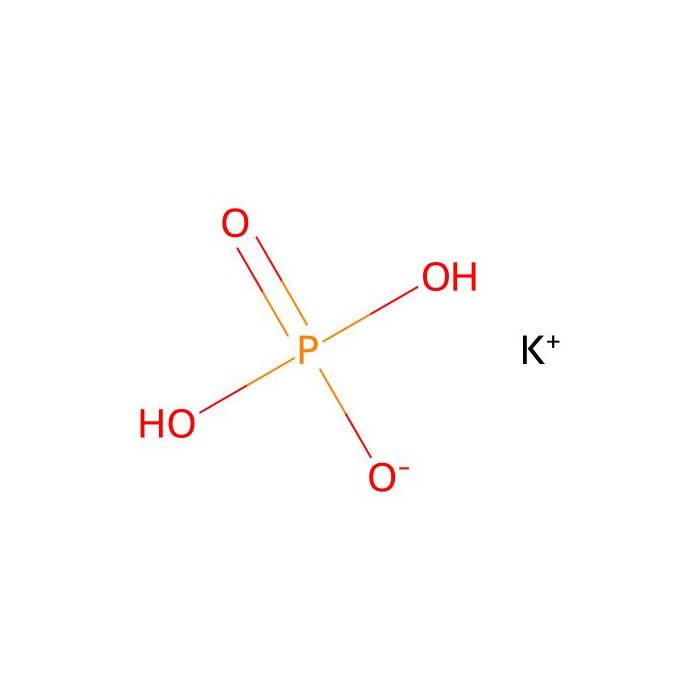
Potassium phosphate monobasic - Anhydrous Grade, UltraBio™, Suitable for molecular biology, ≥99.5%(T) , CAS No.7778-77-0

CAS: 7778-77-0 Cat. No.: P755761 Fórmula: KH2PO4 Peso molecular: 136.09 Número CE: 231-913-4
Disponível para encomenda
GRADE & PURITY Anhydrous Grade ? Anhydrous grade — water removed and packaged dry for moisture-sensitive chemistry. Use in reactions where even trace water would interfere or quench. Suitable for molecular biology ? Molecular-biology grade — free of nucleases and contaminants that degrade DNA/RNA. Use in cloning, PCR, and nucleic-acid work needing clean reagents. UltraBio™ ? UltraBio™ — Aladdin's line for molecular-biology applications. Use for nuclease-free, high-consistency reagents across molecular workflows. ≥99.5%(T)
Synonyms
2-chloromethyl-4-methoxy-3,5-dimethyl-pyridine HCl | Potassium Dihydrogen Phosphate,(S) | POTASSIUM PHOSPHATE, MONOBASIC COMPONENT OF TIS-U-SOL | POTASSIUM PHOSPHATE, MONOBASIC [MI] | Monopotassium dihydrogen orthophosphate
Storage
Room temperature
Shipped In
Normal
★
Size
Alemanha (EU)
USA*
Price
Qty
100g
P755761-100g
Sob encomenda · 8–12 semanas
138,75€
500g
P755761-500g
Sob encomenda · 8–12 semanas
402,54€
Enter a quantity for the sizes you want to add.
🧪
Why this grade

Anhydrous Grade, UltraBio™, Suitable for molecular biology, ≥99.5%(T) Anhydrous Grade,Suitable for molecular biology,UltraBio™ for sensitive chromatographic and analytical workflows requiring minimal baseline interference.

🌡

Storage & shipping

Room temperature Ships Normal Check lot-specific COA for exact specifications.

📋

Quality documents

SDS, COA, datasheet, and spec sheet available for download. Lot-specific COA accessible via lot number lookup.

📚

Literature proof

Cited in 994 peer-reviewed publications across chromatography, organic synthesis, and cross-coupling reactions.

Visão geral

Potassium phosphate monobasic and dibasic, are used to create phosphate buffered solutions such as potassium phosphate buffered water and saline solutions used in biological applications.

Specifications

Sinónimos
2-chloromethyl-4-methoxy-3,5-dimethyl-pyridine HCl | Potassium Dihydrogen Phosphate,(S) | POTASSIUM PHOSPHATE, MONOBASIC COMPONENT OF TIS-U-SOL | POTASSIUM PHOSPHATE, MONOBASIC [MI] | Monopotassium dihydrogen orthophosphate
Especificações e pureza
Anhydrous Grade, UltraBio™, Suitable for molecular biology, ≥99.5%(T)
Condições de armazenamento de armazenamento
Room temperature
Enviado em
Normal
Grau
Anhydrous Grade, Suitable for molecular biology, UltraBio™
Pureza
≥99.5%(T)
Nomes e identificadores
PH4.0-4.5 (25 °C, 1 M in H 2 O)
Sorrisos canónicosOP(=O)(O)[O-].[K+]
IUPAC Namepotassium;dihydrogen phosphate
InChIKeyGNSKLFRGEWLPPA-UHFFFAOYSA-M
INCHI1S/K.H3O4P/c;1-5(2,3)4/h;(H3,1,2,3,4)/q+1;/p-1
SMILES isoméricas OP(=O)(O)[O-].[K+]
WGK Alemanha 2
RTECS TC6615500
Peso molecular 136.09
Reaxy-Rn 11343563
Reaxys-RN_link_address https://www.reaxys.com/reaxys/secured/hopinto.do?context=S&query=IDE.XRN=11343563&ln=

Documentation

📋 Safety Data Sheet (SDS)

Comprehensive hazard, handling, storage, and regulatory compliance document.

Download SDS →

✅ Certificate of Analysis (COA)

Lot-specific quality data. Enter your lot number to retrieve the exact COA.

Look up COA →

📊 Datasheet

Quick-reference summary of product specifications and applications.

View datasheet →

🔬 Specification Sheet

Full quality attributes and acceptance criteria for this grade.

View spec sheet →

Advanced Data

Taxonomic Classification

Taxonomy Tree

KingdomInorganic compounds
SuperclassMixed metal/non-metal compounds
ClasseAlkali metal oxoanionic compounds
SubclassAlkali metal phosphates
Intermediate Tree Nodes Not available
Direct ParentAlkali metal phosphates
Alternative Parents Inorganic salts  Inorganic oxides  
Molecular FrameworkNot available
Substituents Alkali metal phosphate - Inorganic oxide - Inorganic salt
DescriçãoThis compound belongs to the class of inorganic compounds known as alkali metal phosphates. These are inorganic compounds in which the largest oxoanion is phosphate, and in which the heaviest atom not in an oxoanion is an alkali metal.
External Descriptors potassium salt - inorganic phosphate
Estrutura 3D
Modelo de Estrutura Química Interativa


Certificados(CoA,COO,BSE/TSE e Mapa de Análise)
C of A & Other Certificates(BSE/TSE, COO):
Analytical Chart:
Propriedades químicas e físicas
SolubilidadeH 2 O: 1 M at 20 °C, clear, colorless
Ponto de fusão (°C)252.6 °C
Peso molecular136.086 g/mol
XLogP3
Hydrogen Bond Donor Count2
Hydrogen Bond Acceptor Count4
Rotatable Bond Count0
Exact Mass135.933 Da
Monoisotopic Mass135.933 Da
Topological Polar Surface Area80.600 Ų
Heavy Atom Count6
Formal Charge0
Complexity61.900
Isotope Atom Count0
Defined Atom Stereocenter Count0
Undefined Atom Stereocenter Count0
Defined Bond Stereocenter Count0
Undefined Bond Stereocenter Count0
The total count of all stereochemical bonds0
Covalently-Bonded Unit Count2
FAQs e artigos
UltraBio™: Defining Excellence in Molecular Biology Applications
Molecular Biology Grade
The Guide to Anhydrous Grade for Reagents
Common Types of Buffer Solutions
Operational Guide for Fluorescent Labeling of Antibodies Using AF594 NHS Ester
General Principles of Antibody Labeling with NHS-Activated Esters, F/P Calculation, and Troubleshooting Guide
Mag-Fluo-4 AM Magnesium/Calcium Ion Fluorescent Probe: Properties, Experimental Use, and Aladdin Metal Ion Fluorescent Probe Selection Guide
How to Choose a Hydrogen Evolution (HER) Catalyst: Kinetic Barriers in Water Electrolysis, AWE/PEM/AEM Pathways, and a Materials-Family Roadmap (with a Product Map)
Installing a Redox Switch on Biomolecules: Principles, Conjugation Essentials, and an Application Guide for ATTO MB2 NHS ester
Brassinolide Plant Growth Regulator: Mechanism of Action, Application Scenarios, and Use Practices
A Review of Ten Commonly Used Techniques for Detection, Quantification, and Interaction Analysis in Nucleic Acid Research
Selection of Common Research Salts: A Task Map for Alkali Metal Salts & Alkaline Earth Metal Salts (with Product Tables 1–6)
Optical & Optoelectronic Materials Selection Guide:Positioning materials, key metrics, and validation paths along “Generation → Guiding → Control → Readout” (with product navigation and Tables 1–4)
Methodological essentials for mineralization visualization: Alizarin Red S staining vs. Von Kossa silver staining
Glucose Content Determination: A Systematic Review of Detection Principles, Method Validation, and Research Application Frameworks
Phytase: Enzymological Properties, Mechanism of Action, and Applications in Feed and Food
Selection Strategy for PBS, TBS, PBST, and TBST Washing Systems in IHC
Practical Guide to TSA Tyramide Signal Amplification: How to Select Reagents, Optimize the Workflow, and Reduce Background When Detection Signals Are Weak for Low-Abundance Targets
Signal Transduction Mechanism of Graphene Biosensors: From Molecular Recognition to Electrical/Optical Signal Readout and Materials Selection
What Is Synthetic Biology? The Industrialization Pathway from Upstream Reagent Toolchains to Biomanufacturing Applications
Design Logic of Fluorinated 3,3-Disubstituted Oxetane Building Blocks: Structural Construction and Modulation of Amine Basicity, Lipophilicity, and Metabolic Stability
Citations of This Product
Calculadoras de soluções
Revisões

Avaliações dos Clientes

Perguntas frequentes

What are the CAS number, molecular formula and molecular weight?
The CAS Number is 7778-77-0, the molecular formula is KH2PO4, and the molecular weight is 136.09 g/mol. InChIKey GNSKLFRGEWLPPA-UHFFFAOYSA-M.
How is this product shipped?
This product ships under standard ambient conditions. No temperature-controlled packaging is required.
What does UltraBio? mean?
UltraBio? indicates that the product has been processed and tested for biological and biochemical applications. Specifications may include endotoxin limits, microbial controls, sterility, low DNase/RNase/protease activity, and verified biological activity where relevant.
What does Anhydrous Grade mean?
Anhydrous Grade indicates that the material has been processed and tested for moisture-sensitive chemistry. Specifications focus on the impurities that affect performance in that application — for example, metal content for electronics, particle size for batteries, refractive index for optics, or moisture content for moisture-sensitive processes.
How should this product be stored?
Store at room temperature.
What documentation is provided?
Available product documentation, including Certificates of Analysis (COA), Safety Data Sheets (SDS), and specification sheets, is shown in the product document area. Document availability and access follow the current site policy.

Need help choosing the grade?

Our grade selection guide covers purity, stabilizer status, and application suitability for all variants in our catalog.

View Anhydrous Grade grade guide → View Suitable for molecular biology grade guide → View UltraBio™ grade guide →

Shall we send you a message when we have discounts available?

Remind me later

Thank you! Please check your email inbox to confirm.

Oops! Notifications are disabled.