Recombinant DAP12 Antibody - Primary antibody, specific to DAP12, Rabbit IgG

Cat. No.: Ab099136
Disponível para encomenda
GRAU & PUREZA Recombinant ? Recombinant — produced via recombinant expression for defined sequence and consistency. Use for reproducible, animal-free proteins of known origin. ExactAb™ ? ExactAb™ — Aladdin's antibody line emphasizing precision and validated quality. Use for reliable, specificity-validated antibody applications. Validated ? Validated grade — performance confirmed in defined applications before release. Use when you want documented assurance the reagent works as stated. 1.1 mg/mL
Application
WB
Host species
Rabbit
Reactive species
Human
Isotype
Rabbit IgG
Conjugation
Unconjugated
★
Tamanho
Alemanha (EU)
USA*
Preço
Qtd
10μl
Ab099136-10μl
—
2 Em stock
86,69€
50μl
Ab099136-50μl
—
1 Em stock
225,53€
100μl
Ab099136-100μl
Sob encomenda · 8–12 semanas
364,36€
1ml
Ab099136-1ml
Sob encomenda · 8–12 semanas
2950,23€
Enter a quantity for the sizes you want to add.

Visão geral

Rabbit anti Human DAP12 Antibody, Recombinant, could be used for WB and so on.
Application
WB: 1/500-1/1000
Protein Function
Non-covalently associates with activating receptors of the CD300 family. Cross-linking of CD300-TYROBP complexes results in cellular activation.

Especificações

Product Name
Recombinant DAP12 Antibody - Primary antibody, specific to DAP12, Rabbit IgG
Sinónimos
DAP 12 antibody|DAP12 antibody|DNAX activation protein 12 antibody|DNAX-activation protein 12 antibody|KAR-associated protein antibody|KARAP antibody|Killer activating receptor associated protein antibody|Killer-activating receptor-associated protein antibody|PLOSL antibody|TYRO protein tyrosine kinase binding protein antibody|TYRO protein tyrosine kinase-binding protein antibody|TYROBP antibody|DAP12|DNAX-activation protein 12|KARAP|KARAPPLO-SL|KAR-associated protein|killer activating receptor associated protein|Killer-activating receptor-associated protein|TYRO protein tyrosine kinase binding protein|TYRO protein tyrosine kinase-binding protein|TYROBP
Especificações e pureza
ExactAb™, Validated, Recombinant, 1.1 mg/mL
Espécie hospedeira
Rabbit
Especificidade
DAP12
Imunogénio
A synthetic peptide derived from human DAP12 (AA 60-113)
Controlo positivo
WB: THP-1 cell lysate.
Conjugação
Unconjugated
Grau
ExactAb™, Recombinant, Validated
Isótipo
Rabbit IgG
Tipo de corrente de luz
kappa
SDS-PAGE
150 kDa
Método de purificação
Protein A purified
Concentração
1.1 mg/mL
Product Line
Produtos biológicos
Armazenamento e envio
Forma
Liquid
Condições de armazenamento de armazenamento
Store at -20°C,Avoid repeated freezing and thawing
Enviado em
Ice chest + Ice pads
Estabilidade e armazenamento
Store at 4℃ short term (1-2 weeks). Store at -20℃ long term (24 months). Upon receipt, it is recommended to aliquot. Avoid freeze/thaw cycle.
Imagens

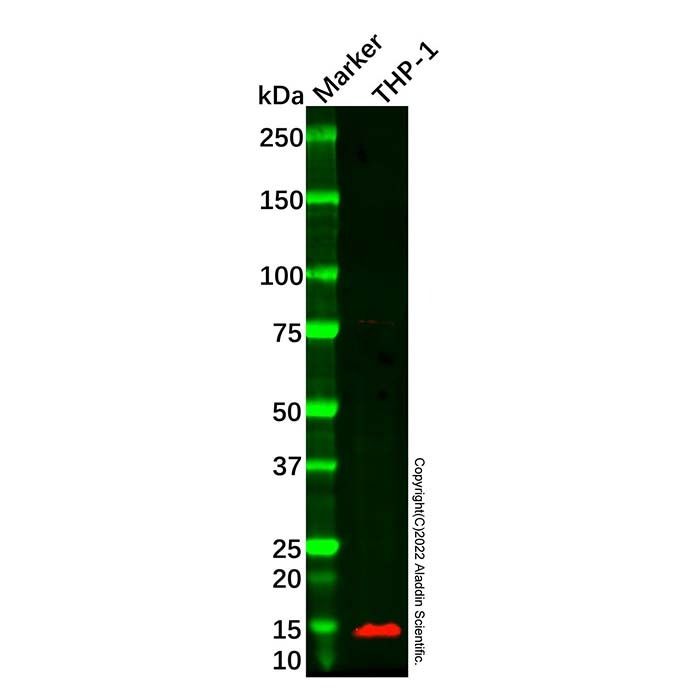
Recombinant DAP12 Antibody (Ab099136) - Western Blot
All lanes: Recombinant DAP12 Antibody (Ab099136) at 1/1000 dilution
Samples: Lysates at 20 µg per lane
Secondary: Goat Anti-Rabbit IgG H&L (HRP) (Ab170144) at 1/20000 dilution

Predicted band size: 12 kDa
Observed band size: 14 kDa
Exposure time: 10.0 s


Aplicação
Aplicação
Dilution info
WB

1/500-1/1000

Dados avançados

Alvos associados (humanos)
TYROBP Tbio TYRO protein tyrosine kinase-binding protein (0 Activities)
Activity TypeActivity Value -log(M)Mechanism of ActionActivity ReferencePublications (PubMed IDs)
Certificados(CoA,COO,BSE/TSE e Mapa de Análise)
C of A & Other Certificates(BSE/TSE, COO):
Analytical Chart:

Find and download the COA for your product by matching the lot number on the packaging.

2 results found

Lot NumberCertificate TypeDataItem
ZJ24F0708997ZJ24F0708997Certificate of AnalysisMay 21, 2026 Ab099136
ZJ24F0708998ZJ24F0708998Certificate of AnalysisMay 21, 2026 Ab099136
FAQs e artigos
Calculadoras de soluções
Revisões

Avaliações dos Clientes

Application Protocols

Item-specific tested applications, recommended dilutions, and sample preparation methods are not specified for this SKU. Consult the CoA/Spec Sheet for validated applications, if available.

General protocol considerations for antibody use (context only; not product claims):

  • ELISA: perform checkerboard titrations to establish optimal capture/detection concentrations; include appropriate blocking and wash conditions.
  • Immunoblot: optimize antibody dilution and membrane blocking; adjust lysis buffer for membrane-associated targets like DAP12 and consider reducing vs non-reducing conditions depending on epitope exposure.
  • Immunoprecipitation: titrate antibody-to-lysate ratios; preclear lysates; validate detergents that preserve DAP12 complexes without denaturing epitopes.
  • Sample controls: include positive biological controls where DAP12 expression is known and negative controls lacking target expression.

These suggestions are general and should be adapted only after confirming the item’s formulation and concentration.

Biological Roles

Focus on target biology (general literature context for DAP12; not product performance claims):

  • DAP12 is an immunoreceptor tyrosine-based activation motif (ITAM)-bearing adaptor protein localized to the membrane, where it pairs with various activating receptors in immune-lineage cells.
  • Upon receptor engagement, DAP12’s ITAM tyrosines can be phosphorylated, recruiting kinases and downstream signaling partners that modulate cellular activation programs.
  • DAP12-associated pathways contribute to regulation of phagocytic activity, adhesion, and cytokine signaling contexts in immune research models.

Implications for research use:

  • Detection or enrichment of DAP12 can help interrogate receptor-adaptor complex formation and signal transduction under defined stimuli.
  • Comparative studies across conditions (e.g., ligand exposure, genetic perturbation) may leverage antibody-based readouts to map pathway changes.

Notes:

  • The accessibility of DAP12 epitopes may differ between native membrane contexts and denatured protein in lysates; consider assay format accordingly.
  • This section summarizes general biology; it does not assert any validated application or performance for this specific SKU. Consult the CoA/Spec Sheet for any available validation data.
Buffer Applications

While not a buffering agent itself, an antibody’s performance is highly dependent on buffer choice. The following are general, practical considerations for antibody-based assays (not item-specific specifications):

  • Storage/working buffers: PBS or TBS at pH 7.2–7.6 are common. Inclusion of 0.01%–0.05% nonionic surfactant can reduce adsorption to plastics; 0.1%–1% protein blockers (BSA, casein) minimize nonspecific binding in assays.
  • Enzyme conjugates: for HRP-based detection, maintain peroxide-free buffers and include stabilizers compatible with peroxidase; avoid sodium azide, which inhibits HRP.
  • Amine-reactive conjugation: perform in amine-free buffers (e.g., 50–100 mM sodium phosphate, pH 7.2–7.4). For thiol coupling, use buffers without EDTA-sensitive metals and with controlled reducing conditions.
  • Sample prep: for membrane proteins like DAP12, lysis buffers may require mild detergents (e.g., 0.1%–1% NP-40 or digitonin) to preserve complexes for immunoprecipitation; optimize to balance solubilization and epitope integrity.
  • pH range considerations: most antibodies retain binding near neutral pH; extreme pH or high ionic strength can reduce affinity or increase aggregation.

Item-specific buffer composition for this SKU is not provided here; verify formulation and any preservatives in the CoA/Spec Sheet before adapting buffers.

Green Alternatives

Antibody reagents generally pose lower environmental hazards than many organic solvents or heavy-metal catalysts; the main sustainability considerations involve cold-chain logistics, buffer components, and preservatives.

Greener practice suggestions (general):

  • Shipping/storage: consolidate orders to reduce cold-chain shipments; use reusable cold packs when feasible.
  • Buffer systems: employ phosphate or HEPES buffers instead of volatile organic solvent systems. Avoid azide in waste streams that contact metals; consider thimerosal-free and azide-free formulations when compatible with your workflow.
  • Process minimization: optimize assay protocols to reduce antibody consumption (microplate miniaturization, efficient blocking) and minimize single-use plastics.
  • Regeneration and reuse: for affinity matrices coupled with antibody, validate mild regeneration buffers to extend column life and reduce waste.

Comparison (general context, not item-specific):

  • Organic solvent-based detection (e.g., chromogenic substrates requiring hazardous solvents) vs. aqueous fluorescent readouts: aqueous methods typically reduce VOC emissions and waste toxicity.

For any buffer exchange or preservative removal, consult the item’s CoA/Spec Sheet to maintain stability while pursuing greener practices.

Pharmaceutical Uses

Not a therapeutic product. This recombinant antibody is designated for research use only.

General roles of research antibodies in pharmaceutical R&D and manufacturing (context only):

  • Analytical reagents: capture/detection in ligand-binding assays, ELISA, and immunoassays supporting pharmacology and biomarker discovery.
  • Process development: reference reagents for assay qualification/validation in upstream or downstream development workflows.
  • Characterization: tools for target engagement studies, mechanism-of-action exploration, and quality control testing of biologics.

Compliance and documentation:

  • For use in regulated environments, obtain and review the lot-specific CoA/Spec Sheet and SDS. Confirm absence/presence of preservatives or animal-derived components per your quality system needs.
  • If low endotoxin or specific residual host cell protein thresholds are required, verify against item-specific certificates before use.

No clinical or diagnostic claims are made for this SKU; it is intended strictly for laboratory research.

Physical Properties

Item-specific properties:

  • Appearance: Not specified for this item; refer to CoA/Spec Sheet.
  • Concentration, buffer composition, preservative: Not specified for this item; refer to CoA/Spec Sheet.
  • pH, osmolality: Not specified for this item; refer to CoA/Spec Sheet.
  • Extinction coefficient (A280), purity by SDS-PAGE/HPLC: Not specified for this item; refer to CoA/Spec Sheet.

General/literature values for protein antibodies (context only; not item specifications):

  • Typical IgG molecular mass: ~150 kDa (literature), though recombinant formats may vary (e.g., scFv, Fab, Fc-fusion).
  • Isoelectric point (pI): commonly ~6–9 depending on sequence and glycosylation (literature).
  • Solubility: high in aqueous buffers (PBS, TBS) at neutral pH; sensitive to denaturants and extreme pH.
  • Stability: enhanced by protein stabilizers (e.g., sugars, polyols) and carrier proteins; avoid surfactant-free interfaces to reduce aggregation.
  • Temperature sensitivity: prolonged exposure to >4–8°C can reduce activity; freeze–thaw cycling accelerates aggregation.

Notes for users:

  • Because item-specific physicochemical constants are not provided here, verify concentration, buffer, and any additives from the product CoA/Spec Sheet before experimental design, especially for molar dosing, coating densities, or conjugation workflows.
Quality and Grades

Item-specific grade statements (from Product Data):

  • Grade/Purity: Recombinant, ExactAb™, Validated.

What these designations typically imply (general guidance; not a substitute for item CoA):

  • Recombinant: Produced from defined DNA constructs in controlled expression systems (e.g., mammalian or other cell lines), providing high lot-to-lot consistency in sequence and reducing batch variability associated with hybridoma or polyclonal production.
  • ExactAb™: Denotes a defined, sequence-controlled recombinant antibody platform emphasizing reproducibility. Consult the CoA/Spec Sheet for the exact expression host, format (IgG, Fab, scFv), and sequence specifics for this SKU.
  • Validated: Indicates internal quality control testing has been performed. The particular methods (e.g., antigen binding by ELISA, specificity by antigen competition, purity by SDS-PAGE/HPLC, endotoxin levels) are not listed here and should be confirmed in the CoA/Spec Sheet.

Practical implications for users:

  • Expect higher reproducibility between lots relative to conventional antibodies; still verify performance in your assay matrix.
  • If you require low endotoxin or formulation without preservatives for cell-based work, confirm these specifications in the CoA/Spec Sheet before use.
  • For critical assays, request or review validation data specific to your application and sample type.
Reaction and Applications

As a recombinant antibody, this product is not a reagent for chemical synthesis reactions. Its utility lies in immunodetection and binding-based research workflows.

Typical research application spaces (general guidance, not item-specific claims):

  • Plate-based binding: direct/indirect ELISA or antigen-capture formats to quantify DAP12-associated analytes after appropriate assay development.
  • Affinity capture/pulldown: immunoprecipitation or co-immunoprecipitation to study DAP12-containing complexes, provided the antibody binds native epitopes.
  • Localization studies: immunostaining of fixed samples if the epitope is preserved; suitability depends on format/epitope exposure.
  • Flow cytometry: possible for cell-surface or intracellular targets contingent on permeabilization and epitope accessibility.

Assay development notes (general):

  • Antigen context matters: DAP12 is a transmembrane adaptor; epitope exposure can differ between denaturing and native conditions. Validate the antibody in the specific application and sample preparation method you plan to use.
  • Controls: include isotype controls, antigen-blocking controls, and knockdown/knockout or overexpression samples where available.

Item-specific tested applications and dilutions are not specified for this SKU; consult the CoA/Spec Sheet.

Reaction Conditions

Not applicable to chemical reaction conditions.

General guidance for bioconjugation and assay setup (context only; not item-specific):

  • Amine coupling (e.g., NHS esters): 50–100 mM phosphate or bicarbonate buffer, pH 7.5–8.5, 30–120 min at 4–25°C; quench with Tris or ethanolamine. Avoid primary amines in the reaction buffer prior to coupling.
  • Thiol coupling (maleimide): generate free thiols by controlled reduction of hinge disulfides (mild TCEP or DTT), then react at pH 6.5–7.5 to favor thiol specificity; remove excess reductant before conjugation.
  • Immobilization to matrices (e.g., Protein A/G or activated resins): follow manufacturer’s instructions; confirm that antibody format (isotype/Fc presence) supports binding if using Protein A/G.

These are general literature conditions provided for context. Item-specific composition, concentration, and compatibility must be confirmed in the CoA/Spec Sheet before attempting any modification.

Safety and Handling

Hazard and classification (item-specific):

  • GHS classification, signal word, pictograms, H-statements: Not specified for this item; consult the product SDS for authoritative information.

General safety guidance for protein antibodies (good laboratory practice):

  • PPE: wear lab coat, appropriate gloves (nitrile) and safety glasses when handling solutions, lyophilizates, or frozen vials.
  • Avoid aerosol formation; open vials gently and centrifuge briefly to collect contents before first use.
  • Biological origin considerations: although recombinant antibodies are not infectious, treat all protein reagents as potentially bioactive; avoid ingestion and contact with skin/eyes.
  • Incompatibilities: avoid strong oxidizers, extremes of pH (<5 or >9 unless formulated accordingly), organic solvents, and high shear mixing that can denature proteins.
  • Freeze–thaw risk: repeated cycles promote aggregation and loss of binding; aliquot upon first thaw.

First-aid overview (general):

  • Skin/eye contact: rinse with water for several minutes; remove contaminated clothing; seek medical attention if irritation persists.
  • Inhalation of aerosols: move to fresh air; seek medical advice if symptoms occur.
  • Ingestion: rinse mouth; do not induce vomiting; seek medical attention.

Always defer to the current SDS for emergency measures, spill response, disposal recommendations, and transport classifications.

Solvent Selection

Not typically applicable. Antibodies are aqueous protein reagents rather than small-molecule solutes for organic synthesis.

Practical guidance (general):

  • Preferred medium: isotonic aqueous buffers (e.g., PBS, TBS) at neutral pH. Avoid organic solvents that promote denaturation (acetone, acetonitrile, methanol) unless used transiently for specialized protocols and validated for your antibody.
  • Additives: low concentrations of nonionic surfactants (e.g., 0.01%–0.05% Tween-20) may reduce nonspecific adsorption; confirm compatibility with your assay.
  • Conjugation workflows: for amine-reactive chemistries, avoid primary amines in buffers (no Tris or glycine); use phosphate or bicarbonate buffers. For thiol chemistries, avoid reducing agents unless intentionally controlling free thiols.

Always check the supplied buffer composition and any preservatives for this item in the CoA/Spec Sheet before buffer exchange or formulation changes.

Storage and Reconstitution

Item-specific storage/shipping (from Product Data):

  • Storage Conditions: Store at -20°C. Avoid repeated freezing and thawing.
  • Shipped In: Ice chest + ice pads.

Additional item-specific details (buffer composition, lyophilized vs. liquid, cryoprotectants, reconstitution solvent, aliquot recommendations) are not specified for this SKU; refer to the CoA/Spec Sheet.

General best practices (context only):

  • Upon receipt: inspect packaging temperature; record lot number. If frozen, place immediately at -20°C. For long-term storage, -80°C is often beneficial if compatible with formulation.
  • Aliquoting: if supplied in liquid form, thaw on ice once, mix gently (avoid vortexing), and prepare single-use aliquots to minimize freeze–thaw. Snap-freeze aliquots and store at -20°C or below.
  • Reconstitution (if lyophilized): reconstitute with sterile, neutral pH buffer (e.g., PBS) to the recommended concentration in the CoA; allow to dissolve gently on ice. Avoid repeated needle passes that introduce shear.
  • Handling: keep on ice during use; avoid prolonged exposure to room temperature. Use low-bind tubes and tips to reduce adsorption.
  • Stability monitoring: track performance over time with internal controls; discard if precipitation, turbidity, or loss of activity is observed.
Structure and Identity

This listing is a recombinant research antibody directed against the DAP12 antigen.

  • SKU: Ab099136
  • Product name: Recombinant DAP12 Antibody
  • Category: Antibody (research use only)
  • Antigen/Target: DAP12

Item-specific identifiers (from Product Data):

  • CAS: Not specified for this item; refer to CoA/Spec Sheet.
  • Molecular formula: Not specified for this item; refer to CoA/Spec Sheet.
  • Molecular weight: Not specified for this item; refer to CoA/Spec Sheet.
  • SMILES / InChIKey / CID: Not applicable for protein antibodies.

General structural notes (literature/general knowledge):

  • Antibodies are Y-shaped immunoglobulin proteins composed of two heavy and two light polypeptide chains stabilized by disulfide bonds.
  • Recombinant antibodies are produced from defined gene sequences in cell culture, yielding consistent primary structure and glycosylation profiles controlled by the expression system.
  • If the format is IgG, typical domain architecture includes variable (V) regions that confer antigen specificity and constant (C) regions that define isotype; however, the specific format/isotype for this item is not specified.
Synthetic Utility

Not applicable. Antibodies are not used as small-molecule building blocks or reagents in chemical synthesis.

Relevant alternative perspective (general):

  • In biochemical workflows, antibodies can serve as affinity reagents for purification or detection rather than synthetic transformations. For chemical conjugation (e.g., to enzymes, fluorophores, or solid supports), standard bioconjugation chemistries (amine- or thiol-reactive linkers) may be applied to the antibody, but such procedures should be optimized based on the supplied formulation and purity, which are not specified here.
Target Specificity

Item-specific information from Product Data:

  • Target/Antigen: DAP12

No further details (clone ID, species reactivity, epitope mapping, isotype/format, cross-reactivity) are specified for this SKU. Consult the CoA/Spec Sheet for any available specificity and validation data relevant to your application.

Perguntas frequentes

What does ExactAb? mean?
ExactAb? indicates the product has been validated for use in rigorous antibody validation workflows. Validation may include positive/negative control samples, signal-to-noise testing, and protocol-specific QC. Lot-specific test data is published on the Certificate of Analysis where available.
What does Recombinant mean?
Recombinant is a defined analytical purity tier suitable for workflows requiring a specific validated property. It specifies a minimum assay percentage, controlled limits on common impurities (water, heavy metals, residue on ignition), and lot-to-lot consistency. Recombinant is one of several purity tiers — choose based on the sensitivity and regulatory requirements of your method.
How should this product be stored?
Store at ?20 °C. Avoid repeated freeze–thaw cycles. Aliquot into single-use volumes before freezing.
How is this product shipped?
This product ships in an insulated container with ice pads. Unpack on arrival and transfer it to the storage condition stated above.
What documentation is provided?
Available product documentation, including Certificates of Analysis (COA), Safety Data Sheets (SDS), and specification sheets, is shown in the product document area. Document availability and access follow the current site policy.
Which species reactivity has this antibody been validated against?
Validated reactivity is listed on the PDP and on each lot's datasheet. We validate against the most commonly tested species for the target (Recombinant DAP12 Antibody); cross-reactivity in untested species may exist but is not guaranteed. Contact technical support for specific species inquiries.

Precisa de ajuda para escolher o grau?

O nosso guia de seleção de graus abrange pureza, estado do estabilizador e adequação à aplicação para todas as variantes do nosso catálogo.

Ver o guia de graus Recombinant → Ver o guia de graus Validated → Ver o guia de graus ExactAb™ →

Produtos Relacionados

Goat Anti-Rabbit IgG H&L Antibody - Secondary antibody, for ELISA,LF,GICA various applications, from Rabbit, generated in Goat
Goat Anti-Rabbit IgG H&L (AF594) - Secondary antibody, IgG
Goat Anti-Rabbit IgG H&L (Biotin) - Secondary antibody, IgG
Goat Anti-Rabbit IgG H&L (AF488) - Secondary antibody, IgG
Goat Anti-Rabbit IgG H&L (AF405) - Secondary antibody, IgG
Donkey Anti-Rabbit IgG H&L (AF647) - Secondary antibody, specific to , IgG
Donkey Anti-Rabbit IgG H&L (Biotin) - Secondary antibody, IgG
Goat Anti-Rabbit IgG H&L (HRP) - Secondary antibody
Goat Anti-Rabbit IgG H&L Antibody - Secondary antibody, Goat IgG
Goat Anti-Rabbit IgG H&L (Biotin) - Secondary antibody
Goat Anti-Rabbit IgG H&L (Cy5) - Secondary antibody
Goat Anti-Rabbit IgG H&L (FITC) - Secondary antibody
Goat Anti-Rabbit IgG H&L (TRITC) - Secondary antibody
Goat Anti-Rabbit IgG H&L (Biotin) - Secondary antibody, Goat IgG
Goat Anti-Rabbit IgG H&L (HRP) - Secondary antibody, Goat IgG
Goat Anti-Rabbit IgG H&L (Cy5) - Secondary antibody, Goat IgG
Goat Anti-Rabbit IgG H&L (TRITC) - Secondary antibody, Goat IgG
Goat Anti-Rabbit IgG H&L (FITC) - Secondary antibody, Goat IgG
Goat Anti-Rabbit IgG H&L (PE) - Secondary antibody, Goat IgG
Goat Anti-Rabbit IgG H&L (APC) - Secondary antibody, Goat IgG
Goat Anti-Rabbit IgG H&L (AF647) - Secondary antibody, Goat IgG
Goat Anti-Rabbit IgG H&L (AF405) - Secondary antibody, Goat IgG
Goat Anti-Rabbit IgG H&L (AF555) - Secondary antibody, Goat IgG
Goat Anti-Rabbit IgG H&L (AF546) - Secondary antibody, specific to Rabbit IgG
Goat Anti-Rabbit IgG H&L (AF700) - Secondary antibody, specific to Rabbit IgG
Goat Anti-Rabbit IgG H&L (AF488) - Secondary antibody
Goat Anti-Rabbit IgG H&L (AF647) (Ready to use) - Secondary antibody, specific to Rabbit IgG

Deseja que lhe enviemos uma mensagem quando tivermos descontos disponíveis?

Lembrar-me mais tarde

Obrigado! Por favor, verifique a sua caixa de entrada de e-mail para confirmar.

Ops! As notificações estão desativadas.