GRADE & PURITYRecombinant?Recombinant — produced via recombinant expression for defined sequence and consistency. Use for reproducible, animal-free proteins of known origin.ExactAb™?ExactAb™ — Aladdin's antibody line emphasizing precision and validated quality. Use for reliable, specificity-validated antibody applications.Validated?Validated grade — performance confirmed in defined applications before release. Use when you want documented assurance the reagent works as stated.0.37 mg/mL
ExactAb™, Validated, Recombinant, 0.37 mg/mL ExactAb™,Recombinant,Validated for sensitive chromatographic and analytical workflows requiring minimal baseline interference.
🌡
Storage & shipping
Store at -20°C,Avoid repeated freezing and thawing Ships Ice chest + Ice pads Check lot-specific COA for exact specifications.
📋
Quality documents
SDS, COA, datasheet, and spec sheet available for download. Lot-specific COA accessible via lot number lookup.
📚
Literature proof
Cited in 0 peer-reviewed publications across chromatography, organic synthesis, and cross-coupling reactions.
Visão geral
Rabbit anti Human DOCK2 Antibody, Recombinant (R08-1V5), could be used for WB and so on.
Specifications
Product Name
Recombinant DOCK2 Antibody - Primary antibody, specific to DOCK2, Rabbit IgG
Sinónimos
Dedicator of cyto kinesis 2 antibody | Dedicator of cytokinesis 2 antibody | Dedicator of cytokinesis protein 2 antibody | DOCK 2 antibody | FLJ46592 antibody | IMD40 antibody | KIAA0209 antibody | dedicator of cytokinesis 2 | dedicator of cytokinesis pro
Especificações e pureza
ExactAb™, Validated, Recombinant, 0.37 mg/mL
Mecanismos bioquímicos e fisiológicos
Involved in cytoskeletal rearrangements required for lymphocyte migration in response of chemokines. Activates RAC1 and RAC2, but not CDC42, by functioning as a guanine nucleotide exchange factor (GEF), which exchanges bound GDP for free GTP. May also par
Espécie hospedeira
Rabbit
Especificidade
DOCK2
Imunogénio
A synthetic peptide derived from human DOCK2 (AA 1770-1830)
Controlo positivo
WB: Jurkat and MOLT-4 cell lysates.
Conjugação
Unconjugated
Grau
ExactAb™, Recombinant, Validated
Isótipo
Rabbit IgG
Tipo de corrente de luz
kappa
SDS-PAGE
150 kDa
Método de purificação
Protein A purified
Concentração
0.37 mg/mL
Product Line
Produtos biológicos
Armazenamento e envio
Forma
Liquid
Condições de armazenamento de armazenamento
Store at -20°C,Avoid repeated freezing and thawing
Enviado em
Ice chest + Ice pads
Estabilidade e armazenamento
Store at 4℃ short term (1-2 weeks). Store at -20℃ long term (24 months). Upon receipt, it is recommended to aliquot. Avoid freeze/thaw cycle.
Imagens
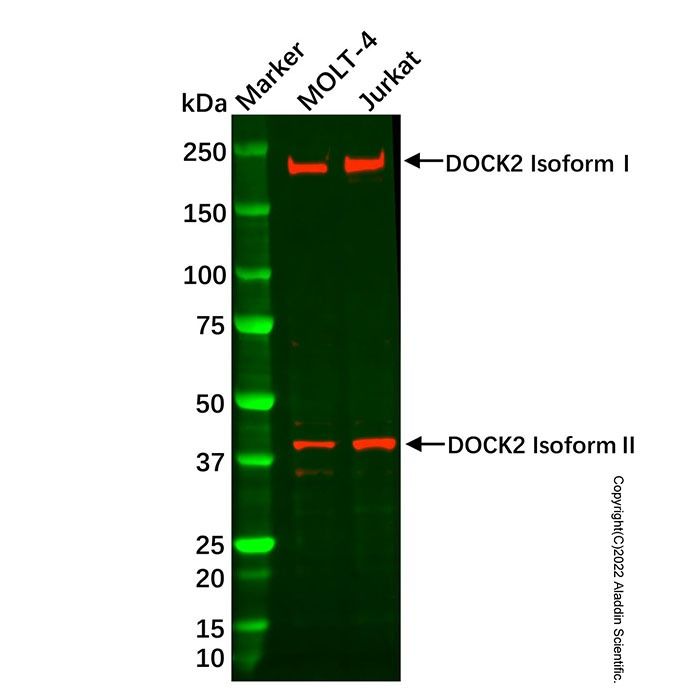
Recombinant DOCK2 Antibody (Ab100270) - Western Blot All lanes: Recombinant DOCK2 Antibody (Ab100270) at 1/2000 dilution Samples: Lysates at 20 µg per lane Secondary: Goat Anti-Rabbit IgG H&L (HRP) (Ab170144) at 1/20000 dilution
Predicted band size: 212 kDa Observed band size: 38, 212 kDa Exposure time: 57.4 s
Aplicação
Aplicação
Dilution info
WB
1/500-1/2000
Documentation
📋 Safety Data Sheet (SDS)
Comprehensive hazard, handling, storage, and regulatory compliance document.
Determine the necessary mass, volume, or concentration for preparing a solution.
Dilution Calculator
Determine the dilution needed to prepare a stock solution.
Reconstitution Calculator
Revisões
Avaliações dos Clientes
Application Protocols
Manufacturer-validated applications and recommended dilutions for SKU Ab100270 are Not specified for this item; refer to CoA/Spec Sheet.
General protocols (for initial optimization only):
Western blot (WB):
Sample: Denatured lysates (10–40 µg/lane). Transfer to PVDF/nitrocellulose.
Block: 5% milk or BSA in TBST, 30–60 min.
Primary: Start 1:1000 in TBST + 1–5% BSA, 1–16 h at RT or 4 °C.
Secondary: Species/isotype-specific HRP or fluorescent secondary, 1 h.
Immunoprecipitation (IP):
Use 1–5 µg antibody per IP. Incubate with lysate 2–16 h at 4 °C. Capture with Protein A/G beads, wash 3–5×, elute with low-pH buffer or SDS sample buffer.
Immunofluorescence (IF/ICC):
Fix with 4% PFA 10–15 min, permeabilize with 0.1% Triton X-100 5–10 min. Primary 1:200 as a start, 1 h RT or overnight 4 °C. Use appropriate fluorescent secondary.
Flow cytometry (intracellular):
Fix/perm cells; titrate antibody to minimize background. Include isotype and FMO controls.
These are starting points only. Optimize per sample type and detection system. For confirmed applications and dilutions for Ab100270, consult the CoA or contact technical support.
Biological Roles
Target overview (literature/general):
DOCK2 (Dedicator of Cytokinesis 2) is a cytoplasmic guanine nucleotide exchange factor (GEF) that preferentially activates Rac1/Rac2. It is highly expressed in hematopoietic cells, especially lymphocytes and neutrophils.
Biological functions: DOCK2 regulates actin cytoskeleton remodeling, chemokine-mediated migration, interstitial motility, immune synapse formation, and lymphocyte trafficking to lymphoid tissues. It contributes to GPCR and TCR/BCR signaling pathways by controlling Rac-dependent pathways, including lamellipodia formation and NADPH oxidase activity.
Pathways: Chemokine receptor signaling (e.g., CXCR4/CXCL12 axis), integrin activation, PI3K-associated signaling, and small GTPase cycling. DOCK2 interacts with ELMO proteins to facilitate efficient nucleotide exchange on Rac.
Genetic/functional studies: DOCK2-deficient models display impaired lymphocyte migration and defective immune responses; in humans, DOCK2 variants are associated with immunological phenotypes (research context).
Reagent relevance:
A DOCK2 antibody enables detection, localization, and immuno-enrichment of the DOCK2 protein to study these roles in cellular and biochemical assays. It can support validation of DOCK2 expression in immune cell subsets or model systems, assessment of pathway activation states, and interrogation of DOCK2-containing protein complexes.
Item-specific biological details such as species reactivity spectrum, epitope region (N-/C-terminus), and cross-reactivity are Not specified for this item; refer to CoA/Spec Sheet.
Buffer Applications
Not directly applicable: This product is an antibody reagent and not a buffering agent.
Practical notes for buffer use with antibodies (general guidance):
Storage buffers: Neutral pH buffers (PBS/TBS, pH ~7.2–7.5) with optional preservatives (e.g., 0.02–0.05% sodium azide) and stabilizers (10–50% glycerol) for subzero storage; actual composition for this item is Not specified.
Assay buffers: Include mild detergents (0.05–0.1% Tween-20) to reduce nonspecific binding in immunoassays; add protein carriers (BSA, casein) for blocking where compatible.
Conjugation: Avoid amine-containing buffers (e.g., Tris) during NHS-ester labeling and avoid reducing agents (DTT, TCEP) for maleimide chemistries unless intentionally generating thiols.
Please consult the CoA/Spec Sheet for the supplied buffer and any restrictions specific to SKU Ab100270.
Green Alternatives
Green chemistry considerations for antibody reagents focus on production and cold-chain impacts rather than solvent replacement:
Recombinant production advantages (general): Reduces reliance on animal ascites or hybridoma culture at large scale, improving ethical profile and often reducing resource variability. Cell-line based expression can be optimized for yield and quality, lowering waste.
Packaging and cold chain: This product ships on ice packs and is stored at −20 °C. Consolidating shipments, selecting right pack sizes to minimize waste, and using energy-efficient freezers help reduce environmental footprint.
Preservatives and disposal: If sodium azide or other preservatives are present (Not specified for this item), implement dedicated waste streams to minimize environmental release. Consider azide-free formulations when compatible with intended use.
Alternative formats: For some workflows, smaller aliquots reduce freeze–thaw cycles and product loss, indirectly reducing waste. Lyophilized formats (if available) can sometimes allow less energy-intensive shipping; the physical form for this item is Not specified.
Comparison (general):
Recombinant antibody vs. polyclonal serum: Higher specificity and consistency; reduced animal use.
Lyophilized vs. liquid: Potentially lower shipping burden; may require careful reconstitution. For this item, formulation details are Not specified; refer to CoA/Spec Sheet.
Pharmaceutical Uses
This product is labeled For research use only and is not intended for diagnostic or therapeutic use.
General formulation insights for antibody reagents (non-clinical, literature):
Typical excipients: Histidine or phosphate buffers (pH 5.5–7.5), sugars/polyols for stabilization (sucrose, trehalose, glycerol), and surfactants (polysorbate 20/80) to reduce interfacial stress. Presence or amounts for this item are Not specified.
Process considerations: Filter sterilization (0.22 µm) and low endotoxin are desirable for sensitive cell-based assays; numerical endotoxin limits for this item are Not specified. For conjugate generation (e.g., HRP, biotin, fluorophores), buffer exchange into additive-free buffer is recommended prior to coupling.
Storage and shipping: Maintain cold chain to preserve activity; avoid freeze–thaw cycling through aliquoting. This item ships on ice and should be stored at −20 °C (per Product Data).
Note: Any reference to GMP, pharmacopeial status, or clinical-grade specifications is not applicable here; those details are Not specified and this product is not for human or veterinary use.
Physical Properties
Item-specific physical properties: Not specified for this item; refer to CoA/Spec Sheet.
General/literature properties for recombinant IgG-class antibodies (for planning only):
Physical state: Typically supplied as an aqueous solution or lyophilized solid; actual appearance/buffer for this item: Not specified; refer to CoA/Spec Sheet.
Molecular weight: Full-length IgG ~150 kDa; Fab ~50 kDa; F(ab')2 ~100 kDa (exact mass depends on isotype/glycosylation). The precise molecular weight for this item is Not specified; refer to CoA/Spec Sheet.
Solubility: Highly soluble in common biological buffers (PBS, TBS). Avoid low-ionic strength or extreme pH that can induce aggregation.
pI: Typically 6–9, isotype/sequence dependent (literature range). Exact pI for this item is Not specified.
Stability: Enhanced by neutral pH (~7.2–7.4), isotonic salts, and stabilizers such as 0.02–0.05% sodium azide (for storage) or 10–50% glycerol for freeze protection. Presence/amount for this item: Not specified; refer to CoA/Spec Sheet.
Optical: Protein absorbance at 280 nm; A280 used for concentration determination (ε depends on sequence). Extinction coefficient for this item: Not specified.
Handling note: Proteins are sensitive to repeated freeze–thaw and elevated temperatures; follow Storage & Reconstitution guidance below and consult the CoA for formulation specifics.
What this means for this item: The antibody is produced recombinantly to deliver sequence-controlled, animal-free production with improved lot-to-lot reproducibility. Validation indicates target-directed performance testing was performed; exact assays and data are Not specified for this item; refer to CoA/Spec Sheet.
General notes on recombinant antibody quality (literature/industry practice):
Recombinant production minimizes drift common to hybridoma lines and allows precise control of isotype or Fc engineering (if applicable). Details of isotype/engineering for this item are Not specified.
Validation typically includes specificity assessment (e.g., KO/knockdown controls, peptide/blocking assays), sensitivity (detection limits), and matrix performance (WB, IHC, IF, FC). The specific panels used for this item are Not specified.
Purity is commonly assessed by SDS-PAGE and SEC-HPLC to quantify aggregates/fragmentation; endotoxin may be measured for cell-based work. Numerical specs (e.g., % monomer, endotoxin EU/mg) are Not specified for this item.
Documentation: For citable research, obtain the lot-specific CoA providing concentration, buffer, preservative content, recommended storage, and any validated applications.
Takeaway: Expect consistent performance characteristic of recombinant ExactAb™ antibodies; consult the CoA for the exact validation scope and formulation of SKU Ab100270.
Reaction and Applications
This is a biochemical affinity reagent rather than a small-molecule reactant. Typical research applications for a recombinant DOCK2 antibody (general guidance; not item-validated claims):
Immunoblotting (Western blot): Detection of endogenous DOCK2 in immune cell lysates (e.g., lymphocytes, neutrophils). Employ KO/siRNA controls to confirm specificity.
Immunoprecipitation/Co-IP: Enrichment of DOCK2 and associated complexes (e.g., Rac GTPases or adaptor proteins) from cytosolic fractions to study signaling assemblies.
Immunofluorescence/Immunocytochemistry: Localization of DOCK2 to cytoplasmic regions; fixation/permeabilization optimization (e.g., PFA + Triton X-100) may be required.
Flow cytometry: Generally less common as DOCK2 is intracellular; feasible with permeabilization.
ELISA/Target capture: As capture or detection reagent in DOCK2-focused assays if epitope accessibility is suitable.
Assay tips (general):
Use validated positive controls (cells/tissues known to express DOCK2; e.g., spleen, lymph node, Jurkat/T cells). Include negative controls (KO/knockdown or tissues lacking DOCK2).
Titrate the antibody to determine the optimal working dilution; matrix and epitope exposure govern best concentration.
For phospho-specific applications, a phospho-specific antibody is required; this product’s epitope specificity is Not specified.
For SKU Ab100270, manufacturer-validated applications are Not specified; consult CoA/Spec Sheet for any tested applications, suggested dilutions, and performance data.
Reaction Conditions
Not applicable to chemical reaction conditions. However, for assay optimization with antibodies (general best practices):
Western blot: Typical starting dilution 1:500–1:2000 for primary antibodies; optimize based on signal and background. Use RIPA or mild lysis buffers depending on epitope accessibility and complex integrity. Include protease/phosphatase inhibitors as needed.
Immunoprecipitation: 1–5 µg antibody per mg lysate protein is a common starting point; incubate 2–16 h at 4 °C with rotation. Capture with Protein A/G beads matched to the antibody isotype. Wash stringency can be tuned with salt (150–500 mM NaCl) and mild detergents.
Immunofluorescence: Start at 1–5 µg/mL or 1:100–1:500; fix with 4% PFA, permeabilize with 0.1–0.3% Triton X-100 if DOCK2 is intracellular. Validate with known positive/negative controls.
ELISA: As capture or detection antibody, coating at 0.5–2 µg/mL is typical; confirm epitope compatibility.
Important: The above are general literature guidelines. Manufacturer-tested applications, optimal dilutions, incubation times, and species reactivity for SKU Ab100270 are Not specified for this item; refer to CoA/Spec Sheet.
Safety and Handling
GHS/SDS information for this specific item:
Signal word / H-statements / Pictograms / Classification: Not specified for this item; consult the product SDS for authoritative hazard information.
General laboratory safety for recombinant antibodies (literature/best practice):
Expected hazards: Antibody preparations are generally considered low hazard, but may contain preservatives (e.g., sodium azide) that are acutely toxic and hazardous to aquatic life. Verify the presence and concentration of any preservatives in the CoA/SDS.
PPE: Wear lab coat, gloves, and safety glasses. Avoid inhalation of aerosols and contact with skin/eyes. Work in a clean environment to prevent sample contamination.
Incompatibilities: Avoid strong oxidizers and extremes of pH or temperature that can denature protein. Do not mix with bleach if sodium azide is present (risk of hydrazoic acid formation).
First aid (general): In case of skin/eye contact, rinse with water for several minutes; remove contaminated clothing. If inhaled, move to fresh air. If ingested, rinse mouth. Seek medical attention according to SDS guidance.
Spill response: Absorb with inert material, wash area with water/detergent. Handle preserved solutions as chemical waste per institutional and local regulations.
Special risks: Repeated freeze–thaw cycles can cause aggregation and loss of binding activity. Aliquot to minimize freeze–thaw. Protect from microbial contamination.
Always defer to the official SDS accompanying this lot for definitive safety, disposal, and transport guidance.
Solvent Selection
Not typically applicable: As a protein reagent supplied in an aqueous buffer, organic solvent selection is generally not relevant.
Practical buffer considerations for antibodies (general guidance):
Working buffers: PBS or TBS at pH ~7.2–7.5 with 0.05–0.1% Tween-20 for immunoassays to reduce nonspecific binding; omit detergents for certain binding assays as needed.
Additives: 10–50% glycerol can improve freeze–thaw tolerance for storage at −20 °C. BSA (e.g., 0.1–1 mg/mL) may stabilize during working dilutions; avoid if BSA-free conditions are required (e.g., conjugation).
Avoid: High concentrations of DMSO, DMF, or alcohols which denature proteins; extreme pH (<5 or >9) unless purposefully eluting from affinity matrices. High salt (>0.5–1 M) can alter binding in some assays.
Conjugation compatibility: For amine-reactive chemistries (e.g., NHS-esters), avoid Tris and primary amine-containing buffers; use PBS or carbonate buffer without amines. For thiol-reactive chemistries (maleimide), ensure free thiols are available and avoid reducing agents unless intentionally generating them.
For this specific item, the supplied buffer composition and any preservatives are Not specified; refer to CoA/Spec Sheet before preparing diluents or performing conjugations.
Storage and Reconstitution
Item-specific storage and shipping:
Storage Conditions: Store at −20 °C; avoid repeated freezing and thawing (from Product Data). Aliquot upon first use to minimize freeze–thaw cycles.
If supplied as liquid: Keep on ice during use. Prepare working aliquots in sterile, low-protein-binding tubes. For short-term (days–weeks), 2–8 °C may be acceptable; verify with CoA. For longer-term, −20 °C or below with stabilizers (e.g., 10–50% glycerol) is common; composition for this item is Not specified.
If supplied lyophilized: Reconstitute with sterile water or recommended buffer to the concentration indicated on the CoA. Gently invert—do not vortex vigorously. Allow 10–15 min for full dissolution on ice. Final buffer composition for this item is Not specified.
Light and proteolysis: Protect from strong light if conjugated; include protease inhibitors in lysates, not in the antibody stock unless specified.
Freeze–thaw: Avoid repeated cycles; aliquot into single-use volumes. Do not store in frost-free freezers due to temperature fluctuations.
Always consult the lot-specific CoA/Spec Sheet for exact concentration, buffer composition, presence of preservatives, and any special storage instructions specific to SKU Ab100270.
Structure and Identity
Item-specific identifiers: Not specified for this item; refer to CoA/Spec Sheet.
Type: Recombinant research antibody (ExactAb™, Validated)
Target: DOCK2 (Dedicator of Cytokinesis 2)
Molecular formula / SMILES / InChIKey / CAS / CID: Not applicable for proteins or not specified for this item; refer to CoA/Spec Sheet.
General structural notes (literature/general):
Antibodies are Y-shaped immunoglobulin proteins composed of two heavy chains and two light chains stabilized by disulfide bonds. Domains comprise variable regions (VH, VL) responsible for antigen binding and constant regions (CH, CL) determining isotype and effector properties.
Recombinant antibodies are expressed from defined DNA sequences in cell systems (e.g., mammalian or other hosts) to ensure batch-to-batch sequence identity and reduced lot variability compared to hybridoma-derived antibodies.
Without clone/isotype details, assume a standard IgG-like architecture; exact isotype, host species, sequence, and any Fc engineering are Not specified for this item; refer to CoA/Spec Sheet.
Antigen recognition: DOCK2 is a cytoplasmic guanine nucleotide exchange factor (GEF) primarily acting on Rac GTPases; epitopes may be linear or conformational, but epitope mapping is Not specified for this item; refer to CoA/Spec Sheet.
Use these general features for planning conjugation, immobilization, or assay design; obtain the exact sequence/isotype and concentration from the product’s CoA for precise structural details.
Synthetic Utility
Not applicable in the conventional organic synthesis sense: This product is a recombinant antibody rather than a small-molecule building block.
General laboratory utility of antibodies (informational):
Affinity capture: Use immobilized antibody for immunoprecipitation or immunoaffinity chromatography to isolate DOCK2 from complex lysates.
Analytical detection: Employ as a primary antibody in immunoassays (WB, IF/IHC, ELISA) to quantify or localize DOCK2.
Probe development: Serves as a scaffold for conjugation to reporters (enzymes, fluorophores) or solid supports (beads, sensors) for target-specific assays.
For synthetic chemistry workflows, select other catalog items (e.g., small molecules, linkers) designed for reaction chemistry. For this antibody, focus on assay design, conjugation chemistry, and protein handling best practices.
Target Specificity
Item-specific details (required for experimental design) are Not specified for this item; refer to CoA/Spec Sheet.
Typically reported attributes for a DOCK2 antibody (general categories only):
Antigen: DOCK2 (Dedicator of Cytokinesis 2) protein.
Epitope: Linear peptide region or conformational epitope within DOCK2 (exact mapping varies by clone).
Species reactivity: Commonly human, mouse, rat where sequence homology supports cross-reactivity; exact profile for this item is Not specified.
Clone and isotype: Critical for Protein A/G binding and secondary selection; Not specified for this item.
Cross-reactivity: Evaluation against related DOCK family proteins (e.g., DOCK1, DOCK5) is recommended; data for this item are Not specified.
Action: Consult the lot-specific CoA/SDS or contact technical support for clone/isotype, immunogen region, species reactivity, and any cross-reactivity assessments for SKU Ab100270.
Perguntas frequentes
What does ExactAb? mean?
ExactAb? indicates the product has been validated for use in rigorous antibody validation workflows. Validation may include positive/negative control samples, signal-to-noise testing, and protocol-specific QC. Lot-specific test data is published on the Certificate of Analysis where available.
What does Recombinant mean?
Recombinant is a defined analytical purity tier suitable for workflows requiring a specific validated property. It specifies a minimum assay percentage, controlled limits on common impurities (water, heavy metals, residue on ignition), and lot-to-lot consistency. Recombinant is one of several purity tiers — choose based on the sensitivity and regulatory requirements of your method.
How should this product be stored?
Store at ?20 °C. Avoid repeated freeze–thaw cycles. Aliquot into single-use volumes before freezing.
How is this product shipped?
This product ships in an insulated container with ice pads. Unpack on arrival and transfer it to the storage condition stated above.
What documentation is provided?
Available product documentation, including Certificates of Analysis (COA), Safety Data Sheets (SDS), and specification sheets, is shown in the product document area. Document availability and access follow the current site policy.
Which species reactivity has this antibody been validated against?
Validated reactivity is listed on the PDP and on each lot's datasheet. We validate against the most commonly tested species for the target (Recombinant DOCK2 Antibody); cross-reactivity in untested species may exist but is not guaranteed. Contact technical support for specific species inquiries.
Need help choosing the grade?
Our grade selection guide covers purity, stabilizer status, and application suitability for all variants in our catalog.
Usamos cookies para garantir o funcionamento adequado do site e, quando permitido, para melhorar a sua experiência. Você pode gerenciar suas preferências a qualquer momento nas Configurações. Saiba mais em nossa Política de Cookies.
Deseja que lhe enviemos uma mensagem quando tivermos descontos disponíveis?
Lembrar-me mais tarde
Obrigado! Por favor, verifique a sua caixa de entrada de e-mail para confirmar.
Products are supplied to verified businesses, institutions, and qualified professionals for research and development use only. Not for use in humans, animals, diagnosis, or therapy.

 ZJ24F0809511