Recombinant eIF4A1 Antibody - Primary antibody, specific to EIF4A1, Rabbit IgG

Cat. No.: Ab101344
Disponível para encomenda
GRAU & PUREZA Recombinant ? Recombinant — produced via recombinant expression for defined sequence and consistency. Use for reproducible, animal-free proteins of known origin. ExactAb™ ? ExactAb™ — Aladdin's antibody line emphasizing precision and validated quality. Use for reliable, specificity-validated antibody applications. Validated ? Validated grade — performance confirmed in defined applications before release. Use when you want documented assurance the reagent works as stated. 1.3 mg/mL
Application
WB
Host species
Rabbit
Reactive species
Human, Mouse, Rat
Isotype
Rabbit IgG
Conjugation
Unconjugated
★
Tamanho
Alemanha (EU)
USA*
Preço
Qtd
10μl
Ab101344-10μl
—
2 Em stock
86,69€
50μl
Ab101344-50μl
—
1 Em stock
225,53€
100μl
Ab101344-100μl
Sob encomenda · 8–12 semanas
364,36€
1ml
Ab101344-1ml
Sob encomenda · 8–12 semanas
2950,23€
Enter a quantity for the sizes you want to add.

Visão geral

Rabbit anti Human eIF4A1 Antibody, Recombinant, could be used for WB and so on.

Application:

WB: 1/500-1/1000

Protein Function

ATP-dependent RNA helicase which is a subunit of the eIF4F complex involved in cap recognition and is required for mRNA binding to ribosome. In the current model of translation initiation, eIF4A unwinds RNA secondary structures in the 5'-UTR of mRNAs which is necessary to allow efficient binding of the small ribosomal subunit, and subsequent scanning for the initiator codon.

Especificações

Product Name
Recombinant eIF4A1 Antibody - Primary antibody, specific to EIF4A1, Rabbit IgG
Sinónimos
ATP-dependent RNA helicase eIF4A-1|DDX2|DDX2A|eIF 4A I|EIF4A|eIF4A I|EIF4A1|Eukaryotic initiation factor 4A-I|Eukaryotic initiation factor 4AI|eukaryotic translation initiation factor 4A, isoform 1|Eukaryotic translation initiation factor 4A1|ATP-dependent RNA helicase eIF4A-1 antibody|DDX2 antibody|DDX2A antibody|eIF 4A I antibody|eIF-4A-I antibody|EIF4A antibody|eIF4A I antibody|eIF4A-I antibody|EIF4A1 antibody|Eukaryotic initiation factor 4A-I antibody|Eukaryotic initiation factor 4AI antibody|eukaryotic translation initiation factor 4A, isoform 1 antibody|Eukaryotic translation initiation factor 4A1 antibody
Especificações e pureza
ExactAb™, Validated, Recombinant, 1.3 mg/mL
Espécie hospedeira
Rabbit
Especificidade
EIF4A1
Imunogénio
A synthetic peptide derived from human eIF4A1 (AA 301-314)
Controlo positivo
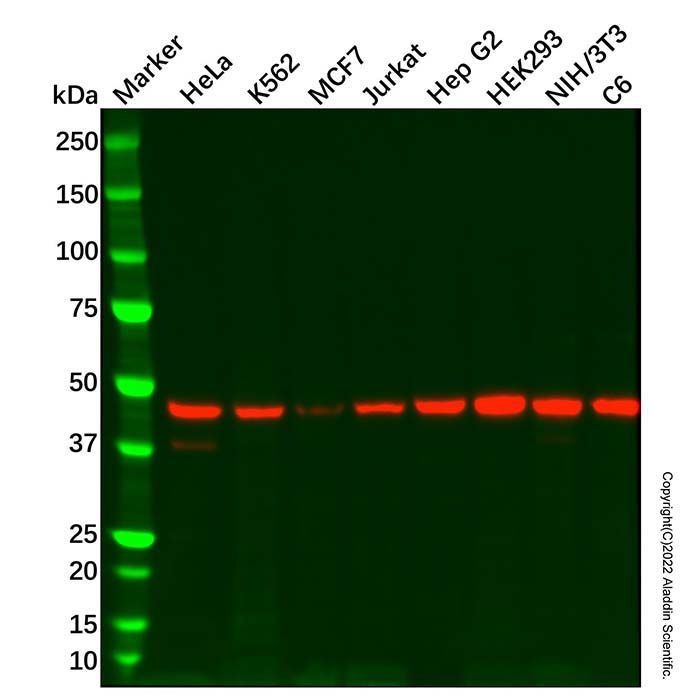
WB: HeLa, K562, MCF7, Jurkat, Hep G2, HEK293, NIH/3T3 and C6 cell lysates.
Conjugação
Unconjugated
Grau
ExactAb™, Recombinant, Validated
Isótipo
Rabbit IgG
SDS-PAGE
150 kDa
Método de purificação
Antigen affinity purified
Concentração
1.3 mg/mL
Product Line
Produtos biológicos
Armazenamento e envio
Forma
Liquid
Condições de armazenamento de armazenamento
Store at -20°C,Avoid repeated freezing and thawing
Enviado em
Ice chest + Ice pads
Estabilidade e armazenamento
Store at 4°C short term (1-2 weeks). Store at -20°C long term (24 months). Upon receipt, it is recommended to aliquot. Avoid freeze/thaw cycle.
Imagens

Recombinant eIF4A1 Antibody (Ab101344) - Western Blot
All lanes: Recombinant eIF4A1 Antibody (Ab101344) at 1/1000 dilution
Samples: Lysates at 20 µg per lane
Secondary: Goat Anti-Rabbit IgG H&L (HRP) (Ab170144) at 1/20000 dilution

Predicted band size: 46 kDa
Observed band size: 45 kDa
Exposure time: 188.9 s

Aplicação
Aplicação
Dilution info
WB

1/500-1/1000

Dados avançados

Alvos associados (humanos)
EIF4A1 Tchem Eukaryotic initiation factor 4A-I (0 Activities)
Activity TypeActivity Value -log(M)Mechanism of ActionActivity ReferencePublications (PubMed IDs)
Mecanismos de ação
Certificados(CoA,COO,BSE/TSE e Mapa de Análise)
C of A & Other Certificates(BSE/TSE, COO):
Analytical Chart:

Find and download the COA for your product by matching the lot number on the packaging.

2 results found

Lot NumberCertificate TypeDataItem
ZJ24F0303284ZJ24F0303284Certificate of AnalysisMar 14, 2024 Ab101344
ZJ24F0303283ZJ24F0303283Certificate of AnalysisMar 14, 2024 Ab101344
FAQs e artigos
Calculadoras de soluções
Revisões

Avaliações dos Clientes

Application Protocols

Item-specific tested applications, recommended dilutions, incubation conditions, retrieval methods, and positive controls are not specified for this SKU; refer to the CoA/Spec Sheet or contact Technical Support for protocol guidance.

Note: Any application (WB, IP, IF, IHC, ELISA, etc.) should be validated in-house with appropriate positive/negative controls and a titration series to determine the optimal working concentration for your samples and instruments.

Biological Roles

Target overview (literature/general)

  • eIF4A1 (eukaryotic translation initiation factor 4A-I) is a DEAD-box RNA helicase that functions within the eIF4F complex to promote cap-dependent translation initiation. It utilizes ATP hydrolysis to unwind secondary structures in the 5′-UTR of mRNAs, facilitating 43S preinitiation complex scanning.
  • Isoforms: eIF4A1 is closely related to eIF4A2; antibodies may cross-react depending on epitope—item-specific cross-reactivity for this SKU is not specified.
  • Cellular localization: Predominantly cytoplasmic; can associate with ribonucleoprotein complexes and stress granules depending on cellular state.
  • Regulation: Activity is modulated by cofactors such as eIF4G and eIF4B, and by small-molecule inhibitors in research contexts; post-translational modifications have been reported in the literature.

Research utility of anti-eIF4A1 antibodies (literature/general)

  • Enable quantification of eIF4A1 expression across cell types and conditions, assessment of translational control mechanisms, and immunoprecipitation of eIF4A1-containing mRNPs for downstream RNA/protein analyses.

Item-specific biological reactivity (species, isoform selectivity), epitope mapping, and performance metrics are not provided; consult the CoA/Spec Sheet for this SKU.

Buffer Applications

Not typically applicable. This product is an antibody reagent rather than a buffer system. For best performance, prepare dilutions in appropriate assay buffers (e.g., PBS or TBS at neutral pH) compatible with your workflow. Item-specific formulation/buffer composition is not specified; refer to the CoA/Spec Sheet.

Green Alternatives

Context

  • For antibody reagents, “green” considerations focus on ethical sourcing, resource use, and cold-chain logistics rather than solvent replacement.

Greener attributes (literature/general)

  • Recombinant production: Avoids animal immunization/ascites, reducing animal use and biological waste. Enables precisely controlled upstream expression and downstream purification with consistent quality, reducing rework and repeat experiments.
  • Lot-to-lot consistency: Fewer failed experiments translates to lower reagent consumption and reduced environmental footprint.
  • Shipping: Ice packs (vs. dry ice) and concentrated formats can reduce transport emissions when stability allows. This SKU ships with ice pads per Product Data.

Trade-offs

  • Cold-chain energy demand remains significant; consider consolidated orders and local storage optimization.
  • Stabilizers and plastics from single-use consumables contribute to waste; adopt recycling programs where possible.

Comparison (general)

  • Recombinant antibody vs. traditional polyclonal: Higher reproducibility and reduced animal use; potentially higher upfront cost but improved experimental efficiency. Specific sustainability metrics for this item are not specified; refer to supplier documentation if needed.
Pharmaceutical Uses

Scope

  • This product is designated “For research use only” and is not intended for diagnostic or therapeutic applications.

General roles of antibodies in pharma workflows (literature/general)

  • In drug discovery and bioprocess development, research-grade antibodies can serve as analytical reagents in QC assays (e.g., Western blot, ELISA) or as capture/detection reagents in process analytics. They may support target validation and mechanism-of-action studies in preclinical research.

Item-specific pharmacopeial status, excipient use, and GMP compliance are not specified for this SKU; for any regulated applications, consult the CoA/Spec Sheet and your quality unit.

Physical Properties

Item-specific properties (from Product Data)

  • Appearance, concentration, formulation, protein content, and excipients: Not specified for this item; refer to CoA/Spec Sheet.

Typical antibody properties (literature/general)

  • Molecular mass: IgG antibodies are typically ~150 kDa as intact monomers; actual mass depends on isotype/glycosylation.
  • Isoelectric point (pI): commonly ~6–9 depending on isotype and sequence; formulation pH is usually ~7.2–7.4 for PBS-based buffers.
  • Solubility: Readily soluble in aqueous isotonic buffers (e.g., PBS, TBS). Denaturing organic solvents are not recommended for functional assays.
  • Stability: Enhanced by storage at ≤−20°C in aliquots; repeated freeze–thaw cycles can cause aggregation and activity loss.
  • Optical properties: Protein UV absorbance with A280 used for quantification (ε depends on sequence; not specified for this item).

Notes

  • No item-specific physical constants (density, refractive index, exact concentration, formulation) are provided; consult the CoA/Spec Sheet for definitive parameters.
Quality and Grades

Item-specific grades (from Product Data)

  • Recombinant: The antibody is produced recombinantly, enabling defined sequence, lot-to-lot consistency, and animal-free production of the variable domains. This minimizes batch variability compared to conventional hybridoma or polyclonal materials.
  • ExactAb™: Branded designation indicating sequence-defined, recombinantly manufactured antibodies with controlled expression and purification parameters. Specific platform criteria for this SKU are not provided; refer to CoA/Spec Sheet.
  • Validated: The listing indicates validation; however, methods, sample types, and performance metrics are not specified for this item. Consult validation data on the CoA/Spec Sheet.

What these grades imply (general)

  • Recombinant antibodies allow stable supply, facile isotype engineering, and enhanced specificity through defined clone sequences.
  • Validation typically encompasses one or more applications (e.g., WB, IP, IHC, IF) with specified species reactivity, observed band sizes, and control samples. Without item-specific details, users should perform in-house titration and verification in their systems.
  • Purity metrics (SDS-PAGE homogeneity, HCP/DNA residuals, endotoxin), buffer composition, and stabilizers are not specified for this item; verify on the CoA/Spec Sheet prior to regulated use.
Reaction and Applications

Applicability

  • As an antibody reagent, this product is not used as a chemical reactant. Classical organic reaction families (e.g., Grignard, cross-coupling) do not apply.

Research applications (literature/general)

  • Antibodies against eIF4A1 are commonly employed in immunoassays that detect endogenous protein levels, modifications, or localization, such as:
    • Western blotting (WB) to detect eIF4A1 band at the expected molecular size (target-specific size is literature-derived; see Biological Roles for context).
    • Immunoprecipitation (IP) or co-IP to capture eIF4A1 and associated complexes for proteomic analysis.
    • Immunofluorescence (IF) or immunohistochemistry (IHC) to visualize cellular/ subcellular distribution of eIF4A1.
    • ELISA or proximity-based assays for quantitative measurements.

Item-specific tested applications, species reactivity, and positive controls are not provided for this SKU; consult the CoA/Spec Sheet. Users should perform titration and include appropriate controls (isotype controls, no-primary controls, and known positive/negative lysates) to verify performance in their system.

Reaction Conditions

Not applicable to chemical synthesis. For immunoassay conditions (e.g., antibody dilutions, incubation times, temperature), no item-specific parameters are provided for this SKU. Users should optimize conditions empirically and consult the CoA/Spec Sheet for any available guidance.

Safety and Handling

Item-specific safety (from Product Data)

  • GHS classification, signal word, pictograms, H-statements: Not specified for this item; refer to SDS.
  • Storage conditions: Store at −20°C; avoid repeated freezing and thawing.
  • Shipping: Ice chest + ice pads.

General laboratory safety (literature/general)

  • Handle antibodies as biological reagents using good laboratory practice: lab coat, nitrile gloves, and eye protection. Avoid ingestion, inhalation of aerosols, and skin/eye contact.
  • Work on ice or at 2–8°C during experimental setup to preserve activity. Keep containers tightly closed to prevent contamination and evaporation.
  • Incompatibilities: Strong oxidizers, extreme pH, and organic denaturants can degrade proteins. Avoid metal-catalyzed oxidation and prolonged exposure to light/heat.
  • First aid overview: In case of contact, rinse affected area with water. If inhaled as aerosol, move to fresh air. If ingested, rinse mouth. Seek medical attention if irritation persists. Defer to SDS for authoritative guidance.
  • Waste: Dispose of proteinaceous materials and consumables according to institutional biosafety and chemical waste procedures.

Peroxide formation, flammability, and other solvent-specific risks are not relevant; this is a water-based protein reagent unless otherwise specified on the CoA.

Solvent Selection

Applicability

  • Not a small-molecule reagent; as a protein antibody, the concept of organic solvent selection is generally not applicable. Use aqueous biological buffers.

General guidance (literature/general)

  • Preferred media: Isotonic buffers such as PBS or TBS at neutral pH for handling and dilutions. Include carrier protein or inert polymers only if compatible with your assay; none are specified for this item.
  • Avoid: Strong organic solvents (e.g., acetonitrile, methanol, DMSO) and extremes of pH or ionic strength that can denature or aggregate antibodies.
  • Detergents: For some applications (e.g., WB, IP), low concentrations of nonionic detergents (e.g., 0.05–0.1% Tween-20) are used in wash buffers; compatibility should be verified empirically.

For application-relevant guidance, see the Application Protocols and Storage & Reconstitution sections; defer to the CoA/Spec Sheet for any item-specific formulation details.

Storage and Reconstitution

Item-specific instructions (from Product Data)

  • Storage: Store at −20°C.
  • Handling: Avoid repeated freezing and thawing.
  • Shipping: Ice chest + ice pads.

General guidance (literature/general)

  • Aliquoting: Upon first receipt, if a liquid format, mix gently, spin down briefly, and aliquot into low-bind tubes sized for single use to prevent freeze–thaw cycles.
  • Temperature: For short-term use (days to 1–2 weeks), many antibodies remain stable at 2–8°C; for long-term storage, keep at −20°C or below per item instruction. Do not store in frost-free freezers that warm during defrost cycles.
  • Thawing: Thaw on ice; mix gently by inversion. Avoid vigorous vortexing or foaming that can denature proteins.
  • Reconstitution: If supplied lyophilized, reconstitution volume, buffer, and target concentration are not specified for this item; follow the CoA/Spec Sheet or vial label. Generally, reconstitute with sterile, neutral pH buffer (e.g., PBS) and allow complete dissolution on ice.
  • Light and contamination: Protect from light where applicable and maintain aseptic technique to avoid microbial growth.

For definitive formulation details (buffer composition, stabilizers, concentration), consult the CoA/Spec Sheet.

Structure and Identity

Item-specific facts (from Product Data)

  • Product: Recombinant eIF4A1 Antibody (SKU: Ab101344)
  • Grade/Purity: Recombinant, ExactAb™, Validated
  • Category: 抗体 (Antibody)
  • Research use: For research use only
  • Molecular identifiers (SMILES, InChIKey, CAS, CID, molecular formula, molecular weight): Not specified for this item; refer to CoA/Spec Sheet.

General structure description (literature/general)

  • This product is a recombinant antibody directed against eIF4A1. Antibodies are Y‑shaped glycoproteins composed of two heavy and two light chains with variable (V) regions forming the antigen-binding sites and constant (C) regions determining isotype/effector functions.
  • Typical recombinant research antibodies are IgG-class molecules with two identical Fab arms and one Fc domain; the variable domains (VH/VL) define epitope specificity; isotype/subclass for this item is not specified.
  • Epitope on eIF4A1, clonality (mono vs poly), and sequence framework are not specified for this item; consult the CoA/Spec Sheet for exact identity attributes.
Synthetic Utility

Not applicable. As a recombinant antibody reagent, this product is not used as a synthetic building block or catalyst in organic chemistry. For practical use information, see Reaction & Applications and Application Protocols (item-specific protocols not provided) and Storage & Reconstitution.

Target Specificity

Item-specific details

  • Antigen/Target: eIF4A1 (Eukaryotic Translation Initiation Factor 4A-I)
  • Clone, isotype, species reactivity, epitope/peptide mapping, and cross-reactivity: Not specified for this item; refer to CoA/Spec Sheet.

General notes (literature/general)

  • Given homology between eIF4A1 and eIF4A2, epitope selection often determines cross-reactivity. Sequence-defined recombinant antibodies can be engineered for isoform selectivity; however, item-specific data are not provided here.

Perguntas frequentes

How should this product be stored?
Store at ?20 °C. Avoid repeated freeze–thaw cycles. Aliquot into single-use volumes before freezing.
What does ExactAb? mean?
ExactAb? indicates the product has been validated for use in rigorous antibody validation workflows. Validation may include positive/negative control samples, signal-to-noise testing, and protocol-specific QC. Lot-specific test data is published on the Certificate of Analysis where available.
What does Recombinant mean?
Recombinant is a defined analytical purity tier suitable for workflows requiring a specific validated property. It specifies a minimum assay percentage, controlled limits on common impurities (water, heavy metals, residue on ignition), and lot-to-lot consistency. Recombinant is one of several purity tiers — choose based on the sensitivity and regulatory requirements of your method.
How is this product shipped?
This product ships in an insulated container with ice pads. Unpack on arrival and transfer it to the storage condition stated above.
What documentation is provided?
Available product documentation, including Certificates of Analysis (COA), Safety Data Sheets (SDS), and specification sheets, is shown in the product document area. Document availability and access follow the current site policy.
Which species reactivity has this antibody been validated against?
Validated reactivity is listed on the PDP and on each lot's datasheet. We validate against the most commonly tested species for the target (Recombinant eIF4A1 Antibody); cross-reactivity in untested species may exist but is not guaranteed. Contact technical support for specific species inquiries.

Precisa de ajuda para escolher o grau?

O nosso guia de seleção de graus abrange pureza, estado do estabilizador e adequação à aplicação para todas as variantes do nosso catálogo.

Ver o guia de graus Recombinant → Ver o guia de graus Validated → Ver o guia de graus ExactAb™ →

Produtos Relacionados

Goat Anti-Rabbit IgG H&L Antibody - Secondary antibody, for ELISA,LF,GICA various applications, from Rabbit, generated in Goat
Goat Anti-Rabbit IgG H&L (AF594) - Secondary antibody, IgG
Goat Anti-Rabbit IgG H&L (Biotin) - Secondary antibody, IgG
Goat Anti-Rabbit IgG H&L (AF488) - Secondary antibody, IgG
Goat Anti-Rabbit IgG H&L (AF405) - Secondary antibody, IgG
Donkey Anti-Rabbit IgG H&L (AF647) - Secondary antibody, specific to , IgG
Donkey Anti-Rabbit IgG H&L (Biotin) - Secondary antibody, IgG
Goat Anti-Rabbit IgG H&L (HRP) - Secondary antibody
Goat Anti-Rabbit IgG H&L Antibody - Secondary antibody, Goat IgG
Goat Anti-Rabbit IgG H&L (Biotin) - Secondary antibody
Goat Anti-Rabbit IgG H&L (Cy5) - Secondary antibody
Goat Anti-Rabbit IgG H&L (FITC) - Secondary antibody
Goat Anti-Rabbit IgG H&L (TRITC) - Secondary antibody
Goat Anti-Rabbit IgG H&L (Biotin) - Secondary antibody, Goat IgG
Goat Anti-Rabbit IgG H&L (HRP) - Secondary antibody, Goat IgG
Goat Anti-Rabbit IgG H&L (Cy5) - Secondary antibody, Goat IgG
Goat Anti-Rabbit IgG H&L (TRITC) - Secondary antibody, Goat IgG
Goat Anti-Rabbit IgG H&L (FITC) - Secondary antibody, Goat IgG
Goat Anti-Rabbit IgG H&L (PE) - Secondary antibody, Goat IgG
Goat Anti-Rabbit IgG H&L (APC) - Secondary antibody, Goat IgG
Goat Anti-Rabbit IgG H&L (AF647) - Secondary antibody, Goat IgG
Goat Anti-Rabbit IgG H&L (AF405) - Secondary antibody, Goat IgG
Goat Anti-Rabbit IgG H&L (AF555) - Secondary antibody, Goat IgG
Goat Anti-Rabbit IgG H&L (AF546) - Secondary antibody, specific to Rabbit IgG
Goat Anti-Rabbit IgG H&L (AF700) - Secondary antibody, specific to Rabbit IgG
Goat Anti-Rabbit IgG H&L (AF488) - Secondary antibody
Goat Anti-Rabbit IgG H&L (AF647) (Ready to use) - Secondary antibody, specific to Rabbit IgG

Deseja que lhe enviemos uma mensagem quando tivermos descontos disponíveis?

Lembrar-me mais tarde

Obrigado! Por favor, verifique a sua caixa de entrada de e-mail para confirmar.

Ops! As notificações estão desativadas.