GRAU & PUREZAExactAb™?ExactAb™ — Aladdin's antibody line emphasizing precision and validated quality. Use for reliable, specificity-validated antibody applications.Validated?Validated grade — performance confirmed in defined applications before release. Use when you want documented assurance the reagent works as stated.1.0 mg/mL
Validated, ExactAb™, 1.0 mg/mL ExactAb™,Validated para fluxos de trabalho cromatográficos e analíticos sensíveis que exigem interferência mínima da linha de base.
🌡
Armazenamento e envio
Store at -20°C,Avoid repeated freezing and thawing Envio Ice chest + Ice pads. Consulte o COA específico do lote para obter as especificações exatas.
📋
Documentos de qualidade
SDS, COA, ficha técnica e folha de especificações disponíveis para download. COA específico do lote acessível por meio de pesquisa por número de lote.
📚
Comprovação documental
Citado em 0 publicações revisadas por pares nas áreas de cromatografia, síntese orgânica e reações de acoplamento cruzado.
Visão geral
Rabbit polyclonal to Src (phospho Y529), Polyclonal, could be used for WB, IHC and so on.
Especificações
Product Name
Src (phospho Y529) Antibody - Primary antibody, specific to Src (phospho Y529), Rabbit IgG
Sinónimos
Src (phospho Y529) | p-Src (phospho Y529) | Src(Phospho-Tyr529) | ASV | Avian sarcoma virus | c SRC | CDNA FLJ14219 fis clone NT2RP3003800 highly similar to Rattus norvegicus tyrosine protein kinase pp60 c src mRNA | cSrc | EC 2.7.10.2 | Neuronal CSRC tyr
Especificações e pureza
Validated, ExactAb™, 1.0 mg/mL
Mecanismos bioquímicos e fisiológicos
Non-receptor protein tyrosine kinase that plays pivotal roles in numerous cellular processes such as proliferation, migration, and transformation. In concert with PTK2B, plays an important role in osteoclastic bone resorption. Both the formation of a SRC-
Espécie hospedeira
Rabbit
Especificidade
Src (phospho Y529)
Imunogénio
A synthetic peptide derived from human Src (phospho Y529) (AA 487-536).
Controlo positivo
WB: A549, NIH/3T3 lysates. IHC: Human breast carcinoma tissue.
Conjugação
Unconjugated
Grau
ExactAb™, Validated
Isótipo
Rabbit IgG
SDS-PAGE
150kDa
Método de purificação
Immunogen affinity purified
Concentração
1.0 mg/mL
Product Line
Produtos biológicos
Armazenamento e envio
Forma
Liquid
Condições de armazenamento de armazenamento
Store at -20°C,Avoid repeated freezing and thawing
Enviado em
Ice chest + Ice pads
Estabilidade e armazenamento
Store at 2-8℃ short term (1-2 weeks). Store at -20℃ long term (12 months). Upon receipt, it is recommended to aliquot. Avoid freeze/thaw cycle.
Imagens
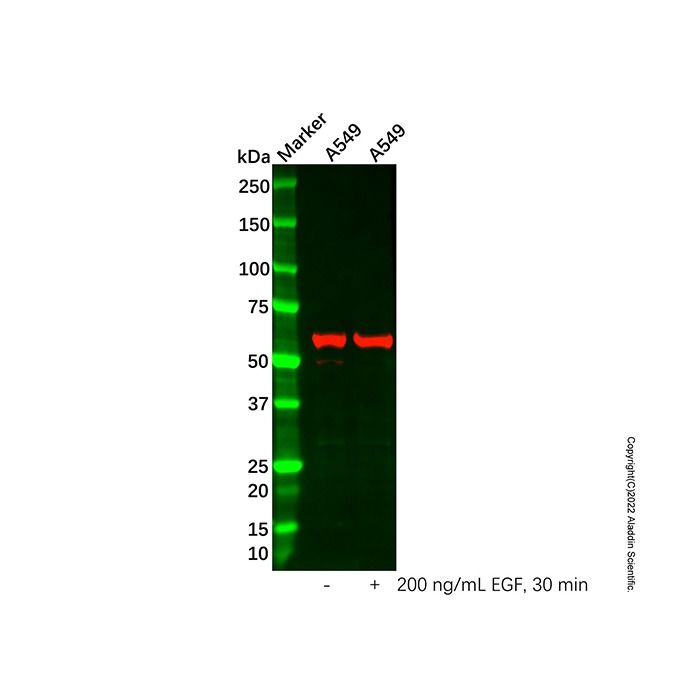
Src (phospho Y529) Antibody (Ab129131) - Western Blot All lanes: Src (phospho Y529) Antibody (Ab129131) at 1/1000 dilution Samples: Lysates at 20 µg per lane Secondary: Goat Anti-Rabbit IgG H&L (HRP) (Ab170144) at 1/20000 dilution Predicted band size: 60 kDa Observed band size: 58 kDa Exposure time: 3.0 s
Src (phospho Y529) Antibody (Ab129131) - Western Blot All lanes: Src (phospho Y529) Antibody (Ab129131) at 1/1000 dilution Samples: Lysates at 20 µg per lane Secondary: Goat Anti-Rabbit IgG H&L (HRP) (Ab170144) at 1/20000 dilution Predicted band size: 60 kDa Observed band size: 58 kDa Exposure time: 5.0 s
Src (phospho Y529) Antibody (Ab129131) - IHC Immunohistochemistry analysis of paraffin-embedded human breast carcinoma, using Src (phospho Y529) Antibody (Ab129131). The picture on the right is blocked with the phospho peptide.
Src (phospho Y529) Antibody (Ab129131) - ELISA Enzyme-Linked Immunosorbent Assay (Phospho-ELISA) for Immunogen Phosphopeptide (Phospho-left) and Non-Phosphopeptide (Phospho-right), using Src (phospho Y529) Antibody (Ab129131).
Aplicação
Aplicação
Dilution info
WB
1/500-1/2000
IHC
1/100-1/300
Documentação
📋 Ficha de dados de segurança (FDS)
Documento abrangente sobre perigos, manuseamento, armazenamento e conformidade regulamentar.
Determine the necessary mass, volume, or concentration for preparing a solution.
Dilution Calculator
Determine the dilution needed to prepare a stock solution.
Reconstitution Calculator
Revisões
Avaliações dos Clientes
Application Protocols
Item-specific validated applications, recommended dilutions, incubation conditions, and positive controls: Not specified for this item; refer to CoA/Spec Sheet.
General guidance (for planning purposes only; literature/general)
Western blot (WB): Start with 1:500–1:2000 for primary antibody as a screening range; optimize based on signal-to-noise and membrane/blocking conditions.
Immunoprecipitation (IP): Typical usage is 1–5 µg antibody per mg total protein lysate, rotating 2–16 h at 4°C; optimize bead type (Protein A/G) according to isotype.
Immunocytochemistry/Immunohistochemistry (ICC/IHC): Begin with 1:100–1:500; validate fixation and antigen retrieval to preserve phospho-tyrosine.
Controls: Include lambda phosphatase–treated samples or non-phospho peptide competition where appropriate to confirm phospho-specificity.
Use the item’s CoA/Spec Sheet for authoritative conditions. The above ranges are general starting points and not specifications for this item.
Biological Roles
This antibody targets Src phosphorylated at Tyr529 (pY529). Src is a non-receptor tyrosine kinase of the Src family, central to signaling pathways regulating proliferation, adhesion, migration, and cytoskeletal dynamics.
Literature background on the epitope and pathway
Regulatory tyrosine: The C-terminal tyrosine of Src (numbering varies by species; commonly referred to as the inhibitory C-terminal Tyr such as human Tyr530, avian Tyr527) is a key switch. When phosphorylated by C-terminal Src kinase (Csk), this site engages the SH2 domain intramolecularly, stabilizing an autoinhibited conformation and suppressing kinase activity.
Dephosphorylation or displacement of the C-terminal pTyr disrupts this autoinhibited state, enabling activation loop phosphorylation and kinase activation.
pY529-specific detection thus serves as a readout of the inhibited state versus dephosphorylated/active Src, depending on cellular context.
Research implications (general)
Monitoring pY529 levels allows interrogation of upstream regulators (e.g., Csk/Ctk), receptor signaling cross-talk, and integrin-mediated adhesion pathways.
Comparative measurements of pY529 with pan-Src or pY416 (activation loop) antibodies provide complementary insight into Src activation status.
Note: The above reflects general biology of Src family regulation. Item-specific cross-reactivity profile, species reactivity, and application suitability are Not specified for this item; refer to CoA/Spec Sheet.
Buffer Applications
Not typically applicable in the sense of classical buffer chemistry selection. For antibody use, common assay buffers include:
General guidance (literature/general)
Lysis buffers: RIPA or NP-40/Triton X-100–based buffers supplemented with phosphatase and protease inhibitors to preserve pTyr epitopes.
Blocking buffers: 3–5% BSA or milk in TBS-T/PBS-T for Western blot; serum or protein-based blockers for IHC/IF depending on host and detection system.
Wash buffers: PBS-T or TBS-T with optimized detergent levels to reduce background while maintaining epitope integrity.
Item-specific buffer formulation recommendations and compatibility are Not specified for this item; refer to CoA/Spec Sheet.
Green Alternatives
Green solvent/chemistry substitution is not directly applicable to this antibody product. Environmental impact can be reduced by:
Minimizing single-use plastics by using reusable racks and low-waste tip options where compatible with sterility needs.
Preparing working aliquots to avoid repeated freeze–thaw and reduce spoilage/waste.
Using non-toxic blocking agents and detergents when feasible, and disposing of buffers according to local regulations.
For antibody-based assays, sustainability gains come more from workflow design (efficient blocking/washing, right-first-time optimization) than from chemical substitution.
Pharmaceutical Uses
This product is an analytical/research antibody and is not intended for clinical or therapeutic use. It does not have specified roles as a drug substance, excipient, or diagnostic kit component in the Product Data.
Item-specific status: Not specified for this item; refer to CoA/Spec Sheet.
General note (literature/general)
In pharmaceutical research settings, phospho-specific antibodies such as this are commonly used as analytical tools in target engagement studies, pathway mapping, and quality attribute monitoring for cell-based assays. Any use in regulated workflows requires appropriate qualification/validation and compliance with relevant guidelines.
Physical Properties
Item-specific data
Appearance: Not specified for this item; refer to CoA/Spec Sheet.
Concentration, formulation buffer, and preservative: Not specified for this item; refer to CoA/Spec Sheet.
Molecular weight and exact composition: Not specified for this item; refer to CoA/Spec Sheet.
General properties for antibody reagents (literature/general)
Physical state: Typically supplied as an aqueous solution or lyophilized solid containing stabilizers (e.g., proteins, sugars) and salts; exact composition varies by lot and product.
Solubility: Antibodies are water-soluble proteins; they are insoluble in most organic solvents and can denature or precipitate in strong chaotropes or extreme pH.
Stability: Sensitive to repeated freeze–thaw; stability improves with storage at recommended temperature and with carrier proteins/cryoprotectants.
pH preference: Most IgG antibodies are stored near neutral pH (≈6.8–7.4); extremes of pH can reduce binding activity by denaturation.
Handling implications
Avoid vigorous vortexing or foaming to reduce aggregation.
If supplied lyophilized, reconstitute with the recommended buffer and allow complete dissolution on ice before gentle mixing.
All numeric specifications such as concentration, buffer composition, and additives are not provided in the Product Data and should be confirmed on the item’s CoA/Specification Sheet.
ExactAb™ (brand/line descriptor): Indicates a defined and quality-controlled antibody line. While the Product Data confirm validation status, detailed validation scope (e.g., WB, IHC, IF, species reactivity) is not specified for this item; refer to the CoA/Spec Sheet for application-specific validation.
“Validated” typically implies the antibody has been performance-checked against its stated target epitope, often including positive/negative controls and phospho-specific discrimination where applicable. For a phospho-epitope antibody, validation commonly assesses selectivity for the phosphorylated form over the non-phosphorylated counterpart.
Lot-to-lot consistency (general)
Validation and defined production workflows aim to reduce variability in affinity and background. Nonetheless, titer and background can vary; optimize dilution for each lot.
Documentation
For this specific item, detailed specifications (host, clonality, isotype, concentration, buffer/preservatives, and tested applications) are Not specified for this item; refer to CoA/Spec Sheet.
Practical notes
Include phosphatase inhibitors during sample prep to maintain the phospho-epitope recognized by this antibody.
Employ appropriate positive controls (cells/tissues with active Src phosphorylation) during method development; see Application Protocols and Target Specificity tabs for item-specific data when available.
Reaction and Applications
This section (synthetic reaction chemistry) is not directly applicable to an antibody reagent. Instead, practical applications pertain to immunoassays and detection of phospho-Src (pY529) in research workflows (e.g., immunoblotting, immunoprecipitation, immunocytochemistry), subject to validation.
Item-specific tested applications: Not specified for this item; refer to CoA/Spec Sheet.
General considerations (literature/general)
Preserve phosphorylation: Add phosphatase inhibitors (e.g., sodium orthovanadate, cocktail inhibitors) during lysis and sample processing.
Denaturing vs native conditions: For Western blot, denaturing SDS-PAGE followed by transfer is typical; for IP, use non-denaturing buffers to maintain antigen conformation.
Controls: Include a non-phosphorylated control or phosphatase-treated sample to assess phospho-specificity.
Stimulation: Upstream receptor or Src activation (e.g., growth factors, integrin engagement) can increase pY529 dynamics; select appropriate biological models as positive controls.
Reaction Conditions
Not applicable to chemical synthesis. For assay conditions:
Item-specific tested conditions: Not specified for this item; refer to CoA/Spec Sheet.
General assay conditions (literature/general)
Western blot: Typical primary antibody incubations range from 1–16 h at 4–25°C in blocking buffer; include phosphatase inhibitors during sample prep to preserve pY epitopes.
Immunoprecipitation: Incubate lysates with antibody under non-denaturing conditions at 4°C with gentle rotation; use protein A/G matrices compatible with the antibody’s isotype.
IHC/IF: Employ antigen retrieval and blocking steps tailored to sample type and host species; phospho-epitopes may require optimized fixation (e.g., PFA) and rapid processing to prevent dephosphorylation.
These are literature-based guidelines; optimize per sample and application.
Safety and Handling
Item-specific hazard information
GHS Classification, Signal Word, H-Statements, Pictograms: Not specified for this item; refer to SDS.
General safety guidance for antibody reagents (literature/general)
Use standard laboratory PPE: lab coat, gloves, and eye protection. Handle using good microbiological practices to avoid contamination.
Avoid ingestion, inhalation of aerosols, and contact with skin and eyes. Wash thoroughly after handling.
If product contains preservatives (e.g., sodium azide) or antimicrobial agents, additional hazards may apply (e.g., acute toxicity for azide). Always consult the SDS and product label for preservative content.
First-aid overview: In case of skin or eye contact, rinse with water for several minutes; remove contaminated clothing. If inhaled, move to fresh air. If swallowed, rinse mouth and seek medical advice. Refer to SDS for detailed guidance.
Storage incompatibilities and handling
Do not mix with strong oxidizers or reactive chemicals. Avoid extreme temperatures and pH that can denature proteins.
Minimize freeze–thaw cycles; aliquot upon first thaw if repeated access is needed.
Waste disposal
Dispose of unused material and contaminated consumables according to institutional biosafety procedures and local regulations. If sodium azide is present, avoid disposal into copper/lead plumbing due to potential formation of explosive metal azides.
Always consult the product-specific SDS for authoritative safety information.
Solvent Selection
Not typically applicable to antibody reagents. These products are supplied in aqueous buffers or lyophilized form and are intended to be used in physiological or assay buffers (e.g., PBS, TBS) rather than organic solvents. For best performance, focus on the buffer composition recommended on the item’s CoA/Spec Sheet (salt concentration, pH, detergents, and blocking proteins), as these have a larger impact on signal-to-noise than solvent choice.
Storage and Reconstitution
Item-specific instructions (from Product Data)
Storage conditions: Store at -20°C. Avoid repeated freezing and thawing.
Shipping conditions: Shipped in an ice chest with ice pads.
Appearance and reconstitution instructions: Not specified for this item; refer to CoA/Spec Sheet.
Practical guidance (literature/general)
Upon receipt, centrifuge briefly to collect contents. If the product is supplied frozen or lyophilized, equilibrate to 2–8°C before opening to minimize condensation.
If repeated use is expected, prepare working aliquots in sterile, low-protein-binding tubes to prevent freeze–thaw–induced aggregation and activity loss. Store aliquots at -20°C or below per the Product Data; avoid frost-free freezers that cycle temperatures.
For lyophilized formats (if applicable), reconstitute with the recommended volume and buffer specified on the CoA/Spec Sheet. Gently mix by pipetting; do not vortex harshly. Allow full dissolution on ice for 10–15 minutes before use.
For long-term storage (>6 months), many antibodies remain more stable at ≤ -80°C, particularly without stabilizing proteins; confirm on the CoA/Spec Sheet.
Do not store working dilutions for extended periods unless supported by stability data; prepare fresh as needed.
Always refer to the product’s CoA/Spec Sheet for definitive buffer composition, stabilizers/preservatives, and reconstitution volumes.
Structure and Identity
This product is an immunochemical reagent: an antibody directed against Src kinase phosphorylated on tyrosine 529 (phospho Y529).
Item-specific facts (from Product Data)
Product name: Src (phospho Y529) Antibody
Grade/Purity: ExactAb™, Validated
CAS, CID, InChIKey, SMILES: Not applicable for antibodies (Not specified for this item; refer to CoA/Spec Sheet.)
Molecular formula and molecular weight: Not specified for this item; refer to CoA/Spec Sheet.
Class: Immunoglobulin (antibody) reagent; specific isotype/clone not specified for this item.
Antigen/epitope: Phosphorylated tyrosine residue at position 529 of Src family kinase Src; the epitope is phosphorylation-state–specific (pTyr529).
2D/epitope description in words: Antibody recognizes a short peptide segment surrounding Src Tyr529, with a phosphate moiety covalently attached to the phenolic oxygen of the tyrosine side chain. The binding pocket typically engages the pTyr group via electrostatic and hydrogen-bond interactions and shows reduced affinity to the corresponding non-phosphorylated peptide.
Host species, clonality (monoclonal/polyclonal), and isotype: Not specified for this item; refer to CoA/Spec Sheet.
Notes
Because this reagent targets a post-translational modification, its utility depends on preserving phosphorylation during lysis and processing (e.g., phosphatase inhibitor inclusion).
Synthetic Utility
Not applicable. This is an immunochemical reagent, not a synthetic building block or reagent. For practical usage, see Target Specificity and Application Protocols. If your workflow involves conjugation (e.g., labeling with HRP, fluorophores, or biotin), follow the manufacturer’s recommendations for antibody conjugation chemistries (e.g., NHS-ester labeling of lysines), but note that such procedures are not specified for this item; refer to CoA/Spec Sheet.
Target Specificity
Item-specific details (from Product Data)
Target: Src (phospho Y529)
Specificity: Intended to recognize Src when phosphorylated at tyrosine 529.
Clone, isotype, host species, and clonality: Not specified for this item; refer to CoA/Spec Sheet.
Species reactivity and cross-reactivity: Not specified for this item; refer to CoA/Spec Sheet.
Epitope mapping and blocking peptide: Not specified for this item; refer to CoA/Spec Sheet.
No additional target data are provided in the Product Data. Consult the CoA/Spec Sheet for definitive specificity and validation details.
Perguntas frequentes
What does ExactAb? mean?
ExactAb? indicates the product has been validated for use in rigorous antibody validation workflows. Validation may include positive/negative control samples, signal-to-noise testing, and protocol-specific QC. Lot-specific test data is published on the Certificate of Analysis where available.
How should this product be stored?
Store at ?20 °C. Avoid repeated freeze–thaw cycles. Aliquot into single-use volumes before freezing.
What does Validated mean?
Validated indicates the product has been validated for use in rigorous antibody validation workflows. Validation may include positive/negative control samples, signal-to-noise testing, and protocol-specific QC. Lot-specific test data is published on the Certificate of Analysis where available.
How is this product shipped?
This product ships in an insulated container with ice pads. Unpack on arrival and transfer it to the storage condition stated above.
What documentation is provided?
Available product documentation, including Certificates of Analysis (COA), Safety Data Sheets (SDS), and specification sheets, is shown in the product document area. Document availability and access follow the current site policy.
Which species reactivity has this antibody been validated against?
Validated reactivity is listed on the PDP and on each lot's datasheet. We validate against the most commonly tested species for the target (Src (phospho Y529) Antibody); cross-reactivity in untested species may exist but is not guaranteed. Contact technical support for specific species inquiries.
Precisa de ajuda para escolher o grau?
O nosso guia de seleção de graus abrange pureza, estado do estabilizador e adequação à aplicação para todas as variantes do nosso catálogo.
Usamos cookies para garantir o funcionamento adequado do site e, quando permitido, para melhorar a sua experiência. Você pode gerenciar suas preferências a qualquer momento nas Configurações. Saiba mais em nossa Política de Cookies.
Deseja que lhe enviemos uma mensagem quando tivermos descontos disponíveis?
Lembrar-me mais tarde
Obrigado! Por favor, verifique a sua caixa de entrada de e-mail para confirmar.
Products are supplied to verified businesses, institutions, and qualified professionals for research and development use only. Not for use in humans, animals, diagnosis, or therapy.

 ZJ25F0622815