Transferrin Receptor/CD71 Mouse mAb - Primary antibody, specific to Transferrin Receptor/CD71, Mouse IgG1

Cat. No.: Ab132254
Disponível para encomenda
GRAU & PUREZA Carrier Free ? Carrier-free — supplied without added carrier protein/stabilizer. Use when carriers (e.g. BSA) would interfere with conjugation or sensitive assays. Azide Free ? Azide-free — without sodium azide preservative. Use in conjugations, cell work, or assays where azide is toxic or inhibitory. Validated ? Validated grade — performance confirmed in defined applications before release. Use when you want documented assurance the reagent works as stated. PBS Only ? PBS-only formulation — supplied in phosphate-buffered saline with no other additives. Use when you need a clean PBS buffer free of stabilizers/carriers. ≥95%(SDS-PAGE) See COA
Application
Flow Cytometry, IF/ICC, IHC
Host species
Mouse
Reactive species
Human
Isotype
Mouse IgG1
Clone Number
OKT-9
Conjugation
Unconjugated
★
Tamanho
Alemanha (EU)
USA*
Preço
Qtd
10μg
Ab132254-10μg
—
Em stock ≥10
41,56€
50μg
Ab132254-50μg
—
4 Em stock
121,40€
100μg
Ab132254-100μg
—
2 Em stock
150,90€
1mg
Ab132254-1mg
Sob encomenda · 8–12 semanas
902,36€
Enter a quantity for the sizes you want to add.

Visão geral

Mouse anti Human Transferrin Receptor/CD71 Antibody, Monoclonal (OKT-9), could be used for IHC, ICC, IF, Flow and so on.
Application:
Flow: Use at an assay dependent concentration.
IHC: Use at an assay dependent concentration.
IF/ICC: Use at an assay dependent concentration.
Protein Function
Cellular uptake of iron occurs via receptor-mediated endocytosis of ligand-occupied transferrin receptor into specialized endosomes. Endosomal acidification leads to iron release. The apotransferrin-receptor complex is then recycled to the cell surface with a return to neutral pH and the concomitant loss of affinity of apotransferrin for its receptor. Transferrin receptor is necessary for development of erythrocytes and the nervous system (By similarity). A second ligand, the heditary hemochromatosis protein HFE, competes for binding with transferrin for an overlapping C-terminal binding site. Positively regulates T and B cell proliferation through iron uptake (PubMed:26642240).
(Microbial infection) Acts as a receptor for new-world arenaviruses: Guanarito, Junin and Machupo virus.

Especificações

Product Name
Transferrin Receptor/CD71 Mouse mAb - Primary antibody, specific to Transferrin Receptor/CD71, Mouse IgG1
Sinónimos
TFR|TRFR|IMD46|CD71 antigen|CD71|CD71TRFR|p90|T9|TfR (Transferrin R)|TfR (TransferrinR)|TfR|TFR1|TFRC|TR|transferrin receptor (p90, CD71)|transferrin receptor protein 1|CD 71 antibody|CD71 antibody|CD71 antigen antibody|IMD46 antibody|OTTHUMP00000208523 antibody|OTTHUMP00000208524 antibody|OTTHUMP00000208525 antibody|p90 antibody|sTfR antibody|T9 antibody|TFR 1 antibody|TfR antibody|TfR1 antibody|TFRC antibody|TR antibody|Transferrin receptor (p90 CD71) antibody|Transferrin receptor protein 1, serum form antibody|Trfr antibody
Especificações e pureza
Carrier Free,Azide Free,Validated,PBS Only,≥95%(SDS-PAGE),See COA
Espécie hospedeira
Mouse
Especificidade
Transferrin Receptor/CD71
Imunogénio
Human acute lymphoblastic leukemia cells
Conjugação
Unconjugated
Grau
Azide Free, Carrier Free, PBS Only, Validated
Isótipo
Mouse IgG1
Tipo de corrente de luz
kappa
SDS-PAGE
150 kDa
Método de purificação
Protein G purified
Concentração
See COA
Product Line
Produtos biológicos
Armazenamento e envio
Forma
Liquid
Condições de armazenamento de armazenamento
Store at 2-8°C,Do not freeze
Enviado em
Wet ice,Do not freeze
Estabilidade e armazenamento
Shipped at 4°C. Store at 4°C long term (12 months). Do not freeze. Upon receipt, it is recommended to aliquot.
Imagens

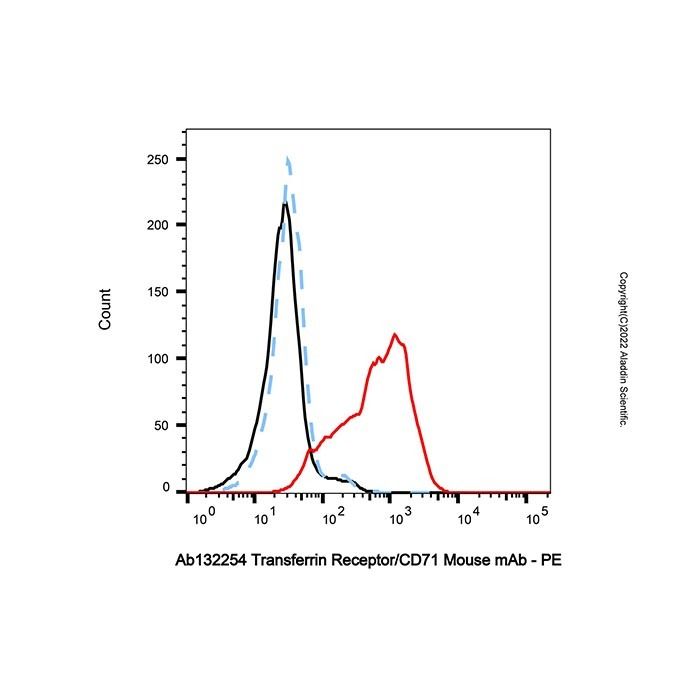
Transferrin Receptor/CD71 Mouse mAb (Ab132254) - Flow Cytometry
Flow Cytometry analysis of Jurkat cells labelling Transferrin Receptor/CD71 (red) with Transferrin Receptor/CD71 Mouse mAb (Ab132254) at 0.5 μg/mL for 1 hour at 4°C. Goat Anti-Mouse IgG (PE) (Ab179006) at a dilution of 1/1000 was used as the secondary antibody. Blue - Isotype control, mouse IgG (Ab170221). Black - Unlabelled control, cells without incubation with primary antibody.

Transferrin Receptor/CD71 Mouse mAb (Ab132254) - Flow Cytometry
Flow Cytometry analysis of 500 ng/mL Ionomycin (I139530) and 10 ng/mL PMA (P408905) co-stimulated Jurkat cells (24h) labelling Transferrin Receptor/CD71 (red) with Transferrin Receptor/CD71 Mouse mAb (Ab132254) at 0.5 μg/mL for 1 hour at 4°C. Goat Anti-Mouse IgG (PE) (Ab179006) at a dilution of 1/1000 was used as the secondary antibody. Blue - Isotype control, mouse IgG (Ab170221). Black - Unlabelled control, cells without incubation with primary antibody.

Transferrin Receptor/CD71 Mouse mAb (Ab132254) - Flow Cytometry
Flow Cytometry analysis of MOLT-4 cells labelling Transferrin Receptor/CD71 (red) with Transferrin Receptor/CD71 Mouse mAb (Ab132254) at 5.0 μg/mL for 1 hour at 4°C. Goat Anti-Mouse IgG (PE) (Ab179006) at a dilution of 1/1000 was used as the secondary antibody. Blue - Isotype control, mouse IgG (Ab170221). Black - Unlabelled control, cells without incubation with primary antibody.

Transferrin Receptor/CD71 Mouse mAb (Ab132254) - Flow Cytometry
Flow Cytometry analysis of 500 ng/mL Ionomycin (I139530) and 10 ng/mL PMA (P408905) co-stimulated MOLT-4 cells (24h) labelling Transferrin Receptor/CD71 (red) with Transferrin Receptor/CD71 Mouse mAb (Ab132254) at 0.5 μg/mL for 1 hour at 4°C. Goat Anti-Mouse IgG (PE) (Ab179006) at a dilution of 1/1000 was used as the secondary antibody. Blue - Isotype control, mouse IgG (Ab170221). Black - Unlabelled control, cells without incubation with primary antibody.

Transferrin Receptor/CD71 Mouse mAb (Ab132254) - Flow Cytometry
Flow Cytometry analysis of K562 cells labelling Transferrin Receptor/CD71 (red) with Transferrin Receptor/CD71 Mouse mAb (Ab132254) at 2.0 μg/mL for 1 hour at 4°C. Goat Anti-Mouse IgG (PE) (Ab179006) at a dilution of 1/1000 was used as the secondary antibody. Blue - Isotype control, mouse IgG (Ab170221). Black - Unlabelled control, cells without incubation with primary antibody.

Transferrin Receptor/CD71 Mouse mAb (Ab132254) - Flow Cytometry
Flow Cytometry analysis of U937 cells labelling Transferrin Receptor/CD71 (red) with Transferrin Receptor/CD71 Mouse mAb (Ab132254) at 2.0 μg/mL for 1 hour at 4°C. Goat Anti-Mouse IgG (PE) (Ab179006) at a dilution of 1/1000 was used as the secondary antibody. Blue - Isotype control, mouse IgG (Ab170221). Black - Unlabelled control, cells without incubation with primary antibody.

Aplicação
Aplicação
Dilution info
IHC

Use at an assay dependent concentration.

Flow Cytometry

Use at an assay dependent concentration.

IF/ICC

Use at an assay dependent concentration.

Dados avançados

Alvos associados (humanos)
TFRC Tclin Transferrin receptor protein 1 (0 Activities)
Activity TypeActivity Value -log(M)Mechanism of ActionActivity ReferencePublications (PubMed IDs)
TFRC Tclin Transferrin receptor protein 1 (0 Activities)
Activity TypeRelationActivity valueUnitsAction TypeJournalPubMed IddoiAssay Aladdin ID
Mecanismos de ação
Certificados(CoA,COO,BSE/TSE e Mapa de Análise)
C of A & Other Certificates(BSE/TSE, COO):
Analytical Chart:

Find and download the COA for your product by matching the lot number on the packaging.

3 results found

Lot NumberCertificate TypeDataItem
ZJ24F0707977ZJ24F0707977Certificate of AnalysisOct 08, 2026 Ab132254
ZJ24F0707978ZJ24F0707978Certificate of AnalysisOct 08, 2026 Ab132254
ZJ24F0707979ZJ24F0707979Certificate of AnalysisOct 08, 2026 Ab132254
FAQs e artigos
Calculadoras de soluções
Revisões

Avaliações dos Clientes

Application Protocols

Item-specific tested applications, dilutions, and positive controls are Not specified for this item; refer to CoA/Spec Sheet.

General protocol frameworks (for planning only; not product-specific instructions)

  • Sample handling: Keep antibody on ice during setup. Because the product is azide-free, maintain sterility of buffers and consumables.
  • Flow cytometry (framework): Prepare cells in PBS + 1–2% protein blocker (e.g., FBS or BSA) if compatible. Incubate with primary antibody on ice or 4°C to minimize internalization. Wash 2–3×, analyze promptly.
  • Immunoblot (framework): Transfer proteins to PVDF/nitrocellulose. Block membrane, incubate with primary antibody, then with species-appropriate secondary. Wash thoroughly to reduce background.
  • Immunofluorescence/IHC (framework): Fix and permeabilize as required by target localization. Block, incubate with primary, then fluor-conjugated or enzyme-conjugated secondary. Control for antigen retrieval conditions when targeting membrane proteins.
  • Conjugation (framework): For carrier-free antibodies, perform buffer exchange into conjugation-appropriate buffer (if needed), react with label under suitable pH/temperature, then purify by desalting/SEC. Verify activity post-labeling.

Please consult the product CoA/Spec Sheet for any validated applications and recommended working conditions specific to Ab132254.

Biological Roles

General biology of Transferrin Receptor (CD71) (literature; not product-specific claims)

  • Function: CD71 (TFRC) is a type II transmembrane glycoprotein that mediates cellular iron uptake by binding diferric transferrin and internalizing via clathrin-mediated endocytosis. Iron release occurs in endosomes at low pH; the receptor recycles to the surface.
  • Expression: Elevated on proliferating cells, activated lymphocytes, erythroid precursors, and many rapidly dividing cell lines. Lower on quiescent cells. Expression is regulated by iron status and IRP/IRE post-transcriptional control.
  • Structure: Homodimer at the plasma membrane; cytosolic tail contains motifs for endocytosis (YXXΦ). The extracellular domain engages transferrin and certain pathogens that exploit CD71 for entry (literature context).
  • Pathways: Interfaces with iron metabolism, oxidative stress responses, and mitochondrial biogenesis. Crosstalk with mTOR and cell-cycle signaling via iron availability.
  • Research utility: A robust marker of activation/proliferation; used for tracking endocytosis, receptor recycling kinetics, and iron homeostasis perturbations.

Note on this product

  • Species reactivity, clone identity, and epitope mapping for Ab132254 are Not specified for this item; refer to CoA/Spec Sheet. Validate applicability to your biological system empirically.
Buffer Applications

Item-specific fact

  • Formulation: PBS Only (carrier-free, azide-free).

General buffer guidance (literature; not product-specific specs)

  • PBS composition (typical): ~137 mM NaCl, 2.7 mM KCl, 10 mM phosphate, pH 7.2–7.4. Maintains isotonic conditions and near-physiological pH, suitable for most immunoassays.
  • Working buffers: For staining or ELISA, PBS can be supplemented at point-of-use with 0.05–0.1% Tween-20 (wash buffers) and 0.5–5% protein blockers (e.g., BSA, casein) to reduce nonspecific binding—note that the stock product is carrier-free; add blockers only in your assay workflow as needed.
  • Metal sensitivity: Phosphate can chelate/divert metal ions; if your assay employs metal-dependent conjugates (e.g., certain labeling chemistries), TBS may be preferable.
  • pH adjustments: Maintain pH 6.8–7.6 during handling to prevent denaturation/aggregation. Avoid low-ionic-strength water dilutions.
  • Sterility: Because the product is azide-free, prepare working buffers with sterile technique and filter (0.22 µm) where compatible.

Any item-specific buffer additives, stabilizers, or recommended diluents beyond PBS are Not specified for this item; refer to CoA/Spec Sheet.

Green Alternatives

Sustainability considerations for antibody reagents (general; not product-specific performance)

  • Preservatives: Azide-free formulation eliminates sodium azide hazards to aquatic life and reduces disposal constraints. Trade-off: higher risk of microbial growth—use aseptic technique and single-use aliquots (without freezing for this item).
  • Shipping: Wet-ice shipping (2–8°C) avoids dry-ice CO2 emissions but shortens allowable transit time; coordinate delivery to minimize spoilage risk.
  • Packaging: Prefer recyclable secondary packaging and concentrate shipments to reduce cold-chain burden.
  • Buffer selection: PBS is benign and widely compatible; avoid buffers requiring hazardous components when not necessary.
  • Process choices: Use low-energy cold storage (2–8°C) instead of ultra-low freezers where stability allows; for this item, freezing is not allowed, which aligns with reduced energy but demands inventory discipline to minimize waste.

Comparison (general)

  • Sodium azide vs. azide-free: Azide provides robust preservation but introduces toxicity and waste-treatment issues. Azide-free is greener but needs stricter asepsis and shorter open-bottle lifetimes.
  • Organic solvent-based conjugations vs. aqueous bioconjugation: Favor aqueous click/enzymatic methods (e.g., Sortase A, transglutaminase, SPAAC) over DMF/DMSO-heavy protocols when feasible.

Actionable tips

  • Plan experiments to use full vial contents promptly after opening.
  • Employ sterile, low-bind consumables to limit losses and contamination, reducing repeat runs and waste.
Pharmaceutical Uses

Scope

  • This reagent is designated For research use only. Not for human or veterinary use, not for diagnostic or therapeutic applications.

General formulation/CMC context for antibodies (literature; not product-specific claims)

  • Excipient roles: Antibodies are commonly formulated with buffers (histidine, phosphate), tonicity agents (NaCl, sucrose), stabilizers (trehalose), and surfactants (polysorbate-20/80). This item is PBS Only and carrier-free, azide-free—well-suited to analytical workflows and conjugation where excipients would interfere.
  • Analytical standards: Research-grade anti-CD71 antibodies may serve as in-process controls or analytical reagents in bioprocess development (e.g., flow cytometry of cell banks, ligand-binding assays), subject to internal qualification.
  • Conjugate manufacturing (research scale): Carrier-free format facilitates site-nonspecific conjugations (e.g., HRP, fluorophores, chelators) without competing proteins.

Regulatory note

  • For GMP, clinical, or diagnostic use, product-specific documentation (e.g., lot traceability, endotoxin/bioburden) and appropriate grade would be required. These attributes are Not specified for this item; refer to CoA/Spec Sheet.
Physical Properties

Item-specific facts (from Product Data)

  • Matrix/buffer: PBS Only (carrier-free, azide-free)
  • Appearance, concentration, protein mass: Not specified for this item; refer to CoA/Spec Sheet.

General/literature properties for IgG-class mAbs (not product specifications)

  • Approximate molecular mass: ~150 kDa for IgG (heavy–light tetramer). Actual value varies with glycoform and isotype.
  • Isoelectric point (pI): typically ~6–9 depending on sequence/glycosylation (literature).
  • Solubility: Highly soluble in aqueous buffers; insoluble in most neat organic solvents. Stability is sensitive to pH, ionic strength, and temperature (literature).
  • Preferred pH range: near-neutral buffers (e.g., PBS pH ~7.2–7.4) to maintain conformational integrity (literature).
  • Viscosity: concentration-dependent; solutions above ~10 mg/mL can become noticeably viscous (literature).
  • Optical properties: Strong UV absorption at 280 nm due to Trp/Tyr; A280 ~1.4 corresponds to ~1 mg/mL for IgG (approximate extinction coefficient; literature).

Handling implications

  • Carrier-free, azide-free protein is more sensitive to microbial growth; maintain sterile technique and minimize time at ambient temperature.

Any parameters not explicitly listed above are Not specified for this item; refer to CoA/Spec Sheet.

Quality and Grades

Item-specific facts (from Product Data)

  • Grade/Purity: Carrier Free, Azide Free, Validated, PBS Only.

What these designations mean (general guidance; not additional specs)

  • Carrier Free: No added protein carriers (e.g., BSA, gelatin). Advantages: precise mass balance for conjugation/immobilization; reduced risk of background in immunoassays; compatible with downstream analytics (MS, SEC). Implication: higher propensity for nonspecific adsorption—use low-bind plastics and include benign protein blockers only at point-of-use if assay allows.
  • Azide Free: No sodium azide preservative. Advantages: compatible with live-cell applications and peroxidase systems that azide inhibits. Implication: increased microbial contamination risk—maintain sterility and store strictly at 2–8°C; consider single-use aliquots if permitted by the item’s instructions (note: this item: do not freeze).
  • PBS Only: Formulated solely in phosphate-buffered saline (near neutral pH). Advantages: physiological ionic strength and pH stability; wide assay compatibility. Implication: limited buffering capacity against drastic pH shifts; avoid dilution into low-ionic-strength water.
  • Validated: Indicates the product has undergone internal performance checks. Specific validated applications, species reactivity, clone ID, and isotype are Not specified for this item; refer to CoA/Spec Sheet.

Recommendation

  • For regulated work or critical assays, request or consult the Certificate of Analysis/Specification Sheet for lot-specific QC methods (purity profile, binding titer/affinity, endotoxin, bioburden) where available.
Reaction and Applications

Item-specific applications

  • Manufacturer Applications: Not specified for this item; refer to CoA/Spec Sheet.

General research uses for anti-Transferrin Receptor (CD71) antibodies (literature; not product-specific claims)

  • Flow cytometry: Detects surface CD71 for cell-cycle activation state, reticulocyte maturation, and iron-uptake studies. Often used to enrich activated lymphocytes or proliferating cell subsets.
  • Immunoblotting: Recognizes CD71 (transferrin receptor 1, ~95 kDa monomer; ~180 kDa dimer under non-reducing conditions) in cell lysates to monitor expression or pathway modulation.
  • Immunofluorescence/IHC: Visualizes membrane localization and internalization dynamics of CD71; useful in endocytosis and receptor trafficking studies.
  • Immunoprecipitation: Pull-down of CD71 complexes for proteomics or interaction studies, including analysis of clathrin-mediated endocytosis components.
  • Ligand competition and uptake assays: Antibody binding can report on receptor availability versus transferrin occupancy (observational assays; experimental design dependent).

Practical tips (general)

  • Because this item is carrier-free and azide-free in PBS, maintain sterility and consider adding assay-appropriate blockers only at the time of use.
  • For live-cell labeling, keep temperatures low (4°C) to minimize internalization during staining unless internalization is desired for trafficking assays.
  • Validate species cross-reactivity and tested applications empirically for your system if not provided on the CoA.
Reaction Conditions

General conditions for common antibody bioconjugations (literature; not product-specific)

  • NHS-ester labeling (Lys): pH 7.5–8.5 in PBS or bicarbonate buffer; 4–25°C; 30–120 min. Quench with Tris or ethanolamine. Avoid high primary-amine buffers.
  • Maleimide–thiol coupling (Cys): Reduce selectively with TCEP (≤1–5 mM) or limited DTT; label at pH 6.5–7.0 to favor thiol selectivity; 4–25°C; 30–120 min. Remove reducing agent before coupling.
  • Glycan oxidation/oxime ligation: Periodate oxidation at 0–4°C in acetate buffer (pH ~5.5), then oxime/hydrazone formation with aminooxy/hydrazide labels at pH 4.5–6.5; aniline can catalyze oxime formation.
  • Click chemistry (SPAAC): Introduce azide or cyclooctyne via amine/glycan handles; conjugate in PBS at neutral pH without copper; 4–25°C.
  • Enzymatic methods: Sortase A at pH 7.0–8.0 with Ca2+ (unless Ca2+-independent variants used); microbial transglutaminase near neutral pH.

Workup and analytics

  • Remove excess reagents by desalting columns (NAP-5/10), spin filters (30–100 kDa MWCO), or SEC.
  • Characterize by UV-Vis (A280 with dye correction), SDS-PAGE (reducing/non-reducing), SEC-HPLC (aggregation), and MS (intact/subunit) where available.

Caveats

  • Maintain 2–8°C when possible to preserve activity; brief room-temperature incubations may be acceptable depending on chemistry.
  • For this specific product, freezing is not permitted; plan workflows accordingly.

Any item-specific recommended conditions are Not specified for this item; refer to CoA/Spec Sheet.

Safety and Handling

Item-specific facts (from Product Data)

  • Storage: Store at 2–8°C. Do not freeze.
  • Shipping: Wet ice. Do not freeze in transit.
  • Grade: Carrier Free, Azide Free, PBS Only.
  • GHS/SDS fields (signal word, hazard statements, pictograms): Not specified for this item; refer to SDS.

General safety guidance (literature/best practice; defer to SDS for authoritative data)

  • Classification: Antibodies in PBS without sodium azide generally present low acute chemical hazard, but are biological materials. Treat as potentially bioactive laboratory reagents; avoid ingestion/injection and aerosol formation.
  • PPE: Laboratory coat, nitrile gloves, and safety glasses. Use biological safety cabinet if sterility must be maintained or if aerosol generation is possible.
  • Hygiene: Avoid microbial contamination—product is azide-free (no bacteriostatic preservative). Work aseptically and return to 2–8°C promptly.
  • Incompatibilities: Avoid organic solvents, strong acids/bases, and oxidants that denature proteins. Do not mix with sodium hypochlorite (bleach) in presence of protein residues—can generate chloramines.
  • First aid (general): Skin—wash with water/soap. Eyes—rinse with water for several minutes. Ingestion—inadvertent ingestion: rinse mouth, seek medical attention. Inhalation of aerosols—move to fresh air. Provide SDS to physician.
  • Spill/cleanup: Absorb with inert material, disinfect area with appropriate laboratory disinfectant. Dispose per institutional biosafety procedures.

Always consult the product’s SDS and institutional EHS policies for risk assessment and waste disposal.

Solvent Selection

Applicability

  • This is an aqueous protein reagent (antibody in PBS). Organic solvent selection is typically not applicable.

General guidance (literature; not item-specific specs)

  • Primary medium: Use isotonic, near-neutral aqueous buffers (e.g., PBS, HEPES-buffered saline). Maintain ionic strength to prevent aggregation.
  • Avoid: Neat organic solvents, high concentrations of DMSO, acetone, acetonitrile, alcohols—these can denature/precipitate antibodies. If coupling chemistry necessitates organic cosolvent (e.g., DMF for NHS esters), keep final organic content low (≤10–20%) and verify stability empirically.
  • Detergents: For certain assays, mild nonionic detergents (0.01–0.1% Tween-20) can reduce nonspecific binding. Confirm compatibility with downstream detection.
  • pH window: Most IgGs are stable around pH 6.5–8.0. Short exposure to mildly basic pH (8.3–8.5) is common for NHS-ester labeling, followed by immediate buffer exchange (literature).

When to choose PBS vs alternatives

  • PBS: Routine immunoassays, flow cytometry, and IHC sample handling.
  • Tris-buffered saline (TBS): Preferred when phosphate can interfere (e.g., with certain metal-dependent systems).
  • HEPES-buffered saline: Enhanced pH stability in CO2-independent conditions (e.g., live-cell imaging).

Item-specific buffer additives and solvent tolerances are Not specified for this item; refer to CoA/Spec Sheet.

Storage and Reconstitution

Item-specific instructions (from Product Data)

  • Storage temperature: Store at 2–8°C.
  • Do not freeze: Freezing is explicitly contraindicated for this product.
  • Shipping: Shipped on wet ice (2–8°C). Do not freeze in transit.
  • Formulation: PBS Only; Carrier Free; Azide Free.

Handling guidance (general best practices; not additional specs)

  • Upon receipt: Inspect for container integrity and keep continuously at 2–8°C. Record opening date.
  • Asepsis: Because the product lacks azide, work aseptically to prevent microbial growth. Use sterile, low-protein-binding tubes and tips.
  • Aliquoting: If multiple uses are anticipated, prepare single-use aliquots under sterile conditions to minimize repeated cap-open events. Store all aliquots at 2–8°C (do not freeze).
  • Mixing: Gently invert—avoid vigorous vortexing or foaming which may denature proteins.
  • Dilution: Use sterile PBS or assay-appropriate sterile buffer at near-neutral pH. Avoid low-ionic-strength water.
  • Stability/expiry: Not specified for this item; refer to CoA/Spec Sheet for shelf life and any post-opening use-by window.
  • Reconstitution: Not applicable if supplied as a liquid. If supplied lyophilized (not specified), reconstitute with sterile buffer per CoA.

Disposal

  • Dispose of unused materials and consumables according to institutional biosafety and chemical waste policies.

For any lot-specific stability data or recommended preservatives/additives, consult the CoA/Spec Sheet.

Structure and Identity

Item-specific facts (from Product Data)

  • Product: Transferrin Receptor/CD71 Mouse mAb (SKU: Ab132254)
  • Type: Monoclonal antibody, host species: Mouse (item-specific)
  • Formulation/grade: Carrier Free, Azide Free, Validated, PBS Only
  • CAS, CID, InChIKey, SMILES: Not specified for this item; refer to CoA/Spec Sheet.
  • Molecular formula and exact molecular weight: Not specified for this item; refer to CoA/Spec Sheet.

General/literature description (for context; not product-specification)

  • Monoclonal antibodies are large glycoproteins composed of two heavy chains (~50 kDa each) and two light chains (~25 kDa each) linked by disulfide bonds, forming a Y-shaped ~150 kDa tetramer (IgG architecture; literature).
  • Structural features: conserved Fc region and variable Fab regions; multiple intrachain and interchain disulfides; N-linked glycosylation on Fc (and sometimes Fab) that can influence Fc interactions (literature).
  • Epitope recognition: anti-CD71 antibodies bind extracellular domains of the human/mouse transferrin receptor (species and epitope for this item are not specified; literature context only).
  • 2D description in words: Protein biopolymer with repeating peptide backbone (–NH–CH(R)–CO–)n, diversified by 20 amino-acid side chains, folded into beta-sheet/loop-rich immunoglobulin domains; surface-exposed lysines/tyrosines/cysteines enable conjugation chemistry (literature).

Notes

  • Because antibodies are heterogeneous glycoproteins, an exact elemental formula or single InChIKey/SMILES is not applicable. Refer to the product CoA for isotype and any clone-specific identity details if available.
Synthetic Utility

Context

  • Although a biological reagent rather than a small-molecule building block, a carrier-free, azide-free monoclonal antibody is an excellent substrate for bioconjugation and immobilization chemistries.

Functional groups and reactivity (literature; not product-specific claims)

  • Lysine ε-amines: Amenable to NHS-ester or isothiocyanate labeling (pH 7.5–8.5) for fluorophores, haptens, or linkers.
  • Cysteines: Native interchain disulfides can be selectively reduced (mildly) to expose thiols for maleimide, iodoacetamide, or pyridyldithiol coupling (partially reducing conditions to control DAR for ADC-like conjugates).
  • Carbohydrates (Fc glycan): Oxidation (NaIO4) yields aldehydes for oxime/hydrazone ligation, or enzymatic remodeling (GalT, EndoS) enables site-specific glycan conjugation.
  • Tyrosines/Tryptophans: Diazonium or radical-mediated tagging (less common; may affect activity).
  • Enzymatic handles: Sortase A (LPXTG motif engineering), microbial transglutaminase (Gln/Lys pairs), and Fc-binding tags (Protein A/G-based oriented immobilization) for site-specificity.

Applications enabled

  • Fluorescent, HRP, or biotin conjugates for detection assays.
  • Surface immobilization on resins, biosensors (SPR/BLI), or microarrays.
  • Payload attachment for targeted delivery in cell studies (non-clinical).

Note

  • Clone identity, isotype, and specific conjugation tolerances for Ab132254 are Not specified for this item; verify activity post-conjugation empirically.
Target Specificity

This section is limited to item-specific information only.

  • Antigen/Target: Transferrin Receptor (CD71) — name from Product Title.
  • Antibody type: Mouse monoclonal antibody (from Product Title).
  • Clone ID, isotype, epitope mapping, species reactivity, cross-reactivity, and validation data: Not specified for this item; refer to CoA/Spec Sheet.
  • Tested applications (WB, IHC, IF, FC), recommended dilutions, positive controls: Not specified for this item; refer to CoA/Spec Sheet.

Precisa de ajuda para escolher o grau?

O nosso guia de seleção de graus abrange pureza, estado do estabilizador e adequação à aplicação para todas as variantes do nosso catálogo.

Ver o guia de graus Carrier Free → Ver o guia de graus Validated → Ver o guia de graus Azide Free → Ver o guia de graus PBS Only →

Produtos Relacionados

Goat Anti-Mouse IgG H&L Antibody - Secondary antibody, for ELISA,LF,GICA various applications, from Mouse, generated in Goat
Goat Anti-Mouse IgG H&L (HRP) - Secondary antibody, for WB,ELISA,IHC-P various applications, from Mouse, generated in Goat, IgG
Mouse IgG - Isotype Control Antibody, generated in Rat, >95%, IgG
Rabbit Anti-Mouse IgG H&L (HRP) - Secondary antibody, IgG
BALB/c Mouse IgG - Isotype Control Antibody, IgG
Rabbit Anti-Mouse IgG antibody - Secondary antibody
Goat Anti-Mouse IgG H&L (FITC) - Secondary antibody
Goat Anti-Mouse IgG H&L (TRITC) - Secondary antibody
Goat Anti-Mouse IgG H&L Antibody - Secondary antibody, Goat IgG
Goat Anti-Mouse IgG H&L (Cy5) - Secondary antibody
Goat Anti-Mouse IgG H&L (HRP) - Secondary antibody
Goat Anti-Mouse IgG H&L (Biotin) - Secondary antibody
Rabbit Anti-Mouse IgG (HRP) - Secondary antibody
Rabbit Anti-Mouse IgG (Biotin) - Secondary antibody
Goat Anti-Mouse IgG H&L (HRP) - Secondary antibody, Goat IgG
Goat Anti-Mouse IgG H&L (TRITC) - Secondary antibody, Goat IgG
Goat Anti-Mouse IgG H&L (Biotin) - Secondary antibody, Goat IgG
Goat Anti-Mouse IgG H&L (FITC) - Secondary antibody, Goat IgG
Goat Anti-Mouse IgG H&L (Cy5) - Secondary antibody, Goat IgG
Goat Anti-Mouse IgG H&L (PE) - Secondary antibody, Goat IgG
Goat Anti-Mouse IgG H&L (APC) - Secondary antibody, Goat IgG
Mouse IgG (Biotin) - Isotype Control Antibody, Mouse IgG
Mouse IgG (PE) - Isotype Control Antibody, Mouse IgG
Mouse IgG (APC) - Isotype Control Antibody, Mouse IgG
Mouse IgG (FITC) - Isotype Control Antibody, Mouse IgG
Mouse IgG2a-Fc - Isotype Control Antibody, Mouse IgG2a
Recombinant Transferrin Receptor Antibody - Primary antibody, specific to Transferrin Receptor, Mouse IgG2b
Goat Anti-Mouse IgG H&L (Alkaline Phosphatase) - Secondary antibody, Goat IgG
Transferrin Receptor/CD71 Mouse mAb - Primary antibody, specific to Transferrin Receptor/CD71, Mouse IgG1
Goat Anti-Mouse IgG H&L (AF405) - Secondary antibody, Goat IgG
Goat Anti-Mouse IgG H&L (AF647) - Secondary antibody, Goat IgG
Mouse IgG2b-kappa, anti-Spike RBD - Isotype Control Antibody, specific to Spike RBD, Mouse IgG2b
Mouse IgG2a-kappa, anti-Spike RBD - Isotype Control Antibody, specific to Spike RBD, Mouse IgG2a
Mouse IgG3-kappa, anti-HEL - Isotype Control Antibody, specific to HEL, Mouse IgG3
Mouse IgG2c-kappa, anti-HEL - Isotype Control Antibody, specific to HEL, Mouse IgG2c
Mouse lgG2A(D265A)-kappa, anti-HEL - Isotype Control Antibody, specific to HEL, Mouse IgG2a(D265A)
Mouse IgG1(D265A)-kappa, anti-HEL - Isotype Control Antibody, specific to HEL, Mouse IgG1(D265A)
Mouse IgG (AF488) - Isotype Control Antibody, IgG
Mouse IgG (PerCP) - Isotype Control Antibody, IgG
Mouse IgG (AF405) - Isotype Control Antibody, IgG
Mouse IgG (AF647) - Isotype Control Antibody, IgG
Goat Anti-Mouse IgG H&L (AF555) - Secondary antibody, specific to Mouse IgG, Goat IgG
Mouse IgG (AF700) - Isotype Control Antibody, IgG
Goat Anti-Mouse IgG H&L (AF700) - Secondary antibody, specific to Mouse IgG, Goat IgG
Jr-141 (anti-TfR) - Primary antibody, specific to TFRC, Human IgG1
Mouse IgG (PE-Cy5) - Isotype Control Antibody
Mouse IgG (PE-Cy7) - Isotype Control Antibody
Mouse IgG2b-kappa, anti-E8L - Isotype Control Antibody, specific to E8L
Mouse IgG2a-kappa, anti-A29L - Isotype Control Antibody, specific to A29L
Transferrin Receptor/CD71 Mouse mAb (APC) - Primary antibody, specific to Transferrin Receptor/CD71
Transferrin Receptor/CD71 Mouse mAb (Biotin) - Primary antibody, specific to Transferrin Receptor/CD71
Transferrin Receptor/CD71 Mouse mAb (AF647) - Primary antibody, specific to Transferrin Receptor/CD71
Transferrin Receptor/CD71 Mouse mAb (PE) - Primary antibody, specific to Transferrin Receptor/CD71
Transferrin Receptor/CD71 Mouse mAb (FITC) - Primary antibody, specific to Transferrin Receptor/CD71
Mouse IgG2c-kappa (AF647), anti-HEL - Isotype Control Antibody, specific to HEL
Mouse IgG2c-kappa (AF700), anti-HEL - Isotype Control Antibody, specific to HEL
Mouse IgG2c-kappa (AF405), anti-HEL - Isotype Control Antibody, specific to HEL
Mouse IgG2c-kappa (Biotin), anti-HEL - Isotype Control Antibody, specific to HEL
Mouse IgG2a-kappa (APC), anti-Spike RBD - Isotype Control Antibody, specific to Spike RBD
Mouse IgG2a-kappa (FITC), anti-Spike RBD - Isotype Control Antibody, specific to Spike RBD
Mouse IgG2a-kappa (AF700), anti-Spike RBD - Isotype Control Antibody, specific to Spike RBD
Mouse IgG2a-kappa (AF647), anti-Spike RBD - Isotype Control Antibody, specific to Spike RBD
Mouse IgG2a-kappa (AF555), anti-Spike RBD - Isotype Control Antibody, specific to Spike RBD
Mouse IgG2a-kappa (AF405), anti-Spike RBD - Isotype Control Antibody, specific to Spike RBD
Mouse IgG2c-kappa (FITC), anti-HEL - Isotype Control Antibody, specific to HEL
Mouse IgG2c-kappa (AF555), anti-HEL - Isotype Control Antibody, specific to HEL
Mouse IgG2c-kappa (APC), anti-HEL - Isotype Control Antibody, specific to HEL
Mouse IgG2c-kappa (PE), anti-HEL - Isotype Control Antibody, specific to HEL
Mouse IgG2a-kappa (Biotin), anti-Spike RBD - Isotype Control Antibody, specific to Spike RBD
Mouse IgG2a-Fc (Biotin) - Isotype Control Antibody
Mouse IgG2a-Fc (FITC) - Isotype Control Antibody
Transferrin Receptor/CD71 Mouse mAb (AF700) - Primary antibody, specific to Transferrin Receptor/CD71
Transferrin Receptor/CD71 Mouse mAb (AF555) - Primary antibody, specific to Transferrin Receptor/CD71
Transferrin Receptor/CD71 Mouse mAb (AF405) - Primary antibody, specific to Transferrin Receptor/CD71
Mouse IgG (AF555) - Isotype Control Antibody
Mouse IgG2b-kappa (Biotin), anti-Spike RBD - Isotype Control Antibody, specific to Spike RBD
Mouse IgG2b-kappa (FITC), anti-Spike RBD - Isotype Control Antibody, specific to Spike RBD
Mouse IgG2b-kappa (APC), anti-Spike RBD - Isotype Control Antibody, specific to Spike RBD
Mouse IgG2b-kappa (APC-Cy7), anti-Spike RBD - Isotype Control Antibody, specific to Spike RBD
Goat Anti-Mouse IgG H&L (PE-Cy5) - Secondary antibody, specific to Mouse IgG
Centrose patent anti-dysadherin (anti-Dysadherin) - Primary antibody, specific to FXYD5
Mouse IgG2a-kappa (AF405), anti-A29L - Isotype Control Antibody, specific to A29L
Mouse IgG2a-kappa (AF488), anti-A29L - Isotype Control Antibody, specific to A29L
Mouse IgG2a-kappa (AF647), anti-A29L - Isotype Control Antibody, specific to A29L
Mouse IgG2a-kappa (AF700), anti-A29L - Isotype Control Antibody, specific to A29L
Mouse IgG2a-kappa (Biotin), anti-A29L - Isotype Control Antibody, specific to A29L
Mouse IgG2a-kappa (FITC), anti-A29L - Isotype Control Antibody, specific to A29L
Mouse IgG3-kappa (Biotin), anti-HEL - Isotype Control Antibody, specific to HEL
Mouse IgG3-kappa (FITC), anti-HEL - Isotype Control Antibody, specific to HEL
Mouse IgG3-kappa (PE), anti-HEL - Isotype Control Antibody, specific to HEL
Mouse IgG3-kappa (AF488), anti-HEL - Isotype Control Antibody, specific to HEL
Mouse IgG3-kappa (APC), anti-HEL - Isotype Control Antibody, specific to HEL
Mouse IgG3-kappa (AF647), anti-HEL - Isotype Control Antibody, specific to HEL
Mouse IgG2b-kappa (AF555), anti-Spike RBD - Isotype Control Antibody, specific to Spike RBD
Goat Anti-Mouse IgG H&L (AF488) - Secondary antibody
Goat Anti-Mouse IgG H&L (PE-Cy7) - Secondary antibody
Mouse IgG (PE-Cy5.5) - Isotype Control Antibody
Goat Anti-Mouse IgG H&L (AF750) - Secondary antibody
Mouse IgG2a-kappa (AF555), anti-A29L - Isotype Control Antibody, specific to A29L
Mouse IgG2a-kappa (PE-Cy5.5), anti-A29L - Isotype Control Antibody, specific to A29L
Goat Anti-Mouse IgG H&L (AF546) - Secondary antibody
Goat Anti-Mouse IgG H&L (Oregon Green 488) - Secondary antibody
Goat Anti-Mouse IgG H&L (Cy3) - Secondary antibody
Mouse IgG2a-kappa (APC), anti-A29L - Isotype Control Antibody, specific to A29L
Mouse IgG3-kappa (AF555), anti-HEL - Isotype Control Antibody, specific to HEL
Mouse IgG (PE-AF647) - Isotype Control Antibody

Deseja que lhe enviemos uma mensagem quando tivermos descontos disponíveis?

Lembrar-me mais tarde

Obrigado! Por favor, verifique a sua caixa de entrada de e-mail para confirmar.

Ops! As notificações estão desativadas.