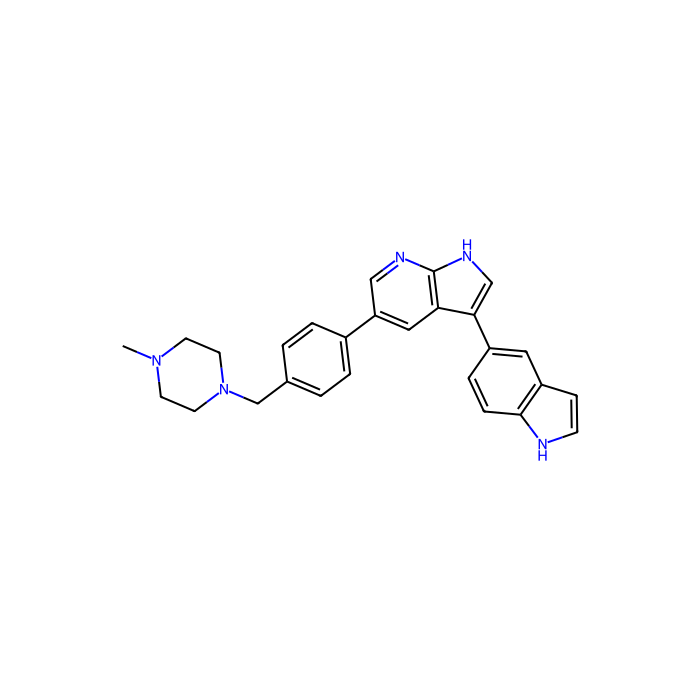
URMC-099 - Moligand™, ≥96% , Inhibitor of cyclin dependent kinase like 2;Inhibitor of death associated protein kinase 3;Inhibitor of fms related receptor tyrosine kinase 3;Inhibitor of leucine rich repeat kinase 2;Inhibitor of mitogen-activated protein ki, Inhibitor of cyclin dependent kinase like 2;Inhibitor of death associated protein kinase 3;Inhibitor of fms related receptor tyrosine kinase 3;Inhibitor of leucine rich repeat kinase 2;Inhibitor of mitogen-activated protein kinase kinase kinase 10;Inhibit

CAS: 1229582-33-5 Cat. No.: U275952 Fórmula: C27H27N5 Peso molecular: 421.54 PubChem CID: 54764565
Disponível para encomenda
GRAU & PUREZA Moligand™ ? Moligand™ — Aladdin's line of ligands and bioactive small molecules. Use for receptor, pathway, and binding studies needing defined small-molecule tools. ≥96%
Synonyms
3-(1H-Indol-5-yl)-5-[4-[(4-methyl-1-piperazinyl)methyl]phenyl]-1Hpyrrolo[2,3-b]pyridine
Storage
Store at -20°C,Argon charged
Shipped In
Ice chest + Ice pads
★
Tamanho
Alemanha (EU)
USA*
Preço
Qtd
5mg
U275952-5mg
—
3 Em stock
87,55€
10mg
U275952-10mg
—
3 Em stock
89,29€
25mg
U275952-25mg
—
3 Em stock
221,19€
50mg
U275952-50mg
—
3 Em stock
340,07€
100mg
U275952-100mg
—
1 Em stock
609,07€
Enter a quantity for the sizes you want to add.

Visão geral

Shipped at room temperature. Store at -20°C.

Especificações

Sinónimos
3-(1H-Indol-5-yl)-5-[4-[(4-methyl-1-piperazinyl)methyl]phenyl]-1Hpyrrolo[2,3-b]pyridine
Especificações e pureza
Moligand™, ≥96%
Mecanismos bioquímicos e fisiológicos
Novel orally bioavailable, brain penetrant\xa0mixed lineage kinase (MLK) inhibitor (IC 50 values of 19, 42, 14, and 150 nM for MLK1, MLK2, MLK3, and the related MLK family member DLK, respectively).
Condições de armazenamento de armazenamento
Store at -20°C,Argon charged
Enviado em
Ice chest + Ice pads
Este produto requer transporte de cadeia fria. Serviços terrestres e outros serviços econômicos não estão disponíveis.
Grau
Moligand™
Tipo de ação
INHIBITOR
Mecanismo de ação
Inhibitor of cyclin dependent kinase like 2;Inhibitor of death associated protein kinase 3;Inhibitor of fms related receptor tyrosine kinase 3;Inhibitor of leucine rich repeat kinase 2;Inhibitor of mitogen-activated protein kinase kinase kinase 10;Inhibit
Nota
Refer to SDS for further information. Need more advice on solubility, usage and handling? Please visit our frequently asked questions (FAQ) page for more details.
Pureza
≥96%
Nomes e identificadores
Pubchem Sid
Pubchem Sid Url
https://pubchem.ncbi.nlm.nih.gov/substance/504771397
Sorrisos canónicos
CN1CCN(CC1)CC2=CC=C(C=C2)C3=CC4=C(NC=C4C5=CC6=C(C=C5)NC=C6)N=C3
IUPAC Name
3-(1H-indol-5-yl)-5-[4-[(4-methylpiperazin-1-yl)methyl]phenyl]-1H-pyrrolo[2,3-b]pyridine
InChIKey
QKKIWEILHCXECO-UHFFFAOYSA-N
INCHI
1S/C27H27N5/c1-31-10-12-32(13-11-31)18-19-2-4-20(5-3-19)23-15-24-25(17-30-27(24)29-16-23)21-6-7-26-22(14-21)8-9-28-26/h2-9,14-17,28H,10-13,18H2,1H3,(H,29,30)
SMILES isoméricas
CN1CCN(CC1)CC2=CC=C(C=C2)C3=CC4=C(NC=C4C5=CC6=C(C=C5)NC=C6)N=C3
PubChem CID
54764565
Peso molecular
421.54

Dados avançados

Taxonomic Classification

Taxonomy Tree

KingdomOrganic compounds
SuperclassOrganoheterocyclic compounds
ClassePyridines and derivatives
SubclassPhenylpyridines
Intermediate Tree Nodes Not available
Direct ParentPhenylpyridines
Alternative Parents Pyrrolopyridines  Indoles  Phenylmethylamines  Benzylamines  N-methylpiperazines  Aralkylamines  Substituted pyrroles  Heteroaromatic compounds  Trialkylamines  Azacyclic compounds  Organopnictogen compounds  Hydrocarbon derivatives  
Molecular FrameworkAromatic heteropolycyclic compounds
Substituents 3-phenylpyridine - Indole - Indole or derivatives - Pyrrolopyridine - Benzylamine - Phenylmethylamine - Aralkylamine - N-alkylpiperazine - N-methylpiperazine - Benzenoid - 1,4-diazinane - Substituted pyrrole - Monocyclic benzene moiety - Piperazine - Heteroaromatic compound - Pyrrole - Tertiary aliphatic amine - Tertiary amine - Azacycle - Amine - Hydrocarbon derivative - Organopnictogen compound - Organonitrogen compound - Organic nitrogen compound - Aromatic heteropolycyclic compound
DescriçãoThis compound belongs to the class of organic compounds known as phenylpyridines. These are polycyclic aromatic compounds containing a benzene ring linked to a pyridine ring through a CC or CN bond.
External Descriptors Not available
Estrutura 3D
Modelo de Estrutura Química Interativa


Alvos associados (humanos)
CDKL2 Tchem Cyclin-dependent kinase-like 2 (0 Activities)
Activity TypeActivity Value -log(M)Mechanism of ActionActivity ReferencePublications (PubMed IDs)
DLK1 Tchem Protein delta homolog 1 (2 Activities)
Activity TypeActivity Value -log(M)Mechanism of ActionActivity ReferencePublications (PubMed IDs)
DAPK3 Tchem Death-associated protein kinase 3 (1 Activities)
Activity TypeActivity Value -log(M)Mechanism of ActionActivity ReferencePublications (PubMed IDs)
SRPK2 Tchem SRSF protein kinase 2 (0 Activities)
Activity TypeActivity Value -log(M)Mechanism of ActionActivity ReferencePublications (PubMed IDs)
FLT3 Tclin Receptor-type tyrosine-protein kinase FLT3 (2 Activities)
Activity TypeActivity Value -log(M)Mechanism of ActionActivity ReferencePublications (PubMed IDs)
TNIK Tchem TRAF2 and NCK-interacting protein kinase (1 Activities)
Activity TypeActivity Value -log(M)Mechanism of ActionActivity ReferencePublications (PubMed IDs)
MAP3K10 Tchem Mitogen-activated protein kinase kinase kinase 10 (1 Activities)
Activity TypeActivity Value -log(M)Mechanism of ActionActivity ReferencePublications (PubMed IDs)
LRRK2 Tchem Leucine-rich repeat serine/threonine-protein kinase 2 (2 Activities)
Activity TypeActivity Value -log(M)Mechanism of ActionActivity ReferencePublications (PubMed IDs)
MAP3K11 Tchem Mitogen-activated protein kinase kinase kinase 11 (2 Activities)
Activity TypeActivity Value -log(M)Mechanism of ActionActivity ReferencePublications (PubMed IDs)
MAP3K2 Tchem Mitogen-activated protein kinase kinase kinase 2 (1 Activities)
Activity TypeActivity Value -log(M)Mechanism of ActionActivity ReferencePublications (PubMed IDs)
ABL1 Tclin Tyrosine-protein kinase ABL1 (2 Activities)
Activity TypeActivity Value -log(M)Mechanism of ActionActivity ReferencePublications (PubMed IDs)
MAP3K9 Tchem Mitogen-activated protein kinase kinase kinase 9 (2 Activities)
Activity TypeActivity Value -log(M)Mechanism of ActionActivity ReferencePublications (PubMed IDs)
ABL1 Tclin Tyrosine-protein kinase ABL (18331 Activities)
Activity TypeRelationActivity valueUnitsAction TypeJournalPubMed IddoiAssay Aladdin ID
EGFR Tclin Epidermal growth factor receptor erbB1 (33727 Activities)
Activity TypeRelationActivity valueUnitsAction TypeJournalPubMed IddoiAssay Aladdin ID
INSR Tclin Insulin receptor (5558 Activities)
Activity TypeRelationActivity valueUnitsAction TypeJournalPubMed IddoiAssay Aladdin ID
KCNH2 Tclin HERG (29587 Activities)
Activity TypeRelationActivity valueUnitsAction TypeJournalPubMed IddoiAssay Aladdin ID
PDGFRB Tclin Platelet-derived growth factor receptor beta (5195 Activities)
Activity TypeRelationActivity valueUnitsAction TypeJournalPubMed IddoiAssay Aladdin ID
IGF1R Tclin Insulin-like growth factor I receptor (8605 Activities)
Activity TypeRelationActivity valueUnitsAction TypeJournalPubMed IddoiAssay Aladdin ID
KIT Tclin Stem cell growth factor receptor (10667 Activities)
Activity TypeRelationActivity valueUnitsAction TypeJournalPubMed IddoiAssay Aladdin ID
MAPK11 Tchem MAP kinase p38 beta (2785 Activities)
Activity TypeRelationActivity valueUnitsAction TypeJournalPubMed IddoiAssay Aladdin ID
LCK Tclin Tyrosine-protein kinase LCK (9212 Activities)
Activity TypeRelationActivity valueUnitsAction TypeJournalPubMed IddoiAssay Aladdin ID
MAPK14 Tchem MAP kinase p38 alpha (12866 Activities)
Activity TypeRelationActivity valueUnitsAction TypeJournalPubMed IddoiAssay Aladdin ID
GSK3B Tclin Glycogen synthase kinase-3 beta (11785 Activities)
Activity TypeRelationActivity valueUnitsAction TypeJournalPubMed IddoiAssay Aladdin ID
CSNK1D Tchem Casein kinase I delta (4546 Activities)
Activity TypeRelationActivity valueUnitsAction TypeJournalPubMed IddoiAssay Aladdin ID
SRC Tclin Tyrosine-protein kinase SRC (10310 Activities)
Activity TypeRelationActivity valueUnitsAction TypeJournalPubMed IddoiAssay Aladdin ID
AKT2 Tchem Serine/threonine-protein kinase AKT2 (4301 Activities)
Activity TypeRelationActivity valueUnitsAction TypeJournalPubMed IddoiAssay Aladdin ID
AKT3 Tchem Serine/threonine-protein kinase AKT3 (3157 Activities)
Activity TypeRelationActivity valueUnitsAction TypeJournalPubMed IddoiAssay Aladdin ID
CHUK Tchem Inhibitor of nuclear factor kappa B kinase alpha subunit (3170 Activities)
Activity TypeRelationActivity valueUnitsAction TypeJournalPubMed IddoiAssay Aladdin ID
IKBKB Tchem Inhibitor of nuclear factor kappa B kinase beta subunit (5554 Activities)
Activity TypeRelationActivity valueUnitsAction TypeJournalPubMed IddoiAssay Aladdin ID
AURKB Tchem Serine/threonine-protein kinase Aurora-B (6805 Activities)
Activity TypeRelationActivity valueUnitsAction TypeJournalPubMed IddoiAssay Aladdin ID
ROCK1 Tclin Rho-associated protein kinase 1 (4723 Activities)
Activity TypeRelationActivity valueUnitsAction TypeJournalPubMed IddoiAssay Aladdin ID
SYK Tclin Tyrosine-protein kinase SYK (7372 Activities)
Activity TypeRelationActivity valueUnitsAction TypeJournalPubMed IddoiAssay Aladdin ID
RPS6KA1 Tchem Ribosomal protein S6 kinase alpha 1 (2796 Activities)
Activity TypeRelationActivity valueUnitsAction TypeJournalPubMed IddoiAssay Aladdin ID
RPS6KA6 Tchem Ribosomal protein S6 kinase alpha 6 (2027 Activities)
Activity TypeRelationActivity valueUnitsAction TypeJournalPubMed IddoiAssay Aladdin ID
FLT1 Tclin Vascular endothelial growth factor receptor 1 (6262 Activities)
Activity TypeRelationActivity valueUnitsAction TypeJournalPubMed IddoiAssay Aladdin ID
MAPK13 Tchem MAP kinase p38 delta (2605 Activities)
Activity TypeRelationActivity valueUnitsAction TypeJournalPubMed IddoiAssay Aladdin ID
ROCK2 Tclin Rho-associated protein kinase 2 (6206 Activities)
Activity TypeRelationActivity valueUnitsAction TypeJournalPubMed IddoiAssay Aladdin ID
CYP2D6 Tclin Cytochrome P450 2D6 (33882 Activities)
Activity TypeRelationActivity valueUnitsAction TypeJournalPubMed IddoiAssay Aladdin ID
MET Tclin Hepatocyte growth factor receptor (10718 Activities)
Activity TypeRelationActivity valueUnitsAction TypeJournalPubMed IddoiAssay Aladdin ID
MAPK3 Tchem MAP kinase ERK1 (4725 Activities)
Activity TypeRelationActivity valueUnitsAction TypeJournalPubMed IddoiAssay Aladdin ID
CDK2 Tchem Cyclin-dependent kinase 2 (9050 Activities)
Activity TypeRelationActivity valueUnitsAction TypeJournalPubMed IddoiAssay Aladdin ID
MAP3K11 Tchem Mitogen-activated protein kinase kinase kinase 11 (808 Activities)
Activity TypeRelationActivity valueUnitsAction TypeJournalPubMed IddoiAssay Aladdin ID
MAP3K10 Tchem Mitogen-activated protein kinase kinase kinase 10 (401 Activities)
Activity TypeRelationActivity valueUnitsAction TypeJournalPubMed IddoiAssay Aladdin ID
NTRK1 Tclin Nerve growth factor receptor Trk-A (7922 Activities)
Activity TypeRelationActivity valueUnitsAction TypeJournalPubMed IddoiAssay Aladdin ID
MAP3K9 Tchem Mitogen-activated protein kinase kinase kinase 9 (945 Activities)
Activity TypeRelationActivity valueUnitsAction TypeJournalPubMed IddoiAssay Aladdin ID
CDK1 Tchem Cyclin-dependent kinase 1 (3927 Activities)
Activity TypeRelationActivity valueUnitsAction TypeJournalPubMed IddoiAssay Aladdin ID
ZAP70 Tchem Tyrosine-protein kinase ZAP-70 (2189 Activities)
Activity TypeRelationActivity valueUnitsAction TypeJournalPubMed IddoiAssay Aladdin ID
MAPK8 Tchem c-Jun N-terminal kinase 1 (5038 Activities)
Activity TypeRelationActivity valueUnitsAction TypeJournalPubMed IddoiAssay Aladdin ID
AKT1 Tchem Serine/threonine-protein kinase AKT (9192 Activities)
Activity TypeRelationActivity valueUnitsAction TypeJournalPubMed IddoiAssay Aladdin ID
FLT3 Tclin Tyrosine-protein kinase receptor FLT3 (13481 Activities)
Activity TypeRelationActivity valueUnitsAction TypeJournalPubMed IddoiAssay Aladdin ID
TYK2 Tclin Tyrosine-protein kinase TYK2 (5029 Activities)
Activity TypeRelationActivity valueUnitsAction TypeJournalPubMed IddoiAssay Aladdin ID
SGK1 Tchem Serine/threonine-protein kinase Sgk1 (2343 Activities)
Activity TypeRelationActivity valueUnitsAction TypeJournalPubMed IddoiAssay Aladdin ID
CYP2C9 Tchem Cytochrome P450 2C9 (32119 Activities)
Activity TypeRelationActivity valueUnitsAction TypeJournalPubMed IddoiAssay Aladdin ID
MAPK12 Tchem MAP kinase p38 gamma (2776 Activities)
Activity TypeRelationActivity valueUnitsAction TypeJournalPubMed IddoiAssay Aladdin ID
CYP3A4 Tclin Cytochrome P450 3A4 (53859 Activities)
Activity TypeRelationActivity valueUnitsAction TypeJournalPubMed IddoiAssay Aladdin ID
AURKA Tchem Serine/threonine-protein kinase Aurora-A (10240 Activities)
Activity TypeRelationActivity valueUnitsAction TypeJournalPubMed IddoiAssay Aladdin ID
AURKC Tchem Serine/threonine-protein kinase Aurora-C (1780 Activities)
Activity TypeRelationActivity valueUnitsAction TypeJournalPubMed IddoiAssay Aladdin ID
MARK2 Tchem MAP/microtubule affinity-regulating kinase 2 (2524 Activities)
Activity TypeRelationActivity valueUnitsAction TypeJournalPubMed IddoiAssay Aladdin ID
CLK1 Tchem Dual specificty protein kinase CLK1 (2189 Activities)
Activity TypeRelationActivity valueUnitsAction TypeJournalPubMed IddoiAssay Aladdin ID
CLK2 Tchem Dual specificity protein kinase CLK2 (3942 Activities)
Activity TypeRelationActivity valueUnitsAction TypeJournalPubMed IddoiAssay Aladdin ID
CLK4 Tchem Dual specificity protein kinase CLK4 (4053 Activities)
Activity TypeRelationActivity valueUnitsAction TypeJournalPubMed IddoiAssay Aladdin ID
TNIK Tchem TRAF2- and NCK-interacting kinase (1174 Activities)
Activity TypeRelationActivity valueUnitsAction TypeJournalPubMed IddoiAssay Aladdin ID
Alvos associados (não humanos)
Cdk4 Cyclin-dependent kinase 4 (3 Activities)
Activity TypeRelationActivity valueUnitsAction TypeJournalPubMed IddoiAssay Aladdin ID
Mapk1 MAP kinase ERK2 (650 Activities)
Activity TypeRelationActivity valueUnitsAction TypeJournalPubMed IddoiAssay Aladdin ID
Hdac6 Histone deacetylase 6 (222 Activities)
Activity TypeRelationActivity valueUnitsAction TypeJournalPubMed IddoiAssay Aladdin ID
Fgfr3 Fibroblast growth factor receptor 3 (21 Activities)
Activity TypeRelationActivity valueUnitsAction TypeJournalPubMed IddoiAssay Aladdin ID
Pseudomonas aeruginosa (123386 Activities)
Activity TypeRelationActivity valueUnitsAction TypeJournalPubMed IddoiAssay Aladdin ID
Klebsiella pneumoniae (43867 Activities)
Activity TypeRelationActivity valueUnitsAction TypeJournalPubMed IddoiAssay Aladdin ID
Staphylococcus aureus (210822 Activities)
Activity TypeRelationActivity valueUnitsAction TypeJournalPubMed IddoiAssay Aladdin ID
Acinetobacter baumannii (41033 Activities)
Activity TypeRelationActivity valueUnitsAction TypeJournalPubMed IddoiAssay Aladdin ID
Escherichia coli (133304 Activities)
Activity TypeRelationActivity valueUnitsAction TypeJournalPubMed IddoiAssay Aladdin ID
Cryptococcus neoformans (21258 Activities)
Activity TypeRelationActivity valueUnitsAction TypeJournalPubMed IddoiAssay Aladdin ID
Candida albicans (78123 Activities)
Activity TypeRelationActivity valueUnitsAction TypeJournalPubMed IddoiAssay Aladdin ID
Mus musculus (284745 Activities)
Activity TypeRelationActivity valueUnitsAction TypeJournalPubMed IddoiAssay Aladdin ID
rep Replicase polyprotein 1ab (378 Activities)
Activity TypeRelationActivity valueUnitsAction TypeJournalPubMed IddoiAssay Aladdin ID
Brain (1 Activities)
Activity TypeRelationActivity valueUnitsAction TypeJournalPubMed IddoiAssay Aladdin ID
Plasma (328 Activities)
Activity TypeRelationActivity valueUnitsAction TypeJournalPubMed IddoiAssay Aladdin ID
Mecanismos de ação
Certificados(CoA,COO,BSE/TSE e Mapa de Análise)
C of A & Other Certificates(BSE/TSE, COO):
Analytical Chart:

Find and download the COA for your product by matching the lot number on the packaging.

5 results found

Lot NumberCertificate TypeDataItem
I2222279I2222279Certificate of AnalysisJul 03, 2026 U275952
I2222280I2222280Certificate of AnalysisJul 03, 2026 U275952
I2222281I2222281Certificate of AnalysisJul 03, 2026 U275952
I2222282I2222282Certificate of AnalysisJul 03, 2026 U275952
I2222283I2222283Certificate of AnalysisJul 03, 2026 U275952
Propriedades químicas e físicas
SolubilidadeSoluble in DMSO to 50 mM
Peso molecular421.500 g/mol
XLogP34.300
Hydrogen Bond Donor Count2
Hydrogen Bond Acceptor Count3
Rotatable Bond Count4
Exact Mass421.227 Da
Monoisotopic Mass421.227 Da
Topological Polar Surface Area51.000 Ų
Heavy Atom Count32
Formal Charge0
Complexity611.000
Isotope Atom Count0
Defined Atom Stereocenter Count0
Undefined Atom Stereocenter Count0
Defined Bond Stereocenter Count0
Undefined Bond Stereocenter Count0
The total count of all stereochemical bonds0
Covalently-Bonded Unit Count1
Calculadoras de soluções
Revisões

Avaliações dos Clientes

Application Protocols

Tested application details (e.g., specific assay protocols, concentrations, or biological systems) are not provided for this item.

  • Manufacturer Applications: Not specified beyond “For research use only.”
  • Recommended dilutions, controls, or positive standards: Not specified for this item; refer to your internal SOPs and literature precedents relevant to your model system.

Please consult the scientific literature for protocol exemplars relevant to your use case, and validate conditions within your lab’s quality system.

Biological Roles

Biological context is provided at a literature level for orientation and must not be construed as item-specific performance claims. Always validate in your system.

  • Compound class: URMC-099 is reported in the literature as a small-molecule kinase-pathway modulator used as a chemical tool in signaling studies.
  • Pathway context (literature): Frequently used to interrogate MAPK-related signaling cascades in cells through small-molecule inhibition paradigms. Specific target annotations for this catalog item are not provided; consult primary references for target profiles.
  • Typical uses:
    • Probe-dependent modulation of intracellular signaling for mechanism studies.
    • Benchmarking in kinase panel assays to map relative selectivity (requires orthogonal verification).
  • Considerations:
    • Off-target interactions can shape phenotypes; employ concentration–response, counterscreens, and chemical orthogonalization (alternate chemotype) to strengthen conclusions.
    • Protein binding, efflux, and metabolic stability can affect apparent potency; align in vitro biochemical potency with cellular target engagement (e.g., NanoBRET, CETSA) for robust interpretation.

Important limitations:

  • No medical or clinical claims are made. This product is for research use only.
  • Target specificity, potency, and selectivity for this item are not specified; rely on your own assays and the scientific literature.
Buffer Applications

Not typically applicable. URMC-099 is a bioactive small molecule, not a buffering agent. It does not define pH or ionic strength in solution.

Practical note:

  • When preparing working solutions, buffer choice should support your biological assay (e.g., HEPES or phosphate buffers for enzyme/cell assays). Maintain low final organic cosolvent (e.g., DMSO) fractions to avoid perturbing buffer capacity or biological systems.
  • Filter and verify that no precipitation occurs upon dilution of DMSO stocks into the selected buffer.

For buffer system selection and preparation, consult standard biochemical buffer references; this product does not serve as a buffer component.

Green Alternatives

As a bioactive small molecule used primarily as a probe in discovery biology, URMC-099 itself is not readily substitutable by a “green” alternative without altering biological outcomes. However, greener choices can be made in handling and assay workflows.

Greener practice levers (general guidance):

  • Solvent choices for preparation and analysis:
    • Prefer ethanol or water-miscible greener cosolvents where compatible with solubility and assay tolerance. DMSO remains common but should be minimized in final assay concentration.
    • For LC analyses, consider water–acetonitrile over water–methanol when waste reduction or energy use favors one at your site; both have different EHS profiles.
  • Waste minimization:
    • Use micro-volume stock preparation and plate-based assays to reduce solvent/compound waste.
    • Implement solvent recycling for preparative steps where feasible.
  • Energy & storage:
    • Consolidate cold storage and use secondary containment to maintain temperature efficiently; plan aliquots to avoid repeated freeze–thaw, reducing waste.

Trade-offs:

  • Switching away from DMSO may reduce solubility and introduce assay artifacts (precipitation, variable exposure). Always verify recovery and activity after solvent changes.

Note: Because this is a specific bioactive entity, any structural substitution to pursue “greener” scaffolds would constitute a different probe and must be revalidated biologically.

Pharmaceutical Uses

This product is provided strictly for research use only and is not intended for human or veterinary use, drug substance manufacture, or clinical applications.

  • Pharmacopeial status: Not specified; URMC-099 is provided as a research chemical, not a USP/EP/JPE compendial material.
  • Formulation role: As a research tool compound, it may be formulated into DMSO stocks and subsequently diluted for in vitro or ex vivo experiments. Any preclinical formulation development is outside the scope of this catalog item.
  • Regulatory: No regulatory filings or GMP claims are associated with this product.

If you seek a material for regulated development, contact your quality organization to assess requirements for GMP sourcing, full impurity profiling, stability programs, and documentation. For this listing, rely on the CoA/SDS for research documentation only.

Physical Properties

Item-specific physicochemical specifications have not been provided in this listing.

  • Appearance: Not specified for this item; refer to CoA/Spec Sheet.
  • Molecular weight: Not specified for this item; refer to CoA/Spec Sheet.
  • Molecular formula: Not specified for this item; refer to CoA/Spec Sheet.
  • Melting point: Not specified for this item; refer to CoA/Spec Sheet.
  • Boiling point: Not applicable/rarely reported for complex bioactive solids; Not specified for this item.
  • Density: Not specified for this item.
  • LogP/cLogP, pKa, PSA: Not specified for this item; consult literature/CoA.
  • Solubility: Not specified for this item. General literature practice for kinase-focused small molecules is to prepare concentrated stocks in anhydrous DMSO, then dilute into assay buffers as needed.
  • UV–Vis characteristics: Not specified for this item.

General guidance (literature-level, non-specification):

  • Many heteroaromatic kinase ligands exhibit moderate-to-high lipophilicity and limited aqueous solubility at neutral pH, with good solubility in DMSO and DMF. URMC-099 is commonly handled as a DMSO stock in research reports, though exact solubility for this item must be verified experimentally or via the CoA.

Always rely on the product’s CoA/Spec Sheet for lot-specific values and on your internal method suitability tests to qualify the compound for your application.

Quality and Grades
  • Grade/Purity: Moligand™ (from product data)

What Moligand™ signifies:

  • Moligand™ is Aladdin’s designation for small-molecule ligands suitable for discovery screening, chemical biology, and target validation workflows. Emphasis is placed on identity confirmation and high assay compatibility rather than chromatographic baseline specifications like HPLC UV cutoff.
  • Typical expectations include NMR/MS identity, and purity suitable for biochemical/cellular assays; exact acceptance criteria and measured values are lot-specific and provided on the CoA.

Item-specific details:

  • Stabilizers/inhibitors: Not specified for this item; refer to CoA/Spec Sheet.
  • Residual solvents, water content, metal content, and specific impurity limits: Not specified for this item; refer to CoA/Spec Sheet.

Implications for use:

  • For quantitative biology or SAR, confirm purity and identity via the provided CoA and, if needed, orthogonal in-house methods (qNMR, HPLC-UV/ELSD/MS).
  • For sensitive optical or electrophysiological readouts, consider assessing background absorbance/fluorescence of the lot in your assay medium.

Documentation:

  • A detailed Certificate of Analysis and Safety Data Sheet accompany the product shipment. Use these documents for method validation, regulatory filings in research contexts, and internal quality records.
Reaction and Applications

This product is supplied as a research-grade small-molecule ligand for discovery biology and chemical probe applications rather than as a synthetic reagent.

Research and screening applications (literature-level, non-clinical):

  • Chemical biology: Use as a small-molecule modulator in pathway dissection studies, target engagement assays (e.g., CETSA, NanoBRET), and phenotypic screening.
  • Assay development: Suitable for establishing positive controls, potency-ranking in kinase panels, and selectivity profiling alongside orthogonal readouts.
  • Tool-compound practices: Validate identity/purity, prepare fresh or aliquoted DMSO stocks, and confirm on-target engagement by biochemical plus cellular assays to mitigate off-target interpretations.

Practical tips:

  • Pre-screen solubility in DMSO across a concentration range (e.g., 1–50 mM) and check for precipitation upon dilution into buffers/media.
  • Filter sterilize assay working solutions where needed (0.22 μm PTFE or PVDF compatible with organic cosolvents) and monitor for adsorption losses.
  • For long experiments, assess chemical stability under assay conditions (light, temperature, pH, protein binding) by LC–MS.

Note: Any references to biochemical pathways or putative targets for URMC-099 should be verified from primary literature; target specificity for this item is not specified in the product data and should not be inferred without experimental confirmation.

Reaction Conditions

Not directly applicable as a synthetic reagent. However, preparation and use in biological experiments require attention to solution handling and stability (general, literature-level guidance):

  • Stock solutions: Commonly prepared in anhydrous DMSO at high concentration; determine solubility empirically. Store aliquots at −20 °C under inert gas to minimize degradation. Avoid repeated freeze–thaw.
  • Working solutions: Prepare immediately before use by diluting DMSO stocks into assay buffer or media with thorough mixing to prevent precipitation. Keep final organic solvent within system tolerance.
  • Light/temperature: Protect from prolonged light exposure and excessive heat during assay setup; monitor stability by LC–MS where data integrity is critical.
  • Plastics interaction: Assess nonspecific binding to plastics at low concentrations; pre-rinse or use low-bind labware as needed.

No specific catalytic, temperature, or time conditions are provided for chemical reactions involving this compound in this catalog entry. For any chemical transformations or conjugations you may plan, consult the primary literature and verify compatibility experimentally.

Safety and Handling

Safety information specific to this item has not been provided in the listing; consult the SDS supplied with the product for authoritative guidance.

  • GHS Classification: Not specified for this item; refer to SDS.
  • Signal Word / H-Statements / Pictograms: Not specified for this item; refer to SDS.
  • Storage conditions (from product data): Store at −20 °C, under argon (argon-charged). Shipments are sent in an ice chest with ice pads to maintain low temperature.

General laboratory PPE and controls:

  • Wear appropriate PPE: lab coat, safety glasses, and compatible chemical-resistant gloves.
  • Handle in a fume hood to avoid inhalation of dust or aerosols. Avoid skin and eye contact.
  • Prevent moisture ingress and oxygen exposure during storage and weighing if the compound is air/moisture sensitive (argon blanket as indicated).

Incompatibilities and precautions (general):

  • Keep away from strong oxidizers and strong acids/bases until compatibility is known.
  • Avoid repeated freeze–thaw of solutions; prepare single-use aliquots where possible.

First-aid overview (general):

  • Inhalation: Move to fresh air; seek medical attention if symptoms persist.
  • Skin/eye contact: Rinse with water for several minutes; remove contaminated clothing; obtain medical advice if irritation continues.
  • Ingestion: Rinse mouth; seek medical attention.

Always defer to the SDS and your institutional EHS policies for risk assessment and safe handling procedures.

Solvent Selection

URMC-099 is a heteroaromatic small-molecule ligand commonly handled as a concentrated DMSO stock for biological assays.

General, literature-level guidance (not item-specific specifications):

  • Primary solvent for stocks: Anhydrous DMSO is typically preferred due to broad solvating power for kinase-oriented scaffolds.
  • Alternative solvents for screening: DMF, ethanol (absolute), or acetonitrile may be used depending on solubility; confirm compatibility with your assay and compound stability.
  • Aqueous media: Direct aqueous solubility may be limited near neutral pH. For cell or enzyme assays, dilute DMSO stocks into buffer immediately before use to keep final DMSO ≤0.1–1% v/v, as tolerated by the system.
  • Polarity/miscibility context: DMSO and DMF are high-dielectric, fully miscible with water; ethanol and acetonitrile offer lower polarity with different evaporation profiles that may be beneficial in certain high-throughput settings.

Selection tips:

  • Choose DMSO for maximum solubility and chemical stability screening.
  • Use acetonitrile for LC method development and rapid evaporation needs.
  • Employ ethanol where biological systems require reduced DMSO; verify solubility and precipitation risk upon dilution.

Important: Actual solubility, stability, and UV cutoff for this item are not specified here—verify empirically and consult the CoA/SDS.

Storage and Reconstitution

Storage conditions (from product data):

  • Store at −20 °C, under argon (argon charged).
  • Shipped in an ice chest with ice pads to maintain low temperature during transit.

Reconstitution:

  • Specific reconstitution instructions are not provided for this item; refer to CoA/Spec Sheet. General practice for small-molecule probes is to prepare concentrated stocks in anhydrous DMSO using inert-atmosphere handling where sensitivity is suspected, then aliquot and freeze.

Handling tips (general):

  • Allow container to reach room temperature in a desiccated environment before opening to minimize moisture condensation.
  • If aliquoting solutions, use dry, inerted vials; purge headspace with argon before freezing.
  • Avoid repeated freeze–thaw cycles by preparing single-use aliquots.

Shelf life and stability:

  • Not specified for this item; refer to CoA/Spec Sheet and SDS. Confirm stability in your specific solvent system by periodic analytical checks (e.g., LC–MS).

Always follow your institutional SOPs for storage, chemical inventory, and disposal.

Structure and Identity

URMC-099 is a small-molecule research ligand supplied under Aladdin's Moligand grade for screening and chemical biology. Item-specific structural identifiers are provided where available.

  • SKU: U275952
  • Product Name: URMC-099
  • CAS: 1229582-33-5
  • PubChem CID: 54764565 (literature identifier)
  • SMILES: Not specified for this item; refer to CoA/Spec Sheet.
  • InChIKey: Not specified for this item; refer to CoA/Spec Sheet. (Product data lists "299320", which is not a standard InChIKey format; consult CoA/SDS.)
  • Molecular formula: Not specified for this item; refer to CoA/Spec Sheet.
  • Molecular weight: Not specified for this item; refer to CoA/Spec Sheet.

Structural features (general, literature-level):

  • URMC-099 is widely described in the literature as a heteroaromatic kinase-ligand scaffold designed for ATP-site engagement. Specific ring systems and substituents should be confirmed from primary references/CoA for this lot.
  • 2D description (general): a polycyclic/heteroaryl core bearing basic side chains commonly seen in kinase-focused libraries; functional groups often include H-bond donors/acceptors for hinge binding. Exact functionalities for this catalog item are not specified here.

Notes:

  • For definitive structure (SMILES, InChI, stereochemistry) and lot-traceable identity testing, please consult the Certificate of Analysis and/or Spectral Data provided with shipment.
Synthetic Utility

URMC-099 is supplied as a finished bioactive small molecule rather than as a general-purpose synthetic building block. Consequently, its role in synthesis is limited and typically centered on analog preparation and SAR studies.

Useful perspectives (general):

  • Derivatization for SAR: Researchers may use URMC-099 as a reference chemotype to design analogs that explore hinge-binding motifs, solubilizing side chains, or vector positions for potency/selectivity tuning. Such efforts require independent synthesis; this catalog item itself is not a protected intermediate.
  • Probing structure–property relationships: Modifications to heteroaryl cores and cationic side chains often modulate solubility, permeability, and kinase selectivity landscapes.
  • Analytical development: The compound can serve as a reference in developing LC–MS methods (retention behavior, ionization response) for related scaffolds.

Limitations:

  • No named-reaction utility or functional-group handles are specified for this item. Attempting late-stage diversification of the supplied material without structural confirmation risks degradation or loss of activity.

For synthetic campaigns, consult primary literature on URMC-099 and related chemotypes for retrosynthetic analysis and route scouting. This listing does not include route details or intermediate specifications.

Target Specificity

Not specified for this item; refer to CoA/Spec Sheet and primary literature. This catalog entry does not provide target annotations, potency, or selectivity data.

Notes:

  • If using URMC-099 as a pathway probe, independently confirm target engagement and off-target profile in your assay system (e.g., biochemical assays, NanoBRET/CETSA, chemoproteomics), and consult peer-reviewed sources for guidance.
  • No claims are made regarding biological targets for this product.

Perguntas frequentes

What is the purity of this product?
This product is supplied at ≥96% purity (chemical assay). Lot-specific values are stated on the Certificate of Analysis.
What is Moligand??
Moligand? is one of Aladdin Scientific's premium product lines, formulated for high-purity applications across multiple workflows. Compared to standard grades in the same workflow, Moligand? products typically offer tighter specifications, more rigorous QC, and stronger lot-to-lot consistency.
How should this product be stored?
Store at ?20 °C under argon. It is supplied under an argon blanket; reseal under inert gas after each use.
How is this product shipped?
This product ships in an insulated container with ice pads. Unpack on arrival and transfer it to the storage condition stated above.
What are the CAS number, molecular formula and molecular weight?
The CAS Number is 1229582-33-5, the molecular formula is C27H27N5, and the molecular weight is 421.54 g/mol. InChIKey QKKIWEILHCXECO-UHFFFAOYSA-N.
What documentation is provided?
Available product documentation, including Certificates of Analysis (COA), Safety Data Sheets (SDS), and specification sheets, is shown in the product document area. Document availability and access follow the current site policy.

Deseja que lhe enviemos uma mensagem quando tivermos descontos disponíveis?

Lembrar-me mais tarde

Obrigado! Por favor, verifique a sua caixa de entrada de e-mail para confirmar.

Ops! As notificações estão desativadas.