AA147 is a small molecule endoplasmic reticulum (ER) proteostasis regulator. The selectively activates ATF6 arm of the unfolded protein response (UPR) .It acts as a prodrug that preferentially triggers ATF6 signaling through a mechanism involving localized metabolic activation and selective covalent modification of ER resident proteins that regulate ATF6 activity.
Especificaciones
Sinónimos
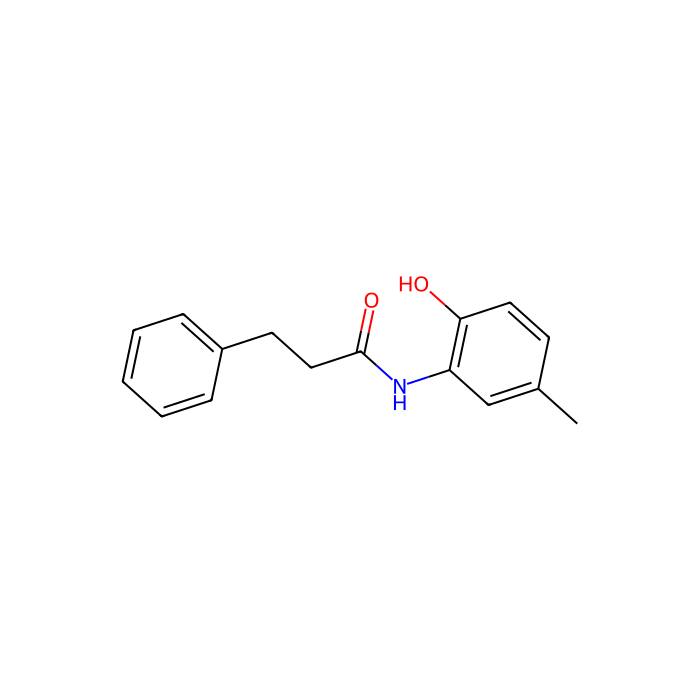
N-(2-Hydroxy-5-methylphenyl)benzenepropanamide
Especificaciones y pureza
≥98%(HPLC)
Mecanismos bioquímicos y fisiológicos
Endoplasmic reticulum (ER) proteostasis regulator. Activates the ATF6 transcriptional program independently of ER stress and/or global UPR activation. Selectively reduces secretion of amyloidogenic transthyretin (TTR) from HepG2 cells. Reduces amyloidogen
Condiciones de almacenamiento de almacenamiento
Store at -20°C
Enviado en
Ice chest + Ice pads
Este producto requiere envío en cadena de frío. Los servicios terrestres y otros servicios económicos no están disponibles.
This compound belongs to the class of organic compounds known as anilides. These are organic heterocyclic compounds derived from oxoacids RkE(=O)l(OH)m (l not 0) by replacing an OH group by the NHPh group or derivative formed by ring substitution.
External Descriptors
Not available
1. Djoumbou Feunang Y, Eisner R, Knox C, Chepelev L, Hastings J, Owen G, Fahy E, Steinbeck C, Subramanian S, Bolton E, Greiner R, and Wishart DS. ClassyFire: Automated Chemical Classification With A Comprehensive, Computable Taxonomy. Journal of Cheminformatics, 2016, 8:61.
Solvent:DMSO, Max Conc. mg/mL: 25.53, Max Conc. mM: 100; Solvent:ethanol, Max Conc. mg/mL: 25.53, Max Conc. mM: 100
Peso molecular
255.310 g/mol
XLogP3
3.300
Hydrogen Bond Donor Count
2
Hydrogen Bond Acceptor Count
2
Rotatable Bond Count
4
Exact Mass
255.126 Da
Monoisotopic Mass
255.126 Da
Topological Polar Surface Area
49.300 Ų
Heavy Atom Count
19
Formal Charge
0
Complexity
286.000
Isotope Atom Count
0
Defined Atom Stereocenter Count
0
Undefined Atom Stereocenter Count
0
Defined Bond Stereocenter Count
0
Undefined Bond Stereocenter Count
0
The total count of all stereochemical bonds
0
Covalently-Bonded Unit Count
1
Calculadoras de soluciones
Molarity Calculator
Determine the necessary mass, volume, or concentration for preparing a solution.
Dilution Calculator
Determine the dilution needed to prepare a stock solution.
Reconstitution Calculator
Reseñas
Reseñas de cliente
Application Protocols
Item-specific (from Product Data)
Tested applications and protocol parameters: Not specified for this item; refer to CoA/Spec Sheet.
General small-molecule handling protocol (example, non-specific)
Stock preparation:
Weigh an appropriate amount quickly to minimize hygroscopic uptake (if unknown, assume moderate hygroscopicity).
Dissolve in anhydrous DMSO to 10–50 mM. Vortex and, if needed, sonicate briefly.
Filter through 0.22 µm PTFE to remove particulates.
Working solutions for assays:
Dilute stock into assay buffer immediately before use. Keep final DMSO at or below assay-validated thresholds (commonly ≤0.5–1% v/v).
Include vehicle controls matched for DMSO percentage.
Storage of aliquots:
Dispense single-use aliquots to avoid repeated freeze–thaw. Label with lot, concentration, and preparation date.
Analytical confirmation:
Spot-check concentration by UV-Vis if chromophoric, or by quantitative 1H NMR/LC–MS against internal standards.
Biological Roles
Item-specific (from Product Data)
Biological function/targets: Not specified for this item; refer to CoA/Spec Sheet and primary literature.
General guidance
Until the structure and annotation are confirmed, treat AA 147 as an uncharacterized small molecule for research use only.
If used in biological assays:
Confirm absence of assay-interfering properties (aggregation, redox cycling, fluorescence/absorbance overlap) using controls.
Record final DMSO percentage and confirm vehicle effects are negligible.
Include cytotoxicity/cell health readouts in parallel when running cell-based assays.
If literature exists for CAS 393121-74-9, curate putative targets and orthogonally validate in your system. Do not extrapolate biological roles across cell lines or species without data.
Buffer Applications
Applicability
This product is not a buffer component per se. Without a known acid/base profile or pKa, buffer formulation guidance is not applicable.
General handling in buffered systems
If preparing assay solutions:
Make a concentrated stock in DMSO or another suitable solvent, then dilute into the desired buffer immediately before use to the target final concentration.
Use surfactant (e.g., 0.01–0.05% Tween-20) if aggregation/precipitation is observed upon dilution.
Maintain consistent final cosolvent percentage across controls and treatments.
Note
For any attempt to use the compound as a pH modulator or buffer component, first obtain pKa and solubility data from the CoA/Spec Sheet; absent those data, such applications are not recommended.
Green Alternatives
Item-specific (from Product Data)
No solvent/process details are specified for this item.
General greener-practice guidance for small-molecule handling
Stock preparation:
Prefer aqueous buffer with minimal DMSO (≤1–2% v/v in final assay) when solubility permits.
If organic solvents are needed, consider ethanol or isopropanol before chlorinated solvents.
Workup and purification (if you later synthesize or modify the compound):
Favor 2-MeTHF or CPME over diethyl ether/THF where performance allows.
Use EtOAc/hexanes or EtOAc/heptane systems rather than chlorinated solvent-heavy systems.
Waste minimization:
Consolidate DMSO/ACN waste streams and avoid unnecessary solvent switching.
Scale trials at micro- to milligram scale before committing to larger runs.
Illustrative comparison (general)
ACN vs MeOH as diluent for LC compatibility: ACN offers lower viscosity and backpressure; MeOH is greener but may reduce solubility for hydrophobic analytes. Choose based on solubility and system constraints.
Pharmaceutical Uses
Item-specific (from Product Data)
Pharmaceutical/formulation role: Not specified for this item; refer to CoA/Spec Sheet.
General notes (non-clinical)
This product is supplied for research use only and is not approved for human or veterinary use, diagnostic purposes, or clinical applications.
In early discovery settings, small molecules from libraries may be used as reference compounds, tool compounds (once characterized), or as starting points for SAR optimization. Any excipient or formulation-related use would require comprehensive characterization and quality documentation, which are not provided here.
If proceeding toward pre-formulation studies, determine: solid form (polymorph/solvate), aqueous/biorelevant solubility, pH–solubility profile, pKa, logD, and chemical stability in common vehicles.
Physical Properties
Item-specific (from Product Data)
Appearance: Not specified for this item; refer to CoA/Spec Sheet.
Melting/Boiling point: Not specified for this item; refer to CoA/Spec Sheet.
Density, refractive index, pKa, logP/logD: Not specified for this item; refer to CoA/Spec Sheet.
Solubility: Not specified for this item; refer to CoA/Spec Sheet.
General/literature-style guidance for first-use characterization (non-specific)
If the solid/liquid state is unknown, start with a small test portion at ambient temperature. Observe crystallinity or viscosity to guide handling.
Start with anhydrous DMSO (50–100 mg/mL stock target) and/or acetonitrile.
If polar functionality is expected, test aqueous miscibility by diluting DMSO stock into buffer with surfactant (0.01–0.05% Tween-20) to check for precipitation.
For nonpolar candidates, try EtOAc, MeOH, ethanol, isopropanol, and CPME.
Thermal behavior: Use DSC/TGA or a micro melting-point apparatus to establish a working temperature window before scaling any process.
Partitioning: In absence of logP, thin-layer chromatography (multiple eluents) can provide quick polarity context (Rf trends).
Note: Treat any values you measure as laboratory-specific until confirmed against the item’s CoA/Spec Sheet.
Quality and Grades
Item-specific (from Product Data)
Grade/Purity: Not specified for this item; refer to CoA/Spec Sheet.
Interpretation and expectations
As part of a small-molecule/compound library entry, materials are typically provided to support screening and discovery workflows. However, without a stated grade (e.g., ≥95% by HPLC, analytical grade, etc.), do not assume a specific assay or purity basis.
Stabilizers/inhibitors: Not specified for this item; refer to CoA/Spec Sheet. If your application is sensitive (e.g., biochemical assays), verify absence/presence of stabilizers.
Best practices to ensure fitness-for-use
Request the CoA to confirm: assay method (HPLC/UPLC/GC), purity, water content, residual solvents, and identity data (NMR, MS).
If UV-critical work (chromatography, photochemistry) is planned, obtain UV-Vis profile or background data; if unavailable, run your own baseline scans.
For quantitative biology/chemistry assays, perform in-house QC: LC–MS purity check and 1H NMR spot check prior to critical experiments.
Document lot-to-lot continuity in LIMS; retain sample for counter-analysis.
Reaction and Applications
Item-specific (from Product Data)
Manufacturer applications: Not specified for this item; refer to CoA/Spec Sheet.
General research use context (non-specific)
As a member of a small-molecule/compound library, AA 147 may be used for high-throughput screening (HTS), target deconvolution workflows, and structure–activity relationship (SAR) development when a structure is provided.
Typical project paths:
Primary screening: evaluate against biochemical or cell-based assays at single concentration followed by dose–response.
Hit validation: orthogonal assays and counterscreens to rule out assay interference.
ADME profiling: solubility, permeability, microsomal stability once identity and purity are confirmed.
If the compound is to be derivatized, obtain full structural information first; without a known scaffold, synthetic diversification cannot be planned.
Practical tips
Prepare fresh DMSO stocks, minimize freeze–thaw, and verify concentration by UV when chromophores are present (or by quantitative NMR when feasible).
Monitor for pan-assay interference compounds (PAINS) behavior using orthogonal readouts and detergent controls where appropriate.
Reaction Conditions
Item-specific (from Product Data)
No reaction condition guidance is provided for this item.
General guidance (non-specific)
If AA 147 is to be used as a reagent or intermediate, consult the CoA/Spec Sheet for structure and stability first. Then select reaction conditions based on functional groups present.
Stability screening before synthesis:
Solvent compatibility: DMSO, ACN, MeOH, toluene, and buffers at various pH values.
Thermal stability: short isochronal exposures (e.g., 40–80°C) with LC–MS monitoring to detect degradation pathways.
Light/oxygen sensitivity: If chromophores or oxidizable motifs are suspected, handle under inert gas and protect from light until proven stable.
Note
Without functional-group information, specific temperatures, catalysts, or yields cannot be responsibly suggested.
Safety and Handling
Item-specific (from Product Data)
GHS Classification, Signal Word, H-Statements, Pictograms: Not specified for this item; refer to SDS.
Storage Conditions: Store at −20°C.
Shipped In: Ice chest + ice pads.
Research Use: For research use only.
General safety guidance (non-specific; defer to SDS)
PPE: Laboratory coat, safety glasses or goggles, appropriate chemically resistant gloves; handle in a fume hood until volatility and hazard class are known.
Incompatibilities: Unknown for this item. As a precaution, avoid strong oxidizers and strong acids/bases until compatibility is established.
First aid (overview):
Inhalation: Move to fresh air; seek medical attention if symptoms persist.
Skin/eye contact: Rinse with water for at least 15 minutes; remove contaminated clothing; seek medical attention if irritation persists.
Ingestion: Rinse mouth; do not induce vomiting; seek medical attention.
Spill response: Absorb with inert material; collect in appropriate waste. For powders, avoid dust generation; for oils, use pads/vermiculite.
Fire: Use CO2, dry chemical, or foam as appropriate; specific flammability is unknown—keep away from ignition sources.
Always consult the product’s SDS for authoritative hazard, toxicology, and accidental release measures prior to use.
Solvent Selection
Item-specific (from Product Data)
Solvent recommendations: Not specified for this item; refer to CoA/Spec Sheet.
General guidance for small-molecule solubilization (non-specific)
Primary screening solvents:
DMSO (anhydrous) for stock solutions (commonly 10–100 mM for screening); dilute into assay buffer just before use.
Acetonitrile and ethanol as secondary options for LC compatibility.
Aqueous work: Assess pH-dependent solubility by titrating small aliquots of NaOH or HCl in water:cosolvent (e.g., 50:50 water:ACN).
Filtration: Use 0.22–0.45 µm PTFE/NYLON filters to remove particulates after dissolution.
Stability checks: Record UV-Vis scans and LC–MS at t = 0 and after 24 h at room temperature and 4°C to identify degradation/precipitation.
Comparison note (general)
DMSO vs DMF: DMSO is broadly preferred in bioassays for lower volatility and compatibility; DMF can be used if DMSO solubility is inadequate but may pose higher toxicity/background.
Storage and Reconstitution
Item-specific (from Product Data)
Storage Conditions: Store at −20°C.
Shipping: Ice chest + ice pads.
Appearance and stabilizer: Not specified for this item; refer to CoA/Spec Sheet.
General guidance
Upon receipt: Allow container to equilibrate to room temperature in a desiccator before opening to avoid condensation.
Reconstitution:
If solid: Prepare a concentrated stock in a dry, oxygen-free solvent appropriate to solubility (commonly anhydrous DMSO). If liquid: use as supplied or standardize by weight/volume.
Target stock concentrations typically 10–100 mM for screening; adjust based on solubility and assay needs.
Aliquoting and storage:
Divide into single-use aliquots in inert, airtight vials or microtubes. Minimize headspace; purge with nitrogen/argon if oxidation is a concern.
Store aliquots at −20°C or colder as stability permits. Avoid freeze–thaw cycles; thaw on ice and use immediately.
Stability checks:
Periodically reassess purity by LC–MS or HPLC after 1–3 months of storage, or sooner if discoloration/precipitation is observed.
Note: For any item-specific stability (light/air/moisture sensitivity), consult the CoA/Spec Sheet and SDS; absent such data, handle conservatively.
Structure and Identity
Item-specific (from Product Data)
Product Name: AA 147 (SKU: A288526)
CAS: 393121-74-9
PubChem CID: 882909
InChIKey: 16616 (as provided; note: this does not follow the usual 27-character InChIKey format)
SMILES: Not specified for this item; refer to CoA/Spec Sheet.
Molecular Formula: Not specified for this item; refer to CoA/Spec Sheet.
Molecular Weight: Not specified for this item; refer to CoA/Spec Sheet.
Interpretive notes
Structural features (rings, heteroatoms, stereochemistry) cannot be described without a valid structure. Not specified for this item; refer to CoA/Spec Sheet or SDS.
The Category Path indicates this is supplied as part of a small-molecule/compound library.
Guidance for identity verification (general best practice)
Cross-verify CAS and CID against authoritative databases in your ELN or LIMS prior to first use.
Request or download the Certificate of Analysis (CoA) to obtain structure (SMILES/InChI), assay method, and impurity profile.
Confirm identity upon receipt by orthogonal means as appropriate for your workflow (e.g., 1H NMR, LC–MS, HRMS).
Synthetic Utility
Item-specific (from Product Data)
Synthetic roles and transformations: Not specified for this item; refer to CoA/Spec Sheet.
General commentary
Without a known structure or functional group map, specific synthetic disconnections cannot be proposed. If the structure is obtained from the CoA or literature, evaluate:
Functional handles (halides, boronates, carboxylates, amines, alcohols) for cross-coupling, amide formation, or protective-group strategies.
Oxidation state and heteroatom content to plan redox or cyclization tactics.
If derivatization is anticipated for SAR:
Establish scalable synthesis and analytical methods (LC–MS/UPLC) for rapid cycle times.
Consider late-stage functionalization options if aromatic/heteroaromatic C–H bonds or pendant amines/alcohols are present.
Conclusion
Obtain the definitive structure before attempting any synthetic planning or route scouting.
Target Specificity
Applicability
This section typically applies to biologics (e.g., antibodies) or fully annotated tool compounds. For AA 147, no target or specificity information is provided.
Item-specific (from Product Data)
Target, pathway, epitope, or selectivity profile: Not specified for this item; refer to CoA/Spec Sheet and primary literature.
Guidance
If using AA 147 as a putative modulator, perform target engagement studies (e.g., CETSA, SPR, ITC, enzymatic kinetics) after confirming identity and purity.
Preguntas frecuentes
What is the purity of this product, and how is it determined?
This product is supplied at ≥98% purity, determined by HPLC. Lot-specific values are stated on the Certificate of Analysis.
How should this product be stored?
Store at ?20 °C. Freezer storage is required to maintain the specified shelf life.
How is this product shipped?
This product ships in an insulated container with ice pads. Unpack on arrival and transfer it to the storage condition stated above.
What are the CAS number, molecular formula and molecular weight?
The CAS Number is 393121-74-9, the molecular formula is C16H17NO2, and the molecular weight is 255.31 g/mol. InChIKey AWHLTHOHBAGPMY-UHFFFAOYSA-N.
What documentation is provided?
Available product documentation, including Certificates of Analysis (COA), Safety Data Sheets (SDS), and specification sheets, is shown in the product document area. Document availability and access follow the current site policy.
Utilizamos cookies para garantizar el correcto funcionamiento del sitio web y, cuando esté permitido, para mejorar su experiencia. Puede gestionar sus preferencias en cualquier momento en Configuración. Más información en nuestra Política de Cookies.
¿Quieres que te enviemos un mensaje cuando tengamos descuentos disponibles?
Recordármelo más tarde
¡Gracias! Por favor, revisa tu bandeja de entrada de correo electrónico para confirmar.
Products are supplied to verified businesses, institutions, and qualified professionals for research and development use only. Not for use in humans, animals, diagnosis, or therapy.

 K2219019