ABX-1431 - Moligand™, ≥98% , Inhibitor of αβ-Hydrolase 6;Inhibitor of Monoacylglycerol lipase;Inhibitor of PLA 2-G7, CAS No.1446817-84-0, Inhibitor of αβ-Hydrolase 6;Inhibitor of Monoacylglycerol lipase;Inhibitor of PLA 2-G7
ABX-1431 - Moligand™, ≥98% , Inhibitor of αβ-Hydrolase 6;Inhibitor of Monoacylglycerol lipase;Inhibitor of PLA 2-G7, CAS No.1446817-84-0, Inhibitor of αβ-Hydrolase 6;Inhibitor of Monoacylglycerol lipase;Inhibitor of PLA 2-G7
GRADE & PURITYMoligand™?Moligand™ — Aladdin's line of ligands and bioactive small molecules. Use for receptor, pathway, and binding studies needing defined small-molecule tools.≥98%
Moligand™, ≥98% Moligand™ for sensitive chromatographic and analytical workflows requiring minimal baseline interference.
🌡
Storage & shipping
Store at -20°C Ships Ice chest + Ice pads Check lot-specific COA for exact specifications.
📋
Quality documents
SDS, COA, datasheet, and spec sheet available for download. Lot-specific COA accessible via lot number lookup.
📚
Literature proof
Cited in 0 peer-reviewed publications across chromatography, organic synthesis, and cross-coupling reactions.
Descripción general
Information
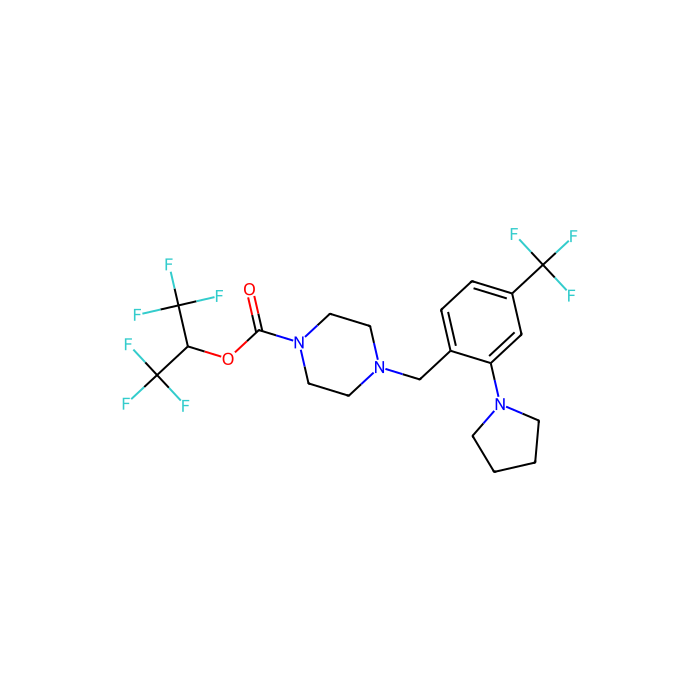
ABX-1431 ABX-1431 is a highly potent, selective, and CNS-penetrant Monoacylglycerol lipase (MGLL) inhibitor with IC50 values of 14 nM and 27 nM for hMGLL and mMGLL respectively.
Targets
hMGLL ; mMGLL 14 nM; 27 nM
In vitro
ABX-1431 is a potent human MGLL inhibitor (average IC50 = 0.014 μM) with >100-fold selectivity against ABHD6 and >200-fold selectivity against PLA2G7. Treatment of intact human PC3 cells with ABX-1431 following a 30 min inhibitor incubation time causes concentration dependent inhibition of MGLL activity with an IC50 value of 0.0022 μM, which is ∼6-fold more potent than that observed in vitro. ABX-1431 inhibits MGLL via carbamoylation of the catalytic nucleophile Ser122.
In vivo
Pharmacokinetic analysis in rats and dogs of ABX-1431 indicate low to moderate systemic clearance, moderate volume of distribution, and high oral bioavailability (64% in rat, 57% in dog). While ABX-1431 is stable in human and dog plasma, it is not stable in rat plasma. ABX-1431 is a potent and selective inhibitor of MGLL in mouse and rat brain in vivo. ABX-1431 inhibits MGLL activity with an ED50 of 0.5-1.4 mg/kg (po) and dose-dependently increases brain 2-AG levels in mouse brain. A rat inflammatory pain model is used to assess the pharmacodynamics effect. ABX-1431 demonstrates potent antinociceptive effects in a formalin paw test at a dose that produced near complete MGLL inhibition and maximal elevation of 2-AG.
ABX-1431 is a highly potent, selective, and CNS-penetrant Monoacylglycerol lipase (MGLL) inhibitor with IC50 values of 14 nM and 27 nM for hMGLL and mMGLL respectively.
Condiciones de almacenamiento de almacenamiento
Store at -20°C
Enviado en
Ice chest + Ice pads
Este producto requiere envío en cadena de frío. Los servicios terrestres y otros servicios económicos no están disponibles.
Grado
Moligand™
Tipo de acción
INHIBITOR
Mecanismo de acción
Inhibitor of αβ-Hydrolase 6;Inhibitor of Monoacylglycerol lipase;Inhibitor of PLA 2-G7
This compound belongs to the class of organic compounds known as phenylpyrrolidines. These are polycyclic aromatic compounds containing a benzene ring linked to a pyrrolidine ring through a CC or CN bond. Pyrrolidine is a five-membered saturated aliphatic heterocycle with one nitrogen atom and four carbon atoms.
External Descriptors
Not available
1. Djoumbou Feunang Y, Eisner R, Knox C, Chepelev L, Hastings J, Owen G, Fahy E, Steinbeck C, Subramanian S, Bolton E, Greiner R, and Wishart DS. ClassyFire: Automated Chemical Classification With A Comprehensive, Computable Taxonomy. Journal of Cheminformatics, 2016, 8:61.
Determine the necessary mass, volume, or concentration for preparing a solution.
Dilution Calculator
Determine the dilution needed to prepare a stock solution.
Reconstitution Calculator
Reseñas
Reseñas de cliente
Application Protocols
No tested application protocols are provided in this listing for ABX-1431. The following are general, non-item-specific procedures commonly used with small-molecule tool compounds.
Stock solution preparation (general)
Allow vial to equilibrate to room temperature in a desiccator before opening to minimize moisture condensation.
Prepare a 10 mM stock in anhydrous DMSO. Vortex and, if needed, sonicate briefly. Inspect for clarity; if undissolved solids remain, reduce concentration or change solvent (e.g., DMF, ethanol).
Aliquot into low-bind microtubes to avoid repeated freeze–thaw cycles; store at -20 °C or per item-specific guidance.
Assay setup (general)
Prepare serial dilutions in DMSO (e.g., 3-fold) and back-dilute into assay buffer to reach final vehicle ≤1% v/v.
Include vehicle controls and, where possible, a known positive control. Run at least triplicates.
Confirm absence of precipitation after dilution by visual check and, if critical, by light scattering or filtration.
Analytical method considerations (general)
LC–MS/MS: Optimize MRM/SIM transitions once the structure/ionization behavior is verified. Assess carryover and matrix effects.
Stability: Assess bench-top and freeze–thaw stability to define retest and on-instrument stability windows.
Biological Roles
This listing does not include target or pathway annotations for ABX-1431. The guidance below is general to small-molecule research ligands and reference standards and is not specific to ABX-1431.
Item-specific (Product Data)
Biological/target information: Not specified for this item; consult primary literature and the CoA.
General considerations for small-molecule ligands
In biochemical research, small-molecule ligands are used to probe protein function, modulate enzymatic activity, or stabilize/destabilize protein conformations in cell-free or cellular systems.
Typical evaluation includes determining concentration–response behavior (e.g., IC50, EC50, Ki), kinetic mechanism, and selectivity versus related proteins using orthogonal assays.
Cellular assessments often quantify on-target pathway modulation and off-target liabilities via counterscreens and phenotypic profiling.
Practical notes (general)
Confirm compound integrity and absence of fluorescent/absorbing interference with the assay readout.
Control for vehicle effects (e.g., DMSO at constant v/v across all wells and controls).
If the target is membrane-associated or cytosolic, consider permeability and efflux by using appropriate cell lines and transporter inhibitors/controls.
For chemoproteomics or thermal profiling, validate engagement with dose-dependent shifts and competition experiments.
Important caveat
No medical or clinical use is implied. All work should be for research use only, following institutional biosafety and chemical safety protocols.
Buffer Applications
ABX-1431 is a small-molecule tool compound and is not itself a buffering agent. Therefore, buffer formulation guidance is generally not applicable.
Item-specific (Product Data)
No buffer-related specifications are provided.
Practical note (general)
When ABX-1431 is tested in biochemical assays, prepare buffers appropriate to the biological target (e.g., HEPES, Tris, phosphate) and ensure vehicle (e.g., DMSO) is kept constant across all wells. Validate compound solubility in the chosen buffer with your co-solvent percentage before running critical experiments.
Green Alternatives
Because ABX-1431 is a targeted small-molecule tool compound used at low mass and concentration, the main green-chemistry leverage points are solvent and process choices in handling and analysis rather than substitution of the molecule itself.
Item-specific (Product Data)
No green metrics are specified for this item.
Greener practice considerations (general guidance)
Prefer water or buffered aqueous media for dilutions where feasible; limit DMSO/DMF to the minimum concentration that maintains solubility.
When organic solvents are required, consider lower-toxicity options (e.g., ethanol, 2-propanol, ethyl acetate for workups) and avoid halogenated solvents unless analytically necessary.
Minimize solvent volumes in method development by micro-scale solubility screening and microsampling LC–MS methods.
Consolidate analytical runs and use short UHPLC methods to reduce solvent consumption.
Employ closed-cap autosampler vials to reduce VOC emissions and extend solution stability.
Example comparison (general, not item-specific)
DMSO vs DMF: DMSO generally preferred for lower volatility and better EHS profile; DMF may be avoided when not essential due to reproductive toxicity concerns.
ACN vs MeOH in LC: Methanol can be a greener alternative if separation performance is acceptable; assess pressure/viscosity impacts.
Waste management
Segregate halogenated/non-halogenated solvent waste; neutralize and dispose per institutional and local environmental regulations.
Pharmaceutical Uses
No pharmacopeial status, excipient role, or manufacturing guidance is provided for this item. ABX-1431 in this catalog is supplied strictly for research use only.
Item-specific (Product Data)
Research Use Note: For research use only
General guidance (non-clinical, non-therapeutic)
In preclinical research settings, small-molecule tool compounds can be used as reference standards for analytical method development (e.g., LC–MS/MS), stability studies under ICH-like conditions, and as positive/negative controls in in vitro assays.
If used as an analytical reference, establish purity, identity, and assign a reference value using validated methods. Document storage conditions and retest intervals.
Not included/Not applicable
No claims are made regarding clinical efficacy, safety, dosage forms, or regulatory filings. This product is not intended for human or veterinary use and has no established role as an excipient.
Physical Properties
Item-specific values are not included in the current listing. Use the CoA/Spec Sheet and SDS for authoritative data.
Item-specific (Product Data)
Appearance: Not specified for this item; refer to CoA/Spec Sheet.
Molecular Weight: Not specified for this item; refer to CoA/Spec Sheet.
Physical constants (literature/computed — not item specifications)
Melting point (solid bioactive small molecules): Often in the 80–220 °C range; specific value for ABX-1431 is not provided here.
Boiling point: Not typically reported for complex small molecules; decomposition before boiling is common. Not specified for this item.
Density, refractive index, logP/logD, pKa: Not specified for this item.
Solubility profile: Not specified for this item. Many screening ligands are soluble in DMSO at 10–50 mM; confirm experimentally for ABX-1431.
Practical notes (general guidance)
If solid: Assess hygroscopicity and polymorphism via TGA/DSC and PXRD if performance is solubility- or bioassay-critical.
Prepare a small solubility screen (DMSO, DMF, ethanol, acetonitrile, aqueous buffers with co-solvent, and pH-adjusted media) before scaling assays.
For UV-based analytics, determine compound-specific absorbance maxima by recording a UV–Vis spectrum in the chosen solvent; do not assume typical cutoffs.
Quality and Grades
Item-specific (Product Data)
Grade/Purity: Moligand™
What Moligand™ means (general description)
Moligand™ designates small-molecule ligands intended for research screening, target engagement studies, and chemical biology. While specific numeric purity and impurity profiles are not provided in this listing, Moligand™ products are curated for use as tool compounds and reference materials in discovery workflows.
Typical expectations for tool-compound grade include: verified identity (e.g., LC–MS/NMR), high assay purity suitable for biochemical/biophysical testing, and stable packaging to protect from moisture and light. Exact specifications (e.g., assay purity %, residual solvents, water, metals, stabilizers, and UV background) are item- and lot-dependent.
This item’s available specifications
Purity value, stabilizers, residual solvents, water content, and chromatographic conditions: Not specified for this item; refer to CoA/Spec Sheet.
Appearance and polymorph information: Not specified for this item; refer to CoA/Spec Sheet.
Practical guidance
For quantitative studies (e.g., kinetic IC50/Ki determination), verify purity and identity upon receipt, especially if your assay is sensitive to minor impurities.
If LC–MS quantitation is planned, acquire or request a certified reference material (CRM) curve or prepare in-house standards verified against the supplied lot.
Reaction and Applications
ABX-1431 is cataloged as a small-molecule tool compound rather than a synthetic reagent. As such, its primary use is as a research ligand/standard in analytical, biochemical, and cellular assays. No manufacturer application notes are provided in this listing.
Item-specific (Product Data)
Manufacturer Applications: Not specified in this listing.
Typical research applications for Moligand™ entries (general guidance)
Chemical biology: Use as a reference ligand in binding/engagement assays (e.g., thermal shift, CETSA, SPR/BLI, DSF) once a target is defined in your workflow.
Biochemistry: Evaluate activity modulation in enzyme assays. Establish concentration–response curves with consistent vehicle control.
Analytics: Serve as a system-suitability or retention-time standard in LC–MS bioanalytical methods when appropriate.
Practical notes
Establish compound integrity before use (LC–MS purity, absence of degradants). Track freeze–thaw cycles.
For plate-based assays, prepare intermediate stocks (e.g., 1 mM in DMSO) to minimize pipetting error and adsorption to plastics. Consider low-bind tubes and plates for hydrophobic compounds.
Validate absence of pan-assay interference (PAINS) behavior and fluorescence/absorbance overlap with assay readouts; acquire spectral scans where relevant.
Not typically applicable
ABX-1431 is not generally used as a reagent in named organic reactions or as a building block; see Synthetic Utility for additional context.
Reaction Conditions
Typical organic reaction conditions are not applicable to ABX-1431 in its role as a research tool compound. The more relevant procedural considerations concern solution preparation for assays and analytics.
Item-specific (Product Data)
No reaction condition guidance is provided.
General solution-preparation conditions (not item specifications)
Stock solutions: Commonly 1–10 mM in anhydrous DMSO; confirm complete dissolution visually and by LC–MS if available.
Working dilutions: Prepare fresh in assay buffer, maintaining constant vehicle (e.g., 0.1–1% DMSO v/v). Mix gently to avoid precipitation; short sonication may help.
Temperature: Room temperature handling is typical; avoid prolonged exposure to elevated temperatures unless stability has been verified.
Light and oxygen: If the compound is light- or air-sensitive (unknown here), protect with amber vials and inert gas overlay.
Stability checks (general)
Run time-course LC–MS to confirm stability in vehicle and buffer over assay duration (e.g., 0, 2, 4, 24 h at room temperature and 37 °C as relevant).
Evaluate adsorption to plastics; use low-bind labware if loss is observed.
Safety and Handling
Always consult the SDS for ABX-1431 for definitive safety information. The present listing does not provide GHS details.
Item-specific (Product Data)
GHS Classification: Not specified for this item; refer to SDS.
Signal Word: Not specified for this item; refer to SDS.
Hazard (H-) Statements: Not specified for this item; refer to SDS.
Pictograms: Not specified for this item; refer to SDS.
Storage Conditions: Store at -20°C
Shipped In: Ice chest + Ice pads
Research Use: For research use only
General laboratory precautions (general guidance)
PPE: Lab coat, safety glasses, and suitable chemical-resistant gloves (e.g., nitrile). Use in a fume hood to avoid inhalation of dust or aerosols.
Incompatibilities: Unknown for this item; as a precaution keep away from strong oxidizers/reductants, strong acids/bases until specific data are available.
Avoid prolonged exposure to ambient light and moisture unless stability is confirmed. Minimize freeze–thaw cycles by aliquoting.
First-aid overview (general)
Inhalation: Move to fresh air; seek medical attention if symptoms persist.
Skin/eye contact: Rinse with water for ≥15 minutes; remove contaminated clothing; seek medical attention if irritation persists.
Ingestion: Rinse mouth; do not induce vomiting; seek medical attention.
Spill and waste (general)
Contain with inert absorbent, collect in labeled waste. Dispose in accordance with institutional and local regulations.
Solvent Selection
Solvent guidance is provided as general best practice for small-molecule tool compounds; compound-specific solubility for ABX-1431 is not specified in this listing.
Item-specific (Product Data)
No solvent/solubility data are provided for this item; refer to CoA/Spec Sheet.
General approach for reconstitution and working solutions (literature/practice)
Primary stock: DMSO is commonly used given its broad solvating power; start with 10 mM and adjust as needed. Verify clarity and absence of precipitate by visual inspection and, ideally, by quick LC–MS.
Alternative organic solvents: DMF, ethanol, or acetonitrile can be considered. Test minimal effective co-solvent content when diluting into aqueous media.
Aqueous compatibility: If biological assays require aqueous buffers, perform serial dilution into buffer with 0.1–1% DMSO or other compatible co-solvent, maintaining constant vehicle across controls.
Small comparison (general, not item-specific)
DMSO: Highest solvating power; may affect enzyme activity at >1–2% v/v.
DMF: Similar solvency; watch for amide reactivity in some systems; cytotoxic above low % levels.
Ethanol: Lower solvency; often tolerable up to 0.5–1% v/v in cells.
Acetonitrile: Good for HPLC and analytical prep; biological tolerance varies.
Practical tips
Warm gently (room temperature to 37 °C) and vortex/sonicate briefly to assist dissolution. Avoid strong heating unless stability is known.
Filter sterile stocks through 0.22 µm PTFE/NY if required by your application.
Storage and Reconstitution
Item-specific (Product Data)
Storage Conditions: Store at -20°C
Shipped In: Ice chest + Ice pads
Appearance: Not specified for this item; refer to CoA/Spec Sheet.
Stabilizers/Antioxidants: Not specified for this item; refer to CoA/Spec Sheet.
General storage guidance (for small-molecule tool compounds)
Keep container tightly closed in a dry, inert atmosphere. If moisture- or light-sensitive (not specified here), use desiccant and amber vials.
Upon first opening, allow vial to warm to room temperature in a desiccator to prevent condensation. Immediately re-seal after use.
Aliquot into single-use portions to minimize freeze–thaw. Record open dates and aliquot IDs.
Reconstitution (general, not item-specific)
Solvent choice: Start with anhydrous DMSO to prepare a 5–10 mM master stock. Adjust based on observed solubility.
Procedure: Add calculated solvent volume, vortex, and sonicate briefly if needed. Verify complete dissolution visually; optionally confirm by LC–MS.
Working solutions: Dilute into assay buffer maintaining constant vehicle (e.g., 0.1–1% DMSO). Use fresh on the day of preparation unless stability has been established.
Stability and retest (general)
Solid state: Many small molecules are stable for 12–24 months at -20 °C if protected from moisture/light; specific retest period for ABX-1431 is not provided.
Solution: DMSO stocks commonly stable for weeks to months at -20 °C; confirm by periodic LC–MS.
Any specific shelf-life, degradants, or photostability data: Not specified for this item; refer to CoA/Spec Sheet.
Structure and Identity
Brief overview: ABX-1431 is listed as a small-molecule entry in our Moligand™ collection. Structural identifiers are limited in the current listing; please consult the CoA or SDS for complete structural information.
Item-specific (Product Data)
SKU: A414203
Product Name: ABX-1431
CAS: 1446817-84-0
PubChem CID: 71657619
InChIKey: 343020 (as provided in listing)
SMILES: Not specified for this item; refer to CoA/Spec Sheet.
Molecular Formula: Not specified for this item; refer to CoA/Spec Sheet.
Molecular Weight: Not specified for this item; refer to CoA/Spec Sheet.
Grade/Purity: Moligand™
Structural features (general guidance)
The 2D structure, functional groups, and stereochemical descriptors are not provided in this listing. Many Moligand™ entries are neutral-to-weakly basic/acidic heteroatom-containing small molecules designed for target engagement screening; however, do not assume this for ABX-1431 without consulting the CoA or primary literature.
Without an explicit structure, ring systems, heteroatoms, HBA/HBD counts, and other descriptors cannot be summarized here.
Traceability and identity best practices (general)
Verify identity by orthogonal methods where appropriate (e.g., HRMS, 1H/13C NMR, LC–MS retention time versus a certified reference, and, if available, IR/UV-Vis). Match against the CAS and CID above.
Record batch/lot number and retain a small reserve sample for future analytics.
Synthetic Utility
ABX-1431 is sold as a finished small-molecule tool compound rather than a synthetic building block. Consequently, it is not typically employed as a reagent or intermediate in routine organic synthesis.
Item-specific (Product Data)
No functional group or reactivity information is provided in this listing.
General perspective (when a tool compound might be used synthetically)
Tool compounds are occasionally used as internal standards or surrogates in reaction development and analytics (e.g., LC–MS response normalization), but this is application-specific and not generally recommended when material is curated for biological assays.
If structure is disclosed elsewhere and possesses orthogonally addressable handles, medicinal chemistry teams might derive analogs; however, that is beyond the scope of this catalog entry and requires primary synthetic literature.
Recommendation
For synthetic campaigns, source appropriate building blocks with known reactivity and specifications. Reserve ABX-1431 for its intended role as a research ligand/standard.
Target Specificity
No target, selectivity, or binding data are provided in this listing for ABX-1431.
Item-specific (Product Data)
Target/epitope/biomolecule: Not specified for this item; refer to CoA/Spec Sheet and primary literature.
General guidance
If ABX-1431 is used as a reference ligand in your studies, determine specificity via a panel of orthogonal assays (biochemical potency, cellular engagement, off-target profiling) and by testing against close homologs or relevant enzyme/receptor families.
Document assay conditions (substrates, cofactors, pH, ionic strength) to enable meaningful cross-study comparisons and reproducibility.
Need help choosing the grade?
Our grade selection guide covers purity, stabilizer status, and application suitability for all variants in our catalog.
We use cookies to ensure the website functions properly and, where permitted, to improve your experience. You can manage your preferences at any time in Settings. Learn more in our Cookie Policy.
Shall we send you a message when we have discounts available?
Remind me later
Thank you! Please check your email inbox to confirm.
Products are supplied to verified businesses, institutions, and qualified professionals for research and development use only. Not for use in humans, animals, diagnosis, or therapy.
 G2227598