
Determine the necessary mass, volume, or concentration for preparing a solution.
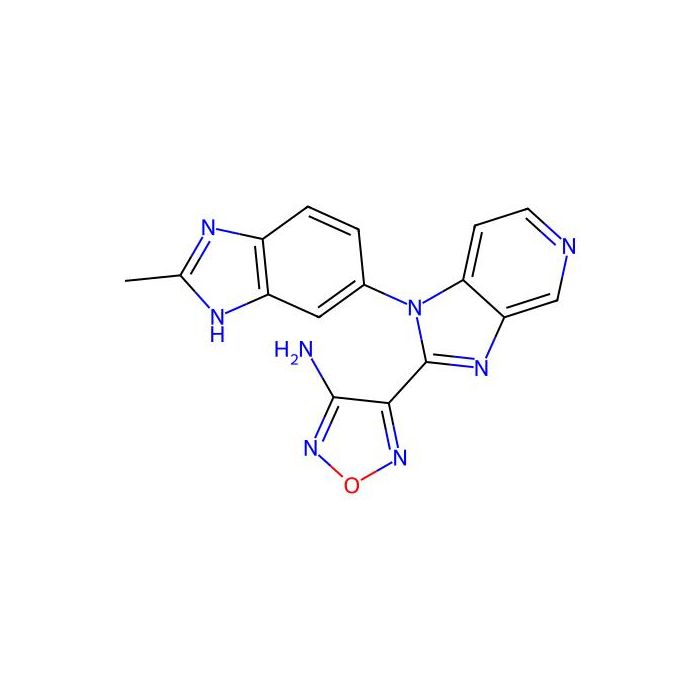
AS2863619 free base - ≥99% , CAS No.2241300-50-3
Disponible para pedir
GRADE & PURITY ≥99%
Storage
Store at -20°C
Shipped In
Ice chest + Ice pads
≥99% for sensitive chromatographic and analytical workflows requiring minimal baseline interference.
Store at -20°C Ships Ice chest + Ice pads Check lot-specific COA for exact specifications.
SDS, COA, datasheet, and spec sheet available for download. Lot-specific COA accessible via lot number lookup.
Cited in 0 peer-reviewed publications across chromatography, organic synthesis, and cross-coupling reactions.
AS2863619 free base enables conversion of antigen-specific effector/memory T cells into Foxp3 + regulatory T (T reg ) cells for the treatment of various immunological diseases. AS2863619 free base is a potent, orally active cyclin-dependent kinase 8 (CDK8) and CDK19 inhibitor with IC 50 s of 0.61 nM and 4.28 nM, respectively. STAT5 activation enhanced by AS2863619 free base inhibition of CDK8/19 , which consequently activates the Foxp3 gene
In Vitro
AS2863619 (1 μM; 22 hours; mouse CD4 + T cells) treatment suppresses serine phosphorylation of the PSP motif of STAT5b to ~40% while enhancing tyrosine phosphorylation in the C-terminal domain to ~160% of control-treated samples. MCE has not independently confirmed the accuracy of these methods. They are for reference only. Western Blot AnalysisCell Line: Mouse CD4 + T cells Concentration: 1 μM Incubation Time: 22 hours Result: Suppressed serine phosphorylation of the PSP motif of STAT5b to ~40% while enhancing tyrosine phosphorylation in the C-terminal domain to ~160% of control-treated samples.
In Vivo
AS2863619 (30 mg/kg; oral administration; daily; for 2 weeks; mice) treatment after sensitization with 2,4-dinitrofluorobenzene (DNFB) dampens the degree of the secondary response, with milder infiltration of inflammatory cells into the skin and decreases ratios of interferon-γ + (IFN-γ + ) cells in a skin contact hypersensitivity model, when compared with vehicle-treated control mice. T reg depletion before the elicitation of the secondary response abolishes AS2863619-induced suppression. KLRG1 + Foxp3 + T cells are specifically increased in DNFB sensitized AS2863619-treated mice . MCE has not independently confirmed the accuracy of these methods. They are for reference only. Animal Model: Mice with DNFB-induced contact skin hypersensitivity Dosage: 30 mg/kg Administration: Oral administration; daily; for 2 weeks Result: The degree of the secondary response, with milder infiltration of inflammatory cells into the skin and decreased ratios of interferon-γ + (IFN-γ + ) cells.
Form:Solid
IC50& Target:CDK8 0.61 nM (IC 50 ) CDK19 4.28 nM (IC 50 ) GSK3α 76.67 nM (IC 50 ) GSK3β 63.06 nM (IC 50 ) STAT5
| Sonrisas canónicas | CC1=NC2=C(N1)C=C(C=C2)N3C4=C(C=NC=C4)N=C3C5=NON=C5N |
|---|---|
| IUPAC Name | 4-[1-(2-methyl-3H-benzimidazol-5-yl)imidazo[4,5-c]pyridin-2-yl]-1,2,5-oxadiazol-3-amine |
| InChIKey | OORKHRHPVSWORX-UHFFFAOYSA-N |
| INCHI | 1S/C16H12N8O/c1-8-19-10-3-2-9(6-11(10)20-8)24-13-4-5-18-7-12(13)21-16(24)14-15(17)23-25-22-14/h2-7H,1H3,(H2,17,23)(H,19,20) |
| PubChem CID | 139600292 |
| Peso molecular | 332.32 |
Comprehensive hazard, handling, storage, and regulatory compliance document.
Download SDS →Lot-specific quality data. Enter your lot number to retrieve the exact COA.
Look up COA →Full quality attributes and acceptance criteria for this grade.
View spec sheet →| Solubilidad | DMSO : 250 mg/mL (752.29 mM; Need ultrasonic) |
|---|---|
| Peso molecular | 332.320 g/mol |
| XLogP3 | 1.200 |
| Hydrogen Bond Donor Count | 2 |
| Hydrogen Bond Acceptor Count | 7 |
| Rotatable Bond Count | 2 |
| Exact Mass | 332.113 Da |
| Monoisotopic Mass | 332.113 Da |
| Topological Polar Surface Area | 124.000 Ų |
| Heavy Atom Count | 25 |
| Formal Charge | 0 |
| Complexity | 495.000 |
| Isotope Atom Count | 0 |
| Defined Atom Stereocenter Count | 0 |
| Undefined Atom Stereocenter Count | 0 |
| Defined Bond Stereocenter Count | 0 |
| Undefined Bond Stereocenter Count | 0 |
| The total count of all stereochemical bonds | 0 |
| Covalently-Bonded Unit Count | 1 |