
Determine the necessary mass, volume, or concentration for preparing a solution.
Caspase-8 inhibitor II, CAS No.210344-98-2
Disponible para pedir
GRADE & PURITY ≥98%
≥98% for sensitive chromatographic and analytical workflows requiring minimal baseline interference.
Store at -20°C Ships Ice chest + Ice pads Check lot-specific COA for exact specifications.
SDS, COA, datasheet, and spec sheet available for download. Lot-specific COA accessible via lot number lookup.
Cited in 0 peer-reviewed publications across chromatography, organic synthesis, and cross-coupling reactions.
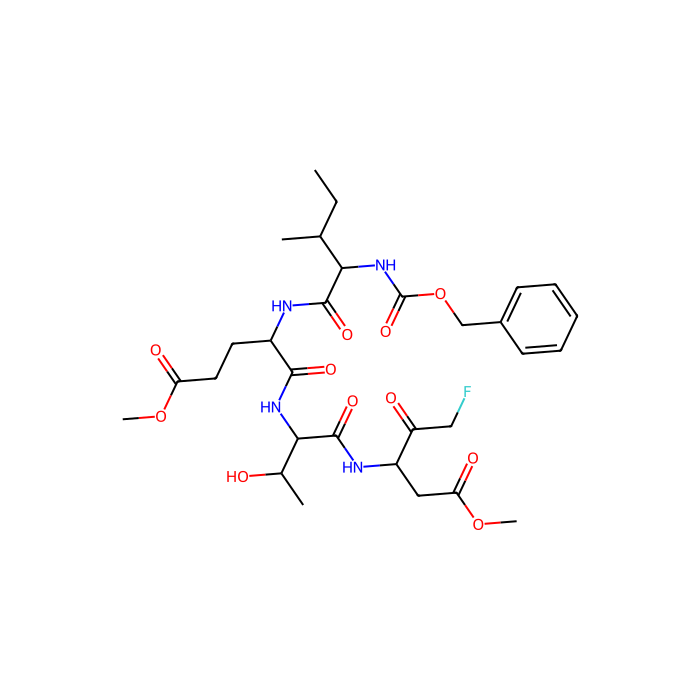
Caspase-8 inhibitor II is a potent, cell-permeable, irreversible inhibitor of caspase-8 and granzyme B. This compound also inhibits influenza virus-induced apoptosis in HeLa cells. Caspase inhibitors play an important role in investigating biological processes and the caspase family of proteins function as key regulators of apoptotic machinery, acting to destroy specific target proteins that are critical to cell survival. Caspase-standard apoptosis assays can then be used to examine treated cells for evidence of apoptosis.|For the fluorometric determination of caspase-6 activity, the following caspase apoptosis detection kit is available from Santa Cruz: Caspase-8 Kit .
Comprehensive hazard, handling, storage, and regulatory compliance document.
Download SDS →Lot-specific quality data. Enter your lot number to retrieve the exact COA.
Look up COA →Full quality attributes and acceptance criteria for this grade.
View spec sheet →Taxonomy Tree
| Kingdom | Organic compounds |
|---|---|
| Superclass | Organic acids and derivatives |
| Clase | Peptidomimetics |
| Subclass | Hybrid peptides |
| Intermediate Tree Nodes | Not available |
| Direct Parent | Hybrid peptides |
| Alternative Parents | Glutamic acid and derivatives Isoleucine and derivatives N-acyl-alpha amino acids and derivatives Alpha amino acid amides Beta amino acids and derivatives Benzyloxycarbonyls Gamma-keto acids and derivatives Fatty acid methyl esters Dicarboxylic acids and derivatives N-acyl amines Alpha-haloketones Carbamate esters Methyl esters Secondary carboxylic acid amides Secondary alcohols Organic carbonic acids and derivatives Organic oxides Organofluorides Organonitrogen compounds Organopnictogen compounds Hydrocarbon derivatives Alkyl fluorides |
| Molecular Framework | Aromatic homomonocyclic compounds |
| Substituents | Hybrid peptide - Glutamic acid or derivatives - Isoleucine or derivatives - N-acyl-alpha amino acid or derivatives - Alpha-amino acid amide - Beta amino acid or derivatives - N-substituted-alpha-amino acid - Alpha-amino acid or derivatives - Benzyloxycarbonyl - Gamma-keto acid - Fatty acid methyl ester - Fatty acid ester - Dicarboxylic acid or derivatives - Fatty amide - Monocyclic benzene moiety - Fatty acyl - Keto acid - N-acyl-amine - Benzenoid - Alpha-haloketone - Methyl ester - Carbamic acid ester - Ketone - Carbonic acid derivative - Carboxamide group - Secondary alcohol - Secondary carboxylic acid amide - Carboxylic acid ester - Carboxylic acid derivative - Organonitrogen compound - Alkyl fluoride - Alkyl halide - Organooxygen compound - Carbonyl group - Hydrocarbon derivative - Organic oxide - Organopnictogen compound - Organic oxygen compound - Organic nitrogen compound - Alcohol - Organofluoride - Organohalogen compound - Aromatic homomonocyclic compound |
| Descripción | This compound belongs to the class of organic compounds known as hybrid peptides. These are compounds containing at least two different types of amino acids (alpha, beta, gamma, delta) linked to each other through a peptide bond. |
| External Descriptors | Not available |