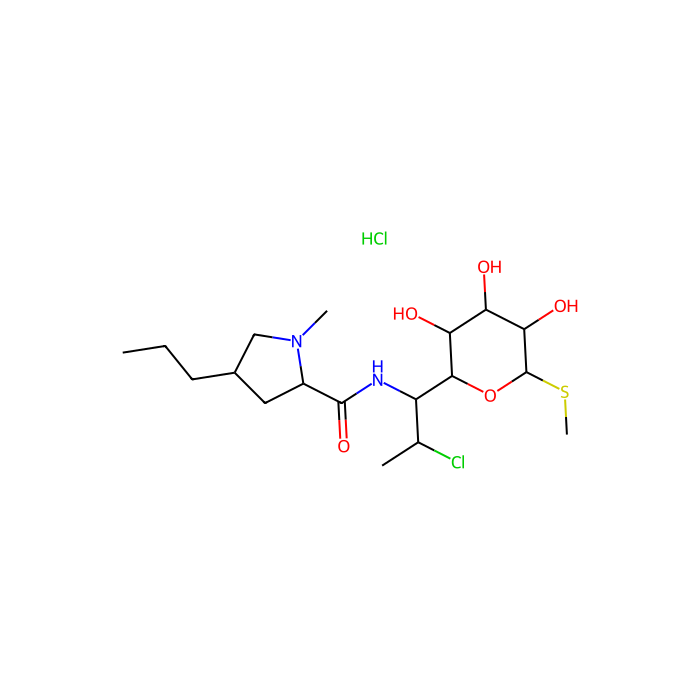
10mM in DMSO for sensitive chromatographic and analytical workflows requiring minimal baseline interference.
🌡
Storage & shipping
Store at -80°C Ships Dry ice packs + Cold packs Check lot-specific COA for exact specifications.
📋
Quality documents
SDS, COA, datasheet, and spec sheet available for download. Lot-specific COA accessible via lot number lookup.
📚
Literature proof
Cited in 4 peer-reviewed publications across chromatography, organic synthesis, and cross-coupling reactions.
Descripción general
Information
Clindamycin HCl Clindamycin HCl inhibits protein synthesis by acting on the 50S ribosomal , used for the treatment of bacterial infections. In vitro
Clindamycin is a classical inhibitor of bacterial protein synthesis, by binding to the 23S ribosomal RNA of the 50S ribosomal subunit.
In vivo
Clindamycin hydrochloride results in fast absorption after oral administration in dogs, with a mean absorption time (MAT) of 0.87 hour, and bioavailability is 72.55%. Clindamycin hydrochloride results in total clearance (CL) of Clindamycin after both IV and oral administration (0.503 vs. 0.458 L/h/kg) in dogs. Clindamycin hydrochloride results in volume of distribution at steady-state (IV) at 2.48 L/kg, indicating a wide distribution of clindamycin in body fluids and tissues. Clindamycin serum concentrations after IV and oral administration remain above 0.5 μg/mL approximately for 10 hours. Clindamycin hydrochloride significantly reduces oral malodor from the dogs\' baseline levels through 42 days. Clindamycin hydrochloride also results in significant reductions in dental plaque, dental calculus, and gingival bleeding in dogs. Clindamycin hydrochloride (2.5 mg/lb), after ultrasonic scaling, root planing, and polishing (USRP) , has a significant effect on plaque and pocket depth measures of periodontal disease but not on gingivitis in canine. Clindamycin hydrochloride results in complete remission ratio of 71.4% (15/21) in dogs with canine superficial bacterial pyoderma after treat within 14 to 28 days. Cell Data
1.Tong Shao, Xiaoshuang Wang, Rentian Guan, Suyuan Zeng, Rui Li, Min Hong, Qiaoli Yue. (2023) Carbonized polymer dots for the sensitive and selective analysis of chlortetracycline based on the aggregation induced emission. NEW JOURNAL OF CHEMISTRY, 47 (37):(17293-17302). [PMID:][10.1039/D3NJ02474A]
2.Wei Xinjie, Luo Xuan, Xu Shuai, Xi Fengna, Zhao Tingting. (2022) A Flexible Electrochemiluminescence Sensor Equipped With Vertically Ordered Mesoporous Silica Nanochannel Film for Sensitive Detection of Clindamycin. Frontiers in Chemistry, [PMID:35464210][10.3389/fchem.2022.872582]
3.Chang Liu, Diandian Deng, Di Xu, Kang Wu, Hong Yang, Kang Zhao, Jianguo Li, Anping Deng. (2018) Development of a monoclonal antibody based-ELISA for the detection of chloramphenicol in shrimp, feed and milk samples and validation by LC-MS/MS coupled with immunoaffinity clean-up. Analytical Methods, 11 (4):(507-516). [PMID:][10.1039/C8AY02284D]
4.Xin Liu, Zhenlong Zhang, Huafang Zhang, Yuefeng Liu, Huiping Gao, Yanli Mao. (2026) Triple functional passivation of SnO2 surface defects for highly efficient and stable perovskite solar cells. Surfaces and Interfaces, [PMID:][10.1016/j.surfin.2026.110023]
Calculadoras de soluciones
Molarity Calculator
Determine the necessary mass, volume, or concentration for preparing a solution.
Dilution Calculator
Determine the dilution needed to prepare a stock solution.
Reconstitution Calculator
Reseñas
Reseñas de cliente
Preguntas frecuentes
How should this product be stored?
Store at ?80 °C. Ultra-low temperature storage is required to maintain the specified shelf life.
How is this product shipped?
This product ships frozen with dry ice and cold packs. Unpack on arrival and transfer it to the storage condition stated above; handle dry ice with insulated gloves in a ventilated area.
What are the CAS number, molecular formula and molecular weight?
The CAS Number is 21462-39-5, the molecular formula is C18H34Cl2N2O5S, and the molecular weight is 461.44 g/mol.
What documentation is provided?
Available product documentation, including Certificates of Analysis (COA), Safety Data Sheets (SDS), and specification sheets, is shown in the product document area. Document availability and access follow the current site policy.
We use cookies to ensure the website functions properly and, where permitted, to improve your experience. You can manage your preferences at any time in Settings. Learn more in our Cookie Policy.
Shall we send you a message when we have discounts available?
Remind me later
Thank you! Please check your email inbox to confirm.
Products are supplied to verified businesses, institutions, and qualified professionals for research and development use only. Not for use in humans, animals, diagnosis, or therapy.