Determine the necessary mass, volume, or concentration for preparing a solution.
Dilution Calculator
Determine the dilution needed to prepare a stock solution.
Reconstitution Calculator
Reseñas
Reseñas de cliente
Application Protocols
No manufacturer-validated protocols are provided for this specific SKU. Below are general, literature-based procedures offered as starting points (not item-specific specs):
Surface coating (research):
Prepare 50–100 µg/mL solution in sterile PBS or water.
Add to clean substrate (e.g., tissue-culture plastic or glass) to fully cover.
Incubate 1 h at RT or overnight at 4°C.
Aspirate and rinse gently with buffer. Use promptly or dry under sterile airflow.
Hydrogel blending:
Dissolve peptide at desired concentration (e.g., 1–10 mg/mL) in acetate or PBS.
Mix with polymer partner (e.g., alginate, PEG) and initiate crosslinking (EDC/NHS, genipin, photoinitiator) per reaction guidelines.
Bioconjugation via EDC/NHS:
Adjust peptide solution to pH 5.0 in 0.1 M acetate buffer.
Add EDC (2–10 eq per –COOH) and NHS (1–5 eq); react 15–60 min.
Introduce amine-bearing counterpart; adjust pH to 6.5–7.4; react 1–12 h.
Purify by dialysis/SEC as appropriate.
Note: Filter-sterilize (0.22 µm, low protein-binding) if sterility is required for in vitro work. Validate concentrations and conditions with small-scale pilots before scaling.
Biological Roles
General biology context (literature; not a claim about in vivo use of this product):
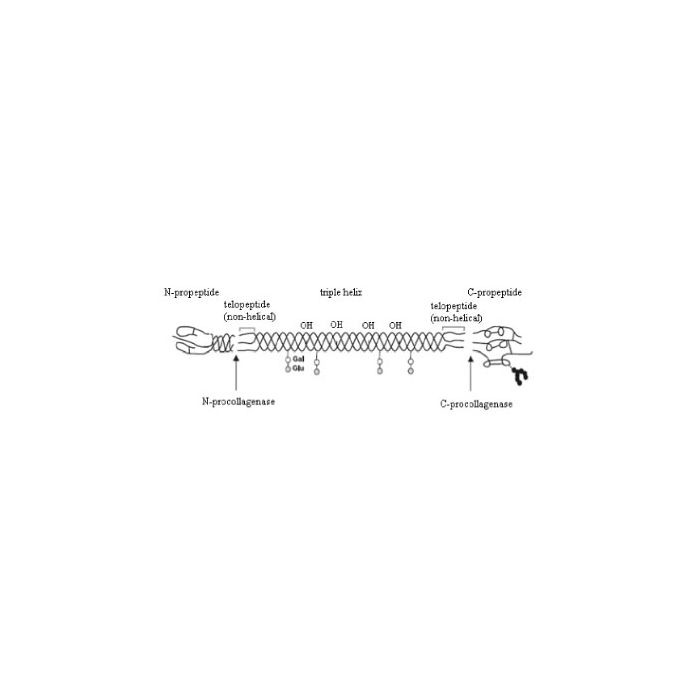
Type I collagen is the predominant fibrillar collagen in mammalian connective tissues (tendon, bone, skin). Its hallmark sequence is repetitive Gly–X–Y (X/Y often Pro/Hyp) forming a triple helix and higher-order fibrils.
Collagen peptides (hydrolysates) are fragments of native collagen lacking the triple-helical long-range structure but retaining characteristic amino-acid composition (high glycine, proline, hydroxyproline). They display distinct solution behavior and can modulate interactions with minerals and surfaces in vitro.
In research models, collagen-derived peptides serve as bioactive motifs for cell adhesion and matrix remodeling studies (e.g., GFOGER sequences for integrin-binding; literature). They are tools for probing ECM-protein interactions, enzyme specificity (collagenases/gelatinases), and mineralization templating.
Note: This product is supplied strictly for research use only. No medical, nutritional, or clinical claims are made or implied.
Buffer Applications
This product is not a buffering agent. However, buffer choice is central to dissolving and reacting collagen peptides (general guidance; literature):
Neutral work: PBS or HEPES, pH 7.2–7.6, for adsorption-based coatings and general handling where enzymatic activity is not a concern.
Carbodiimide coupling: Acetate (pH 4.5–5.5) or MES (pH 5.0–6.0) buffers favor EDC/NHS activation of carboxylates and limit side reactions; suppress high phosphate during activation to avoid precipitation with carbodiimide byproducts.
Aldehyde-based crosslinking: Sodium phosphate or bicarbonate buffers at pH 7.4–8.5 can promote Schiff-base formation; consider subsequent reductive amination in the same or slightly basic buffer.
Enzymatic processing: Tris-HCl or HEPES with Ca2+/Zn2+ (as required) for collagenase/gelatinase assays in vitro.
Item-specific buffer compatibility and optimal pH: Not specified for this item; refer to CoA/Spec Sheet.
Green Alternatives
Context for sustainability and greener choices (general):
Renewable feedstock: Collagen peptides are derived from natural collagen. When sourced from byproducts (e.g., hides, skins, fish scales), they can upcycle waste streams. Confirm sourcing policies with supplier if critical to your program.
Process considerations: Hydrolysis and drying consume water and energy. Selection of lower-temperature enzymatic hydrolysis (vs acid/alkali) is often cited as greener (literature), with fewer salts and reduced neutralization wastes.
Alternatives:
Recombinant collagen-mimetic peptides (CMPs): Precisely defined sequences; potentially lower batch-to-batch variability but higher cost and resource intensity per gram.
Gelatin (less hydrolyzed collagen): Higher MW; different rheology; may reduce need for additional crosslinkers in some hydrogels but offers less control over functional density.
Synthetic peptide mimics/peptoids: Petroleum-derived; highly tunable; may avoid animal sourcing but can have larger synthesis footprints.
Item-specific sourcing/certifications (e.g., bovine/fish origin, animal-free): Not specified for this item; refer to CoA/Spec Sheet.
Pharmaceutical Uses
No clinical or therapeutic use is claimed. The following reflects general formulation and manufacturing research contexts (not for human or animal use):
Excipient research: Collagen peptides can act as bulking/structure-modifying agents in lyophilized systems or as matrix components in prototype delivery depots (research scale).
Processability: Their relatively low viscosity at moderate concentrations (vs gelatin) can facilitate spray-drying or film-casting studies.
Compatibility: Multiple functional groups enable covalent immobilization to device surfaces in R&D prototyping.
Item-specific pharmacopeial status (e.g., Ph. Eur., USP), residual solvent limits, microbial/endotoxin specs: Not specified for this item; refer to CoA/Spec Sheet.
Reminder: This product is supplied for research use only and is not intended for drug, diagnostic, or clinical applications.
Physical Properties
Item-specific physicochemical constants are not defined for peptide mixtures. Provide values below only as general/literature context; do not treat as specifications for this SKU.
Appearance: Not specified for this item; refer to CoA/Spec Sheet.
Molecular Weight (distribution): Not specified for this item; refer to CoA/Spec Sheet.
Literature: collage-derived peptides often center around ~0.5–10 kDa depending on hydrolysis and supplier.
Solubility: Not specified for this item; refer to CoA/Spec Sheet.
Literature: collagen peptides are typically water-soluble; solubility can improve with mild warming and stirring; ionic strength and pH affect clarity/viscosity.
pI/pKa: Not specified for this item; refer to CoA/Spec Sheet.
Literature: effective isoelectric behavior depends on amino-acid composition; many collagen hydrolysates show minimal solubility near pH ~5–6 and improved solubility away from pI.
Density, BP/MP, logP, refractive index: Not applicable to a heterogeneous, nonvolatile peptide mixture; Not specified for this item; refer to CoA/Spec Sheet.
Practical notes (general):
Dissolution is typically facilitated in DI water or neutral buffers with gentle agitation. Avoid localized high concentrations by sprinkling powder into vortexed solvent.
Viscosity increases with concentration; filtration (0.22–0.45 µm) may require low protein-binding membranes.
Quality and Grades
Grade/Purity: Not specified for this item; refer to CoA/Spec Sheet.
Endotoxin/bioburden: Not specified for this item; refer to CoA/Spec Sheet.
(Notes: Many research applications may require low endotoxin and controlled microbial counts; confirm with CoA.)
Average MW (distribution): Not specified for this item; refer to CoA/Spec Sheet.
(Critical for rheology, diffusion, and bio-interface behavior.)
Amino acid profile: Not specified for this item; refer to CoA/Spec Sheet.
(Collagen peptides typically show high Gly, Pro, and Hyp, literature.)
Ash/moisture: Not specified for this item; refer to CoA/Spec Sheet.
Stabilizers/Preservatives: Not specified for this item; refer to CoA/Spec Sheet.
Guidance on grades (general):
Research grade collagen peptides are suitable for in vitro studies, coatings, and materials R&D; they are not intended for clinical use.
Parameters often controlled: MW distribution (GPC/SE-HPLC), residual salts, microbial, endotoxin (LAL), pH of 1% solution, and UV–Vis clarity. Verify item-specific acceptance criteria on the CoA for each lot.
This product is designated: For research use only (per catalog).
Reaction and Applications
Collagen Peptide Type I is widely used in materials chemistry and biointerface engineering. The mixture presents multiple reactive handles (–NH2, –COOH, –OH) enabling diverse chemistries.
Typical research applications (general):
Surface coatings: Adsorptive or covalent immobilization on glass, polystyrene, or metals to enhance cell adhesion in vitro (research only). Pre-activate surfaces (e.g., silanization) for stronger binding.
Hydrogel formation: Blending with polysaccharides (alginate, hyaluronan) or synthetic polymers (PEG) followed by crosslinking (e.g., EDC/NHS, genipin) to tune mechanics and porosity.
Bioconjugation: Attachment of fluorophores, peptides (RGD), or proteins via carbodiimide coupling (carboxyl-to-amine), NHS esters, or aldehyde/Schiff-base strategies (after periodate oxidation of suitable partners).
Mineralization studies: Template for calcium phosphate nucleation in biomineralization models.
Mechanistic notes (general):
EDC/NHS coupling: Activates carboxylates to form O-acylisourea/NHS-esters; optimal pH ~4.5–7.4; coupling to primary amines on the peptide yields amide bonds.
Aldehyde crosslinking (e.g., glutaraldehyde): Forms imines with lysine ε-amines; subsequent reduction (NaBH3CN) stabilizes linkages.
Enzymatic processing: Collagenase/gelatinase digestion patterns can be used to probe structure or to generate fragments of defined size (research workflows).
Item-specific recommended uses from manufacturer: Not specified for this item; refer to CoA/Spec Sheet.
Reaction Conditions
General laboratory conditions for common chemistries with collagen peptides (literature guidance; not item-specific specs):
EDC/NHS amide coupling:
Solvent: Aqueous acetate (0.1 M, pH 4.5–5.5) for activation; then introduce amine-bearing partner near pH 6–7.4.
Temperature: 20–25°C.
Stoichiometry: EDC 2–10 eq per carboxyl (estimated), NHS 1–5 eq to stabilize intermediate.
Time: 0.5–4 h activation; 1–12 h coupling depending on density and diffusion.
Glutaraldehyde crosslinking (research use):
Solvent: PBS or phosphate buffer, pH 7.4–8.0.
Concentration: 0.01–0.5% glutaraldehyde (v/v) depending on desired crosslink density.
Time: Minutes to hours; quench/reduce imines (e.g., NaBH3CN) as needed.
Methacrylation (for photo-crosslinkable gels):
Reagent: Methacrylic anhydride (controlled addition) in carbonate/bicarbonate buffer, pH 8–9, 4–10°C to limit over-reaction.
Purification: Dialysis or diafiltration to remove small molecules.
Coating protocols:
Typical loadings: 5–200 µg/mL in PBS/water; adsorb onto tissue-culture plastic or glass 1–24 h at RT or 4°C; rinse to remove unbound material.
Expected yields and extents are highly system-dependent due to MW distribution and surface accessibility. Optimize empirically for each lot and geometry.
Safety and Handling
Safety data specific to this item are not provided below; consult the SDS for authoritative guidance.
GHS Classification: Not specified for this item; refer to SDS.
Signal Word / H-Statements / Pictograms: Not specified for this item; refer to SDS.
Primary hazards (general): Low volatility peptide solid; dust may cause mechanical eye/respiratory irritation. Hygroscopic; can support microbial growth when in solution.
Incompatibilities (general): Strong oxidizers; avoid microbial contamination in aqueous solutions. For crosslinking chemistry, avoid unintended exposure to aldehydes or carbodiimides unless controlled.
PPE: Lab coat, safety glasses, disposable nitrile gloves. Use dust control (weighing in fume hood) to minimize inhalation of particulates.
First aid (general):
Inhalation: Move to fresh air; seek medical attention if symptoms persist.
Skin: Wash with soap and water.
Eyes: Rinse cautiously with water for several minutes; remove contact lenses if present and easy to do.
Ingestion: Rinse mouth; seek medical advice if unwell.
Thermal decomposition: As with proteins, may char and generate nitrogen-containing fumes on overheating.
Disposal: Follow institutional procedures for non-hazardous organic/biological lab waste; autoclave or biocide-treat solutions if contamination is suspected.
Always defer to the product-specific SDS and institutional EHS guidance.
Solvent Selection
This product is a peptide mixture and not used as a solvent. Solvent choice pertains to dissolving or processing the peptide.
General dissolution guidance (literature):
Primary solvent: High-purity water (DI, Milli-Q). Many collagen peptides dissolve readily at room temperature with stirring.
Buffers: Phosphate (pH 6.5–7.4), HEPES (pH 7.2–7.6), or acetate (pH 4.5–5.5) depending on downstream chemistry (e.g., EDC/NHS coupling more efficient at mildly acidic pH).
Salt effects: Moderate ionic strength (e.g., 50–150 mM NaCl) can improve clarity; excessive salt may salting-out at high peptide concentrations.
Co-solvents: Generally not required. Avoid strong organic solvents that denature or precipitate peptides (acetone, acetonitrile, high-percentage ethanol). Small amounts of ethanol (≤10% v/v) are sometimes used to aid wetting.
Comparison (general):
Water vs PBS: PBS provides isotonicity and buffering near neutral pH; water gives maximum flexibility for subsequent pH adjustments.
Acetate vs MES: Acetate supports EDC/NHS coupling to carboxyls at pH ~4.5–5.5; MES (pH ~5.5–6.7) can also be used, balancing reaction rate and peptide solubility.
Item-specific solubility/compatibility: Not specified for this item; refer to CoA/Spec Sheet.
General best practices (literature; not item-specific specs):
Solid: Keep tightly closed in a moisture-resistant container with desiccant. Protect from humidity and prolonged heat. If long-term storage is anticipated, a cool, dry place is preferred.
Reconstitution solvent: High-purity water or suitable buffer (see Solvent Selection). Sprinkle powder into vortexing solvent; stir gently until fully dissolved. Avoid foaming.
Typical working concentrations (research): Coatings 5–200 µg/mL; gels/conjugations 1–50 mg/mL depending on application and viscosity.
Sterilization: Prefer aseptic preparation and 0.22 µm filtration. Avoid autoclaving solutions (risk of degradation and Maillard reactions if sugars present).
Solution storage (general): 2–8°C for short term (days); aliquot and store at −20°C for longer term (weeks to months). Avoid repeated freeze–thaw; thaw on ice and mix gently.
Microbial control: Prepare fresh or include suitable bioburden controls for extended use (per institutional policy).
Any item-specific limits (e.g., solubility, pH range, preservatives) and shelf-life: Not specified for this item; refer to CoA/Spec Sheet.
Structure and Identity
Collagen Peptide Type I is a heterogeneous mixture of short polypeptides obtained by controlled hydrolysis of Type I collagen (triple-helical structural protein). It is not a single, discrete molecule.
SKU: C1516250
Product Name: Collagen Peptide Type Ⅰ
CAS: 9064-67-9 (collagen hydrolysate; Type I-derived)
CID: 71571507 (mixture record)
InChIKey: Not specified for this item; refer to CoA/Spec Sheet.
SMILES: Not specified for this item; refer to CoA/Spec Sheet.
Molecular Formula: Not specified for this item; refer to CoA/Spec Sheet.
Average Molecular Weight: Not specified for this item; refer to CoA/Spec Sheet.
Note: Collagen peptide lots are typically described by an average MW distribution (literature: often in the ~0.5–10 kDa range depending on hydrolysis), but the exact range is item-specific.
Structural features (general, literature):
Backbone: Polypeptide chains with repeating Gly–X–Y motifs (X/Y frequently Pro/Hyp) reflecting origin from Type I collagen.
Stereochemistry: Natural L-amino acids; mixture of sequences and chain lengths; not a defined stereochemical single entity.
2D description: Linear peptide fragments bearing alternating amide bonds; side chains include aliphatic, hydroxylated (Hyp, Ser, Thr), acidic (Asp/Glu), and basic (Lys/Arg) residues.
Synthetic Utility
From a synthetic chemistry perspective, collagen peptides provide a multifunctional, macromolecular scaffold for derivatization and materials assembly.
Key functional handles (general):
Primary amines: N-termini and lysine side chains for acylation (anhydrides, NHS-esters), isothiocyanates, or aldehyde-based conjugation (Schiff-base then reduction).
Carboxylic acids: C-termini and Asp/Glu for carbodiimide couplings (EDC/NHS) to amines, creating amide crosslinks or conjugates.
Hydroxyls: Ser/Thr and hydroxyproline residues; susceptible to carbonate formation (e.g., with CDI-activated carbonates) or periodate oxidation on vicinal diols of suitable partners (not Hyp itself).
Representative transformations (literature):
PEGylation (NHS-PEG, aldehyde-PEG) to modulate solubility and mechanical properties.
Click-compatible installation: Introduce azide/alkyne handles via NHS-azide/alkyne reagents for subsequent CuAAC or SPAAC on the polymer backbone or surfaces.
Photocrosslinking: Methacrylation (e.g., with methacrylic anhydride) to yield photoresponsive hydrogels under UV/visible initiation.
Utility in retrosynthesis/materials design:
Serves as a biodegradable, proteinaceous backbone to which small molecules, dyes, or bioactive peptides are appended for constructing composites, films, and 3D matrices.
Target Specificity
Not applicable. This product is a peptide mixture (not an antibody or affinity reagent). No antigen, clone, isotype, or species reactivity applies. For selective biointeraction studies, consider well-defined collagen-mimetic peptides or integrin-binding sequences (e.g., GFOGER) as separate reagents.
Preguntas frecuentes
How should this product be stored?
Store in a cool place, desiccated. Keep the container tightly closed with desiccant — the material is moisture-sensitive.
How is this product shipped?
This product ships under standard ambient conditions. No temperature-controlled packaging is required.
What are the CAS number, molecular formula and molecular weight?
The CAS Number is 9064-67-9.
What documentation is provided?
Available product documentation, including Certificates of Analysis (COA), Safety Data Sheets (SDS), and specification sheets, is shown in the product document area. Document availability and access follow the current site policy.
Utilizamos cookies para garantizar el correcto funcionamiento del sitio web y, cuando esté permitido, para mejorar su experiencia. Puede gestionar sus preferencias en cualquier momento en Configuración. Más información en nuestra Política de Cookies.
¿Quieres que te enviemos un mensaje cuando tengamos descuentos disponibles?
Recordármelo más tarde
¡Gracias! Por favor, revisa tu bandeja de entrada de correo electrónico para confirmar.
Products are supplied to verified businesses, institutions, and qualified professionals for research and development use only. Not for use in humans, animals, diagnosis, or therapy.

 H2619216