
Determine the necessary mass, volume, or concentration for preparing a solution.
| Activity Type | Activity Value -log(M) | Mechanism of Action | Activity Reference | Publications (PubMed IDs) |
|---|
Moligand™, 10mM in DMSO Moligand™ for sensitive chromatographic and analytical workflows requiring minimal baseline interference.
Store at -80°C Ships Dry ice packs + Cold packs Check lot-specific COA for exact specifications.
SDS, COA, datasheet, and spec sheet available for download. Lot-specific COA accessible via lot number lookup.
Cited in 0 peer-reviewed publications across chromatography, organic synthesis, and cross-coupling reactions.
Information
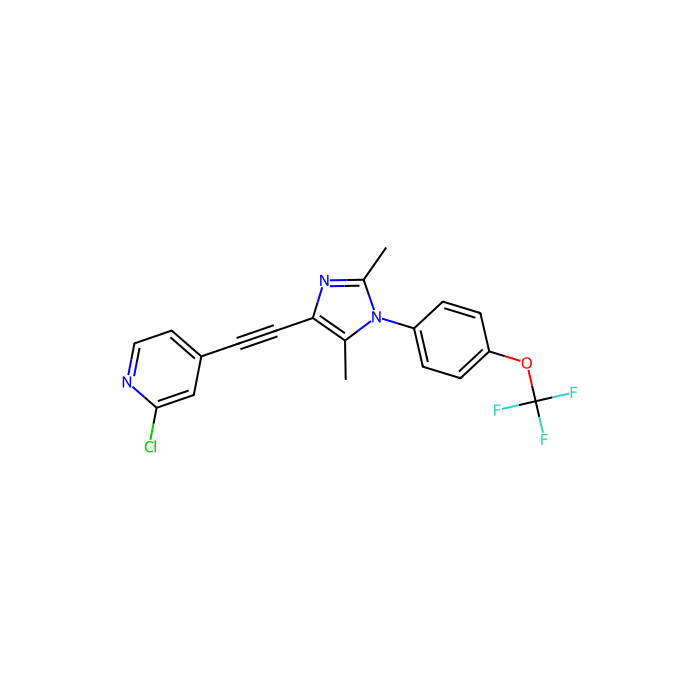
CTEP (RO4956371) is a novel, long-acting, orally bioavailable allosteric antagonist ofmGlu5receptor withIC50of 2.2 nM, shows >1000-fold selectivity over other mGlu receptors.
In vitro
CTEP inhibits quisqualate-induced Ca2+ mobilization with an IC50 of 11.4 nM and [3H]IP accumulation with an IC50 of 6.4 nM in HEK293 cells stably expressing human mGlu5. CTEP inhibits the constitutive activity of human mGlu5 by approximately 50% with an IC50 of 40.1 nM in HEK293 cells stably expressing human mGlu5.
In vivo
CTEP is significantly active at doses of 0.1 mg/kg and 0.3 mg/kg in treatment of anxiety in mouse. CTEP significantly increases drinking time at doses of 0.3 mg/kg and 1.0 mg/kg in the Vogel conflict drinking test in rat, whereas it has no effect at lower doses. The half-life of CTEP (oral) is 18 h, and the B/P ratio based on total drug concentrations in plasma and whole brain homogenates is 2.6 in mice. After single oral doses of 4.5 and 8.7 mg/kg CTEP formulated as microsuspension in a saline/Tween vehicle administrated to adult C57BL/6 mice is rapidly absorbed and achieves close to maximal exposure after approximately 30 min. Chronic administration in adult mice with a dose of 2 mg/kg p.o. every 48 h for 2 months reaches a minimal CTEP brain exposure of 240 ng/g. CTEP fully displaces [3H]ABP688 in mouse brain regions known to express mGlu5, and 50% displacement is achieved with doses producing an average compound concentration of 77.5 ng/g measured in whole brain homogenate. CTEP (2 mg/kg p.o. bid) achieves uninterrupted mGlu5 occupancy per 48 hours in mice. CTEP (2 mg/kg p.o.) treatment corrects elevated hippocampal long-term depression, excessive protein synthesis, and audiogenic seizures in the Fmr1 knockout mouse.
Cell Data
cell lines:
Concentrations:
Incubation Time:
Powder Purity:≥99%
| Isómeros SMILES | CC1=C(N=C(N1C2=CC=C(C=C2)OC(F)(F)F)C)C#CC3=CC(=NC=C3)Cl |
|---|---|
| CAS alternativo | 871362-31-1 |
| Términos de entrada MeSH | 2-chloro-4-((2,5-dimethyl-1-(4-(trifluoromethoxy)phenyl)-1H-imidazol-4-yl)ethynyl)pyridine;CTEP cpd;RO 4956371;RO-4956371;RO4956371 |
| Peso molecular | 391.77 |
| Reaxy-Rn | 12133353 |
| Reaxys-RN_link_address | https://www.reaxys.com/reaxys/secured/hopinto.do?context=S&query=IDE.XRN=12133353&ln= |
Comprehensive hazard, handling, storage, and regulatory compliance document.
Download SDS →Lot-specific quality data. Enter your lot number to retrieve the exact COA.
Look up COA →Full quality attributes and acceptance criteria for this grade.
View spec sheet →| Activity Type | Activity Value -log(M) | Mechanism of Action | Activity Reference | Publications (PubMed IDs) |
|---|
| Activity Type | Activity Value -log(M) | Mechanism of Action | Activity Reference | Publications (PubMed IDs) |
|---|
| Solubilidad | Solubility (25°C) In vitro DMSO: 58 mg/mL (199.77 mM); Water: Insoluble; Ethanol: Insoluble; |
|---|
Our grade selection guide covers purity, stabilizer status, and application suitability for all variants in our catalog.
View Moligand™ grade guide →