
Determine the necessary mass, volume, or concentration for preparing a solution.
| Activity Type | Activity Value -log(M) | Mechanism of Action | Activity Reference | Publications (PubMed IDs) |
|---|
Moligand™, 10mM in DMSO Moligand™ for sensitive chromatographic and analytical workflows requiring minimal baseline interference.
Store at -80°C Ships Dry ice packs + Cold packs Check lot-specific COA for exact specifications.
SDS, COA, datasheet, and spec sheet available for download. Lot-specific COA accessible via lot number lookup.
Cited in 24 peer-reviewed publications across chromatography, organic synthesis, and cross-coupling reactions.
Information
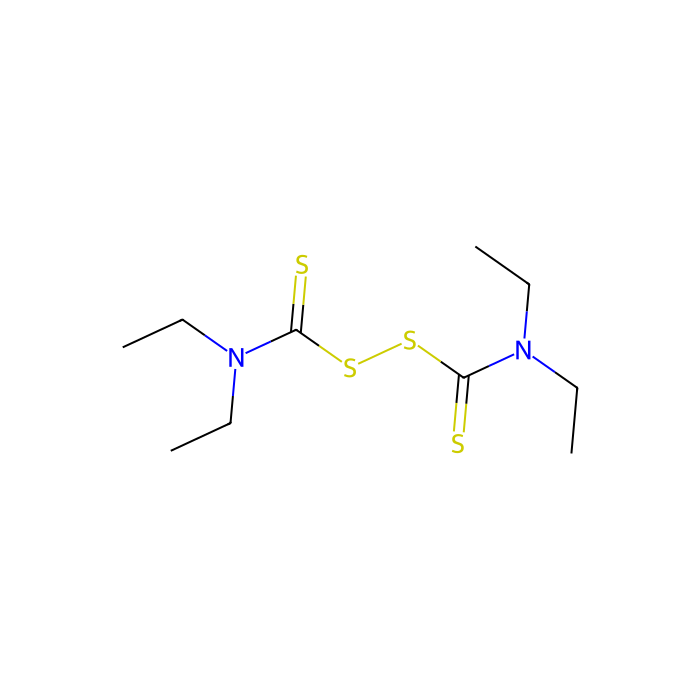
Disulfiram (NSC 190940, Tetraethylthiuram disulfide, TETD) is a specific inhibitor ofaldehyde-dehydrogenase (ALDH)with IC50 of 0.15 μM and 1.45 μM for hALDH1 and hALDH2, respectively. Disulfiram is used for the treatment of chronic alcoholism by producing
In vitro
Disulfiram-copper complex potently inhibits the proteasomal activity in cultured breast cancer MDA-MB-231 and MCF10DCIS.com cells, but not normal, immortalized MCF-10A cells, before induction of apoptotic cancer cell death. [1] Disulfiram (DS), a clinically used anti-alcoholism drug, strongly inhibits constitutive and 5-FU-induced NF-kappaB activity in a dose-dependent manner. Disulfiram inhibits both NF-kappaB nuclear translocation and DNA binding activity but has no effect on 5-FU-induced IkappaBalpha degradation. Disulfiram significantly enhances the apoptotic effect of 5-FU on DLD-1 and RKO(WT) cell lines and synergistically potentiated the cytotoxicity of 5-FU to both cell lines. Disulfiram also effectively abolishes 5-FU chemoresistance in a 5-FU resistant cell line H630(5-FU) in vitro. [2] Oseltamivir decreases the number of viable cells, and the addition of CuCl(2) significantly enhances the DSF-induced cell death to less than 10% of control. [3] Disulfiram given to melanoma cells in combination with Cu2+ or Zn2+ decreases expression of cyclin A and reduces proliferation in vitro at lower concentrations than disulfiram alone. [4]
In vivo
Disulfiram significantly inhibits the tumor growth (by 74%), associated with in vivo proteasome inhibition (as measured by decreased levels of tumor tissue proteasome activity and accumulation of ubiquitinated proteins and natural proteasome substrates p27 and Bax) and apoptosis induction (as shown by caspase activation and apoptotic nuclei formation) in mice bearing MDA-MB-231 tumor xenografts. [1] Disulfiram blocks the P-glycoprotein extrusion pump, inhibits the transcription factor nuclear factor-kappaB, sensitizes tumors to chemotherapy, reduces angiogenesis, and inhibits tumor growth in mice. Disulfiram inhibits growth and angiogenesis in melanomas transplanted in severe combined immunodeficient mice, and these effects are potentiated by Zn2+ supplementation. [4]
Cell Data
cell lines:
Concentrations:
Incubation Time:
Powder Purity:≥98%
| ALogP | 3.9 |
|---|
| Isómeros SMILES | CCN(CC)C(=S)SSC(=S)N(CC)CC |
|---|---|
| WGK Alemania | 3 |
| RTECS | JO1225000 |
| Peso molecular | 296.54 |
| Beilstein | 1712560 |
| Reaxy-Rn | 1712560 |
| Reaxys-RN_link_address | https://www.reaxys.com/reaxys/secured/hopinto.do?context=S&query=IDE.XRN=1712560&ln= |
Comprehensive hazard, handling, storage, and regulatory compliance document.
Download SDS →Lot-specific quality data. Enter your lot number to retrieve the exact COA.
Look up COA →Full quality attributes and acceptance criteria for this grade.
View spec sheet →| Activity Type | Activity Value -log(M) | Mechanism of Action | Activity Reference | Publications (PubMed IDs) |
|---|
| Activity Type | Activity Value -log(M) | Mechanism of Action | Activity Reference | Publications (PubMed IDs) |
|---|
| Activity Type | Activity Value -log(M) | Mechanism of Action | Activity Reference | Publications (PubMed IDs) |
|---|
| Activity Type | Activity Value -log(M) | Mechanism of Action | Activity Reference | Publications (PubMed IDs) |
|---|
| Activity Type | Activity Value -log(M) | Mechanism of Action | Activity Reference | Publications (PubMed IDs) |
|---|
| Activity Type | Activity Value -log(M) | Mechanism of Action | Activity Reference | Publications (PubMed IDs) |
|---|
| Activity Type | Activity Value -log(M) | Mechanism of Action | Activity Reference | Publications (PubMed IDs) |
|---|
| Activity Type | Activity Value -log(M) | Mechanism of Action | Activity Reference | Publications (PubMed IDs) |
|---|
| Activity Type | Activity Value -log(M) | Mechanism of Action | Activity Reference | Publications (PubMed IDs) |
|---|
| Activity Type | Activity Value -log(M) | Mechanism of Action | Activity Reference | Publications (PubMed IDs) |
|---|
| Activity Type | Activity Value -log(M) | Mechanism of Action | Activity Reference | Publications (PubMed IDs) |
|---|
| Activity Type | Activity Value -log(M) | Mechanism of Action | Activity Reference | Publications (PubMed IDs) |
|---|
| Activity Type | Activity Value -log(M) | Mechanism of Action | Activity Reference | Publications (PubMed IDs) |
|---|
| Solubilidad | Solubility (25°C) In vitro DMSO: 26 mg/mL (201.37 mM); Water: 26 mg/mL (201.37 mM); Ethanol: 26 mg/mL (201.37 mM); |
|---|---|
| Punto de fusión (°C) | 69-71°C |
| 1. Huayu Zhang, Yueyun He, Xiaobin Liao, Xueping Tang, Qingsong Li, Jing Zou, Zhibing Jiang, Mazhan Zhuang, Zhimin Yang. (2023) Feasibility of NDEA formation control from DEDTC in chlorination/chloramination by pre-ozonation: Mechanisms and influencing factors. SCIENCE OF THE TOTAL ENVIRONMENT, [PMID:38052386] [10.1016/j.scitotenv.2023.169054] |
| 2. Keli Wang, Xuan Zhou, Jian Liu, Xiaobo Wang, Xia Zhang. (2023) Compaction of Hydrophobic Molybdenum Disulfide Coatings for Promoting Tribological Behaviors on Engineering Steel. LANGMUIR, [PMID:37319373] [10.1021/acs.langmuir.3c01176] |
| 3. Yuan Meng, Wu Qian, Zhang Mingyang, Lai Minshan, Chen Wenbo, Yang Jianfeng, Jiang Li, Cao Ji. (2023) Disulfiram enhances the antitumor activity of cisplatin by inhibiting the Fanconi anemia repair pathway. Journal of Zhejiang University-SCIENCE B, 24 (3): (207-220). [PMID:36915997] [10.1631/jzus.B2200405] |
| 4. Liu Minchao, Shang Cheng, Zhao Tiancong, Yu Hongyue, Kou Yufang, Lv Zirui, Hou Mengmeng, Zhang Fan, Li Qiaowei, Zhao Dongyuan, Li Xiaomin. (2023) Site-specific anisotropic assembly of amorphous mesoporous subunits on crystalline metal–organic framework. Nature Communications, 14 (1): (1-9). [PMID:36869046] [10.1038/s41467-023-36832-2] |
| 5. Chuan-Zhu Zhang, Jun-Cheng Jiang, An-Chi Huang, Yan Tang, Lin-Jie Xie, Juan Zhai, Zhi-Xiang Xing. (2022) A novel multifunctional additive strategy improves the cycling stability and thermal stability of SiO/C anode Li-ion batteries. PROCESS SAFETY AND ENVIRONMENTAL PROTECTION, [PMID:] [10.1016/j.psep.2022.06.046] |
| 6. Xianhua Xie, Xin Jin, Binbin He, Yang Zou, Jumin Yang, Changjun Liu, Xiaoling Kong, Wenguang Liu, Wei Wang. (2022) A change-prone zwitterionic hyperbranched terpolymer-based diabetic wound dressing. Applied Materials Today, [PMID:] [10.1016/j.apmt.2022.101477] |
| 7. Zehua Cheng, Liqiang Gu, Yunyang Zhao, Lele Yang, Ling Chen, Ting Wang, Mai Luo, Jinchao Wei, Peng Li. (2021) Copper ions assisted fluorescent detection of some dithiocarbamates based on nickel nanocluster with aggregation-induced emission enhancement behavior. JOURNAL OF HAZARDOUS MATERIALS, [PMID:34879534] [10.1016/j.jhazmat.2021.127555] |
| 8. Md Aquib, Hang Zhang, Faisal Raza, Parikshit Banerjee, Rohit Bavi, Samuel Kesse, Kofi Oti Boakye-Yiadom, Mensura Sied Filli, Muhammad Asim Farooq, Bo Wang. (2021) Delivery of repurposed disulfiram by aminated mesoporous silica nanoparticles for anticancer therapy. JOURNAL OF MOLECULAR LIQUIDS, [PMID:] [10.1016/j.molliq.2021.117065] |
| 9. Rong Fan, Jidong Sui, Xuepeng Dong, Biao Jing, Zhenming Gao. (2021) Wedelolactone alleviates acute pancreatitis and associated lung injury via GPX4 mediated suppression of pyroptosis and ferroptosis. FREE RADICAL BIOLOGY AND MEDICINE, [PMID:34246777] [10.1016/j.freeradbiomed.2021.07.009] |
| 10. Xiangyu Meng, Kaiying Jia, Kai Sun, Liming Zhang, Zhifei Wang. (2021) Smart responsive nanoplatform via in situ forming disulfiram-copper ion chelation complex for cancer combination chemotherapy. CHEMICAL ENGINEERING JOURNAL, [PMID:] [10.1016/j.cej.2021.128947] |
| 11. Nuo Xu, Yuan-Fan Yang, Long Chen, Jian Lin. (2020) A Ferritin–Albumin–Cu Nanoparticle that Efficaciously Delivers Copper(II) Ions to a Tumor and Improves the Therapeutic Efficacy of Disulfiram. ACS Omega, [PMID:32426598] [10.1021/acsomega.0c00293] |
| 12. Xiaoguang Tao, Jingxin Gou, Qianying Zhang, Xinyi Tan, Tianyang Ren, Qing Yao, Bin Tian, Longfa Kou, Ling Zhang, Xing Tang. (2018) Synergistic breast tumor cell killing achieved by intracellular co-delivery of doxorubicin and disulfiram via core–shell–corona nanoparticles. Biomaterials Science, 6 (7): (1869-1881). [PMID:29808221] [10.1039/C8BM00271A] |
| 13. Chunjuan Zhang, Tonghua Xu, Donglei Zhang, Wei He, Siling Wang, Tongying Jiang. (2018) Disulfiram thermosensitive in-situ gel based on solid dispersion for cataract. Asian Journal of Pharmaceutical Sciences, [PMID:32104427] [10.1016/j.ajps.2018.02.010] |
| 14. Wang Yining, Zhou Qiaomei, Luo Wangping, Yang Xiaoyan, Zhang Jinguo, Lou Yijie, Mao Jin, Chen Jiayi, Wu Fan, Hou Jue, Tang Guping, Bai Hongzhen, Yu Risheng. (2024) A collagenase-decorated Cu-based nanotheranostics: remodeling extracellular matrix for optimizing cuproptosis and MRI in pancreatic ductal adenocarcinoma. JOURNAL OF NANOBIOTECHNOLOGY, 22 (1): (1-19). [PMID:39523309] [10.1186/s12951-024-02968-6] |
| 15. Xiangyu Meng, Jiayi Wu, Zunfu Hu, Xiuwen Zheng, Zhifei Wang. (2024) Coordinating effect of ferroptosis and in situ disulfiram toxification for enhanced cancer therapy. CHEMICAL ENGINEERING JOURNAL, [PMID:] [10.1016/j.cej.2024.149313] |
| 16. Shang Chi, Yaping Li, Tingting Ye, Jiawei Kang, Zhihui Xiang, Xiaoqing Kuang, Chenggang Yi, Yiying Qi, Wei Wang. (2025) Energy reconversion of ultrasound on a piezoelectric hydrogel promotes ROS/CO generation and wound self-closure for infected chronic wound healing. Matter, [PMID:] [10.1016/j.matt.2025.101989] |
| 17. Gang Feng, Yifan Wu, Xinzi He, Tingting Ye, Shang Chi, Xiaoxiao Ji, Jiawei Kang, Kaicheng Xu, JinFeng Zhou, Zhihui Xiang, Wei Wang, Yaping Li, Yiying Qi. (2025) Lubricated hydrogel with STING-inhibiting EXOs protect the osteoarthritis by suppressing the senescent microenvironment. Nano Today, [PMID:] [10.1016/j.nantod.2025.102688] |
| 18. Xiangyu Zuo, Hongxiang Yu, Feng Zhou, Xia Zhang. (2025) Synergistic Lubrication Achieved by Proton-Ionic Liquids and MoS2 as High-Performance Water-Based Lubricant Additives. LANGMUIR, [PMID:39973513] [10.1021/acs.langmuir.4c05246] |
| 19. Zhou Zhixin, Zhou Cheng, Liu Jia, Yuan Ye, Yao Chundong, Liu Miaodeng, Deng Lixue, Sun Jia, Chen Zuoyu, Wang Lin, Wang Zheng. (2024) Tumor specific in situ synthesis of therapeutic agent for precision cancer therapy. JOURNAL OF NANOBIOTECHNOLOGY, 22 (1): (1-18). [PMID:39385273] [10.1186/s12951-024-02825-6] |
| 20. Zhu Junqiao, Tang Wei, Sun Zhiting, Zhu Xinhai, Quan Qiang, Yin Jiaxin, Huang Qiugui, Jia Guoxia, Zhao Yang, Tang Yuqin, Zhang Yan, Xie Linhao, Zhao Jianfu. (2025) Smart pH-sensitive and sequentially controlled drug delivery system based on PLGA-PEG overcomes multidrug resistance in hepatocellular carcinoma by endocytosis-mediated energy dissipation and energy production decrease. JOURNAL OF NANOPARTICLE RESEARCH, 27 (10): (1-16). [PMID:] [10.1007/s11051-025-06463-3] |
| 21. Yuqin Chen, Zixia Hu, Guode Zhao, Mei Li, Ziying Jiang, Liangjia Xu, Jiannan Zheng, Weiwei Li, Ying Peng, Jiang Zheng. (2025) Metabolic activation, hepatic protein covalent binding, and cytotoxicity of arctigenin. TOXICOLOGY LETTERS, [PMID:41325899] [10.1016/j.toxlet.2025.111785] |
| 22. Xinzi He, Yaping Li, Zhihui Xiang, Yifan Wu, Jinfeng Zhou, Peng Tang, Xiaoxiao Ji, Zhongming Huang, Jianbin Xu, Wei Wang, Yiying Qi. (2026) Sonocatalytic multifunctional hydrogel in-situ remodels the infectious microenvironment for eradicating refractory osteomyelitis. JOURNAL OF CONTROLLED RELEASE, [PMID:41655907] [10.1016/j.jconrel.2026.114686] |
| 23. Xiao-Qing Ling, Xin-Yan Zhao, Qi-Yan Lv, Jun-Yang Chen, Hai-Yang Dai, Hui-Fang Cui, XiaoJie Song. (2026) A dual-targeting and pH/NIR-stimuli-responsive nanoassembly for enhanced cuproptosis, chemo-, and phototherapy in colorectal cancer. JOURNAL OF DRUG DELIVERY SCIENCE AND TECHNOLOGY, [PMID:] [10.1016/j.jddst.2026.108137] |
| 24. Chang ZHOU, Tian-shan LIANG, Yi-bo ZHAN, FU Shan-shan, XU Jian-peng, Yuan-qi ZHAO, Ze-quan ZHENG. (2026) Giving Old Drugs New Life: Disulfiram Alleviates Microglial Pyroptosis and Disulfidptosis-like Cytoskeletal/Mitochondrial Alterations in Cerebral Ischemia-reperfusion Injury. BRAIN RESEARCH BULLETIN, [PMID:] [10.1016/j.brainresbull.2026.111845] |
Our grade selection guide covers purity, stabilizer status, and application suitability for all variants in our catalog.
View Moligand™ grade guide →