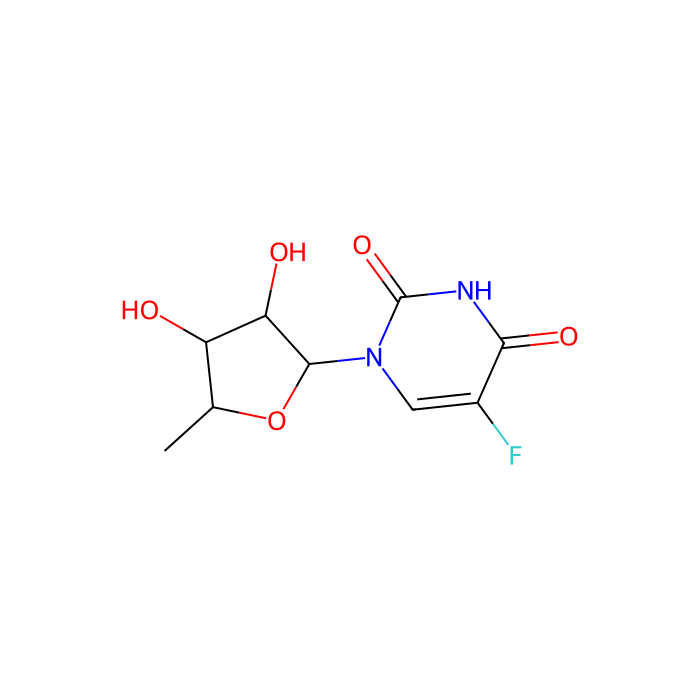
10mM in DMSO for sensitive chromatographic and analytical workflows requiring minimal baseline interference.
🌡
Storage & shipping
Store at -80°C Ships Dry ice packs + Cold packs Check lot-specific COA for exact specifications.
📋
Quality documents
SDS, COA, datasheet, and spec sheet available for download. Lot-specific COA accessible via lot number lookup.
📚
Literature proof
Cited in 4 peer-reviewed publications across chromatography, organic synthesis, and cross-coupling reactions.
Descripción general
Information
Doxifluridine Doxifluridine (5'-DFUR, AMC 0101) is an oral prodrug that is converted to the cytotoxic agent 5-fluorouracil (5-FU). In vitro
Doxifluridine suppresses tube formation of HUVEC and vascular endothelial growth factor production by FU-MMT-1 cells. Doxifluridine is converted to 5-FU and subsequently to FdUMP, and the results suggest that Doxifluridine exerts its cytotoxic effects through inhibition of TS and incorporation into RNA. Doxifluridine is a fluoropyrimidine derivative that is activated preferentially in malignant cells by thymidine phosphorylase to form 5-fluorouracil (5-FU). Doxifluridine is developed to improve the therapeutic index of 5-FU and to reduce toxicity, including the immunosuppressive, myelosuppressive, and cardiotoxic effects of 5-FU and other fluorinated pyrimidines.
In vivo
Metronomic Doxifluridine alone significantly suppresses tumor growth compared with the untreated (control) group, while metronomic Doxifluridine in combination with TNP-470 significantly inhibits tumor growth compared with each treatment alone in in FU-MMT-1 xenografts. Doxifluridine in combination with TNP-470 also leads to a significant reduction of intratumoral vascularity. Doxifluridine significantly inhibits the growth of KPL-4 tumors, reduces the tissue levels of IL-6, and alleviates body weight loss in nude mice bearing KPL-4 tumors. Doxifluridine results in a significant reduction in the activity of phenytoin p-hydroxylation in rats. Doxifluridine decreases the elimination rate constant and the total clearance in rats. Cell Data
cell lines:OSA cells
Concentrations:
Incubation Time:
Powder Purity:≥99%
Specifications
Sinónimos
5'-DFUR, AMC 0101 | 5'-deoxy-5-fluoro-uridine
Especificaciones y pureza
10mM in DMSO
Mecanismos bioquímicos y fisiológicos
Doxifluridine (5\'-DFUR, AMC 0101) is an oral prodrug that is converted to the cytotoxic agent 5-fluorouracil (5-FU).
Condiciones de almacenamiento de almacenamiento
Store at -80°C
Enviado en
Dry ice packs + Cold packs
Este producto requiere envío en cadena de frío. Los servicios terrestres y otros servicios económicos no están disponibles.
1.Jiao Sha, Ruke Zhang, Yuanyuan Zun, Rui Zhao, Yameng Wan, Haixia He, Renren Sun, Gaoliang Jiang, Yu Li, Tao Li, Baozeng Ren. (2020) Equilibrium solubility, thermodynamic properties and Hansen solubility parameter of doxifluridine in (±)-2-ethyl-1-hexanol + (methanol, ethanol and acetone) at various temperatures. JOURNAL OF MOLECULAR LIQUIDS, [PMID:][10.1016/j.molliq.2020.114130]
2.Jiao Sha, Teng Ma, Rui Zhao, Pengshuai Zhang, Renren Sun, Gaoliang Jiang, Yameng Wan, Haixia He, Xinding Yao, Yu Li, Tao Li, Baozeng Ren. (2020) The dissolution behaviour and apparent thermodynamic analysis of doxifluridine in twelve pure solvents at various temperatures. JOURNAL OF CHEMICAL THERMODYNAMICS, [PMID:][10.1016/j.jct.2020.106073]
3.Wang Xue-jie, You Jin-zong. (2015) Study on the thermal decomposition of capecitabine. JOURNAL OF THERMAL ANALYSIS AND CALORIMETRY, 123 (3):(2485-2497). [PMID:][10.1007/s10973-015-4857-9]
4.Xinqi Qiu, Minhui Zhang, Yan Liu, Mingao Li, Quanzhou Wu, Jianfeng He. (2024) Novel water-compatible surface molecularly imprinted polymer microspheres based on boronate affinity and hydrophilic coating for efficient enrichment and separation of capecitabine from urine samples. MICROCHEMICAL JOURNAL, [PMID:][10.1016/j.microc.2024.111289]
Calculadoras de soluciones
Molarity Calculator
Determine the necessary mass, volume, or concentration for preparing a solution.
Dilution Calculator
Determine the dilution needed to prepare a stock solution.
We use cookies to ensure the website functions properly and, where permitted, to improve your experience. You can manage your preferences at any time in Settings. Learn more in our Cookie Policy.
Shall we send you a message when we have discounts available?
Remind me later
Thank you! Please check your email inbox to confirm.
Products are supplied to verified businesses, institutions, and qualified professionals for research and development use only. Not for use in humans, animals, diagnosis, or therapy.