
From Antibacterials to Photovoltaics: How Two Ring Nitrogens Make Quinoxaline a Cross-Domain “Universal” Scaffold
From Antibacterials to Photovoltaics: How Two Ring Nitrogens Make Quinoxaline a Cross-Domain “Universal” Scaffold
In pharmaceuticals, veterinary drugs, dyes, and even organic optoelectronic materials, researchers repeatedly run into the same parent core: quinoxaline (also known as benzopyrazine). It is not a “structure exclusive to one industry,” but rather a fused heteroaromatic scaffold that turns key properties into tunable parameters: a rigid, planar conjugated framework plus two pyridine-type ring nitrogens. These features allow quinoxaline to be continuously remodeled as a bioactive scaffold, and also to serve as a materials unit for tuning energy levels and molecular packing.
Why can quinoxaline bridge two seemingly unrelated application chains—antibacterial drugs/veterinary medicines and organic solar cells—and generate a large ecosystem of “quinoxaline intermediates/products” in R&D and supply chains? This article focuses on those two questions.
1.Why can the same quinoxaline core serve both “drug discovery” and “organic optoelectronic materials”?
Two scenarios are common in R&D:
1. Small-molecule discovery (e.g., anti-infectives):
A relatively rigid aromatic scaffold with patterns that can be rationalized is desired, so SAR can be iterated around a stable framework. At the same time, clear interaction sites and substitution vectors are needed, making “where you can modify” and “what the modification affects” more controllable.
2. Organic optoelectronic materials (e.g., OPV/OFET/OLED):
An electron-accepting structural unit is needed. Without disrupting the main conjugated framework, substitution and extension should convert key device variables—energy levels (HOMO/LUMO), molecular packing, and thin-film morphology—into “tunable parameters,” enabling systematic performance optimization.
Quinoxaline appears so frequently because it concentrates three classes of “tunable structural handles” valued in both scenarios into a single parent core:
(1) A planar, rigid, aromatic conjugated backbone: promotes electronic delocalization and more readily yields packing and conformational patterns that can be rationally discussed and compared.
(2) Two ring-nitrogen sites: provide clear levers for electronic tuning and typically participate in interactions as hydrogen-bond acceptors and/or coordination-relevant sites.
(3) Multiple substitutable positions: make it easy to “tune properties by position” without changing the core scaffold—turning optimization from “trial-and-error” into “dial-based parameter tuning.”
2.Basic concepts: What is quinoxaline? What do “quinoxaline intermediates/products” mean?
2.1 Chemical definition of quinoxaline (Quinoxaline)
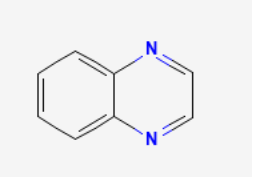
Quinoxaline is a fused aromatic nitrogen heterobicycle: it can be viewed as an aromatic bicyclic system formed by fusion of a benzene ring and a pyrazine ring. Common English synonyms include benzo[b]pyrazine (often shortened to benzopyrazine). Some catalogs also list benzo[a]pyrazine, and it is also described as 1,4-diazanaphthalene.
1. CAS Registry Number: 91-19-0
2. Molecular formula: C₈H₆N₂
2.2 A common confusion: Quinoxaline vs Quinazoline
The two share the same molecular formula (C₈H₆N₂) and are both fused aromatic bicyclic systems, but the nitrogen positions differ:
1. Quinoxaline: benzene fused to pyrazine; can be viewed as 1,4-diazanaphthalene.
2. Quinazoline: benzene fused to pyrimidine; can be viewed as 1,3-diazanaphthalene.
This kind of “nitrogen positional swap” changes electron distribution, typical reactive sites, and common substitution strategies in downstream applications.
2.3 Practical definitions: “quinoxaline intermediates / quinoxaline products”
2.3.1 What does “quinoxaline-type” mean?
a) Quinoxaline derivatives: compounds whose structures already contain the quinoxaline core (with any substituents allowed).
b) Practical check: the name/structure contains quinoxaline (or substituted naming), and when drawn you can clearly see the quinoxaline skeleton as “benzene + pyrazine fused.”
There is also a more synthetic route–oriented usage:
a) Ring-forming precursors: route intermediates used to construct the quinoxaline core; these precursors may not themselves contain a quinoxaline ring.
b) A typical route is condensation of a 1,2-dicarbonyl compound with o-phenylenediamine (or another 1,2-diamine) to form the quinoxaline skeleton.
2.3.2 Quinoxaline intermediates (building blocks) vs products
Name | Mainly for… | Typical structural features | Typical next steps |
Quinoxaline intermediates / building blocks (intermediate / building block) | Continued synthesis, structural iteration, rapid library building | Contains the quinoxaline core plus one or more “clearly actionable” reactive handles for the next step | Couplings (Suzuki/Negishi, etc.), nucleophilic substitution, reduction/oxidation, amidation, ring closure/fusion, etc. |
Quinoxaline products (product / ready-to-use compound) | Direct entry into application chains: activity/performance testing, or analytical reference use | Emphasizes “ready-to-use” functional attributes (activity, function, reference value) rather than “handles for further elaboration” | Pharmacology/antibacterial/material device testing; or analytical reference standards for qualitative/quantitative methods development |
3.Structural features: What key properties does quinoxaline convert into “controllable variables”?
Structural “dial” (what you change) | Property variables changed directly | Typical application landing points |
Fused aromatic planarity + conjugation length / coplanarity (ring fusion extension, π-bridges, steric twisting or not) | π–π stacking and aggregation tendency; absorption range and intensity; charge delocalization/transport; high sensitivity to thin-film morphology | Organic semiconductors/OPV/OFET/OLED, dyes and luminophores; also drug scaffolds where planar π systems participate in binding/intercalation |
Two ring nitrogens (N1/N4; pyridine-type acceptor sites) (influenced by ortho substitution and electronic effects) | H-bond acceptor strength, dipole moment and local charge distribution; electron-accepting character (stabilizing LUMO, tuning bandgap/ICT); potential participation in coordination/interactions; note: overall basicity of quinoxaline is very weak (pKaH ≈ 0.6), so under typical conditions it is not equivalent to an “easily salt-forming strong base” | Drug SAR: iterative tuning of interaction sites (H-bond acceptor/dipole); materials molecular engineering: tune energy levels and bandgap via substitution/ring fusion/EWGs, while managing aggregation and morphology |
N-oxidation (N-oxide / di-N-oxide; converting ring N to N→O) | Polarity/hydrophilicity increases markedly; H-bond acceptor pattern changes; coordination/crystal packing may rearrange; redox behavior and electronic structure can shift | Drug/biological activity & mechanism studies, reference standards; in materials/functional molecules, used to tune polarity, interactions, and energy levels (a “small change, big property shift” dial) |
Substitution position and strength (2,3 positions vs 5–8 positions; EDGs/EWGs, F/CN, etc.) | Electronic effects and energy levels (HOMO/LUMO), dipole moment; steric effects altering coplanarity; solubility and aggregation behavior. Strong EWGs often lower energy levels more, but may also strengthen aggregation and complicate morphology control—trade-offs are required | Materials: coordinated optimization of energy levels–morphology (e.g., tuning LUMO/bandgap while controlling aggregation scale); drugs: comparable iteration on the same core along “electronics/hydrophobicity/steric occupancy” axes |
Multiple substitutable sites + functional handles (halides, boronic acids/esters, aldehydes/acids/esters, amines, nitriles, nitro, etc.) | Synthetic accessibility and “library-building efficiency”; fine tuning of solubility, sterics, and packing; provides deterministic routes for coupling/ring fusion/functional group interconversion | Rapid library construction of quinoxaline intermediates; in both materials and drugs, a common workflow is “build the scaffold via handles first, then fine-tune energy levels/solubility/morphology or the activity window” |
4.Classification of Quinoxaline-Related Chemicals
4.1 How to sort quinoxaline building blocks: let the “reactive handle” decide the next reaction
Building-block subtype (defined by what you plan to do next) | Typical “handle / feature” | Structural change you usually want to achieve | Common R&D scenarios |
A. Coupling / modular-assembly type (build substitution diversity) | Halides (Cl/Br/I), boronic acids / boronate esters, etc. | Rapidly swap in a ring of aryl/heteroaryl/alkenyl substituents to enable “same core, many substitutions” comparisons | Medicinal chemistry SAR library building; materials unit replacement and side-chain/conjugated-fragment stitching |
B. Functional-group interconversion type (introduce side chains / adjust solubility / keep a ring-closure entry) | Aldehydes/ketones, carboxylic acids/esters/acyl chlorides, nitriles, nitro/amino groups, etc. | Side-chain installation (condensation / reductive amination / amidation / hydrolysis, etc.), or reserving an interface for annulation / ring expansion | “Functionalized building blocks” with an explicit connection point; key nodes before fine-tuning salt form/solubility and sterics |
C. Property-tuning branch (not necessarily the “final step,” but it can shift properties strongly) | N-oxides (mono-/di-N-oxide), strongly electron-withdrawing substitution (e.g., polyfluoro, nitrile, etc., depending on the system) | Polarity / H-bond map / redox behavior and electronic structure are pulled markedly; interactions and morphology may change | A “dial” that pushes properties into a different regime: in drugs, adjust interactions/properties; in materials, tune energy levels/absorption/aggregation |
4.2 Grouping of tool compounds: for experimental evaluation and analytical QC
Product subtype | Typical application landing points | What to focus on when selecting |
A. Bioactivity-related (active molecules / pharmacology chain; includes representative QdNO family members) | Activity screening, mechanism studies, positive controls; (for veterinary/feed directions) used for related research evaluation | Purity and impurity profile; salt form / solvent form; stability (light/oxygen/moisture); whether “reference-standard grade / traceable” is required |
B. Organic optoelectronic materials (device / energy-level / morphology chain) | Evaluation and device validation of acceptor/conjugated fragments in organic solar cells, OFET/OLED, etc. | Molecular weight / dispersity (polymers); substitution pattern and solubility; thin-film morphology reproducibility; batch-to-batch consistency |
C. Reference standards / analytical standards (identification–quantitation / method-development chain) | LC/GC/LC-MS method development; qualitative/quantitative analysis; impurity/metabolite/degradation studies and QC | Certificates / traceability; assay value assignment method; solvent system and storage conditions; inter-batch consistency |
5.Two representative application lines: QdNO antibacterials & quinoxaline acceptors in organic optoelectronics
5A|Why QdNO (quinoxaline 1,4-di-N-oxide) is “typical”: how the N→O switch connects to antibacterial clues
Key point | Mechanistic clue brought by N→O |
Structural handle | 1,4-di-N-oxide (two N→O) is a key defining branch feature |
Mechanistic handle | N→O can markedly alter the molecule’s redox behavior in biological systems; therefore it is often discussed within the framework of bioreductive activation |
What is commonly observed experimentally? | Multiple studies have reported that, after bacteria are exposed to QdNOs, signals related to oxidative stress (ROS / related pathways) and DNA damage responses (including the SOS response) are observed |
One-sentence takeaway | N→O is a structural switch that links antibacterial effects to microenvironmental conditions and reductive activation |
Notes / cautions | Some QdNO family members are historically associated with animal growth promotion / veterinary use, and long-term safety and regulatory discussions have accompanied them. For example, the EU has withdrawn/banned authorizations for certain uses of carbadox and olaquindox, and the U.S. has ongoing regulatory assessment and policy updates for carbadox as well. Requirements differ substantially by region; for residue testing/QC, use the regulations of the target market as the source of truth. |
5B|Optoelectronic materials: why quinoxaline is often used as an acceptor core
Common challenge | Key variables quinoxaline can “tune” as a core | Typical ways to modify | How to judge (metrics) |
Want higher efficiency, but don’t want to waste energy (efficiency vs energy loss) | More systematic tuning of energy levels (especially acceptor levels), bandgap and absorption, and the strength of intramolecular charge transfer (ICT); meanwhile it also affects packing and phase separation | Modify core substitution (donating/withdrawing groups, sterics), change π-bridges/terminal groups, change side chains (solubility and packing) | Balance of Voc / Jsc / FF; energy-loss trends (including non-radiative loss discussions); absorption coverage and charge generation/recombination characteristics |
Want higher performance, but also need stable morphology and reproducible processing (high performance vs processability/reproducibility) | Many editable sites enable series-based comparisons; but morphology is highly sensitive—small changes on the same backbone (side chains/substitution sites) can shift packing and phase separation, causing performance and reproducibility fluctuations | First tune the core/side chains to control molecular arrangement and phase-separation length scale in films; if structure alone is insufficient, use blending/ternary formulations to co-tune morphology and improve stability/reproducibility | Film-forming reproducibility and batch consistency; morphology stability (after storage/thermal treatment/light exposure); device stability and process compatibility |
6.Product Navigation for Quinoxaline-Related Items: locate products by research task (Tables A–D)
Research task / experimental need | Recommended table to check first | Why this table first |
Electrophysiology / brain-slice perfusion / in vivo dosing where you need fast, reversible blockade of excitatory synaptic transmission (AMPA/kainate pathways) | Table A: Neuroscience tool compounds (CNQX/NBQX and disodium salts) | Table A directly lists standard antagonists and disodium salts (water-soluble, easy to prepare), matching the key selection criteria in neuroscience experiments: fresh preparation, controllable concentration, minimal solvent interference. If you also need classic quinoxaline-2,3-dione tools for comparison or family benchmarking, you can cross-reference the DNQX entry in Table C. |
Also blocking AMPA/kainate pathways, but you care more about solubility and dosing convenience (minimize DMSO, improve aqueous compatibility) | Table A: Neuroscience tool compounds (prioritize disodium-salt entries) | Disodium salts are commonly used to improve aqueous operability; locating “disodium salt” in Table A quickly yields specs better suited for aqueous perfusion/injection, reducing solvent-related variability. |
Veterinary-drug residue testing method development for feed/livestock products/tissue samples (calibration curves, QC) | Table B: Veterinary/feed additive–related (QdNO family) and metabolites | Table B concentrates QdNO members frequently used in regulation/analysis (e.g., carbadox, olaquindox, quinocetone) and key metabolites (e.g., desoxycarbadox), aligning with method-development needs for standards/QC. |
Metabolism/toxicology mechanism studies related to QdNOs (N-oxide reduction, reactive intermediates, structure–safety links) | Table C: N-oxides / 2,3-dione core (model scaffolds & key precursors) | Table C provides “scaffold-level models” (quinoxaline 1,4-di-N-oxide, di-N-oxide derivatives, quinoxaline-2,3-dione and halogen/fluoro variants), better for mechanistic controls and dissecting structure variables than for direct finished-product residue analysis. |
Structural modification and SAR library building in quinoxaline/quinoxaline directions: need rapid installation of amines/ethers/thioethers/aryl groups/side chains | Table D: Parent core and common substituted intermediates (halides/carboxylic acids/hydroxyl/nitro/amino, etc.) | Table D is organized around derivatizable handles: halides (SNAr / coupling precursors), carboxylic acids (amide coupling), amino/nitro (reduction → further coupling), hydroxyl (O-derivatization). Ideal for fast route-driven reagent selection. |
“Same scaffold, multi-position scan” (2/3/6/7 substitution differences) to validate site sensitivity | Table D: Parent core and common substituted intermediates | Table D covers mono-/di-halides, multiple positions (2,3 / 2,6 / 6,7) and multiple functional groups (NO₂/NH₂/CO₂H/OH), enabling you to directly assemble a “position-scan” series with fewer route switches. |
Need a standard parent core or a “physicochemical/spectroscopic reference” (high GC purity, high consistency) for synthesis routes | Table D: Parent core and common substituted intermediates (quinoxaline parent core) | Table D includes the quinoxaline parent core (≥99% GC), suitable as a starting material, reference, and “baseline scaffold” for method development—helpful for excluding interference from impurities or structural differences. |
Need reactivity/coordination behavior controls for “strong EWG / strong H-bonding / strong tautomerism” systems (e.g., dihydroxy, dione cores) | Table C or Table D (depending on whether you need dione/di-N-oxide) | If your target is mechanistic work on dione/di-N-oxide scaffolds, prioritize Table C; if your target is conventional derivatization/controls starting from OH/NO₂/NH₂/halides, prioritize Table D. |
Table A|Neuroscience Tool Compounds (AMPA/Kainate Receptor Antagonists, including water-soluble disodium salts)
Category | CAS No. | Aladdin Cat. No. | Name | Spec / Purity | Key features & applications |
Neuroscience tool compound | AMPA/kainate receptor antagonist | 115066-14-3 | CNQX, AMPA/kainate antagonist | Moligand™, ≥98% | Classic competitive AMPA/kainate receptor antagonist: used in electrophysiology/neural-circuit studies to block fast excitatory synaptic transmission, excitotoxicity models, and receptor function analyses. | |
Neuroscience tool compound | Water-soluble salt of CNQX | 479347-85-8 | CNQX disodium salt | ≥98% | Disodium salt of CNQX (easier to prepare in aqueous solution): suitable for electrophysiology and ex vivo tissue experiments requiring aqueous dosing/perfusion, reducing interference from organic solvents (e.g., DMSO). | |
Neuroscience tool compound | AMPA/kainate receptor antagonist | 118876-58-7 | NBQX, AMPA/kainate antagonist | ≥99% | Common AMPA/kainate receptor antagonist: used to block AMPA-mediated excitatory transmission and in neuroprotection studies for ischemia/epilepsy/excitotoxicity models; widely used in brain-slice and in vivo experiments. | |
Neuroscience tool compound | Water-soluble salt of NBQX | 479347-86-9 | NBQX disodium salt | ≥98% (HPLC) | Disodium salt of NBQX (high water solubility): convenient for aqueous systems (perfusion solutions / in vivo dosing), enabling more stable AMPA-pathway blockade and reproducible controls. |
Table B|Veterinary Drugs / Feed Additives (QdNO Family) and Metabolites (Analytical Standards / Residue Studies)
Category | CAS No. | Aladdin Cat. No. | Name | Spec / Purity | Key features & applications |
Veterinary drug / feed additive | QdNO antibacterial (reference standard) | 6804-07-5 | Carbadox | Analytical reference standard | A representative quinoxaline-1,4-di-N-oxide (QdNO) antibacterial/growth-promoting agent: reference standards are commonly used to establish and QC residue testing methods in feed/tissue samples (LC/LC-MS, etc.). | |
Veterinary drug / feed additive | QdNO antibacterial (reference standard) | 23696-28-8 | Olaquindox | Analytical reference standard | Olaquindox is a representative QdNO compound: reference standard used for residue testing in feed and animal products, method confirmation, and intra-/inter-batch QC. | |
Veterinary drug / feed additive | QdNO (quinocetone) | 81810-66-4 | Quinocetone | ≥98% | Quinocetone is one of the representative QdNO members: commonly used in veterinary/feed-additive studies and as a residue-analysis reference; also used in research on QdNO N-oxide redox metabolism and safety evaluation. | |
Veterinary-related | Carbadox metabolite / residue-analysis reference | 55456-55-8 | N,N′-Desoxycarbadox | — | One of the key metabolites of carbadox: commonly used as an analytical reference in veterinary-drug residue and metabolism studies (method development, confirmation, QC). |
Table C|Quinoxaline N-Oxides / Quinoxaline-2,3-Dione Core (Model Scaffolds and Key Precursors)
Category | CAS No. | Aladdin Cat. No. | Name | Spec / Purity | Key features & applications |
Quinoxaline-1,4-di-N-oxide | QdNO model / also known as Quindoxin | 2423-66-7 | Quinoxaline 1,4-dioxide | ≥95% | A fundamental QdNO family model (Quindoxin / quinoxaline N,N′-dioxide): used as a model compound in studies of N-oxide reduction, metabolic/toxicological mechanisms, and antibacterial relevance; also commonly used as a methodological reference. | |
Quinoxaline-1,4-di-N-oxide | QdNO scaffold derivative | 13297-17-1 | 2-Acetyl-3-methylquinoxaline 1,4-dioxide | ≥98% | A typical QdNO (quinoxaline N,N′-dioxide) scaffold: frequently appears in structure families of antibacterial/feed-additive quinoxaline derivatives; also used as a model in N-oxide reduction/metabolism and reactivity studies. | |
Quinoxaline-2,3-dione scaffold | strongly electron-withdrawing nitro derivative | 2379-57-9 | 1,4-Dihydro-6,7-dinitroquinoxaline-2,3-dione (DNQX) | ≥98% | A classic non-NMDA ionotropic glutamate receptor antagonist: DNQX is a competitive AMPA/kainate receptor antagonist, widely used in brain-slice/electrophysiology to block fast excitatory synaptic transmission and to distinguish AMPA/KA from NMDA components; also serves as a structural/physicochemical reference scaffold within the quinoxaline-2,3-dione family. | |
Quinoxaline-2,3-dione scaffold | chloro derivative | 25983-13-5 | 6,7-Dichloroquinoxaline-2,3(1H,4H)-dione | ≥97% | Quinoxaline-2,3-diones are widely used as scaffolds in glutamate-receptor antagonist research and related method development; 6/7 halogenation facilitates further derivatization and is a common precursor for building CNQX/NBQX-type structural families. | |
Quinoxaline-2,3-dione scaffold | fluoro derivative | 91895-29-3 | 6,7-Difluoroquinoxaline-2,3(1H,4H)-dione | ≥97% | Fluorination can markedly alter electron distribution and hydrophobicity: used as an “electronics/hydrophobicity dial” on the quinoxaline-2,3-dione scaffold for antagonist-scaffold/physicochemical comparisons and derivatization studies. |
Table D|Quinoxaline Core and Common Substituted Intermediates (alkyl/aryl/carboxylic acid/hydroxyl/halogen/nitro/amino, etc.)
Category | CAS No. | Aladdin Cat. No. | Name | Spec / Purity | Key features & applications |
Basic core | Quinoxaline | 91-19-0 | Quinoxaline | ≥99% (GC) | Parent quinoxaline core: commonly used as a heteroaromatic starting scaffold for medicinal chemistry and materials-molecule construction; also used as a standard reference for physicochemical properties, reactivity, and spectroscopy. | |
Simply substituted quinoxaline | alkyl model compound | 2379-55-7 | 2,3-Dimethylquinoxaline | ≥97% | A hydrophobic/electronic-effect model with 2,3-alkyl substitution: often used for heteroaromatic reactivity and spectral/physicochemical benchmarking; also serves as a starting point for further selective functionalization (e.g., side-chain oxidation/halogenation). | |
Aryl-substituted quinoxaline | π-system reference for materials & medchem | 1684-14-6 | 2,3-Diphenylquinoxaline | ≥98% | 2,3-diaryl substitution extends conjugation: commonly used for photophysical/electrochemical and π–π stacking comparisons; can also serve as a scaffold reference after introducing hydrophobic fragments in medicinal chemistry. | |
Carboxylic-acid quinoxaline | coupling “handle” (amidation/esterification) | 879-65-2 | Quinoxaline-2-carboxylic acid | ≥97% | The carboxylic-acid handle enables amidation/esterification (one of the most common medchem linkages), allowing attachment of quinoxaline to amine/alcohol side chains to rapidly build SAR or introduce solubility-tuning side chains. | |
Carboxylic-acid quinoxaline | coupling “handle” (amidation/esterification) | 74003-63-7 | 3-Methylquinoxaline-2-carboxylic acid | ≥95% | The 2-carboxylic acid supports amidation/esterification “stitching,” while the 3-methyl group fine-tunes hydrophobicity and conformation; commonly used to “connect quinoxaline onto side chains” in medicinal chemistry or functional molecules. | |
Carboxylic-acid quinoxaline | coupling “handle” (amidation/esterification) | 6925-00-4 | Quinoxaline-6-carboxylic acid | ≥95% | The 6-carboxylic acid facilitates amidation/esterification to append side chains at the 6-position (tuning solubility/steric occupancy/polarity), frequently used in lead optimization and fragment stitching. | |
Hydroxy quinoxaline | tautomerism/coordination “O-handle” | 1196-57-2 | Quinoxalin-2-ol (2-hydroxyquinoxaline) | ≥99% | The 2-hydroxy system often tautomerizes with the 2-oxo form: used in coordination chemistry/H-bonding and physicochemical comparisons; can undergo O-alkylation/acylation as an entry to further functionalization. | |
Hydroxy quinoxaline | tautomerism/coordination “O-handle” | 15804-19-0 | 2,3-Dihydroxyquinoxaline | ≥98% | The 2,3-dihydroxy system often shows keto–enol and lactam–lactim tautomerism: used in coordination/H-bond network studies; also enables O-alkylation/acylation and conversion to related diones/derivatives. | |
Hydroxy + halogen quinoxaline | multifunctional handles (coordination + substitution) | 6639-79-8 | 6-Chloro-2,3-dihydroxyquinoxaline | ≥95% | Hydroxy groups provide coordination/H-bonding and O-derivatization entry; 6-chloro offers further SNAr/derivatization possibilities—useful for optimization/screening with dual “O-site + halogen-site” dials. | |
Halo quinoxaline | single handle (SNAr / further functionalization) | 1448-87-9 | 2-Chloroquinoxaline | ≥97% | 2-halogenation is a classic SNAr entry: commonly used to introduce amines/alkoxy/thioether substituents and build 2-substituted quinoxaline series; also a key intermediate for heteroaromatic fragment stitching. | |
Halo quinoxaline | dual-site handles (SNAr / downstream derivatization) | 2213-63-0 | 2,3-Dichloroquinoxaline | ≥98% | 2/3 dihalides enable stepwise SNAr substitution (amination/etherification/thioetherification, etc.) to rapidly build 2,3-disubstituted quinoxaline libraries; also serves as a general-purpose “handle” for subsequent functional-group interconversions. | |
Halo quinoxaline | multi-site handles (SNAr / selective derivatization) | 18671-97-1 | 2,6-Dichloroquinoxaline | ≥97% | 2/6 dihalides facilitate site-selective substitution (often SNAr at C2 first, then further derivatization at C6), suitable for building “same scaffold, multi-position scan” libraries. | |
Halo quinoxaline | multi-site halogenation (substitution/coupling precursors) | 19853-64-6 | 6,7-Dichloroquinoxaline | ≥95% | 6/7 dihalides are suitable for position scanning and for further substitution/coupling precursors (depending on the reaction system, via substitution or metalation/coupling routes); commonly used to construct multi-substituted quinoxaline libraries. | |
Nitro quinoxaline | electronic-effects dial & reduction entry | 18514-76-6 | 5-Nitroquinoxaline | ≥95% | Nitro is a common “electronic-effects dial,” and also an entry to amines via reduction (then acylation/sulfonylation/diazotization, etc.); used to build “nitro ↔ amino” paired comparisons and downstream derivatization. | |
Nitro quinoxaline | electronic-effects dial & reduction entry | 6639-87-8 | 6-Nitroquinoxaline | ≥98% | The 6-nitro group tunes electronics and serves as a precursor to 6-amino via reduction; commonly used to build paired “nitro/amino” controls and to provide routes for further coupling/salt formation. | |
Amino quinoxaline | salt formation / coupling entry | 6298-37-9 | 6-Aminoquinoxaline | ≥95% | The amino group enables salt formation and coupling (amidation/urea formation/sulfonylation, etc.); it can also undergo diazotization for further functionalization—useful for rapid “substituent–solubility/electronic effect” co-optimization. | |
Non-quinoxaline scaffold | related redox intermediate / control | 2797-51-5 | 2-Amino-3-chloro-1,4-naphthoquinone | ≥98% (HPLC) | A naphthoquinone (not quinoxaline): often used as a redox-active aromatic quinone intermediate/control; can be derivatized via nucleophilic substitution/coupling, and can also serve as a “strong electron acceptor / chromophoric scaffold” control substrate in reaction screening. |
Note: The above are representative Aladdin products. For additional specifications, please refer to the product list at the end of the article, or search the Aladdin website using the product name / CAS / catalog number.
For more related articles, please see below: